![Aizu-nuri Lacquerware Soup Bowl (Marumi-Wan, Red) by Karin Honpo — 425-Year Fukushima Lacquer Tradition (¥1,714 / ≈$11 USD) [2026 Buyer’s Guide]](https://jpmono.com/wp-content/uploads/2026/05/karin-honpo-aizu-nuri-marumi-wan-where-to-buy-2026-featured.jpg)
Aizu-nuri (会津塗) is the lacquerware tradition of the Aizu region in western Fukushima Prefecture, practiced continuously since 1590 when the Gamō clan, newly assigned to the domain by Toyotomi Hideyoshi, invited lacquer craftspeople from Wakasa (modern Fukui) to seed the Aizu workshops. METI designated Aizu-nuri a Traditional Craft Product in 1975. It is one of four major Tōhoku lacquer traditions, and one of the first to adopt modern dishwasher-safe synthetic-urushi finishes alongside its traditional urushi line.
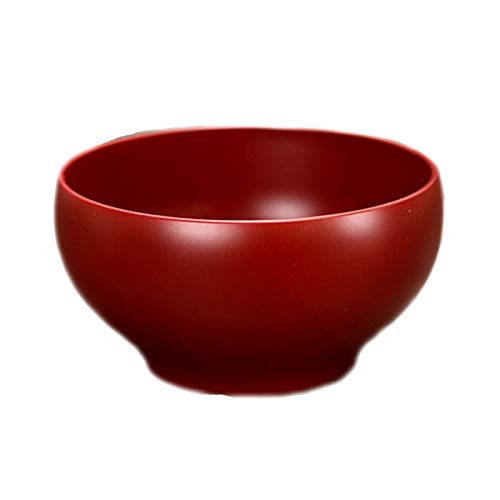
This guide covers the Marumi-Wan (丸味椀, rounded soup bowl) in vermilion red from 漆器かりん本舗 (Karin Honpo), a multi-generational Aizu lacquer retailer distributing pieces from workshops in Aizuwakamatsu. The marumi-wan uses the modern Aizu finish — microwave and dishwasher-safe — which makes it one of the lowest-friction first lacquer purchases available from Japan. Listed at ¥1,714 (≈$11 USD), it sits well below the ¥5,000–15,000 traditional-tier entry point. From a Japanese editor’s perspective: this is daily-use Aizu at impulse-purchase pricing, with a real Aizu lineage behind the listing rather than an anonymous import.
This guide is written for international readers who want one practical Japanese lacquer bowl for everyday miso soup, rice, or small servings, not collectors after museum-grade urushi. We cover the spec, the historical context of Aizuwakamatsu, what the “modern Aizu finish” actually means, how to compare it against ceramic or premium-tier lacquer alternatives, and how to ship it outside Japan.
🔄 Updated:
⏱️ ~12 min read
- Who this is for — and who should skip it
- Product overview (from published specs)
- 📍 Where this comes from — Aizu, Fukushima, and 425 years of lacquer
- Price snapshot across stores
- What it does well
- Weaknesses and things to verify before buying
- Conclusion — which buyer type are you?
- Other ways to approach this purchase
- 🏆 Editor’s Pick
- ❓ Frequently Asked Questions
- 📌 Related Japanese Crafts
Who this is for — and who should skip it
- Want a daily Japanese lacquer bowl for miso soup, rice, or small donburi
- Need microwave and dishwasher compatibility (most traditional urushi cannot handle either)
- Are willing to spend ¥1,500–2,500 but not yet ¥5,000+ on a single bowl
- Prefer a named Aizu retailer (Karin Honpo) over an anonymous import
- Live outside Japan and want one trial piece before committing to a set
- Want traditional natural-urushi lacquer with the deep cured-urushi feel — this is the modern synthetic-finish line
- Need a large rice bowl (donburi) — ⌀ 11 cm is soup-bowl size, not donburi size
- Are collecting maker-signed studio pieces; this is a workshop product, not a named artisan’s work
- Want a tea-ceremony bowl (chawan) or stacking box (jubako) — different forms entirely
- Plan to scrub it with abrasive sponges — even the modern finish will mark
Product overview (from published specs)
Specs below are quoted from the Amazon JP listing for ASIN B089VY9P8Z as of . The JPY price is authoritative; the USD figure is an estimate at ¥150/USD baseline. Live pricing and stock fluctuate — verify at the retailer before buying.
Aizu-nuri Lacquerware Soup Bowl (Marumi-Wan, Red) by Karin Honpo
お椀 汁椀 日本製 食洗機対応 電子レンジ対応 会津塗 丸味椀 赤
通常2~3日以内に発送します。 · Sold by 漆器かりん本舗 · ASIN B089VY9P8Z
Price and availability as of 2026-08-31 02:30 JST. The Amazon listing at the time of purchase is authoritative. jpmono.com earns a commission on qualifying purchases at no extra cost to you.
| Field | Value |
|---|---|
| Item | Aizu-nuri Marumi-Wan (round soup bowl), red |
| Maker / Retailer | 漆器かりん本舗 (Karin Honpo), Aizuwakamatsu, Fukushima |
| ASIN | B089VY9P8Z |
| Material | Wooden body with modern Aizu-nuri synthetic-urushi finish |
| Dimensions | Approx. ⌀ 11 × H 6.5 cm |
| Weight | ~80 g |
| Microwave | Safe per listing |
| Dishwasher | Safe per listing |
| Made in | Aizuwakamatsu, Fukushima Prefecture, Japan |
| Price (JP listing) | ¥1,714 (≈ $11 USD as of May 2026) |
| International shipping | Amazon JP Global Store; ~$8–15 USD shipping to US/EU. Lacquerware unrestricted for personal import. |
📖 Glossary — key terms in this article
- Aizu-nuri (会津塗)
- Lacquerware tradition of the Aizu region in western Fukushima, founded 1590; one of four major Tōhoku lacquer schools.
- Urushi (漆)
- The sap of the Asian lacquer tree (Toxicodendron vernicifluum), refined and cured in thin coats; traditional Japanese lacquer.
- Modern Aizu finish
- A synthetic urushi-equivalent finish (cashew-shell lacquer or polyurethane-based clear) adopted by Aizu workshops from the 1980s; tougher than natural urushi and microwave/dishwasher-safe.
- Marumi-wan (丸味椀)
- “Rounded bowl” — the standard daily soup-bowl form, distinct from the flatter hira-wan or the deeper donburi.
- Hana-nuri (花塗)
- A solid-color lacquer finish without painted motifs; deep vermilion and lacquer black are the canonical Aizu hana-nuri colors.
- METI designation
- Japan’s Ministry of Economy, Trade and Industry “Traditional Craft Product” certification (伝統的工芸品), administered under the 1974 law. Aizu-nuri received it in 1975.
- Boshin War (戊辰戦争)
- The 1868–69 civil war that ended the Tokugawa shogunate and established the Meiji government. The Aizu domain fought on the losing side; the siege of Aizu (1868) devastated the city.
📍 Where this comes from — Aizu, Fukushima, and 425 years of lacquer

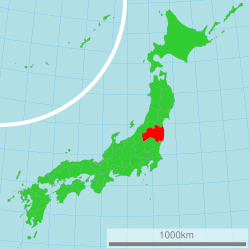
Aizuwakamatsu (会津若松) is a city of about 110,000 in western Fukushima Prefecture (福島県), set in the Aizu basin and ringed by mountains. Historically it was the seat of the Aizu domain — a strategic gateway between Tōhoku and the Sea-of-Japan coast at Niigata. The basin’s cold, snowy winters and abundant wood from the surrounding mountains are part of why a lacquer industry took root and stayed.
The founding date of Aizu-nuri is precise. In 1590, Gamō Ujisato (蒲生氏郷), a Christian daimyō and patron of arts who had distinguished himself in Toyotomi Hideyoshi’s campaigns, was assigned to Aizu. He invited lacquer craftspeople from Wakasa (modern Fukui) to establish workshops in the new domain. The original technique was essentially Wakasa-nuri — multi-layer urushi on wooden bodies — but over the next 400 years Aizu developed distinct regional styles: Aizu-bandai mountain motifs, hana-nuri deep solid colors, and hanamuri gold-painted patterns.
-
1590 — Gamō Ujisato is assigned to Aizu by Toyotomi Hideyoshi; invites lacquer craftspeople from Wakasa (Fukui) to seed local workshops. -
Edo period — Aizu-nuri expands under Tokugawa-era stability and becomes one of four major Tōhoku lacquer traditions, alongside Tsugaru, Kawatsura, and Hidehira. -
1868 — Boshin War / siege of Aizu. The Aizu domain fights on the losing side of the Meiji Restoration; the city is devastated and many craftspeople are killed or scattered. -
Late 19th c. — Aizu-nuri continues largely through women-led households — the wives and daughters of conscripted or killed male craftspeople — an uncommon continuity pattern in Japanese craft history. -
1975 — Aizu-nuri is designated a Traditional Craft Product (伝統的工芸品) by METI under the 1974 craft-protection law. -
1980s — Aizu pioneers the modern dishwasher-safe synthetic-urushi finish (cashew-shell lacquer, polyurethane-based clear coats), bringing daily-use lacquer into the modern kitchen. -
2026 — Karin Honpo and other Aizu retailers distribute through Amazon JP and Global Store, including the marumi-wan covered in this guide.
The Aizu story has an unusual continuity arc. After the 1868 siege, when many male craftspeople had been conscripted or killed in the war, the Aizu-nuri tradition survived in significant part through women — wives, daughters, and widows of lacquerers who kept the workshops running. This is not the typical male-line continuity that dominates most Japanese craft histories, and it shaped Aizu’s later openness to practical, daily-use product lines rather than guarded ceremonial-only output.
“Aizu-nuri is one of the few major Japanese lacquer traditions that decided, in the 1980s, that lacquer should survive the dishwasher. The Marumi-Wan is the working bowl that decision produced.”
That 1980s pivot is what produces objects like this Karin Honpo marumi-wan. Modern Aizu workshops keep a traditional urushi line for high-end ceremonial pieces, but most of their volume is now in the synthetic-finish line — cashew lacquer for vermilion red and lacquer black, polyurethane-based clear coats over wooden bodies. The result looks and feels much like natural urushi, with two practical advantages: it tolerates the dishwasher and microwave, and it resists the chemical damage (citrus, alcohol, prolonged soaking) that ages natural urushi quickly.
Karin Honpo (漆器かりん本舗) operates as a named Aizu lacquer retailer, sourcing from multiple Aizuwakamatsu workshops and selling under one brand. The company has built a substantial Amazon JP presence on accessible Aizu-nuri pieces, of which the Marumi-Wan is among the most-purchased. For an international reader buying a first daily lacquer bowl, the value of “Karin Honpo” as a name is mostly that it points back to an identifiable Aizu retailer rather than to an anonymous import — the bowl is part of an Aizu lineage with a 425-year continuity claim, not a generic lacquer-look bowl manufactured elsewhere.
Price snapshot across stores
Prices reflect the Amazon JP listing snapshot for B089VY9P8Z as of . USD figures are approximate at a ¥150/USD baseline; live rates fluctuate. The JPY price is the authoritative one for the specific item.
| Store | Item / Variant | Price | Notes |
|---|---|---|---|
| 🇺🇸 Amazon.com (US) | Browse Japanese lacquer soup bowls | varies (USD) | Best if you’re shopping from the US — Prime shipping, USD pricing, no international customs. Amazon US carries Japanese lacquer bowls from several makers; the specific Karin Honpo marumi-wan ships from Japan (next row). |
| 🇯🇵 Amazon JP Global Store | Karin Honpo Marumi-Wan, red (B089VY9P8Z) | ¥1,714 (≈ $11 USD) | Ships internationally from Japan. ~80 g; expect $8–15 USD shipping to US/EU. Lacquerware is unrestricted for personal import in most destinations. |
| Maker direct (Karin Honpo) | Same item via Karin Honpo’s own store | Comparable to Amazon JP | Karin Honpo runs a direct online storefront on Japanese e-commerce platforms; not all support direct international checkout — a proxy service may be required. |
| Proxy services (Buyee / Tenso) | Forwarded from JP retailers | ¥1,714 + proxy fee + shipping | Useful if the maker-direct store doesn’t accept your country’s payment. Expect a 5–10% service fee on top of item + forwarding-shipping. |
What it does well
Microwave-safe and dishwasher-safe per the listing — qualities that traditional natural-urushi lacquer cannot match. For a household using a dishwasher daily, this is the practical decision point.
Deep vermilion red with the rounded marumi-wan profile — the silhouette anyone reading “Japanese soup bowl” likely pictures. Pairs naturally with rice ware, donburi, and tea cups in white, indigo, or black ceramic.
At ¥1,714 (≈$11 USD), this sits well below the ¥5,000–15,000 traditional-tier entry point. If you’ve been hesitant to spend on a lacquer piece without trying one first, this is the sample-sized commitment.
Sourced through Karin Honpo, a multi-generational Aizu retailer in Aizuwakamatsu — not an anonymous “Japanese lacquer-style” import. The bowl sits inside a 425-year regional tradition with documented continuity.
Weaknesses and things to verify before buying
- This is not natural urushi. The modern Aizu finish is a synthetic urushi-equivalent (cashew lacquer / polyurethane clear). Visually close, tactilely close, but if you are specifically chasing the cured natural-urushi feel — the soft, slightly warm-to-the-touch finish that develops decades of patina — you want the ¥5,000–15,000 traditional tier instead.
- ⌀ 11 cm is soup-bowl size, not donburi size. The marumi-wan fits miso soup, small rice servings, or side dishes. It will not hold a katsudon or a full ramen serving. Verify the dimensions against your intended use before ordering.
- The “dishwasher-safe” claim is for modern household dishwashers, not industrial. The listing’s microwave/dishwasher claim assumes typical home equipment. Restaurant-grade high-temperature sanitizing cycles are out of scope and may shorten the finish’s life.
- Color expectations: the vermilion in the product photo is photographed under listing-standard lighting. In a dimmer kitchen the red reads slightly darker and more brick-toned. If the saturated photo color is critical to you, plan for some variance.
- Loyalty points and list-price savings are not stated in the listing snapshot we sourced. If you’re optimizing for points cashback through Amazon JP, verify the current points rate at checkout rather than relying on this article.
- Stock and price fluctuate on Amazon JP. ¥1,714 is the snapshot price at the time of writing; the JP listing has shown variation within roughly ¥1,500–2,200 historically. Always verify current price before purchase.
- International shipping is via Amazon JP Global Store — not all destinations are supported, and shipping cost varies by region (typically $8–15 USD to US/EU on this weight class; higher to South America, Africa, or smaller island nations).
Conclusion — which buyer type are you?
You want natural urushi with multi-month curing and a maker’s signature. Skip this; look at Wakamatsu Shikki Cooperative pieces (¥20,000+) or Aizu-nuri tea-ceremony bowls (¥5,000–15,000).
You want one good Japanese lacquer bowl for everyday miso, dishwasher-safe, with a real lineage. This is the match. Order the red marumi-wan as your trial piece, then add the black if it sticks in rotation.
¥1,714 is already at the low end of named-retailer Japanese lacquer; going cheaper usually means generic imports. This still fits — but check shipping cost in your country before ordering one bowl in isolation; bundling 2–3 pieces lowers per-item shipping.
You only ever serve cold food, dislike red and black as table colors, or specifically prefer ceramic for thermal mass. Skip; look at a porcelain miso bowl or a Hasami-yaki ceramic piece instead.
Other ways to approach this purchase
Amazon JP marks down Karin Honpo pieces during seasonal events (Golden Week, Black Friday, year-end). The marumi-wan has dipped below ¥1,500 historically; setting a price alert on the ASIN can save a few hundred yen if you’re patient.
Not generally applicable at this price tier — lacquer pieces under ¥2,000 rarely appear on Japan’s used-goods marketplaces in inspectable condition. Buying new is the practical default here.
If you hold an Amazon JP account with points balance, the ¥1,714 price often clears with a single points top-up. Amazon US Prime members shopping the parallel category get free shipping on alternative bowls without crossing the customs threshold.
If shipping costs would more than double the item price (likely in some regions of South America or Africa), a Hasami-yaki porcelain miso bowl bought locally serves the function and avoids the import friction.
🏆 Editor’s Pick
❓ Frequently Asked Questions
Is this bowl really microwave and dishwasher-safe, or is that a translation issue?
Per the Amazon JP listing for B089VY9P8Z, both are stated explicitly (食洗機対応 / 電子レンジ対応). This is possible because the Karin Honpo marumi-wan uses the modern Aizu synthetic-urushi finish — typically cashew-shell lacquer or a polyurethane-based clear coat — not traditional natural urushi. Natural urushi is sensitive to dishwasher heat and detergent and is generally not microwave-rated; the modern Aizu line was developed specifically to handle both.
What is the difference between Aizu-nuri and Wajima-nuri or other Japanese lacquerware?
Aizu-nuri is the Fukushima (Tōhoku) lacquer tradition, founded 1590 by craftspeople invited from Wakasa by the Gamō clan. Wajima-nuri is the Ishikawa (Hokuriku) tradition, known for ji-no-ko earth-powder undercoats and multi-decade durability — and generally priced an order of magnitude higher. Aizu’s distinguishing modern feature is the dishwasher-safe synthetic-finish line pioneered in the 1980s; Wajima largely remains in the traditional natural-urushi tier.
Does Amazon ship this bowl to my country?
Amazon JP Global Store ships lacquerware to most major destinations, including the US, Canada, UK, EU, Australia, and many Asian countries. At ~80 g, expect roughly $8–15 USD shipping to the US or EU; higher to more remote regions. Lacquerware is unrestricted as personal-use import in most jurisdictions, so customs is rarely an issue at this price point. Verify your country in the Amazon JP checkout before ordering.
How big is the marumi-wan compared to a Western soup bowl?
At ⌀ 11 × H 6.5 cm, this is slightly smaller than a typical Western soup bowl (which usually runs 14–18 cm in diameter). It holds roughly the volume of a single miso-soup serving (~200 ml). For Western use, it works well for a personal serving of broth, a dessert bowl for ice cream, or a small side dish; it is too small for a full ramen serving or a Western entrée-sized soup.
Can I use it for hot rice and miso soup, or just one of them?
Both. The marumi-wan form is conventionally a soup bowl in Japan, but at ⌀ 11 cm it also serves as a small rice bowl (chawan-size). Many Japanese households rotate the same form for both roles depending on the meal. Hot rice and hot soup are both well within the finish’s heat tolerance.
How do I care for it after washing?
Per the listing’s care notes: wipe dry after washing (do not air-dry indefinitely in a damp rack); avoid abrasive sponges; store dry and out of direct sunlight. The modern Aizu finish is more forgiving than natural urushi, but extended exposure to sun or prolonged soaking in hot detergent will still age the surface over years.
What’s the difference between this and a ¥10,000 traditional Aizu bowl?
Three main things. (1) Finish: this uses synthetic urushi-equivalent; a ¥10,000+ piece typically uses multi-coat natural urushi cured over months. (2) Body and undercoat: the traditional tier may have hand-shaped wood and labor-intensive ground coats, where the budget tier may use turned wood with simpler preparation. (3) Patina trajectory: natural urushi softens and develops depth over decades of use; synthetic finishes hold their look but do not patina in the same way. Functionally, both serve soup equally well — the difference is craft-collector value, not table use.
jpmono.com is curated by a Japan-based editorial team (working out of Toyama in the Hokuriku region and Nara in Kansai) and is independent. We don’t take payment from the makers we feature; income comes from affiliate links. Read more about our editorial standards.
🤖 Editorial note: this article was drafted with AI assistance from publicly available product-listing data and verified Aizu-nuri historical references, then reviewed by the jpmono editorial team. Source listing data was current as of ; pricing and stock may have shifted since.
Affiliate disclosure: jpmono.com may earn a commission on qualifying purchases made through links on this page, at no additional cost to you.