![Odate Magewappa Oval Bento Box (Medium 640ml) by Ōdate Kōgeisha — Hand-Bent Cedar Lunch Box from Akita (¥7,700 / ≈$52 USD) [2026 Buyer’s Guide]](https://jpmono.com/wp-content/uploads/2026/05/odate-kogeisha-magewappa-bento-medium-where-to-buy-2026-featured-1400x561.jpg)
Ōdate magewappa (大館曲げわっぱ) is the hand-bent cedar tradition of Ōdate, a small city in northern Akita Prefecture in the deep interior of Tōhoku. Thin boards of Akita-sugi cedar are softened in hot water, curved by hand around a wooden form, and stitched at the seam with strips of mountain cherry-bark — a technique practiced in Ōdate for roughly four hundred years and designated a METI Traditional Craft Product in 1980. The bento (lunch) box is the form that traveled best internationally: cedar’s natural antimicrobial compounds keep cooked rice fresh, and its porous structure absorbs the condensation puddles that pool inside plastic lunch boxes.
The piece in this guide is the Ōdate Kōgeisha medium oval bento (model 2540) at 640 ml, listed at ¥7,700 (≈$52 USD as of May 2026) on Amazon JP. Ōdate Kōgeisha is the largest Ōdate cooperative — founded in 1955 to consolidate marketing and quality control across roughly fifteen to twenty member workshops — and its pieces sit in the entry-mid tier of the magewappa market, between unbranded plywood imitations and the ¥15,000-30,000 named-craftsperson pieces from workshops such as Kurikyu or Shibata Yoshinobu Shōten.
This guide is written for an international reader who has seen magewappa on Instagram or in a bento blog and wants to understand what they are actually buying before ordering one. We cover the four-hundred-year history of the craft (an unusually well-documented samurai-poverty-relief origin), the three Ōdate Kōgeisha sizes, daily care, and the practical question of how to get one shipped outside Japan.
🔄 Last updated
⏱ ~14 min read

- Who this is for — and who should skip it
- Product overview (from published specs)
- Glossary — terms used in this article
- 📍 Where this comes from — place, era, and the craft tradition
- Which size should you choose?
- 📦 Shipping & where to buy from outside Japan
- Price snapshot across stores
- What it does well
- Weaknesses and things to verify before buying
- Conclusion — which buyer type are you?
- Other ways to approach this purchase
- 🏆 Editor’s Pick — the Ōdate magewappa we’d start with
- ❓ Frequently Asked Questions
- 📌 Related Japanese Crafts
Who this is for — and who should skip it
- Adults who pack their own lunch most weekdays and want a daily-use bento that actually improves rice texture
- Buyers replacing plastic lunch boxes for sustainability or food-safety reasons
- Cooks who appreciate the visual difference natural cedar makes in bento photos
- Readers who want a real Ōdate piece without paying the ¥15,000-30,000 named-craftsperson premium
- Gift-givers looking for a Japanese craft object under $60 USD shipped
- Anyone who needs to microwave their lunch — wood cannot go in the microwave
- Anyone who relies on a dishwasher — magewappa is strictly hand-wash with hot water, no detergent
- People who pack hot soup, curry, or other liquid-heavy meals (the cedar absorbs liquids and stains)
- Households with two bentos per day and no rotation — the box needs 24+ hours to air-dry between uses
- Children under about eight, who tend to be rough with the cherry-bark stitching
Product overview (from published specs)
Specifications below are drawn from the Amazon JP listing for ASIN B01CTK9M4S as of the writing date. JPY is the authoritative price for the specific listed item; USD figures are approximate at a ¥150/USD baseline. Live pricing on Amazon JP fluctuates and may have shifted since.
Odate Magewappa Oval Bento Box (Medium 640ml) by Ōdate Kōgeisha
大館工芸社 小判弁当(中)2540 640ml 曲げわっぱ わっぱ 弁当箱 日本製 bento box
在庫あり。 · Sold by 大館工芸社公式ストア · ASIN B01CTK9M4S
Price and availability as of 2026-09-01 05:22 JST. The Amazon listing at the time of purchase is authoritative. jpmono.com earns a commission on qualifying purchases at no extra cost to you.
| Attribute | Detail |
|---|---|
| Maker | Ōdate Kōgeisha Cooperative (大館工芸社) — founded 1955, Ōdate, Akita |
| Model | 2540 — oval (koban-gata) bento, medium |
| Dimensions | 18.8 × 12 × 5.8 cm (oval form, one compartment with separate lid) |
| Capacity | 640 ml — standard Japanese adult-portion bento |
| Weight | Approximately 110 g |
| Material | Akita-sugi (秋田杉, Akita cedar) bent-wood body with mountain cherry-bark (yamazakura-no-kawa 山桜の皮) stitching at the seam |
| Finish | Natural / oil finish (varies slightly per piece — wood is a living material) |
| Origin | Ōdate, Akita Prefecture, Japan — METI Traditional Craft Product designation 1980 |
| Price (Amazon JP) | ¥7,700 (≈ $52 USD as of May 2026) |
| International shipping | Amazon JP Global Store to US/EU/AU/CA, ~$8-15 USD shipping for this ~110 g item; cedar is unrestricted personal import |
Glossary — terms used in this article
Magewappa (曲げわっぱ)
Literally “bent (mage) round vessel (wappa).” Refers to thin cedar or hinoki boards softened in hot water, curved around a form, and stitched at the seam. Several regions produce magewappa, but Ōdate magewappa from Akita is the best-known and the only one with METI Traditional Craft Product status (1980).
Akita-sugi (秋田杉)
Akita cedar — Cryptomeria japonica grown in the Akita mountains, traditionally counted (alongside Yoshino-sugi from Nara and Owase-hinoki from Mie) as one of the three premier Japanese softwoods. Grows slowly over 60-100 years in cool, snowy conditions, producing tight-grained, dimensionally stable wood.
Yamazakura-no-kawa (山桜の皮)
Mountain cherry-bark — strips of bark from Prunus jamasakura used to stitch the seam where the bent cedar board meets. The bark is itself soaked to soften, then threaded through small holes drilled in the cedar. The dark cherry-bark against the pale cedar is the visual signature of Ōdate magewappa.
Koban-gata (小判型)
“Koban shape” — the canonical oval form of Japanese bento boxes, named after the koban, the oval gold coins minted during the Edo period. The koban-gata is contrasted with round (marugata 丸型) and rectangular (kakugata 角型) forms.
Bushi-shōkun (武士小職)
“Samurai side-occupation” — Edo-period domain programs that authorized low-ranking samurai to practice crafts during the agricultural off-season to supplement stipends. Ōdate magewappa is one of the most clearly documented bushi-shōkun crafts in Japan.
METI Traditional Craft Product (国指定伝統的工芸品)
A national designation administered by Japan’s Ministry of Economy, Trade and Industry, given to crafts that meet criteria including continuous regional production, traditional materials, and traditional technique. Ōdate magewappa received the designation in 1980.
📍 Where this comes from — place, era, and the craft tradition

The region — Ōdate, in northern Akita
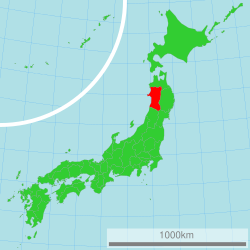
Ōdate (大館) is a city of approximately 70,000 people in northern Akita Prefecture (秋田県), in the deep interior of the Tōhoku region. The city sits in a mountain basin surrounded by the Ōu Mountains, with the Yoneshiro River cutting through the central plain. The closest international airports are Akita Airport (AXT), about 60 km south, and Aomori Airport (AOJ), about 80 km north; by rail, Ōdate is three and a quarter hours from Tokyo on the JR Akita Shinkansen to Akita City, then another sixty minutes by local train.
Geographically, Ōdate’s significance to the craft comes from its proximity to the Akita-sugi cedar forests. Akita-sugi has been counted, together with Yoshino-sugi from Nara and Owase-hinoki from Mie, as one of the three premier Japanese softwoods. The cedar grows slowly in the cool, snowy climate of the Ōu Mountains — sixty to a hundred years before harvest — and produces wood with tight annual rings, uniform color, and the dimensional stability that bent-wood vessels require.
The historical anchor — early 1600s, the Satake clan’s winter program
Ōdate magewappa has an unusually well-documented social origin. The Satake clan (佐竹氏) was transferred from the Hitachi domain (modern Ibaraki) to the Akita domain in 1602 as part of the Tokugawa shogunate’s nationwide daimyō reshuffle. The Satake brought several thousand samurai retainers north with them, but Akita’s smaller economic base could not support that many warrior families at full stipend; the lower-ranking samurai were impoverished.
The Satake daimyō Yoshikage, beginning around 1626, established a bushi-shōkun program: low-ranking samurai households were granted access to Akita-sugi cedar from the domain forests and instructed to develop a winter craft that could be sold to supplement their stipends. The chosen craft was bent-wood vessels — magewappa, magemono — already practiced at a small scale in the region for everyday use. The domain subsidized raw material, skill training at the Ōdate castle workshops, and marketing through the domain’s official channels to merchant networks in Edo and Kyoto.
Within roughly thirty years, by the 1660s, Ōdate had developed into a recognized magewappa production center, with quality distinctly higher than pre-Satake magewappa — straight-grained Akita cedar, careful bending technique, and the cherry-bark stitching that became the visual signature.
“Ōdate magewappa is the most directly documented social-policy craft origin in Japan — a craft explicitly designed by a daimyō to relieve samurai poverty, supported with materials and marketing, that succeeded so completely the original purpose is now anachronistic.”
- 1602 — Satake clan transferred from Hitachi to Akita domain in the Tokugawa daimyō reshuffle
- 1626 onward — Satake Yoshikage establishes the bushi-shōkun winter-craft program for impoverished samurai households
- 1660s — Ōdate magewappa formalized as a recognized production center, marketed through Edo and Kyoto merchant networks
- 1868–1873 — Meiji Restoration abolishes the samurai class; the original samurai-relief structure ends, but the Ōdate workshops continue as commercial operations
- 1955 — Ōdate Kōgeisha cooperative founded to consolidate marketing and quality control across multiple Ōdate workshops
- 1960s–1970s — Plastic and aluminum bento boxes dominate the mass market; many Ōdate workshops close at the trough
- 1980 — METI designates Ōdate magewappa as a Traditional Craft Product (国指定伝統的工芸品)
- 2010s onward — International bento culture surfaces magewappa as the canonical traditional bento format; export share rises from ~2% to ~15–20% of Ōdate Kōgeisha sales
- 2026 — Roughly 30–50 active magewappa makers in Ōdate; Kōgeisha sits at the entry-mid tier of the market
Why Akita-sugi cedar works for a lunch box
Akita-sugi has several properties that make it specifically suited to bento use, not just generic wood-vessel use. The tight grain — produced by 60-100 years of slow growth in cool, snowy mountains — gives the wood uniform color and dimensional stability through repeated wet-dry cycles. The porous structure absorbs roughly twenty percent of its weight in water without distortion, which means the cedar pulls excess moisture out of freshly cooked rice and prevents the condensation puddle that pools at the bottom of plastic boxes.
The cedar also produces phytocidal compounds — naturally occurring antimicrobial molecules — that inhibit bacterial growth on the cedar surface. In practical terms this means rice stays palatable longer in a magewappa than in a plastic equivalent, particularly in warmer weather. The gentle cedar aroma transfers to the food without dominating its flavor; many long-term users report this as the feature they would miss most if they switched back.
Twentieth-century revival and the 1980 METI designation
Ōdate magewappa survived the Meiji-era abolition of the samurai class — the workshops continued as commercial operations once the bushi-shōkun structure ended — but the lowest point came in the 1960s and 1970s, when cheap plastic and aluminum bento boxes dominated the Japanese mass market. Many Ōdate workshops closed in this stretch. The revival began in the 1980s, driven by a food-safety and environmental shift that surfaced cedar’s antimicrobial advantage, and by a design movement that aligned magewappa’s clean geometric form with broader Japanese-minimalist aesthetics. The METI Traditional Craft Product designation in 1980 formalized recognition that had been building through the 1970s.
Ōdate Kōgeisha (大館工芸社), the largest cooperative, was founded in 1955 to consolidate marketing and quality control among multiple Ōdate workshops. As of 2026, the cooperative includes approximately fifteen to twenty member workshops working under unified branding, and its pieces represent the consistent entry-tier of the magewappa market. Premium individual-craftsperson workshops — Kurikyu, Shibata Yoshinobu Shōten, and others — sit at the high end of the price spectrum, typically ¥12,000–30,000.
The international bento moment
The 2010s rise of global “bento culture” — driven partly by the photogenic appeal of natural cedar in Instagram bento photography and partly by the broader Japanese-minimalism design wave — created international demand for traditional bento boxes. Ōdate magewappa, with its visible cherry-bark stitching and clear functional advantage over plastic, became the canonical authentic-Japanese option in this market. International customers now account for an estimated 15–20% of Ōdate Kōgeisha’s sales, up from roughly 2% in 2010.
Which size should you choose?
Ōdate Kōgeisha produces the oval (koban) bento in three sizes. The price step from small to medium is essentially flat (¥200) because Kōgeisha’s pricing is dominated by labor, not material; the step from medium to large is larger (¥1,675) because the large piece requires noticeably more cedar and more bending time. The medium 640 ml is the canonical adult bento.
Small — 490 ml (model 2450)

18 × 11 × 5 cm · 490 ml · ¥7,500
The smaller version. Suited for children, smaller appetites, or as a single-side container in a larger meal. Almost the same price as the medium because Kōgeisha prices by labor rather than material — the smaller piece takes nearly the same bending time. Choose this only if you specifically prefer a smaller portion.
Medium — 640 ml (model 2540) — this guide’s pick
18.8 × 12 × 5.8 cm · 640 ml · ¥7,700
The canonical adult-portion bento. 640 ml accommodates a serving of rice plus two to three sides — the standard Japanese bento composition. Fits in any standard bento bag and on a Japanese commuter-train table-tray. The default starting point for anyone choosing their first magewappa.
Large — 750 ml (model 2430)

20.5 × 13 × 6 cm · 750 ml · ¥9,375
The larger version. Suited for larger appetites, athletes, or readers who pack two meals at once. The ¥1,675 step above medium reflects the additional cedar and labor. Heavier in a bag (~135 g) and slightly tight in some standard bento bags — measure your carrying setup before choosing this size.
Other Japanese-craft household objects in this price range — useful for comparing regions, materials, and traditions before committing to your first piece.




📦 Shipping & where to buy from outside Japan
The Ōdate Kōgeisha medium oval bento is listed on Amazon JP Global Store, which ships to the US, EU, AU, CA, and most major destinations. The item is light (~110 g) so the international shipping fee is at the bottom of the Amazon JP Global Store range — typically $8–15 USD to North America and Europe. Cedar wooden ware is unrestricted personal import in all major jurisdictions and is not subject to CITES.
Amazon US (amazon.com) does not individually list this specific Ōdate Kōgeisha SKU, but it does carry related Japanese kitchen and bento goods, including some Ōdate Kōgeisha pieces sold through international resellers and a large number of Chinese-made plywood imitations. If you shop on Amazon US, verify the Ōdate origin before purchasing — “made in Akita” on the listing description is the marker to look for.
Alternative paths include the Ōdate Magewappa Cooperative’s direct mail order (cooperative website, Japanese-language; ships internationally on request), proxy services such as Buyee or Tenso for retailers that do not ship abroad, and specialty Japanese-goods retailers in North America and Europe (Tortoise General Store, Native & Co, Asobu) that typically carry Ōdate magewappa at a 1.5–2× markup over the Amazon JP price.
Price snapshot across stores
Prices below are based on listings at the time of writing and may have changed. USD figures are approximate at a ¥150/USD baseline. JPY is the authoritative price for the specific listed item.
| Store | Item / Variant | Price | Notes |
|---|---|---|---|
| 🇺🇸 Amazon.com (US) | Browse Japanese magewappa bento boxes | varies (USD) | Best if you’re shopping from the US — Prime shipping, USD pricing, no international customs. Amazon US carries Ōdate magewappa from various sellers alongside many plywood imitations; verify “made in Akita” before buying. The exact Kōgeisha 2540 piece is sourced from Japan (next row). |
| 🇯🇵 Amazon JP Global Store | Ōdate Kōgeisha Oval Bento (Medium) 640 ml — model 2540 | ¥7,700 (≈$52 USD) | Ships internationally from Japan; ~$8–15 USD shipping for this ~110 g item. The source listing for the specific Kōgeisha 2540 piece this guide covers. |
| Maker direct | Ōdate Magewappa Cooperative mail order | ¥7,700 (varies) | Japanese-language cooperative website; international shipping on request. Useful for the lifetime-repair pathway after years of use. |
| Proxy services (Buyee / Tenso) | Same SKU via Japanese retailers | ¥7,700 + proxy fees | Useful if Amazon JP Global Store does not stock the size you want; adds ~$10-20 USD in proxy and forwarding fees on top of shipping. |
What it does well
The cedar absorbs excess moisture from cooked rice — no condensation puddle, and the rice stays palatable for several hours longer than in a plastic equivalent.
Akita-sugi produces phytocidal compounds that inhibit bacterial growth on the cedar surface — meaningful for unrefrigerated lunches in warm weather.
At roughly 110 g empty, the magewappa is lighter than most plastic bento boxes of the same capacity. Easy daily commute.
Ōdate Kōgeisha offers repair of cherry-bark stitching and other structural elements for the life of the piece — uncommon in this price tier.
Weaknesses and things to verify before buying
- Strictly no microwave or dishwasher. Wood warps and cracks in both. If your lunch routine requires reheating at work, this is the wrong box — pick a plastic or stainless box and keep the magewappa for cold or room-temperature meals.
- Hand-wash with hot water only — no detergent. Cedar absorbs soap residue and then releases it into the next meal. Plan on a soft sponge, hot water, and full air-dry. Buyers who rely on a dishwasher for everything else will find this an adjustment.
- 24-hour air-dry between uses. If you pack a bento daily, you’ll need a second box on rotation. Putting the magewappa away damp will eventually grow mold inside the seams.
- Wet or oily foods stain and can soak in. Hot curry, miso soup, or anything with free liquid will leave a mark; the cedar’s absorbency is the same property that makes it work for rice. Use a sheet of bento paper (敷紙) as a liner if you pack saucy sides.
- Finish and color vary piece-to-piece. Natural cedar grain is non-uniform; pieces darken with use over years. Buyers who expect a factory-uniform appearance should set expectations accordingly.
- Cherry-bark stitching is a wear point. The stitching is repairable by the maker but can loosen with rough handling; not the best choice for children under about eight.
- Watch for non-Akita imitations. Both Amazon US and aggregator marketplaces stock “Japanese magewappa” pieces that are actually plywood or Chinese-made; verify “made in Akita” or the Ōdate Kōgeisha brand before paying for the real thing.
Conclusion — which buyer type are you?
If you want a named-craftsperson signature piece, look at Kurikyu or Shibata Yoshinobu Shōten (¥12,000–30,000). Ōdate Kōgeisha is the consistent entry-mid, not the artisan-signed top tier.
If you pack a daily bento and want a real Akita magewappa without paying for a maker’s name, the Kōgeisha 640 ml at ¥7,700 is the canonical first piece. Start here.
Below the Kōgeisha tier, most “magewappa” listings are plywood or Chinese imitations. A plain wooden or bamboo bento at ¥2,000–3,000 may serve better than a counterfeit Akita piece.
If you need a microwaveable, dishwasher-safe, soup-friendly daily container, magewappa will frustrate you. A stainless or quality plastic bento is the honest answer.
Other ways to approach this purchase
Peak Ōdate production runs January–April (winter workshop season). Inventory across sizes is highest March–May; you are reading this in the right window.
Buying through Amazon JP is fine for the initial purchase; for repair after years of use, contact the Ōdate Magewappa Cooperative directly — Kōgeisha offers lifetime repair on its pieces.
A pack of bento paper (¥300–800) and a furoshiki or insulated bag ($5–30) make the magewappa a complete daily setup. Consider bundling.
If your lunch routine doesn’t tolerate hand-wash + air-dry + no-microwave, a stainless box from Zojirushi or a quality plastic bento is the right purchase. The magewappa rewards a specific workflow, not all of them.
🏆 Editor’s Pick — the Ōdate magewappa we’d start with
❓ Frequently Asked Questions
Does Amazon JP Global Store ship this to the US / EU / Australia?
Yes. The Ōdate Kōgeisha medium oval bento is listed on Amazon JP Global Store for direct international shipping to the US, EU, AU, CA and most major destinations. The item is light (~110 g), so the shipping fee is at the low end of the range — typically $8–15 USD to North America and Europe. Cedar wood is not subject to CITES and is unrestricted personal import.
Can I put the magewappa in the microwave or dishwasher?
No — both will damage the cedar. The microwave warps and cracks bent-wood vessels; the dishwasher’s heat, detergent, and prolonged water contact cause warping and weaken the cherry-bark stitching. Hand-wash with hot water only, no detergent, and air-dry for at least 24 hours between uses.
How long does a magewappa last?
With normal care — hand-wash, full air-dry, no oily or wet foods packed directly against the cedar — a Kōgeisha piece commonly lasts 10–20 years of daily use. Cedar darkens and develops a pleasant subtle scent over time. Ōdate Kōgeisha offers lifetime repair of the cherry-bark stitching and structural elements, which extends life further.
Which size should I pick — small, medium, or large?
The medium 640 ml is the standard Japanese adult-portion bento — rice plus two to three sides — and the right starting point for most adults. The small 490 ml suits children, smaller appetites, or use as a side container. The large 750 ml suits larger appetites or two-meal packing but adds weight and may not fit some standard bento bags.
How do I tell a real Ōdate magewappa from an imitation?
Look for three markers: (1) “made in Akita” or “Ōdate” on the listing or packaging; (2) the Kōgeisha cooperative mark or a named-workshop signature (Kurikyu, Shibata Yoshinobu Shōten, etc.); (3) visible cherry-bark stitching at the seam — the dark cherry-bark against pale cedar is the visual signature. Pieces under ¥3,000 are essentially always plywood or non-Akita imitations.
Can I pack hot food in it?
Warm food is fine — cooked rice straight off the rice cooker is the canonical use case, and cedar’s moisture absorption is most effective with warm rice. Avoid free liquids (soup, curry sauce, sauce-heavy stews) because the cedar will absorb them and stain. A sheet of bento paper as a liner mitigates this if you must pack saucier sides.
Is this a good gift for someone outside Japan?
Yes, for the right recipient — someone who packs a regular lunch, is open to hand-wash care, and appreciates Japanese craft. The piece arrives gift-presentable from Amazon JP. Pair with a pack of bento paper and a furoshiki cloth ($5–10 USD) for a complete starter set under $80 USD shipped.
jpmono.com is curated by a Japan-based editorial team (working out of Toyama in the Hokuriku region and Nara in Kansai) and is independent. We do not take payment from the makers we feature; income comes from affiliate links. Read more about our editorial standards.
🤖 This article was drafted with AI assistance and edited by the jpmono editorial team. Specifications and pricing reflect listings at the time of writing; please verify at the retailer before purchasing.
Affiliate disclosure: jpmono.com may earn a commission on qualifying purchases made through links on this page, at no additional cost to you.