![Tsugaru-nuri Lacquer Chopsticks (Husband-and-Wife Pair) in Paulownia Box — Hand-Lacquered Aomori Tradition (¥7,480 / ≈$50 USD) [2026 Buyer’s Guide]](https://jpmono.com/wp-content/uploads/2026/05/harimaya-tsugaru-nuri-meoto-chopsticks-where-to-buy-2026-featured-1190x1050.jpg)
Tsugaru-nuri Lacquer Chopsticks (Husband-and-Wife Pair) in Paulownia Box — Hand-Lacquered Aomori Tradition (¥7,480 / ≈$50 USD) [2026 Buyer’s Guide]
Tsugaru-nuri (津軽塗) is the multi-layer lacquer tradition of Hirosaki, in western Aomori Prefecture. The practice has been continuous since 1685, when the Hirosaki Domain — under the Tsugaru clan — invited the lacquer master Ikeda Genbei (池田源兵衛) to establish the workshop that became the foundation of every Tsugaru-nuri piece made today. The tradition was designated a METI Traditional Craft Product (国指定伝統的工芸品) in 1975, and what distinguishes it from every other Japanese lacquerware school is the 48-step layering process — the most labor-intensive in Japan — that produces the characteristic mottled-pattern surfaces: Karanuri (唐塗, “Chinese-paint”), Nanakonuri (七々子塗, “rapeseed-grain”), Kinmanuri (錦塗, “brocade”), and Monsha-nuri (紋紗塗, “crest-fine-mesh”).
The piece in this guide is a meoto-bashi (夫婦箸, “husband-and-wife” chopsticks) pair from Harimaya (はりま屋), one of the cooperative-member workshops still active in central Hirosaki. The pair is sized to the canonical Japanese meoto convention — 23.5 cm for the longer “husband” stick and 20.5 cm for the shorter “wife” stick — and arrives in a paulownia (kiri, 桐) gift box ready for an anniversary, wedding, or engagement. At ¥7,480 (approximately $50 USD as of May 2026, at a ¥150/USD baseline) this is the practical entry to real Tsugaru-nuri: the price is low enough to consider impulsively, but every stick still passes through the full 48-step process.
This guide walks through the 340-year arc behind the object — where it is made, what the layering actually involves, who Harimaya is within the Hirosaki cooperative, and how international buyers can actually purchase it. The comparison axes are: pattern (Karanuri vs the other three named patterns), pair-vs-single format, gift-box vs no-box, and the small handful of competing meoto-bashi sets from other Tsugaru workshops also visible on the Amazon JP Global Store.
🔄 Last updated: May 16, 2026
⏱ Read time: ~12 min

- Who this is for — and who should skip it
- Product overview (from published specs)
- 📍 Where this comes from — Hirosaki, western Aomori
- Price snapshot across stores
- What it does well
- Weaknesses and things to verify before buying
- Conclusion — which buyer type are you?
- Other ways to approach this purchase
- 🏆 Editor’s Pick
- ❓ Frequently Asked Questions
- 📌 Related Japanese Crafts
Who this is for — and who should skip it
- You want a Japanese craft anniversary or wedding gift in the $40–$70 range that still has real provenance.
- You value visual depth — the Karanuri surface has 4–5 visible color layers polished through to the top coat.
- You can commit to hand-washing; urushi lacquer is not dishwasher-safe.
- You want the paulownia gift box (kiri-bako) included, not bought separately.
- You are buying for two people who share meals together — the size difference is part of the gesture.
- You need single chopsticks (not a pair) — this listing is the meoto-bashi set only.
- You expect dishwasher and microwave compatibility — urushi cannot survive either.
- You have a documented urushi (raw lacquer) allergy; rare, but real for sensitive skin.
- You want a specific named pattern (Nanakonuri, Kinmanuri, Monsha-nuri) — this ASIN ships the Karanuri-style surface.
- You are buying for daily heavy-use commuting / lunchbox carrying; thinner everyday lacquer chopsticks suit that role better.
Product overview (from published specs)
The table below combines the Amazon JP Global Store listing (the sourced ASIN, B07C1V92KR), the comparable Amazon US search path, and Harimaya / Tsugaru-nuri Cooperative maker context. Only the JP Global Store listing has confirmed live data for this exact ASIN; the other rows are framing for buyers shopping from outside Japan.
Tsugaru-nuri Lacquer Chopsticks (Husband-and-Wife Pair) in Paulownia Box
津軽塗箸 夫婦箸 桐箱入
通常2~3日以内に発送します。 · Sold by 八代目 はりま屋 · ASIN B07C1V92KR
Price and availability as of 2026-08-31 02:30 JST. The Amazon listing at the time of purchase is authoritative. jpmono.com earns a commission on qualifying purchases at no extra cost to you.
| Specification | Detail |
|---|---|
| Brand / maker | Harimaya (はりま屋), Hirosaki, Aomori Prefecture |
| ASIN | B07C1V92KR |
| Material | Wood core, hand-applied multi-layer Tsugaru-nuri urushi lacquer |
| Pattern | Karanuri-style mottled surface (per listing photo) |
| Sizes | 23.5 cm (husband) + 20.5 cm (wife) — standard meoto-bashi sizing |
| Packaging | Paulownia (kiri, 桐) wood gift box included |
| Weight | Approximately 80 g (pair + box, per listing) |
| Origin | Hirosaki, Aomori Prefecture, Japan |
| Tradition | Tsugaru-nuri — METI Traditional Craft Product designation, 1975; founding 1685 |
| Listing price (JP) | ¥7,480 (≈ $50 USD as of May 2026, ¥150/USD baseline) |
| International shipping | Amazon JP Global Store. $8–15 USD shipping to US/EU. Lacquer is unrestricted personal import. |
Sources: Amazon JP Global Store listing snapshot for B07C1V92KR (May 2026), Tsugaru-nuri Industry Cooperative public materials, METI Traditional Craft register. Live pricing may have shifted since the writing date.
📖 Glossary — Tsugaru-nuri and related terms
Tsugaru-nuri (津軽塗) — Multi-layer lacquerware tradition of Hirosaki, western Aomori. Founded 1685 under Hirosaki Domain patronage. Famous for its 48-step layering process.
Urushi (漆) — Refined sap of the Japanese lacquer tree (Toxicodendron vernicifluum). Cures by polymerization in high humidity; the finished surface is unusually durable, water-resistant, and somewhat heat-sensitive.
Meoto-bashi (夫婦箸) — “Husband-and-wife chopsticks.” A paired set with the longer stick (23.5 cm) traditionally for the husband and the shorter (20.5 cm) for the wife. A canonical Japanese couple gift.
Karanuri (唐塗) — “Chinese-paint.” The most common Tsugaru-nuri pattern: random multi-color mottled surface produced by applying paint through a perforated stencil, building up layers, then polishing back through them.
Nanakonuri (七々子塗) — “Rapeseed-grain.” A finer-grained dot-cluster pattern named after rapeseed (na) seeds.
Kinmanuri (錦塗) — “Brocade.” Premium tier with metallic accents evoking Nishijin brocade weaving from Kyoto.
Monsha-nuri (紋紗塗) — “Crest-fine-mesh.” Geometric, mesh-like surface.
Kiri-bako (桐箱) — Paulownia-wood box. Paulownia is exceptionally light and naturally moisture-regulating, which is why it has been the standard gift-and-storage box wood for centuries.
METI Traditional Craft (国指定伝統的工芸品) — Japan’s Ministry of Economy, Trade and Industry designation for crafts that meet specific continuity, technique, and regional-origin criteria. Tsugaru-nuri was designated in 1975.
📍 Where this comes from — Hirosaki, western Aomori

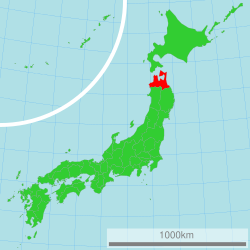
Hirosaki (弘前) is a city of approximately 170,000 in western Aomori, Japan’s northernmost main-island prefecture. The Tsugaru plain on which it sits is sheltered between the Sea of Japan to the west and the Ōu mountain range to the east — the same Ōu range that runs the length of Tōhoku — and the climate is heavy-snow inland: a long winter, a short and intense summer, and the long, humidity-stable shoulder seasons that urushi lacquer happens to need to cure properly. The city was built around Hirosaki Castle, completed in 1611 by the Tsugaru clan, and its Edo-period street grid is still substantially legible in the modern downtown.
The historical anchor is precise. In 1685 (Jōkyō 2), the Hirosaki Domain — looking to diversify its craft economy beyond rice agriculture and military goods — invited Ikeda Genbei (池田源兵衛), a lacquer master with training in the Kyoto–Edo line, to establish a domain-supported lacquer workshop. Ikeda’s son and successors developed the four signature patterns over the next century: Karanuri, Nanakonuri, Kinmanuri, and Monsha-nuri. When the Meiji restoration in 1868 ended domain patronage across the country, Tsugaru-nuri craftspeople reorganized as a commercial cooperative and survived the transition by selling into the Tokyo and Osaka markets through the Edo-era trade routes already in place.
-
1611 — Hirosaki Castle completed under the Tsugaru clan; the castle town becomes the Tsugaru-domain economic center. -
1685 — Ikeda Genbei invited from the Kyoto–Edo lacquer line to establish a domain-supported workshop. The founding date of Tsugaru-nuri. -
c. 1700–1800 — The four signature patterns — Karanuri, Nanakonuri, Kinmanuri, Monsha-nuri — codified by Ikeda’s successors. The 48-step process becomes the standard. -
Edo period — Tsugaru-nuri exported across Tōhoku and down to Edo and Osaka via established trade routes. -
1868 — Meiji restoration ends domain patronage. Hirosaki lacquer workshops reorganize as a commercial cooperative. -
1975 — Tsugaru-nuri designated a METI Traditional Craft Product (国指定伝統的工芸品), among the earliest cohort. -
Today — Approximately 50 active workshops remain in Hirosaki, organized through the Tsugaru-nuri Industry Cooperative. Harimaya is one of them.
The defining feature is the 48 steps. In rough outline, the process moves through four broad phases: a 4–6-step base wood preparation; a 6–8-step black base coat; an 8–12-step pattern coat applied through perforated stencils in multiple colors; a 6–8-step top sealing coat; and a 12–16-step polishing phase in which the surface is ground back through the upper layers until the underlying colors emerge as the mottled Karanuri pattern. Across the four phases, the work takes two to three months per piece, and no other Japanese lacquer school matches the layer count. A pair of chopsticks 23.5 cm long has, on the visible surface, the same 48 steps as a Tsugaru-nuri tea caddy or stacking bento; the difference is scale, not method.
“Forty-eight steps over two to three months — for a pair of chopsticks. The Tsugaru lacquer that finishes a ¥7,480 meoto-bashi is, as a technique, the same lacquer that finishes a ¥500,000 tea caddy.”
What “still being made here” actually means in 2026 is concrete. Roughly fifty workshops are still active in central Hirosaki, organized through the Tsugaru-nuri Industry Cooperative, with the Tsugaru-nuri Hall (津軽塗会館) serving as the visitor center. Harimaya is one of the cooperative-member shops; the meoto-bashi pair in this guide is hand-lacquered by craftspeople who learned the 48-step process through the standard master-apprentice line that connects, on paper, to Ikeda Genbei’s workshop. The pair format is one of the most-purchased Tsugaru-nuri categories — accessible price point, gift-ready paulownia packaging, and a culturally canonical “couple gift” role that maps cleanly onto weddings, anniversaries, and engagement presents.
Price snapshot across stores
Pricing reflects listed values at the time of writing (May 2026). USD figures are approximate at a ¥150/USD baseline and depend on the prevailing exchange rate.
| Store | Item / Variant | Price | Notes |
|---|---|---|---|
| 🇺🇸 Amazon.com (US) | Browse Japanese lacquer chopsticks & meoto-bashi pairs | varies (USD) | Best if you’re shopping from the US — Prime shipping, USD pricing, no international customs. Amazon US carries Japanese lacquer chopsticks from various makers, useful for comparing pattern style and price tiers. Harimaya’s exact Tsugaru-nuri pair is sourced from Japan (next row). |
| 🇯🇵 Amazon JP Global Store | Harimaya Karanuri meoto-bashi (B07C1V92KR), paulownia box | ¥7,480 (≈ $50 USD) | Ships internationally from Japan. $8–15 USD shipping to US/EU. The sourced listing for this article. |
| Maker direct (Harimaya / Tsugaru-nuri Hall) | Full Tsugaru-nuri pattern range — Karanuri, Nanakonuri, Kinmanuri, Monsha-nuri | ¥6,000–¥30,000 range | Direct from Hirosaki. Tsugaru-nuri Hall (津軽塗会館) ships internationally; phone or fax order for non-Japanese addresses. Best for specific premium patterns not on Amazon. |
| Proxy services (Buyee / Tenso) | Rakuten / Yahoo! Japan Tsugaru-nuri listings forwarded internationally | listing + ~10–15% fee + international forwarding | Useful when the specific pattern you want is only on a JP-domestic marketplace. Adds 3–10 business days and a service fee. |
What it does well
Weaknesses and things to verify before buying
- Hand-wash only. Urushi lacquer cannot survive dishwashers (temperature, alkaline detergents) or microwaves. If your household routinely runs the dishwasher, these chopsticks will not survive long term — verify your habits before gifting.
- Pattern variation is real. Karanuri is intentionally random; the pair you receive will not exactly match the listing photo. For buyers who want a specific look, this is a feature; for buyers who expect product-photo precision, it is a caveat.
- Sizes are fixed. 23.5 cm / 20.5 cm is the standard meoto-bashi size set. Buyers with very small or very large hands should test their comfort with these lengths first — there is no “long” or “short” SKU.
- Urushi sensitivity in rare cases. Cured urushi is normally inert, but a small number of individuals are sensitive to trace residual urushi compounds. If the recipient has known lacquer allergies, this is not a safe gift.
- Listing-photo pattern is Karanuri. If you want Nanakonuri, Kinmanuri, or Monsha-nuri specifically, this ASIN will not fulfill that — pursue maker-direct or proxy purchase paths instead.
- Live pricing may have shifted. Only the Amazon JP listing snapshot for ASIN B07C1V92KR is available at the writing date (May 2026); confirm current price and shipping cost at the listing before buying.
- International shipping cost depends on destination. The $8–15 USD range cited above is typical for US/EU; expect higher for South America, Africa, or remote APAC destinations, and check whether your country imposes customs duties above its de minimis threshold.
Conclusion — which buyer type are you?
Other ways to approach this purchase
🏆 Editor’s Pick
Harimaya Tsugaru-nuri Meoto-bashi Pair in Paulownia Box (B07C1V92KR)
At ¥7,480 (≈ $50 USD as of May 2026) this is the practical entry to real, hand-lacquered, 48-step-process Tsugaru-nuri. The pair format is gift-ready, the paulownia box is included, and the two sizes (23.5 cm “husband” + 20.5 cm “wife”) fit the canonical meoto-bashi convention used for weddings and anniversaries across Japan.
- The meoto pair is the canonical Tsugaru-nuri gift format — couple-friendly across weddings and anniversaries.
- Paulownia (kiri) gift box included, ready-to-give without additional wrapping.
- The same 48-step process as a ¥500,000 tea caddy, applied to a ¥7,480 pair — entry-tier real Tsugaru-nuri.
❓ Frequently Asked Questions
Can these chopsticks be washed in a dishwasher?
No. Urushi lacquer is heat-sensitive and degrades under dishwasher temperatures and alkaline detergents. Hand-wash only with mild soap, then dry promptly. Microwaves are also off-limits.
How long does international shipping take?
Amazon JP Global Store typically delivers to the US and EU in 5–10 business days. Shipping cost falls in the $8–15 USD range for an item of this weight (~80 g). Customs duties for personal lacquer imports are generally not assessed below most countries’ de minimis thresholds, but confirm your local rules before ordering.
Will I receive exactly the pattern shown in the listing photo?
The pattern category (Karanuri) is consistent, but the exact mottling varies pair-to-pair because the 48-step polish-back process produces a random surface by design. For buyers who value uniqueness, this is part of the appeal; for buyers who want photo-precise matching, it is a caveat to know before ordering.
Is this suitable as a wedding or anniversary gift?
Yes — meoto-bashi (夫婦箸, “husband-and-wife chopsticks”) is the canonical Japanese couple-gift chopstick format, with the size difference between the two sticks treated as part of the symbolic gesture. The included paulownia (kiri) box is the standard gift presentation, so no extra wrapping is needed.
How do Tsugaru-nuri chopsticks differ from Wajima-nuri or Kiso lacquerware?
All three are urushi lacquer traditions, but Tsugaru-nuri’s signature is the 48-step layering process that produces the mottled multi-color surface. Wajima-nuri (Ishikawa) and Kiso-shikki (Nagano) typically emphasize smooth single-color or maki-e gold-painted surfaces. Tsugaru-nuri is the most visually patterned of the major schools.
Can I get the other named patterns — Nanakonuri, Kinmanuri, Monsha-nuri?
Yes, but not from this exact ASIN. The other named patterns are available direct from Harimaya, through the Tsugaru-nuri Hall in Hirosaki, or via a Japan-shopping proxy service such as Buyee or Tenso. Kinmanuri (the brocade-tier pattern with metallic accents) typically sits one price tier above the Karanuri at roughly ¥12,000–¥18,000 for a meoto pair.
How should I store the chopsticks long-term?
Keep them dry, out of direct sunlight (UV slowly degrades urushi), and away from prolonged acid contact (vinegar, citrus marinades). The paulownia box is itself an excellent long-term storage container — paulownia naturally regulates humidity, which is one reason it has been the standard Japanese gift-and-storage wood for centuries.
jpmono.com is curated by a Japan-based editorial team (working out of Toyama in the Hokuriku region and Nara in Kansai) and is independent. We don’t take payment from the makers we feature; income comes from affiliate links. Read more about our editorial standards.
This article was prepared with AI-assisted research and editorial review. All factual claims (founding dates, METI designations, dimensions, prices) are sourced from publicly available maker listings, Amazon JP Global Store data, and the Tsugaru-nuri Industry Cooperative’s public materials at the time of writing.
Affiliate disclosure: jpmono.com may earn a commission on qualifying purchases made through links on this page, at no additional cost to you.