![Ryukyu Shikki Tsuikin Lacquer Kashizara Plate: Where to Buy [2026]](https://jpmono.com/wp-content/uploads/2026/07/ryukyu-shikki-tsuikin-lacquer-kashizara-where-to-buy-2026-featured.jpg)
- What it is: A small lacquered confection plate (kashizara) whose pattern is not painted or carved but pressed on, in low relief, from colored lacquer dough.
- Made in: Okinawa Prefecture — Ryukyu Shikki (琉球漆器, “Ryukyu lacquerware”), a tradition that grew out of the Ryukyu Kingdom’s tribute trade with Ming China.
- Price band: Not captured in our snapshot — the linked listing is authoritative for current pricing.
- Best for: Collectors who already own Honshu lacquer (Wajima, Kyoto, Takaoka) and want the one technique those regions do not practice.
- Skip if: You want a dishwasher-safe daily plate, or you need urushi-free tableware for allergy reasons.
- Shipping: ships internationally from Amazon Japan — jump to our pick ↓
Lacquer, in most of Japan, is something you draw with. In Okinawa, it is something you knead.
Tsuikin (堆錦) is the Ryukyu Islands’ signature lacquer technique, and it works nothing like the maki-e gold-powder drawing of Kyoto or the carved tsuishu relief of Murakami. Pigment is kneaded directly into raw lacquer until it becomes a pliable dough — tsuikin-mochi, literally “tsuikin rice-cake.” That dough is rolled thin, cut to shape like pastry, and pressed onto the lacquered ground, where it sits slightly proud of the surface. Run a finger across a tsuikin plate and you can feel the hibiscus petal before you have finished looking at it.
The technique matters internationally because it is genuinely rare, and because the reason it is rare is not romantic. Most of the Shuri workshops that carried this craft — along with their pattern archives and their records — burned in the 1945 Battle of Okinawa. What exists today comes from a small number of studios rebuilt after the war, which is why supply outside Japan stays thin and why a listing that is in stock this month may not be next month.
This article is written for the reader deciding whether a kashizara at this level is worth an international order. We cover what the listing does and does not confirm, how tsuikin differs from the other lacquer techniques you may already own, where Okinawa sits in the lacquer landscape, and the honest reasons to pass.
🔄 Last updated: July 20, 2026
⏱️ Read time: about 11 minutes

ℹ️ Live pricing and several dimensional specs were not in our snapshot — the linked listing is authoritative, and unconfirmed attributes are marked as such throughout.
- Who this is for — and who should skip it
- Product overview (from published specs)
- 📍 Where this comes from — place, era, and the craft tradition
- 📌 How does it compare?
- 📦 Shipping & where to buy from outside Japan
- Price snapshot across stores
- What it does well
- Weaknesses and things to verify before buying
- Conclusion — which buyer type are you?
- Other ways to approach this purchase
- 🏆 Editor’s Pick
- ❓ Frequently Asked Questions
Who this is for — and who should skip it
- Already own Honshu lacquer and want a technique your shelf does not have — tsuikin is pressed relief, not drawn or carved.
- Serve wagashi, chocolate, or small fruit and want a plate that reads as an object rather than a background.
- Are buying a gift where the story is part of the gift, and a one-line explanation genuinely lands.
- Accept hand-wash-only tableware as a normal condition rather than an inconvenience.
- Are comfortable ordering from Japan and reading a listing carefully before committing.
- Need dishwasher and microwave compatibility — urushi lacquerware tolerates neither.
- Have a known urushi (lacquer) sensitivity, or are buying for someone whose sensitivity you cannot check.
- Want a matched multi-place setting; Ryukyu output is small and consistent sets are hard to source.
- Require confirmed dimensions and weight before ordering — the snapshot does not supply them.
- Are shopping primarily on price, where mass-produced coated tableware will always win.
Product overview (from published specs)
The table below separates what the spec and listing actually establish from what remains unconfirmed. Attributes we could not verify are marked rather than estimated, because a plate’s diameter is exactly the kind of number that quietly becomes wrong when it is guessed.
Ryukyu Shikki Tsuikin Lacquer Kashizara Plate
宮崎漆器 琉球漆器 銘々皿 取り皿 菓子皿 5枚セット
通常6~7日以内に発送します。 · Sold by あおぞらshop · ASIN B0GH89Z9RW
Price and availability as of 2026-08-31 02:30 JST. The Amazon listing at the time of purchase is authoritative. jpmono.com earns a commission on qualifying purchases at no extra cost to you.
| Attribute | Value | Source / confidence |
|---|---|---|
| Craft tradition | Ryukyu Shikki (琉球漆器), Ryukyu lacquerware | Confirmed |
| Origin | Okinawa Prefecture, Japan | Confirmed |
| Decoration technique | Tsuikin (堆錦) — colored lacquer dough rolled, cut, and pressed into low relief | Confirmed |
| Form | Kashizara (菓子皿) — confection / sweets plate | Confirmed |
| Ground color | Vermilion ground with floral (hibiscus / deigo) relief motif | Per listing description |
| Approx. size | Roughly 15–21 cm across | Approximate range only — confirm exact diameter on the listing |
| Core material | Wooden core; deigo is the traditional Ryukyu core wood | Tradition confirmed; this item’s specific core wood unconfirmed — check manufacturer site |
| Weight | — | Not in snapshot |
| Price | — | Not in snapshot — see the live listing |
📖 Glossary — the terms used on this page
- Ryukyu Shikki (琉球漆器) — “Ryukyu lacquerware.” The lacquer tradition of the Okinawan islands, distinct in technique and palette from mainland Japanese lacquer.
- Tsuikin (堆錦) — Okinawa’s signature technique: pigment kneaded into lacquer to form a dough, rolled thin, cut, and pressed onto the ground as low relief.
- Tsuikin-mochi (堆錦餅) — the pliable lacquer dough itself, named for its rice-cake-like consistency.
- Kashizara (菓子皿) — a small plate for confections, typically served with tea.
- Urushi (漆) — the sap of the lacquer tree, which hardens through humidity rather than drying. Okinawa’s warm, humid climate is unusually favorable for curing it.
- Deigo (デイゴ) — the Indian coral tree, Okinawa’s prefectural flower. Its light, soft, dimensionally stable wood became the standard Ryukyu core material.
- Tsuishu (堆朱) — carved lacquer relief, built up in layers and cut away. Frequently confused with tsuikin; the two are opposites in method.
- Maki-e (蒔絵) — metal powder drawn onto wet lacquer, the mainland decorative standard.
- Kaizuri Bugyosho (貝摺奉行所) — the Shuri court bureau that supervised lacquer and mother-of-pearl production under royal control.
📍 Where this comes from — place, era, and the craft tradition

Okinawa is not a detached corner of Japan that happens to make lacquer. It is a former independent kingdom whose entire economic model was maritime trade, and the lacquer is a direct product of that model. The Ryukyu Kingdom sat at the crossing point of sea routes between China, Southeast Asia, and Japan, and it made its living moving goods and courtesies along them.
Lacquerware was one of the courtesies.
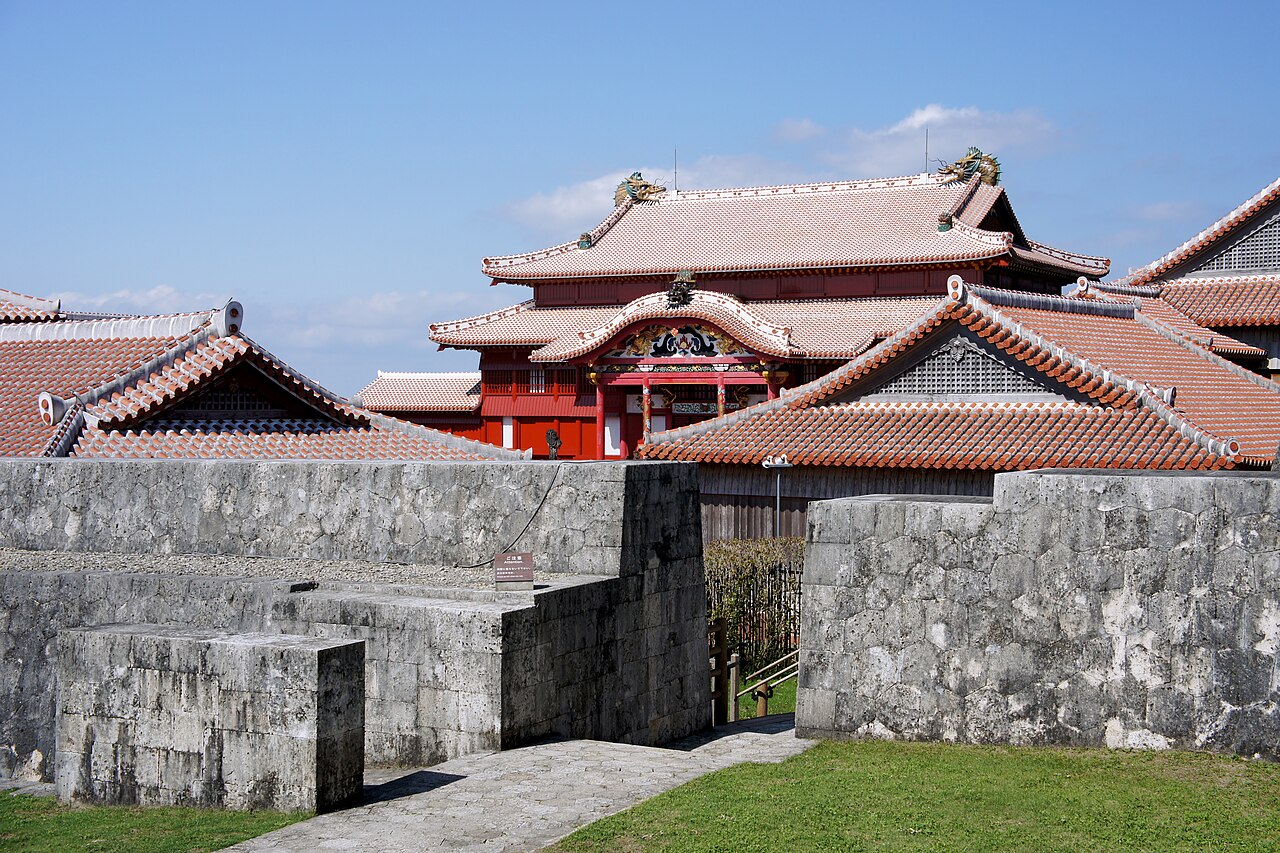
From the 14th through the 16th centuries, the kingdom conducted tribute trade with Ming China, and lacquered goods were made specifically as diplomatic gifts — for the Chinese court, for Satsuma, and for the Shogunate. This is an unusual origin for a household craft. Most Japanese regional crafts begin as local utility and acquire prestige later; Ryukyu lacquer began at the top, as state-level gift-giving, and worked its way down.
The court did not leave this to chance. It ran a dedicated bureau, the Kaizuri Bugyosho, which supervised lacquer and mother-of-pearl production under direct royal control. Quality was a matter of foreign policy.
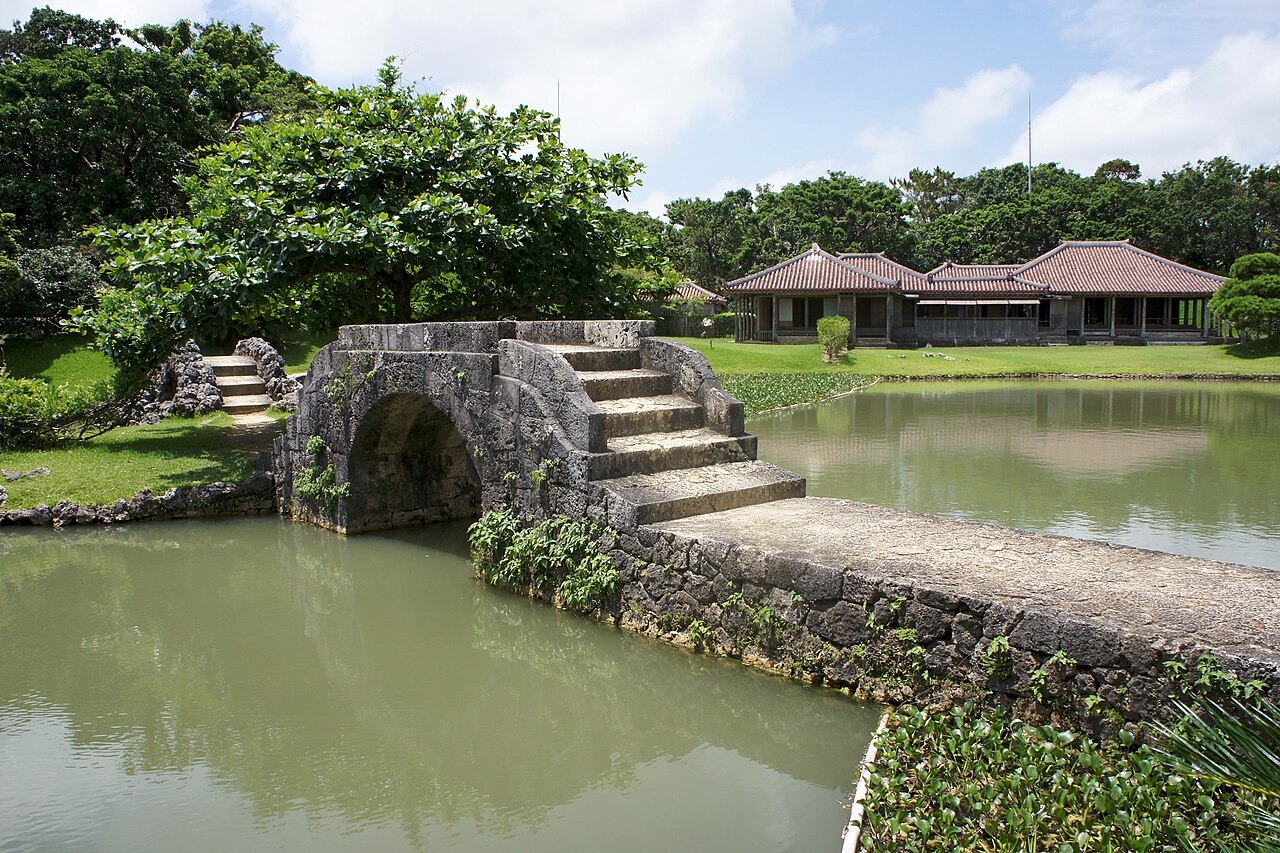
“Ryukyu lacquer was not first made for a household. It was made to be handed to a Ming envoy, and the kingdom staffed a government bureau to make sure it was good enough.”
The material logic of a subtropical island
Two local conditions decided what Ryukyu lacquer would become. The first is climate: urushi does not dry, it cures, and it cures through warmth and humidity. Okinawa’s subtropical weather — the same weather that makes the islands uncomfortable in August — is unusually favorable for hardening lacquer. What is a workshop problem in northern Japan is ambient in Naha.
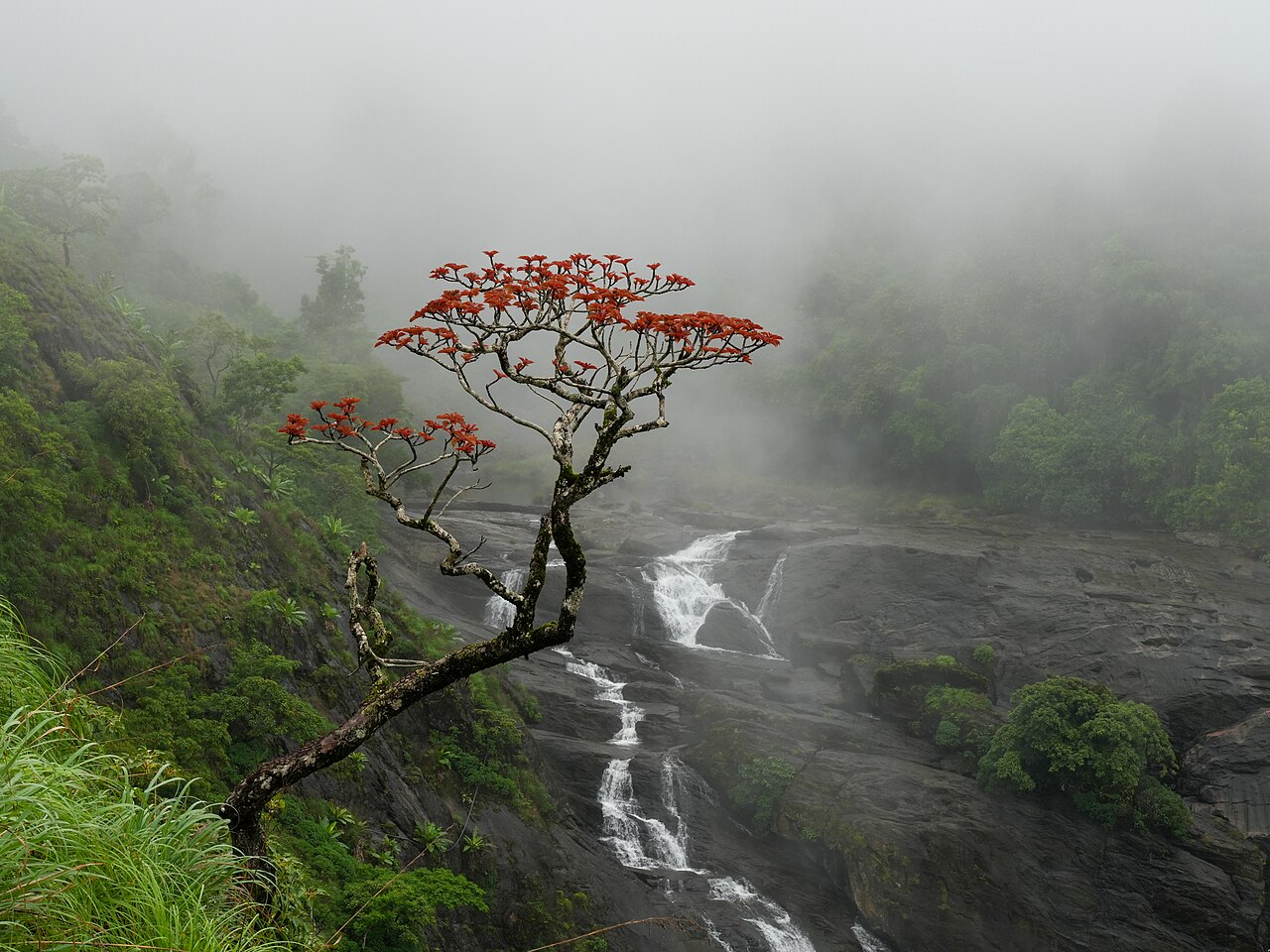
The second is wood. Native deigo, the Indian coral tree, is light, soft, and dimensionally stable, which makes it well suited to turning and to holding a lacquer ground without warping against it. It became the standard core material, and it is also Okinawa’s prefectural flower — the craft and the emblem grew from the same tree.
Tsuikin — the technique that only happened here
Tsuikin was developed around the 18th century, and it is worth being precise about why it is distinct. In tsuishu, the maker builds up many lacquer layers and carves relief out of them — a subtractive process measured in months. In maki-e, the maker draws with metal powder on wet lacquer — an additive process, but a flat one. Tsuikin does neither. Pigment is kneaded into lacquer until it behaves like dough, the dough is rolled into a thin sheet, shapes are cut from it, and those shapes are pressed onto the ground.
The result is relief that was assembled rather than excavated or drawn. It is closer to appliqué than to painting, and it gives Ryukyu work its characteristic soft-edged, slightly raised florals against strong vermilion and black grounds.
1945, and what survived
The continuity story here is harder than most. Most Shuri workshops burned in the 1945 Battle of Okinawa, and their archives burned with them — meaning not only the tools and the buildings but the accumulated pattern records that a decorative tradition depends on.
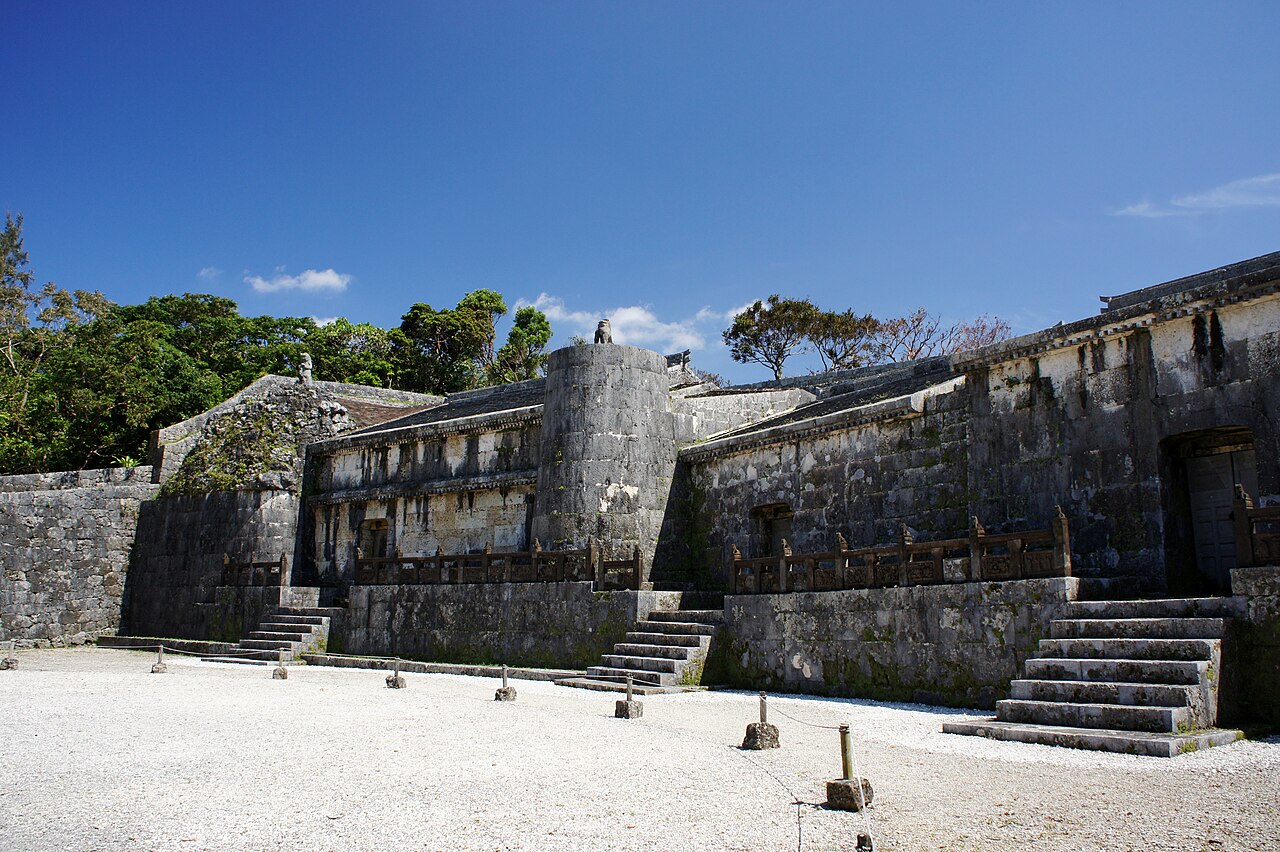
Today’s production therefore comes from a small number of postwar-rebuilt studios. This is the single most practical fact in this article, because it explains the buying experience directly: thin supply outside Japan, intermittent listings, and limited ability to source matching sets. When a Ryukyu tsuikin piece is available internationally, availability is the constraint, not selection.
- 14th century — The Ryukyu Kingdom begins tribute trade with Ming China; lacquered goods enter the gift economy.
- 15th–16th century — Lacquerware is produced as diplomatic gifts for the Chinese court, Satsuma, and the Shogunate.
- Shuri court era — The Kaizuri Bugyosho bureau supervises lacquer and mother-of-pearl production under royal control.
- c. 18th century — Tsuikin is developed — colored lacquer dough pressed into low relief, unique to Okinawa.
- 1945 — The Battle of Okinawa destroys most Shuri workshops and their pattern archives.
- Postwar — A small number of rebuilt studios resume production, becoming the source of all current output.
- 2026 — Supply outside Japan remains thin; international listings appear and disappear.
How the plate is actually used
A kashizara is a tea-adjacent object. It carries wagashi — the small, dense, seasonal confections served with green tea — and its job is to frame one or two pieces, not to hold a portion. At roughly 15–21 cm, this is a plate for a single serving with space around it.
Vermilion is doing specific work in that context. Wagashi tend toward muted, seasonal palettes — white bean paste, pale pink, matcha green — and a strong red ground sets them off in a way a neutral plate does not. The same logic applies to dark chocolate, a use that has nothing to do with tradition and works anyway.
📌 How does it compare?
Other Okinawan crafts, and the mainland lacquer traditions this plate is most usefully measured against.
 🥃 Ryukyu Glass Kara-Kara Sake Server
🎨 Ryukyu Bingata Placemat
🔪 Okinawa Hand-Forged Kitchen Knife
 🍜 Wajima Nuri Lacquer Soup Bowl
 🌸 Kyo Shikki Maki-e Kogo
🪵 Murakami Kibori Tsuishu Coasters
 🐚 Takaoka Aogai Raden Lacquer Box
 🍶 Shiro-Satsuma Sake Cup
📦 Shipping & where to buy from outside Japan
Amazon Japan’s Global Store ships to 65+ countries, including Canada, the UK, and Australia, and estimates import fees at checkout for most destinations — which means the number you approve at checkout is generally the number you pay, with no separate bill from the courier on delivery. We maintain destination-specific guides for Canada, the UK, and Australia.
Expect roughly $15–$40 in international shipping for an item of this size and weight class to the US, EU, Canada, the UK, or Australia, though the exact figure depends on the seller and destination. Lacquerware carries no voltage, battery, or certification restrictions, so it is one of the more straightforward categories to import.
If the specific listing is unavailable when you look — which, given the size of Ryukyu production, is a realistic outcome — proxy services such as Buyee or Tenso can forward from Japanese domestic sellers who do not ship internationally. That path adds a service fee and a domestic leg, and it removes Amazon’s import-fee estimate, so treat it as the fallback rather than the default.
General to urushi lacquerware as a material — the listing did not supply item-specific care instructions, so confirm against whatever the seller includes.
- 🍽️ Dishwasher: no — heat and detergent damage urushi surfaces.
- ♨️ Microwave: no.
- 🧴 Daily care: hand-wash in lukewarm water with a soft cloth, then dry immediately; avoid abrasives and prolonged soaking.
- ☀️ Storage: keep out of direct sunlight and away from dry heat, both of which can dull or craze a lacquer surface over time.
- 🔧 Repairs: lacquer is traditionally re-coatable, but re-coating service for this item is unconfirmed — check with the maker or seller.
Price snapshot across stores
| Store | Item / variant | Price | Notes |
|---|---|---|---|
| 🇺🇸 Amazon.com (US) | Browse Japanese lacquerware plates & serving ware | varies (USD) | Best if you are shopping from the US — Prime shipping, USD pricing, no international customs. Amazon US carries Japanese lacquer trays, bowls, and plates from mainland makers, useful for comparing form and price tiers. The Ryukyu tsuikin piece in this guide ships from Japan (next row). |
| 🇯🇵 Amazon JP Global Store | Ryukyu Shikki tsuikin kashizara, vermilion ground | Not in our snapshot — see listing | Ships internationally from Japan to 65+ countries — including Canada, the UK, and Australia — with import fees estimated at checkout. This is where the specific item covered here is sourced. |
| Maker direct | Studio-direct tsuikin ware | — | Postwar-rebuilt Okinawan studios are few, and international ordering is generally not offered. Verify on the studio’s own site before assuming availability. |
| Proxy services (Buyee / Tenso) | Japanese domestic listings, forwarded | Item price + service fee + forwarding | Widens the pool to domestic-only sellers when the Global Store listing is out of stock. Adds fees and a domestic shipping leg, and customs are handled on arrival rather than estimated at checkout. |
Prices and stock fluctuate; the linked listings are authoritative for current data. Where a JPY price appears on this site, USD figures alongside it are approximate estimates at a ¥150/USD baseline as of mid-2026. For this item, no price was captured in our snapshot, so none is stated here.
What it does well
Weaknesses and things to verify before buying
- No price in our snapshot. We could not capture live pricing, so we cannot tell you whether this represents good value at its current figure. Check the listing before forming an expectation.
- Exact dimensions unconfirmed. The 15–21 cm figure is a range, not a measurement. If the plate has to fit a specific tray, box, or shelf, confirm the diameter on the listing first.
- Core wood unconfirmed for this item. Deigo is the traditional Ryukyu core material, but the snapshot does not state what this particular plate is built on. Do not assume deigo without checking.
- Hand-wash only, permanently. Urushi tolerates neither dishwasher nor microwave. This is a material property, not a manufacturer’s excess of caution, and it does not change with careful use.
- Urushi can provoke skin reactions in sensitive individuals. Fully cured lacquer is generally inert, but sensitivity exists. This is worth knowing before buying as a gift for someone whose reactions you cannot check.
- Supply is genuinely thin. With production concentrated in a small number of postwar studios, listings appear and vanish, and re-ordering a matching second piece later is not something to count on.
- Hand-finished pieces vary. Pressed relief is placed by hand, so motif position and ground tone can differ from the listing photograph in small ways. This is inherent to the technique rather than a defect.
- Returns across borders are costly. International return shipping on a modestly priced item can approach the item’s value. Resolve your questions before ordering rather than after.
Conclusion — which buyer type are you?
Other ways to approach this purchase
🏆 Editor’s Pick
❓ Frequently Asked Questions
What is tsuikin, and how is it different from other Japanese lacquer decoration?
Tsuikin is Okinawa’s signature technique, developed around the 18th century. Colored lacquer is kneaded with pigment into a pliable dough called tsuikin-mochi, rolled thin, cut to shape, and pressed onto the lacquered ground to build a low relief. That makes it different from tsuishu, where relief is carved out of built-up layers, and from maki-e, where metal powder is drawn onto wet lacquer. Tsuikin assembles the pattern; the others excavate or draw it.
Does Amazon Japan ship this outside Japan?
Amazon Japan’s Global Store ships to 65+ countries, including Canada, the UK, and Australia, and estimates import fees at checkout for most destinations. Lacquerware has no voltage, battery, or certification restrictions, so it is a straightforward category to import. Availability for any specific listing should be confirmed at the listing itself.
Can I put a Ryukyu lacquer plate in the dishwasher or microwave?
No to both. Urushi lacquer is damaged by dishwasher heat and detergent, and it is not microwave-safe. Hand-wash in lukewarm water with a soft cloth, dry immediately, avoid abrasives and long soaking, and store away from direct sunlight and dry heat. This is general urushi guidance; item-specific instructions were not in our snapshot, so follow whatever the seller supplies.
Why is Ryukyu lacquerware so hard to find outside Japan?
Most Shuri workshops and their pattern archives burned in the 1945 Battle of Okinawa. Current production comes from a small number of postwar-rebuilt studios, so total output is limited and the share reaching international listings is thinner still. Availability, rather than choice among many options, is usually the constraint.
What is a kashizara actually used for?
A kashizara is a confection plate, traditionally used to serve wagashi alongside green tea. At roughly 15–21 cm it is sized to frame one or two pieces with space around them rather than to hold a full portion. It works equally well for chocolate, small pastries, or fruit.
Why is deigo wood associated with Ryukyu lacquerware?
Deigo, the Indian coral tree and Okinawa’s prefectural flower, produces wood that is light, soft, and dimensionally stable — well suited to serving as a lacquer core without warping. It became the standard Ryukyu core material. Okinawa’s warm, humid climate also happens to be unusually favorable for curing urushi, which hardens through humidity rather than drying.
How much does this plate cost?
Our data snapshot did not capture a current price for this listing, so we do not state one. The linked Amazon Japan Global Store listing is authoritative for both price and availability, and prices on small-studio craft items can shift between restocks.
jpmono.com is a Japan-based curation site, with editorial centers in Toyama (Hokuriku region) and Nara (Kansai region), introducing Japanese household objects to international readers. We focus on items with verifiable craft heritage and clear international shipping paths. We do not physically test every product — we read maker’s specs and source listings — and we do not take payment from the makers we feature; income comes from affiliate links.
This article was prepared with AI assistance and reviewed against the source listing and spec data by a human editor. Factual claims about the craft tradition are drawn from the article’s verified source notes; attributes not present in our data snapshot are marked as unconfirmed rather than estimated.
Affiliate disclosure: jpmono.com may earn a commission on qualifying purchases made through links on this page, at no additional cost to you.