![Nambu Hand-Forged Kurouchi Santoku Knife from Iwate: Where to Buy [2026]](https://jpmono.com/wp-content/uploads/2026/05/japan-map-regions-and-prefectures-800x1050.png)
A Nambu hand-forged kurouchi santoku is the kind of kitchen knife that looks unfinished to a Western eye and is anything but. The blade flanks are left black — the raw scale of the forge fire, called kurouchi (黒打ち, “black-forged”) — and only the cutting edge is ground bright and thin. It comes from Iwate, the far-northern prefecture of Honshu, where iron sand, charcoal, and a forging culture older than the samurai sword have been worked together for more than a thousand years.
What makes the object notable to an international reader is not novelty but lineage. The same Iwate iron economy that produced nambu tekki (南部鉄器, “Nambu ironware”) — the heavy cast kettles and trivets now sold worldwide — also fed a blade tradition that reaches back through the Morioka castle town to the Mokusa-tō (舞草刀) swordsmiths of the Heian period. A kurouchi santoku is the everyday-kitchen descendant of that line: carbon steel, hammered, and finished by hand rather than stamped by machine.
This guide is written for the international buyer deciding whether a Nambu kurouchi santoku belongs in the kitchen. It explains the dark forged finish, how a carbon-steel core behaves compared with stainless knives, who the knife suits, where it sits against polished Echizen and mass-production Seki blades, and the practicalities of obtaining one abroad.
📅 Published:
🔄 Updated:
⏱️ Read time: ~12 min
- Who this is for — and who should skip it
- Product overview (from published specs)
- Where this comes from — place, era, and the craft tradition
- 📦 Shipping & where to buy from outside Japan
- Buying considerations
- What it does well
- Weaknesses and things to verify before buying
- Conclusion — which buyer type are you?
- Other ways to approach this purchase
- ❓ Frequently Asked Questions
Who this is for — and who should skip it
- Want one all-purpose knife for vegetables, boneless meat, and fish — the santoku format
- Appreciate a hand-forged, visibly handmade object and the look of the rustic black kurouchi finish
- Are willing to hand-wash and dry a carbon-steel blade after every use
- Already own or will buy a Japanese whetstone and want a knife you can keep sharp yourself
- Value Iwate / Tohoku forging heritage and want a piece tied to a documented regional tradition
- Want a maintenance-free knife you can leave wet or put in the dishwasher
- Expect a mirror-polished, uniform blade — kurouchi is deliberately matte and irregular
- Cut frozen food, bones, or hard shell (thin high-carbon edges chip against hard objects)
- Prefer a left/right-neutral factory knife and have no interest in periodic sharpening
Product overview (from published specs)
Published data on Iwate / Nambu hand-forged kurouchi santoku knives varies by maker. Based on the regional craft tradition, these are typically carbon-steel blades with a rustic black forge-finish, ground thin at the edge. Exact steel grade, dimensions, and weight should be confirmed at the retailer. The table below marks what is known versus unconfirmed rather than guessing.
| Attribute | This knife | Source |
|---|---|---|
| Type | Santoku (三徳) — all-purpose Japanese kitchen knife | General product information |
| Blade construction | Hand-forged carbon-steel core, hand-ground edge | Spec hint |
| Finish | Kurouchi (黒打ち) — rustic black forge scale on the flanks | Spec hint |
| Origin | Iwate Prefecture, Tōhoku, Japan | Spec |
| Exact steel grade | Varies by maker | Not in data |
| Blade length / weight | Varies by maker | Not in data |
Steel grade, length, and weight vary by maker and production run. Compare the specifications available for the knife you are considering before choosing.
📖 Glossary — key terms
- Kurouchi (黒打ち, “black-forged”) — the dark iron-oxide scale left on the blade flanks straight from the forge. It is the steel’s own surface, not a paint or coating, and only the edge is ground bright.
- Santoku (三徳, “three virtues”) — the all-purpose Japanese home knife, named for handling meat, fish, and vegetables. A flatter belly and shorter blade than a Western chef’s knife.
- Nambu (南部) — the historical domain and clan name of the Morioka region in Iwate; also the prefix for nambu tekki, the local cast ironware.
- Mokusa-tō (舞草刀) — early curved swords forged by smiths in present-day Ichinoseki, Iwate, from the Heian period; counted among the proto-lineages of the Japanese sword.
- Hagane (鋼) — high-carbon steel. It takes and holds a keener edge than stainless but will rust without drying and care.
- Tōhoku (東北) — the northeastern region of Honshu, comprising Iwate and five neighboring prefectures.
Related guides on jpmono.com — same region, same craft family, or a direct head-to-head on blade style.
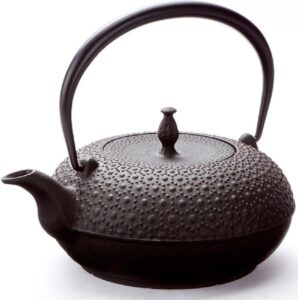
Nambu iron, same Iwate forge heritage
Oigen Nambu tetsubin iron kettle →
Another Iwate handcraft
Iwate homespun wool scarf →
Compare: polished Echizen santoku
Echizen uchihamono santoku knife →
Hand-forged Hokuriku blade
Kaga hamono hand-forged nakiri →
Northern Japan forged blade
Ainu makiri knife (Hokkaido) →
Tohoku woodcraft (Akita)
Kabazaiku cherry-bark tea caddy →
Tohoku textile (Aomori)
Hirosaki kogin-sashi coaster set →
Where this comes from — place, era, and the craft tradition

Iwate is the second-largest prefecture in Japan and one of its oldest iron lands. It sits at the top of the Tōhoku region — the northeastern arm of Honshu — with the Kitakami river plain running down its center and the volcanic mass of Mount Iwate (岩手山, 2,038 m) overlooking the prefectural capital, Morioka. The combination that mattered for metalwork was local: iron-bearing sand washed from the volcanic geology, hardwood forests for charcoal, and rivers to move both. Those three inputs are why both a casting tradition and a forging tradition took root here rather than being imported.

The region’s historical weight comes from Hiraizumi, in the south of the prefecture. In the 12th century the Northern Fujiwara clan built a golden Buddhist capital there; the Konjikidō (金色堂, “golden hall”) of Chūson-ji was completed in 1124, its interior sheathed in gold leaf and inlaid lacquer. That wealth concentrated artisans — metalworkers, lacquerers, gilders — in the north well before Edo-period domain patronage did. Hiraizumi’s temples and gardens were inscribed as a UNESCO World Heritage Site in 2011. It is the visible proof that northern Honshu was never a cultural backwater.
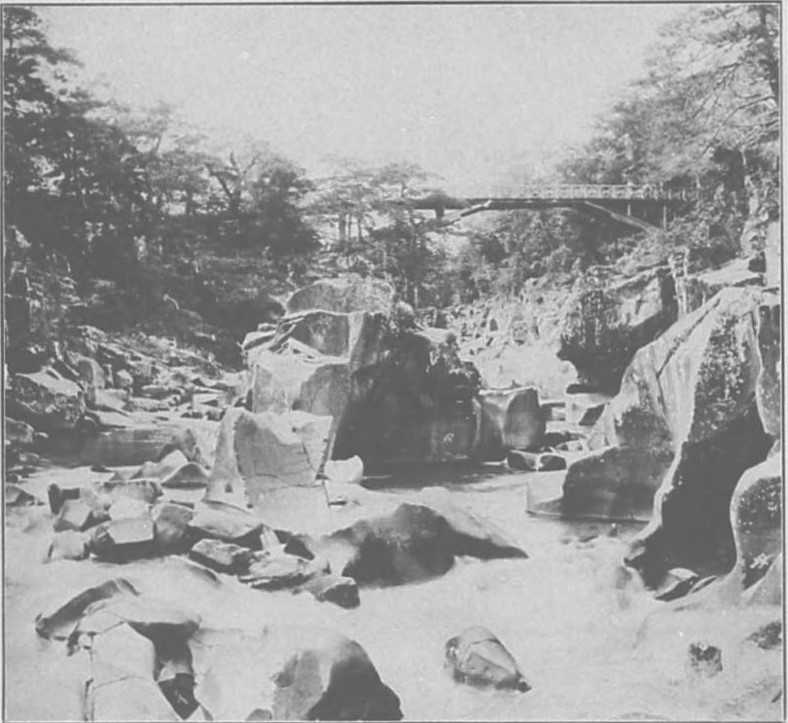
The blade lineage is older still. Around Ichinoseki, in present-day southern Iwate, smiths known as the Mokusa-tō (舞草刀) forged curved blades from the Heian period onward — work counted among the proto-lineages of the curved Japanese sword itself. These were frontier smiths at the northern edge of the early imperial state, and their craft predates the famous sword centers of the south. A modern kurouchi kitchen knife is not those swords, but it descends from the same regional knowledge of how to coax a hard edge from local iron and charcoal.
- 802 — Isawa Castle established on the northern frontier, anchoring the imperial state in present-day Iwate.
- Heian period — Mokusa-tō swordsmiths forge curved blades around Ichinoseki, a proto-lineage of the Japanese sword.
- 1124 — Konjikidō of Chūson-ji completed at Hiraizumi under the Northern Fujiwara.
- Edo period — The Morioka (Nambu) domain develops an iron-sand economy, seeding Nambu cast ironware.
- 1975 — Nambu ironware designated a Traditional Craft by Japan’s Ministry of Economy, Trade and Industry (METI).
- 2011 — Hiraizumi inscribed as a UNESCO World Heritage Site.
- Today — Iwate and Tōhoku smiths carry the forge tradition into kurouchi carbon-steel kitchen knives.
Under the Morioka domain — the Nambu clan’s seat — that same iron-sand-and-charcoal economy produced the cast ironware the region is now best known for. Nambu cast iron and forged blade work are two branches of one industrial tree: one poured into molds, the other hammered on the anvil. Nambu ironware received METI Traditional Craft designation in 1975, and the casting workshops around Morioka and Mizusawa remain active. The forging side is smaller and less codified, but it is the same metallurgical culture applied to an edge instead of a kettle.
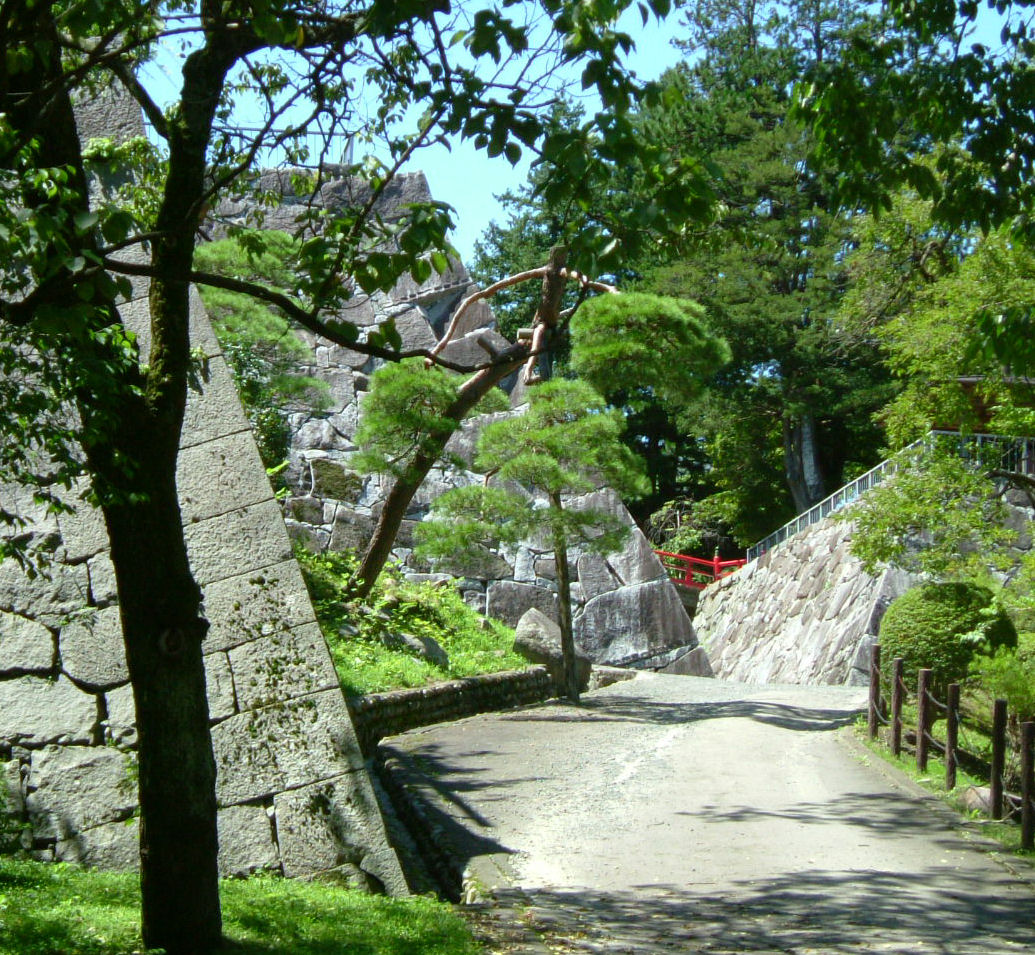
“The black on the blade is not decoration added later — it is the forge fire’s own mark, left on the steel and ground away only where it has to cut.”
What “still being made here” means, in practice, is that the kurouchi finish is a record of process rather than a style applied for looks. A smith heats the carbon-steel blank, hammers it to shape, and leaves the dark oxide scale on the flanks; only the edge is taken to a stone and ground thin and bright. The result reads as rough to anyone expecting a polished German knife, and that roughness is the point — it is the most honest possible surface a forged blade can have. The volcanic landscape that supplied the iron sand and charcoal is still the backdrop to the work.

📦 Shipping & where to buy from outside Japan
An Iwate / Nambu hand-forged kurouchi santoku is commonly distributed through the Amazon JP Global Store, which serves the US, EU, UK, Australia, Canada, and most major overseas destinations. A kitchen knife of this size is light; international forwarding typically runs $15–$40 to the US and EU, more to other regions. Kitchen knives are unrestricted personal imports in nearly all jurisdictions — some countries regulate carry or set an 18+ purchase age, but importing one for home use is permitted in the great majority of cases. Declare it as “hand-forged kitchen knife, Japan.”
Alternative paths if the Global Store is not available to you: a proxy/forwarding service such as Buyee or Tenso can receive a domestic Japanese order and forward it internationally, and some Iwate / Tōhoku makers sell direct from their own sites. Prices in USD throughout this article are approximate and depend on the current exchange rate (¥150/USD baseline as of mid-2026); the JPY figure is always the authoritative one.
Buying considerations
| Store | Item / variant | Price (JPY / USD est.) | Notes |
|---|---|---|---|
| 🇺🇸 Amazon.com (US) | Browse Japanese kitchen knives | varies (USD) | Best if you are shopping from the US — Prime shipping, USD pricing, no international customs. Amazon US carries hand-forged Japanese kurouchi and santoku knives from a range of makers, useful for comparing geometry and steel types. The exact Nambu piece is sourced from Japan (next row). |
| 🇯🇵 Amazon JP Global Store | Nambu kurouchi santoku | — | International shipping option from Japan; confirm destination coverage and fees before ordering. |
| Maker direct | Same or similar kurouchi santoku | Varies | Some Iwate / Tōhoku smiths sell from their own sites. Often domestic-shipping only — pair with a proxy. |
| Proxy services (Buyee / Tenso) | Forwarded domestic order | Item + service fee + freight | Forwarding for Japan-only shops |
What it does well
Weaknesses and things to verify before buying
- Carbon steel rusts. A high-carbon blade left wet or stored damp will spot and stain. It needs hand-washing, immediate drying, and ideally a thin film of food-safe oil for long storage. This is the single biggest reason to pass if you want low maintenance.
- The kurouchi finish is rough by design. If you expect a uniform, mirror-polished blade, the matte black flanks and visible hammer marks may read as “unfinished.” That is the intended look, not a defect.
- Thin high-carbon edges chip. Do not cut frozen food, bones, hard squash rinds, or shellfish shell. The same thinness that makes it cut beautifully makes it vulnerable against hard objects.
- Specifications vary. Handle material and steel grade may differ; choose a knife whose specifications suit your use. A single-bevel blade is sharpened differently and is handed (right/left).
- No dishwasher, ever. Detergent and heat will corrode the carbon core and can loosen a wooden handle. Hand-wash only.
- It will need sharpening. Plan on a Japanese whetstone (1000 / 6000 grit is the common home pairing). If you will not maintain an edge, a factory stainless knife is the more honest choice.
Conclusion — which buyer type are you?
Other ways to approach this purchase
❓ Frequently Asked Questions
Does this knife ship internationally from Japan?
Yes. Iwate / Nambu hand-forged kurouchi santoku knives are commonly distributed through the Amazon JP Global Store, which serves the US, EU, UK, Australia, Canada, and most major overseas destinations. A knife of this size typically costs $15–$40 to forward. Kitchen knives are unrestricted personal imports in nearly all jurisdictions.
Is the black kurouchi finish a coating that wears off?
No. Kurouchi (黒打ち) is the iron-oxide scale left on the blade straight from the forge — it is the steel’s own surface, not paint. The flanks stay dark; only the ground edge is bright. It may lighten slightly with years of washing but it is not a coating that flakes away.
Carbon steel — will it rust?
It can if neglected. High-carbon (hagane) steel will spot if left wet or stored damp. Hand-wash, dry immediately, and wipe a thin film of food-safe oil on the blade before long storage. With that routine it stays sound and develops a stable patina; it is not maintenance-free.
Is a santoku a good first Japanese knife?
For most home kitchens, yes. The santoku handles vegetables, boneless meat, and fish with one blade, and its shorter, flatter profile is forgiving for cooks used to a Western chef’s knife. The carbon-steel core here adds upkeep, so it suits someone ready to hand-wash and sharpen rather than an absolute first-timer who wants zero care.
How do I sharpen and care for it?
Use a Japanese whetstone — a 1000 / 6000 grit pairing is the common home setup, the 1000 for routine edges and the 6000 for finishing. Avoid pull-through steel sharpeners. Never put a carbon-steel blade in the dishwasher, do not cut frozen food or bones, and dry it after every wash. Bevels vary: single-bevel sharpening differs from double-bevel, so choose a technique that matches the knife.
How does Iwate / Nambu blade work differ from Echizen or Seki knives?
Echizen (Fukui) is known for highly polished, often Damascus-clad hand-forged knives; Seki (Gifu) is the large-volume town producing mass-market stainless blades. The Iwate / Nambu kurouchi tradition sits closer to the rustic, forge-finished end — carbon steel left black, tied to the same iron economy as Nambu cast ironware. See the cross-links for direct comparisons.
Can it go in the dishwasher?
No. Detergent and heat corrode the carbon-steel core and can loosen or crack a wooden handle. Hand-wash with mild soap, rinse, and dry immediately. This is non-negotiable for any carbon-steel kurouchi blade.
jpmono.com is curated by a Japan-based editorial team (working out of Toyama in the Hokuriku region and Nara in Kansai) and is independent. We do not take payment from the makers we feature; income comes from editorial work. We do not physically test every product — we read maker specifications and craft sources. Read more about our editorial standards.
This article was prepared with AI assistance and reviewed against craft references. Specifications and prices can vary by maker and over time.
Affiliate disclosure: jpmono.com may earn a commission on qualifying purchases made through links on this page, at no additional cost to you.