![Nara Shikki Raden Kogo: Where to Buy Mother-of-Pearl Lacquer Incense Boxes [2026]](https://jpmono.com/wp-content/uploads/2026/05/japan-map-regions-and-prefectures-800x1050.png)
Nara Shikki (奈良漆器, “Nara lacquerware”) is the urushi-lacquer craft of Japan’s first permanent capital, and its defining signature is raden (螺鈿, “shell inlay”) — thin slivers of iridescent mother-of-pearl set into black or vermilion lacquer so that the surface shifts color as the light moves across it. A kogo (香合, “incense container”) is the small lidded box that holds kneaded or chip incense in tea practice and temple ritual. Made in Nara Shikki, it becomes a palm-sized object where an eighth-century court technique survives in a form you can actually keep on a shelf.
What makes this notable to an international reader is the lineage, not the marketing. The mother-of-pearl tradition in Nara descends directly from the Tang-influenced treasures stored in the Shosoin (正倉院) repository at Todai-ji, assembled in the 700s under Emperor Shomu. Nara was the seat of the Nanto (南都, “southern capital”) temples — Todai-ji, Kofuku-ji, Kasuga Taisha — and that concentration of Buddhist ritual created continuous demand for refined incense and lacquer utensils long after the political capital moved north. Production today is small-scale and studio-based, closer to collector-grade work than to mass goods.
This guide helps readers understand the Nara Shikki raden kogo, how to judge inlay quality, and what to look for when buying one from outside Japan. It explains terms used for the craft and compares general ways of sourcing Japanese lacquerware.
🔄 Updated: June 17, 2026
⏱️ Read time: ~10 min
- Who this is for — and who should skip it
- Product overview (from published specs)
- Where this comes from — place, era, and the craft tradition
- Where to buy
- What it does well
- Weaknesses and things to verify before buying
- Conclusion — which buyer type are you?
- Other ways to approach this purchase
- ❓ Frequently Asked Questions
Who this is for — and who should skip it
- Practice tea ceremony (sado) and want a kogo with genuine regional provenance
- Collect urushi lacquer and value hand-cut shell inlay over printed decoration
- Want a small, giftable object that carries the Shosoin / Nara lineage
- Are comfortable buying a studio-made craft item where each piece varies slightly
- Prefer an heirloom-grade object you keep for decades, not a disposable one
- Want a cheap, mass-produced incense box — this is collector-grade work
- Need guaranteed same-day stock; studio production runs are small and irregular
- Expect machine-perfect uniformity across the inlay pattern
- Will not hand-wash and keep it away from heat, alcohol, and direct sun
- Are price-sensitive and would resent paying a craft premium over function
Product overview (from published specs)
| Attribute | Detail (maker materials) |
|---|---|
| Craft | Nara Shikki (Nara lacquerware), raden mother-of-pearl inlay |
| Form | Kogo — small lidded incense container |
| Core material | Urushi (natural lacquer) over a wood or formed base, with hand-cut shell inlay |
| Decoration | Raden (mother-of-pearl) set into black urushi; vermilion grounds also traditional |
| Origin | Nara, Nara Prefecture, Kansai region |
| Intended use | Holding kneaded (nerikoh) or chip incense for tea ceremony and temple ritual; also display |
| Dimensions / weight | Not specified |
| Price | Not specified |
📖 Glossary — key terms in this guide
- urushi (漆) — natural lacquer tapped from the urushi tree, built up in thin cured layers; the base of all Japanese lacquerware.
- raden (螺鈿) — “shell inlay”; thin slices of iridescent mother-of-pearl (often from turbo or abalone shell) cut and set into the lacquer surface.
- kogo (香合) — a small lidded container for incense, used in the tea ceremony and Buddhist ritual.
- nerikoh (練香) — kneaded incense, the soft pellet form often stored in a kogo for warmer-season tea practice.
- Shosoin (正倉院) — the 8th-century imperial repository at Todai-ji holding treasures of Emperor Shomu, including early raden objects.
- Nanto (南都) — “southern capital,” the historical name for Nara’s great temple complex (Todai-ji, Kofuku-ji, Kasuga Taisha).
- makie (蒔絵) — a related lacquer technique using sprinkled gold/silver powder; distinct from raden’s shell inlay.
Where this comes from — place, era, and the craft tradition

Nara sits in the southern part of the Nara basin, an inland plain ringed by low mountains in the Kansai region. It is a short train ride south of Kyoto and well west of Tokyo. The city’s importance is not industrial geography but political and religious history: in 710 the imperial court established its first permanent capital here, called Heijo-kyo, and for most of the eighth century Nara was the center of the Japanese state.
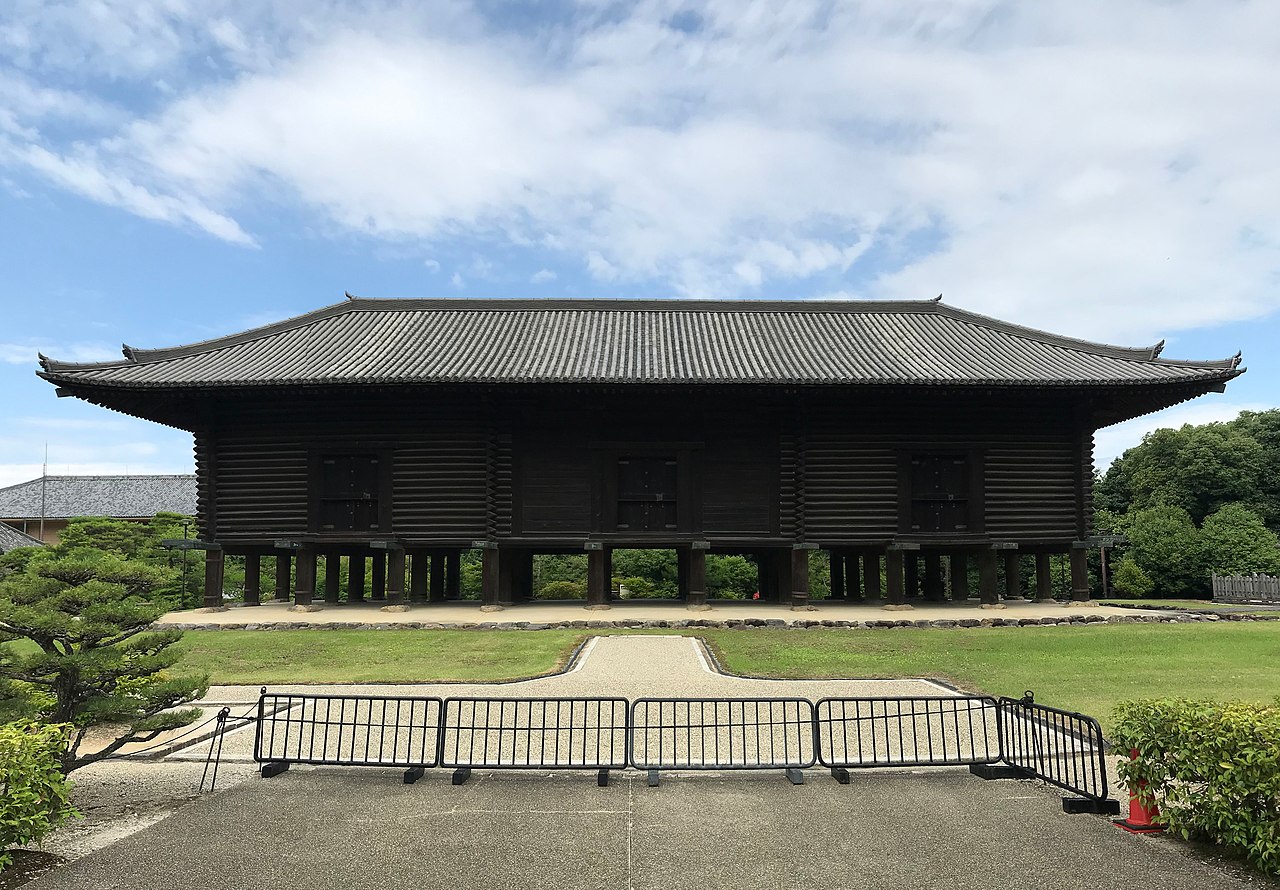
That period — the Nara period (710–794) — is when the court first concentrated bronze-casters, paper-makers, and lacquer artisans into permanent workshops, and when continental techniques arriving along the Silk Road were absorbed into Japanese craft. The single most important survival is the Shosoin repository at Todai-ji, which still holds eighth-century objects assembled under Emperor Shomu, including pieces decorated with mother-of-pearl inlay. Those objects are the direct ancestor of today’s Nara Shikki raden technique.
- 710 — Heijo-kyo established at Nara as Japan’s first permanent capital.
- 752 — The Great Buddha of Todai-ji is consecrated under Emperor Shomu.
- 756 — Imperial treasures, including raden-inlaid objects, enter the Shosoin repository.
- 794 — The capital moves to Heian-kyo (Kyoto); Nara’s Nanto temples keep ritual-craft demand alive.
- 12th c. — Todai-ji and Kofuku-ji are rebuilt after war; demand for incense and lacquer utensils continues.
- Edo period — Nara lacquer studios formalize raden kogo and tea utensils for the tea ceremony.
- 2026 — Small Nara studios continue hand-cutting shell inlay by hand for collector-grade pieces.
The political center moved to Kyoto in 794, but Nara did not empty of craft. The Nanto temples — Todai-ji, Kofuku-ji, and Kasuga Taisha — remained major institutions with a steady appetite for Buddhist ritual objects, including incense utensils. That continuity is the reason refined inlay work persisted in the old capital for more than a thousand years.

The kogo earns its place in this lineage because it is a ritual object first. In tea practice, kneaded incense is warmed in the brazier in the colder months and chip incense is used in summer; the kogo is the vessel that presents it. A small lidded box is also an ideal canvas for raden — the lid catches the light, and even a few millimeters of shell inlay read clearly at arm’s length.
“The mother-of-pearl on a Nara kogo is not decoration borrowed from history — it is the same technique that entered the Shosoin in the 700s, scaled down to the size of your palm.”
What “still made here” means in practice is modest and worth stating plainly: production is small-scale and studio-based, and the work is prized as collector-grade rather than as mass goods. Output is irregular, individual pieces vary, and the hand-cutting of shell is slow. That is the trade-off behind the price — and the reason it is closer to a small heirloom than to a commodity incense box.
Related lacquer, ceramic, and woodwork guides on jpmono — useful for placing this kogo against neighboring crafts and price tiers.
Where to buy
Prices for individual Nara shikki raden kogo pieces vary with the lacquerwork and inlay. Consider the object as a tea or display container and compare its craftsmanship before purchasing.
| Store | Item / Variant | Price (JPY + USD est.) | Notes |
|---|---|---|---|
| 🇺🇸 Amazon US (search) | Browse Japanese lacquerware & incense containers | varies (USD) | Best if you’re shopping from the US — Prime shipping, USD pricing, no international customs. Amazon US carries Japanese lacquer boxes and incense goods from various makers, useful for comparing styles and price tiers. This exact Nara Shikki piece is sourced from Japan (next row). |
| 🇯🇵 Amazon JP Global Store | Nara Shikki raden kogo | Check seller details | Ships internationally from Japan to most major destinations via the Global Store. |
| Maker direct | Studio / gallery pieces, made to order | Varies by piece | Nara Shikki is studio-based; maker and gallery sites may list one-off pieces. Often Japan-only checkout — a proxy may be needed. |
| Proxy services (Buyee / Tenso) | Any Japan-only order forwarded abroad | Item price + forwarding fee | Use when a piece is listed only on a Japan-domestic shop. Adds a service fee and a second shipping leg; factor in customs. |
The cost of Nara shikki raden kogo varies with the amount of lacquerwork and shell inlay; treat any figure as a guide rather than a fixed standard.
What it does well
Raden is real mother-of-pearl set into lacquer, not a printed pattern — the surface shifts color as the light moves, which a photo never fully captures.
The technique traces to the Shosoin treasures of 8th-century Nara — a provenance that is historical fact, not heritage marketing.
A kogo is small, light, and self-contained — a natural gift or keepsake that carries real cultural weight without taking up shelf space.
It is a working tea utensil for holding kneaded or chip incense, not only a display object — usable if you practice sado.
Weaknesses and things to verify before buying
- Seller details vary. Confirm the container’s intended use and care requirements before buying.
- Each piece varies. Studio work means the inlay layout, shell color, and exact finish differ from unit to unit; the photo is representative, not a guarantee of the piece you receive.
- Care is non-trivial. Urushi dislikes prolonged direct sunlight, heat, alcohol, and dishwashers. It should be wiped gently and hand-handled; this is not a wipe-and-forget object.
- Authenticity ambiguity online. “Raden-style” and printed shell patterns exist. Look for genuine shell inlay and Nara Shikki origin rather than a lookalike print.
- Small production runs can mean limited availability, and maker-direct pieces may be made to order with a wait.
- International shipping and customs. Via the Amazon JP Global Store the item ships abroad, but customs duties may apply over your local threshold; budget for that on top of the listed price.
Conclusion — which buyer type are you?
You value hand-cut shell inlay and documented Nara lineage. Buy the genuine raden kogo and consider maker-direct for a one-off piece.
You want one good, authentic kogo for tea or display. Look for clear information about genuine raden inlay and Nara Shikki origin.
If the craft premium is too steep, browse simpler lacquer or ceramic incense containers on Amazon US first to set your baseline.
If you want a low-maintenance, machine-uniform box and do not care about provenance, this is not the right object for you.
Other ways to approach this purchase
Craft items rarely discount deeply, but Global Store prices move with the exchange rate. A favorable yen swing can matter more than any coupon.
Older raden kogo appear in Japanese antique and tea-utensil markets; a proxy service can forward them. Inspect inlay condition carefully.
If you buy through Amazon, stacking card or member rewards can offset international shipping. Confirm the Global Store delivers to your country first.
If the dimensions and price are not clearly stated, wait rather than buying blind.
❓ Frequently Asked Questions
What exactly is a kogo, and do I need to practice tea ceremony to use one?
A kogo is a small lidded container for incense, traditionally used in the tea ceremony and Buddhist ritual to hold kneaded or chip incense. You don’t need to practice tea to own one — many buyers keep it as a display object or a place for a single incense pellet — but it is a genuine tea utensil if you do.
Is the mother-of-pearl real shell or a printed pattern?
Genuine raden is real shell — thin slivers of mother-of-pearl cut and inlaid into the lacquer, which is why it shifts color in the light. Printed raden-style imitations exist, so look for clear confirmation of genuine shell inlay and Nara Shikki origin.
Can I have it shipped outside Japan?
Yes. Nara shikki raden kogo pieces can require international shipping from Japan; customs duties may apply over your local threshold, and Japan-only sellers may require a proxy service.
How do I care for urushi lacquer with shell inlay?
Wipe it gently with a soft, dry or barely damp cloth. Keep it away from prolonged direct sunlight, heat, alcohol, and dishwashers, all of which can damage urushi over time. Handled this way, a good piece lasts for decades.
Why is the price not shown clearly in this guide?
Prices for Nara shikki raden kogo pieces vary with their lacquer and inlay work, so compare craftsmanship rather than assuming a single standard.
How is this different from a maki-e lacquer box?
Maki-e decorates the surface with sprinkled gold or silver powder, while raden inlays slices of iridescent shell. They are distinct techniques and often appear together; this kogo’s signature is the shell-inlay raden tradition of Nara.
jpmono.com is curated by a Japan-based editorial team working out of Toyama in the Hokuriku region and Nara in Kansai, and is independent. We do not take payment from the makers we feature; income comes from affiliate links. We do not physically test every product.
Affiliate disclosure: jpmono.com may earn a commission on qualifying purchases made through links on this page, at no additional cost to you.