![Okuaizu Yamabudo Basket Bag: Fukushima Wild Grapevine Craft [2026]](https://jpmono.com/wp-content/uploads/2026/06/okuaizu-yamabudo-basket-bag-where-to-buy-2026-featured.jpg)
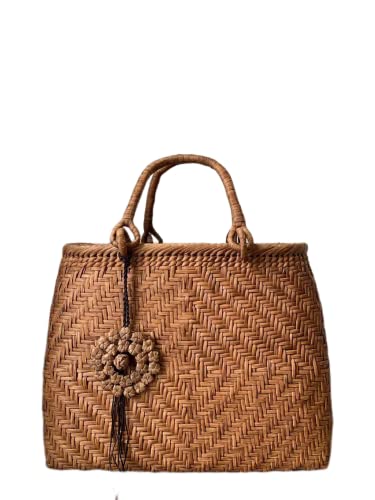
In the deep mountain interior of Fukushima, where the Tadami River cuts through one of Japan’s heaviest snowfall zones, farmland disappears under meters of snow for months at a time. For centuries the villages here answered the long winters with their hands — stripping bark from wild grapevine and braiding it into baskets strong enough to outlive the people who made them. A yamabudo (山葡萄, “wild grapevine”) basket bag from Okuaizu is one of the most durable everyday objects in the Japanese craft canon, and one of the slowest to make.
The piece in this guide is a hand-woven tote in the Okuaizu amikumizaiku (奥会津編み組細工, “Okuaizu braided basketry”) tradition centered on Mishima town (三島町). The cluster was recognized as a National Traditional Craft of Japan in 2003. Bark can only be harvested in a brief window in early summer, and never from the same vine for several years, so supply is genuinely constrained — these bags are bought to be used for decades, and the surface darkens to a glossy amber the longer it is carried.
This article is written for international readers weighing a yamabudo bag as a long-term purchase rather than a souvenir. We cover what the craft actually is, where it sits in Japan, how to read the listing honestly given limited published data, what to verify before buying, and how to buy it from outside Japan. Where the data is thin, we say so plainly rather than guessing.
🔄 Updated:
⏱️ Read time: ~10 min
- Who this is for — and who should skip it
- Product overview (from published specs)
- 📍 Where this comes from — place, era, and the craft tradition
- Price snapshot across stores
- 📦 Shipping & where to buy from outside Japan
- What it does well
- Weaknesses and things to verify before buying
- Conclusion — which buyer type are you?
- Other ways to approach this purchase
- 🏆 Editor’s Pick
- ❓ Frequently Asked Questions
Who this is for — and who should skip it
- Want a single bag you will use and repair for decades, not a seasonal accessory
- Value visible hand-work and are comfortable with natural irregularity
- Like objects that improve with age — the bark deepens to amber with use
- Appreciate a documented craft lineage (nationally designated since 2003)
- Are willing to wait, since bark harvest and weaving are slow and supply is limited
- Want a low-cost, disposable, or trend-driven bag
- Need it waterproof or worry-free in heavy rain (natural bark is not)
- Expect machine-perfect symmetry and uniform color
- Need it shipped instantly — making and stock are constrained
- Are unwilling to do light seasonal care to keep the bark healthy
Product overview (from published specs)
Published specification data for this specific listing is limited at the time of writing. The values below are drawn from the spec sheet and the craft category; figures that are not confirmed in the available data are marked rather than guessed. Always verify the current listing before purchasing.
Okuaizu Yamabudo Basket Bag
山葡萄籠バッグ 手作り 山葡萄かごバッグ 【細ひご・菱形模様】内布あり チャーム付き 幅約31cm×縦約24cm×マチ約12cm【星凌商店】
在庫あり。 · Sold by 星凌商店 · ASIN B0B59HVK6B
Price and availability as of 2026-08-31 02:30 JST. The Amazon listing at the time of purchase is authoritative. jpmono.com earns a commission on qualifying purchases at no extra cost to you.
| Attribute | Detail (per available data) |
|---|---|
| Craft | Okuaizu amikumizaiku (奥会津編み組細工) — hand braided basketry |
| Material | Yamabudo (wild grapevine) bark; leather-trimmed handles |
| Form | Tote / basket bag, hand-woven |
| Origin | Mishima town, Okuaizu, Fukushima Prefecture, Tōhoku |
| Designation | National Traditional Craft of Japan (designated 2003) |
| Dimensions / weight | Unconfirmed — check listing |
| Item ID (ASIN) | B0B59HVK6B |
| Price | Unconfirmed — verify on the current listing (see note below) |
Data note: the fetched dataset for this item returned no live pricing or listing snapshot. Only the Amazon JP Global Store listing is the sourced path for the specific item; live pricing and stock may have shifted since the writing date. We have not invented any price, dimension, or spec not present in the data.
Sources for this overview: Amazon US search (primary, tag moonill-20) for comparable Japanese basketry; Amazon JP Global Store (secondary, tag moonill-22) as the sourced listing for this specific item; maker-direct and proxy services where relevant.
📖 Glossary — key terms
- Yamabudo (山葡萄) — wild grapevine; its inner bark is stripped, dried, and woven. Prized for strength and the amber sheen it develops with use.
- Amikumizaiku (編み組細工) — “braided / plaited work,” the umbrella term for the woven basketry of the Okuaizu district.
- Okuaizu (奥会津) — the “deep Aizu” mountain interior of western Fukushima, along the Tadami River.
- Mishima (三島町) — the town at the center of the designated craft, in Okuaizu.
- Hiroro — a mountain sedge, and matatabi (silver vine) — the two other local plants traditionally woven alongside yamabudo.
- Seikatsu kōgei undō (生活工芸運動) — the postwar “life-craft movement” Mishima built from the 1970s to keep the handwork alive.
📍 Where this comes from — place, era, and the craft tradition

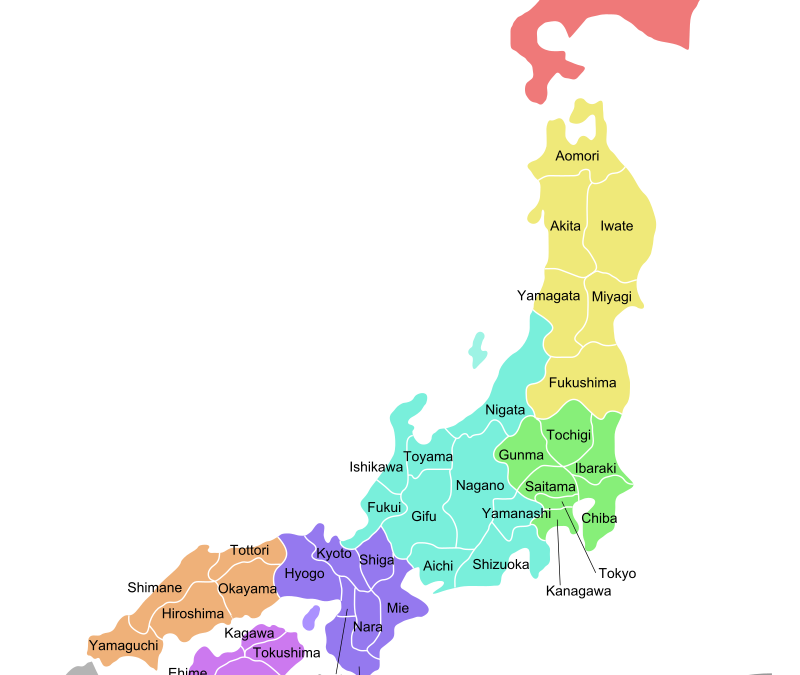
Okuaizu is the deep interior of the Aizu region in western Fukushima Prefecture, in the Tōhoku region of northern Honshū. The land folds into steep, forested mountains threaded by the Tadami River, and the town of Mishima sits among them. In absolute terms it is about 250 km north of Tokyo; in human terms it is a place defined by snow. This is one of the heaviest snowfall zones in all of Japan, and for much of the year the farmland is buried.

That climate is the whole story of the craft. With outdoor farm work impossible for months, households turned the winters into braiding work, weaving baskets and bags from the plants the mountains provided: yamabudo (wild grapevine) bark, hiroro (a mountain sedge), and matatabi (silver vine). The materials were close at hand, the labor filled the idle season, and the results were tools the household actually needed. The techniques are traditionally believed to reach back centuries, with roots some trace as far as Jōmon-era basketry — a folk-traditional claim rather than a proven one, but it speaks to how deeply woven the practice is into the region.
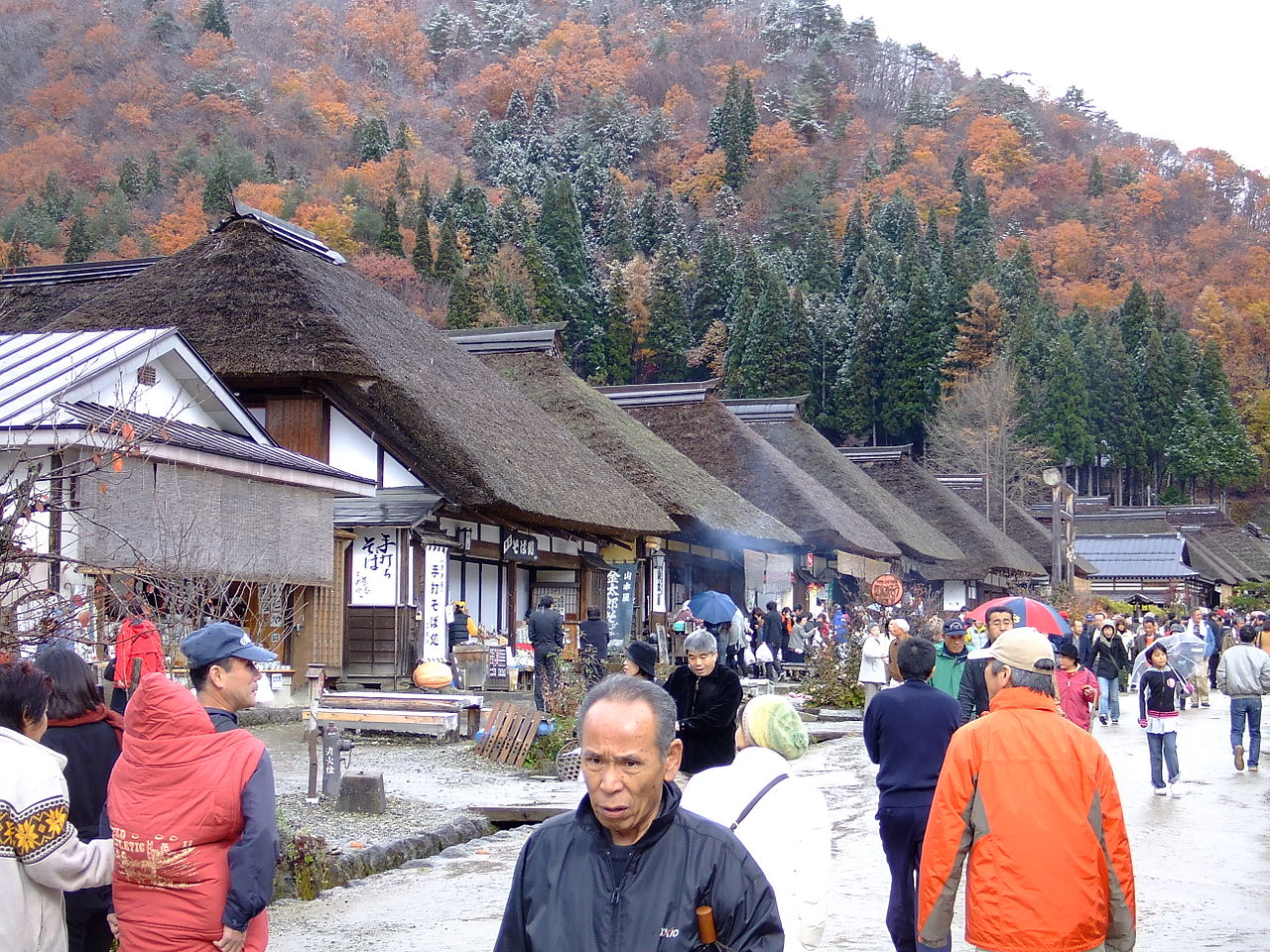
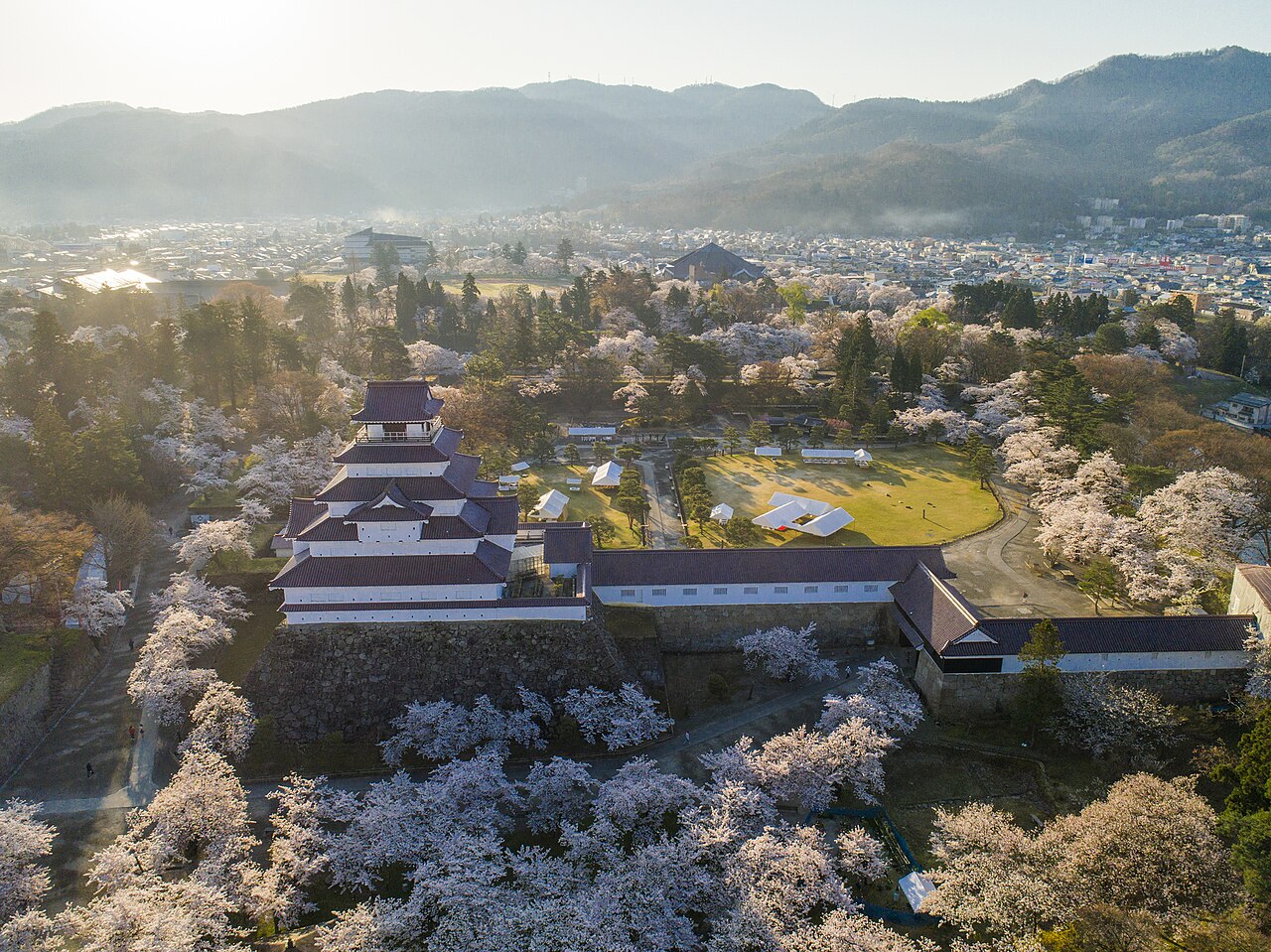
The Aizu region was historically anchored by the Aizu domain, governed from Tsuruga Castle in Aizu-Wakamatsu. The domain’s economy organized the surrounding mountain villages, and the household handwork of places like Mishima sat within that wider Aizu craft culture — the same region that produced Aizu lacquer and Aizu painted candles. The objects of Okuaizu were never courtly luxury goods; they were the practical output of farming households through the snow season.
- Jōmon era — basketry techniques in the region traced back (folk-traditional)
- Edo period — Aizu domain anchors the region from Tsuruga Castle; villages braid through the snow season
- Through the modern era — yamabudo, hiroro, and matatabi woven as everyday household tools
- 1970s — Mishima builds its “life-craft movement” (生活工芸運動) to keep the handwork alive
- 2003 — cluster designated a National Traditional Craft as “Okuaizu Amikumizaiku”
- Each June — the brief annual window when yamabudo bark can be stripped
- 2026 — still hand-woven in Mishima, with constrained supply
What “still being made here” means for yamabudo is unusually literal, because the material itself sets the pace. The inner bark of the wild grapevine can only be harvested in a brief window in early summer — roughly June — and not from the same vine again for several years, so a weaver cannot simply scale up. A single bag may take a long time to make, and the number of skilled hands in the district is finite. That scarcity is not marketing; it is the biology of the plant and the demographics of a snow-country village.
“A yamabudo bag is not finished when it leaves the weaver’s hands — it is finished by the decades of hands that carry it, as the bark darkens slowly to amber.”
This is why the bags are routinely handed down. Where most accessories are consumed and discarded, a well-kept yamabudo bag is expected to outlast its first owner, the surface growing darker and glossier with the oils of daily handling. Buying one is closer to buying a tool you will maintain than to buying fashion.
Related Japanese craft on jpmono — neighboring Aizu crafts, and other regional basketry and woodwork for comparison.
 Aizu Ouchi-nuri dolls →
Same Fukushima region, lacquer craft
 Aizu painted candles →
Fukushima, hand-painted craft
Akita cherry-bark caddy →
Different bark, different region
 Hokkaido wood-carved bear →
Northern Japan folk woodcraft
 Aomori hiba board →
Tōhoku wood, everyday object
 Miyajima rice scoop →
Hand-shaped wooden craft
 Hakone yosegi pen stand →
Pattern-built woodwork
 Kiso wooden comb →
Mountain-village woodcraft
Price snapshot across stores
Live pricing for this specific item was unavailable in the fetched data at the time of writing. The table maps the purchase paths rather than asserting prices that we cannot confirm. JPY is the authoritative currency for the sourced item; USD figures elsewhere are approximate estimates at a ¥150/USD baseline.
| Store | Item / variant | Price (JPY + USD est.) | Notes |
|---|---|---|---|
| 🇺🇸 Amazon.com (US) | Browse Japanese woven basket bags | varies (USD) | Best if you are shopping from the US — Prime shipping, USD pricing, no international customs. Amazon US carries Japanese woven bags and basketry from various makers; the exact Okuaizu yamabudo piece is sourced from Japan (next row). |
| 🇯🇵 Amazon JP Global Store | This exact item (ASIN B0B59HVK6B) | Check listing — price unconfirmed in data | The sourced listing for the specific bag. Ships internationally from Japan to most major destinations. |
| Maker direct | Okuaizu / Mishima craft associations | Varies; often Japan-only checkout | Widest selection of weavers and patterns, but many sites do not ship abroad directly. |
| Proxy services (Buyee / Tenso) | Any Japan-only listing | Item price + proxy fee + forwarding | Use when a piece is listed only on a Japan-domestic store; adds fees and a forwarding step. |
📦 Shipping & where to buy from outside Japan
The specific item in this guide is sourced from the Amazon JP Global Store, which ships internationally from Japan to most major destinations. Based on listings of comparable Japanese household items, international shipping typically runs in the range of about $15–$40 to the US and EU, and higher to other regions; the exact figure depends on weight, destination, and the carrier the seller uses.
If a particular weaver’s piece is listed only on a Japan-domestic store, proxy and forwarding services such as Buyee or Tenso can purchase and re-ship it, adding their own fees. Orders above your country’s import threshold may incur customs duties or local taxes on arrival — budget for that separately. As a natural-fiber accessory with no electrical components, a yamabudo bag carries none of the voltage or certification concerns that apply to Japanese appliances.
What it does well
Weaknesses and things to verify before buying
- Price was unconfirmed in our data. The fetched dataset returned no live price for this listing. Verify the current figure on the Amazon JP Global Store page before committing.
- Dimensions and weight are unconfirmed. Check the listing for interior capacity and opening size — basket bags vary widely, and you cannot judge fit from photos alone.
- Natural bark is not waterproof. These bags are not designed for heavy rain or wet conditions; treat them as you would untreated leather.
- Expect irregularity. Grain, color, and weave will differ from the photo. That is intrinsic to hand-work, not a defect — but it is not for buyers who want machine uniformity.
- Supply and lead time are constrained. Bark is harvested only briefly each June and weaving is slow, so stock can be limited and a specific pattern may sell out.
- Light ongoing care is required. Periodic gentle handling, keeping it dry, and occasional cleaning are needed to keep the bark healthy over decades.
- International shipping and customs add cost and time. Confirm that the seller ships to your country, and budget for possible import duties.
Conclusion — which buyer type are you?
Other ways to approach this purchase
🏆 Editor’s Pick
❓ Frequently Asked Questions
Does Amazon JP ship a yamabudo basket bag internationally?
Yes. The specific item is sourced from the Amazon JP Global Store, which ships from Japan to most major destinations. Confirm your country is listed at checkout, and note that customs duties may apply on arrival.
Why is the yamabudo bag so expensive and often out of stock?
Wild-grapevine bark can only be stripped in a brief window in early summer, and not from the same vine for several years. Combined with slow hand-weaving and a finite number of weavers in Mishima, supply is genuinely limited.
How do I care for it, and is it waterproof?
It is not waterproof — keep it out of heavy rain. With light, regular handling and dry storage, the bark stays healthy and darkens to a glossy amber over years. Treat it roughly as you would untreated leather.
How is this different from Akita cherry-bark or Beppu bamboo work?
They differ by material, region, and product type. Okuaizu uses yamabudo (wild grapevine) bark in Fukushima; Akita kabazaiku uses cherry bark; Beppu basketry uses madake bamboo in Oita. Each has its own techniques and look.
Is it a good gift?
Yes, for a recipient who values lasting hand-made objects. Because the bag improves with age and is routinely handed down, it suits milestone gifts. It is less suitable for someone wanting a low-maintenance or waterproof bag.
What does the “National Traditional Craft” designation mean here?
In 2003 the Okuaizu braided basketry cluster was designated a National Traditional Craft of Japan as “Okuaizu Amikumizaiku,” recognizing the region’s yamabudo, hiroro, and matatabi weaving traditions and their continuity.
jpmono.com is curated by a Japan-based editorial team (working out of Toyama in the Hokuriku region and Nara in Kansai) and is independent. We don’t take payment from the makers we feature; income comes from affiliate links. Because the live dataset for this item was thin, we have flagged unconfirmed figures rather than inventing them.
This article was prepared with AI assistance and reviewed against the available source data. Where listing data was incomplete, unconfirmed values were marked rather than estimated.
Affiliate disclosure: jpmono.com may earn a commission on qualifying purchases made through links on this page, at no additional cost to you.