![Nōsaku NAJIMI Tin Tumbler 350cc (501341, ¥7,900 / ≈$52 USD) — A 100% Tin Tumbler from Takaoka, the 400-Year Maeda-Domain Metalcasting Town [2026 Guide for International Readers]](https://jpmono.com/wp-content/uploads/2026/05/nousaku-najimi-tin-tumbler-350cc-where-to-buy-2026-featured-25.jpg)
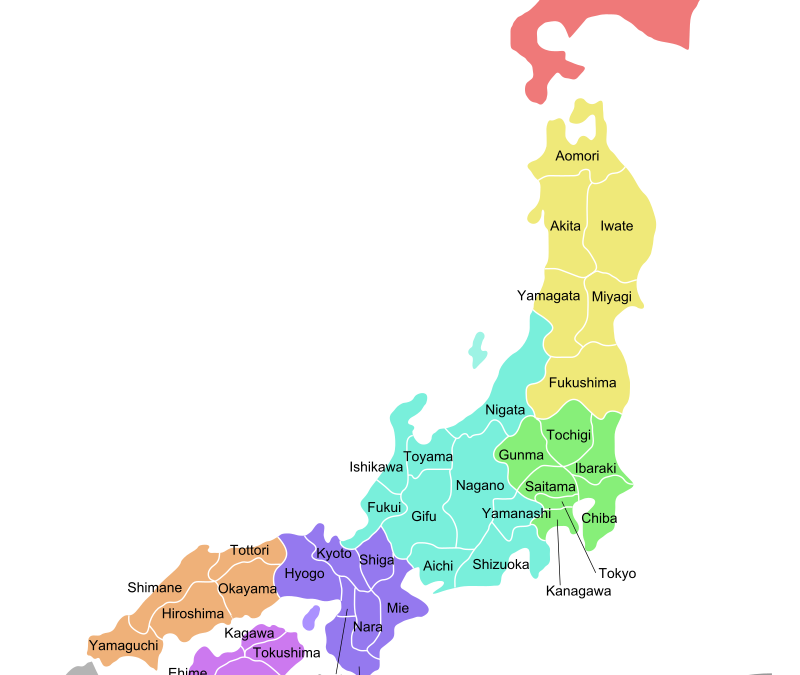
Nōsaku (能作) is a foundry that has been operating in Takaoka, Toyama Prefecture, since 1916. Takaoka itself sits on the Sea of Japan coast of Honshu, in the area Japanese geography calls the Hokuriku region — a city of about 166,000 people that Lord Toshinaga Maeda of the Kaga domain founded as a castle town in 1609 and seeded with seven foundry artisans from Kawachi province two years later. Four centuries on, roughly 70 to 100 foundries are still active in the city, and Nōsaku is one of the largest.
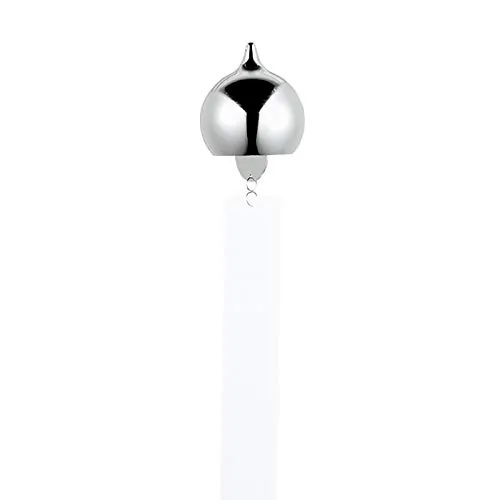
The NAJIMI 350cc tumbler (model 501341, ¥7,900 / ≈$52 USD on the Amazon JP Global Store at the time of writing) is one of the signature pieces from Nōsaku’s pivot to 100% pure-tin tableware in the mid-2000s. Designed by in-house designer Akiko Sakai (坂井 明紀子), its silhouette is slightly wider at the mid-section than at the rim and base — the name NAJIMI (なじむ) means “to fit naturally” in Japanese, and the shape is engineered to settle into the palm. At 350cc, it is sized exactly to take a Japanese 350 ml beer can or highball pour.
This article is written for international readers ordering from outside Japan. It covers the product specs as listed on the Amazon JP catalog, the place and craft tradition the tumbler comes from, the variants in the NAJIMI line, how to actually buy it (shipping, customs, alternatives), and where it fits relative to other Toyama and Hokuriku craft pieces. The voice is that of a Japan-based editorial team working out of Toyama and Nara, not a first-person review — we have not physically tested the tumbler.
🔄 Last updated: May 12, 2026
⏱️ Reading time: about 14 minutes
🏷️ Categories: Japanese Craft · Tableware · Toyama

- Who this is for — and who should skip it
- Product overview (from published specs)
- 📍 Where this comes from — place, era, and the craft tradition
- Price snapshot across stores
- What it does well
- Weaknesses and things to verify before buying
- Conclusion — which buyer type are you?
- Other ways to approach this purchase
- 🏆 Editor’s Pick
- ❓ Frequently Asked Questions
- 📌 Related Japanese Crafts
Who this is for — and who should skip it
- Drink beer, highball, or chilled sake regularly and want a vessel that pulls heat out of the drink in seconds
- Care about provenance — a piece cast in a foundry district documented since 1611, by a maker active since 1916
- Are looking for a gift in the ¥7,000–¥10,000 / $50–$70 range that arrives already in a presentation box
- Appreciate quiet, slightly asymmetric Japanese product design (the NAJIMI silhouette is mid-section-wider, not perfectly symmetrical)
- Are willing to hand-wash and keep the piece out of the dishwasher, microwave, freezer, and open flame
- Need dishwasher- or microwave-safe glassware for a busy household
- Want a vessel you can store cold drinks in inside the freezer (tin’s low-temperature crystalline behavior makes this inadvisable)
- Are price-sensitive and consider $50+ for a single tumbler outside your budget
- Prefer plated or alloy finishes — the surface is unpolished pure tin and will dull and scratch with use
- Live in a country Amazon JP Global Store does not ship to and do not want to use a proxy service
Product overview (from published specs)
The table below summarizes the specifications listed on the Amazon JP catalog at the time of writing. Prices and stock fluctuate; verify on the listing for current data.

Nōsaku NAJIMI Tin Tumbler 350cc (501341)
NOUSAKU 能作 NAJIMIタンブラー 350cc 〔錫100%〕 501341 シルバー
残り20点(入荷予定あり) · Sold by Amazon.co.jp · ASIN B00B6O13KA
Price and availability as of 2026-08-31 02:30 JST. The Amazon listing at the time of purchase is authoritative. jpmono.com earns a commission on qualifying purchases at no extra cost to you.
| Spec | Detail | Source |
|---|---|---|
| Model | 501341 (silver / unpolished tin) | Amazon JP listing |
| Material | 100% pure tin (Sn) — no lead, no nickel | Amazon JP listing |
| Dimensions | H 8.2 cm × ⌀ 9.0 cm | Amazon JP listing |
| Capacity | 350cc (≈ 12 fl oz US) — fits one 350 ml beer can | Amazon JP listing |
| Designer | Akiko Sakai (坂井 明紀子), in-house | Amazon JP listing |
| Origin | Takaoka, Toyama Prefecture, Japan | Amazon JP listing / maker |
| Maker founded | Nōsaku Co., Ltd. — 1916 | Maker public record |
| Gift box | 95 × 98 × 110 mm — ships gift-ready | Amazon JP listing |
| Price | ¥7,900 (≈ $52 USD as of May 2026) | Amazon JP, May 2026 |
| Sold by | Third-party (Kyoto tableware specialty store Ginyou); not Amazon-direct | Amazon JP listing |
| International shipping | Amazon JP Global Store ships to US, EU, AU, Canada and many others; est. $15–$40 to US | Amazon JP listing |
USD figures are approximate and depend on the current exchange rate. The JPY price is authoritative.
📖 Glossary — Japanese craft terms used in this article
Takaoka copperware (高岡銅器, Takaoka dōki) — the metalcasting tradition of Takaoka city in Toyama Prefecture, established 1611 under the Kaga domain. Counter-intuitively named “copperware,” the category includes bronze, brass, iron, and modern tin pieces. Designated a METI Traditional Craft Product in 1975.
Kaga domain (加賀藩, Kaga-han) — the Maeda family’s feudal holding in the Edo period. Assessed at 1.02 million koku of rice, the wealthiest tozama (outside-the-Tokugawa-line) domain. Capital at Kanazawa, with Takaoka as a secondary economic center.
Tozama daimyō (外様大名) — feudal lords who submitted to the Tokugawa only after the Battle of Sekigahara (1600). Generally kept at arm’s length by the Shogunate; the Maeda were the wealthiest exception.
Hokuriku (北陸) — literally “northern land road.” The Sea-of-Japan-coast region of central-northern Honshu, comprising Toyama, Ishikawa, Fukui, and (in some definitions) Niigata. Heavy snow country.
Shokunin (職人) — craftsman / artisan. Implies long apprenticeship and lifelong specialization.
METI Traditional Craft Product (伝統的工芸品) — a Japanese national designation administered by the Ministry of Economy, Trade and Industry (METI), recognizing a craft tradition as having heritage value. Takaoka copperware was among the first 15 categories designated, in 1975.
Butsugu (仏具) — Buddhist altar fittings. Nōsaku’s original product line from 1916 until the mid-2000s pivot to tableware.
NAJIMI (なじむ) — Japanese verb meaning “to fit naturally” or “to settle into.” The tumbler is named for the way its slightly asymmetric silhouette settles into the user’s palm.
Kanburi (寒鰤) — winter yellowtail; a Toyama Bay specialty caught between December and February.
📍 Where this comes from — place, era, and the craft tradition

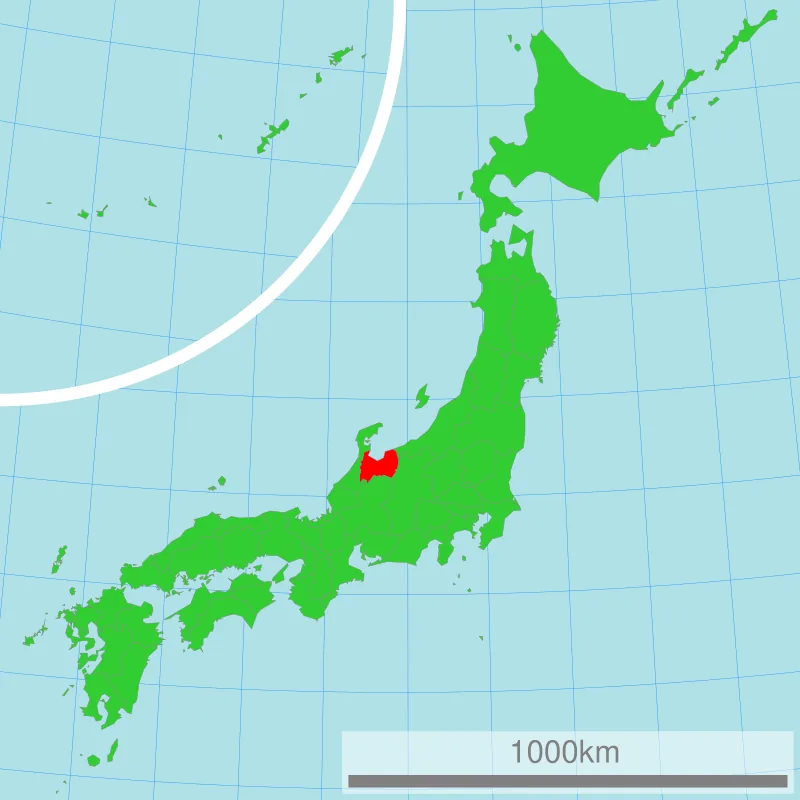
The region on the map — Toyama Prefecture and the Hokuriku region
Toyama Prefecture sits on the Sea of Japan coast of central-northern Honshu, in the area Japanese geography calls the Hokuriku region (北陸地方 — literally “northern land road”). For an international reader, the prefecture is approximately 350 km northwest of Tokyo, 200 km northeast of Kyoto, and about 250 km north of Nagoya. The Hokuriku Shinkansen connects Tokyo to Toyama City in about two hours and ten minutes.
Geographically the prefecture is a basin. The Tateyama mountain range (立山連峰), with peaks above 3,000 m and forming part of the Northern Japanese Alps, runs along its southern edge, and Toyama Bay opens to the north. Snowmelt and underground spring water from Tateyama feed the Jinzū, Shō, and Oyabe river systems — water exceptionally clean by Japanese standards, and historically the reason sake brewing, paper-making, and metalcasting all took root in the basin. Winters bring two to four meters of snowfall in the foothills; summers are humid.

Toyama Bay is also one of Japan’s most distinctive fishing grounds. Winter brings kanburi (寒ブリ, cold-season yellowtail); spring brings hotaru-ika (ホタルイカ, firefly squid); and the bay produces shiroebi (白エビ, white shrimp) — a small endemic shrimp not found in commercial quantities elsewhere in Japan. The relevance to this article: when the tumbler is filled in Toyama, the contents being chilled are often a Hokuriku junmai or a Takaoka-brewed sake served alongside cold-water fish from the bay.
Takaoka — the city founded in 1609
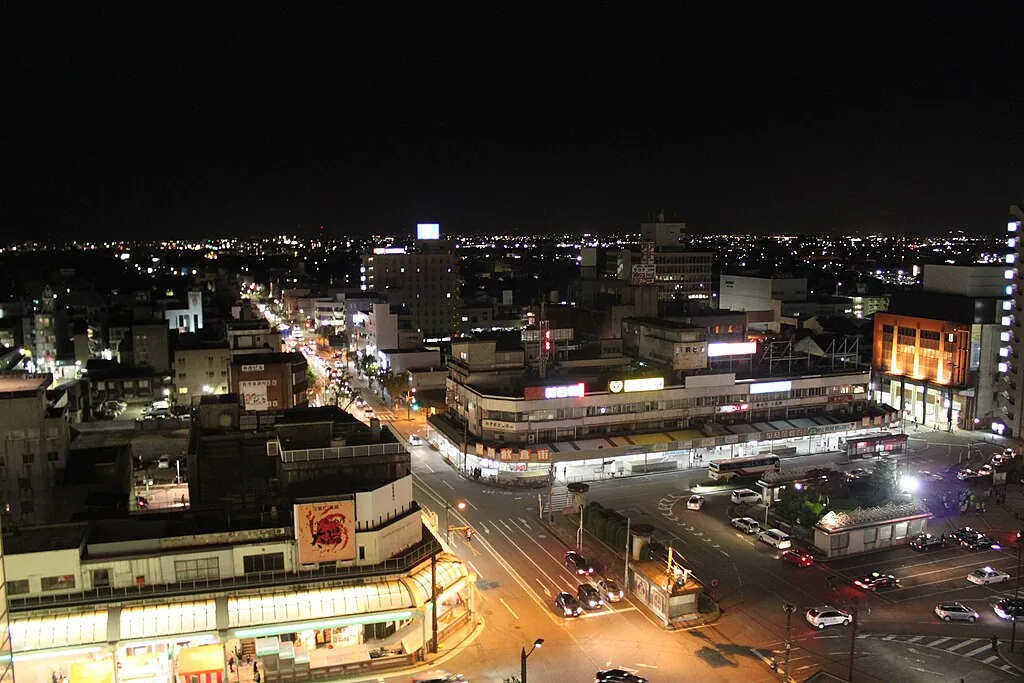
Takaoka (高岡市) is a city of about 166,000 people on the Shō River delta in western Toyama Prefecture, the second-largest in the prefecture after Toyama City itself. The Edo-period port of Fushiki (伏木港), now part of the city, received continental trade ships from the Heian period onward.
Takaoka was founded specifically as a castle town in 1609 by Lord Toshinaga Maeda (前田利長, 1562–1614), the second-generation head of the Kaga domain. The Kaga domain — the Maeda family’s holding — was the wealthiest tozama daimyō domain in the Edo period, assessed at 1.02 million koku of rice; only the Shogun’s own holdings exceeded this. Kanazawa, in modern Ishikawa Prefecture immediately west of Toyama, was the domain’s capital. The Maeda patronized the arts heavily — Kaga-yūzen textile dyeing, Kanazawa gold-leaf, lacquerware, Noh theater — and Takaoka became the metalcasting arm of that broader patronage.
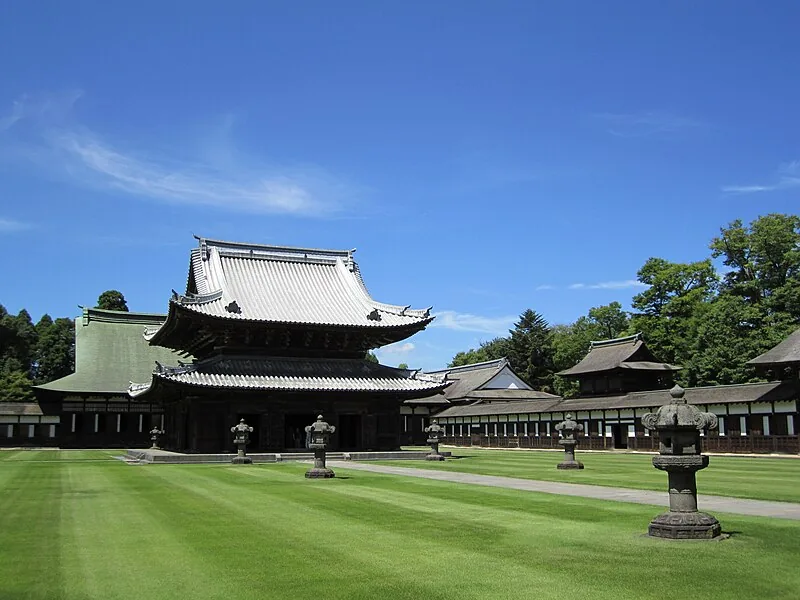
In 1611, two years after founding the city, Toshinaga Maeda invited seven foundry artisans from Kawachi province (河内国, in what is now eastern Osaka Prefecture, an old metalcasting center near the imperial capitals) to settle in Takaoka. They were given land in what is now the Kanayamachi district (金屋町, literally “metalworkers’ town”); the district is still preserved with its Edo-period merchant streetscape and sits a ten-minute walk from Takaoka Station. In 1615, the Tokugawa Shogunate issued the “One Country, One Castle” edict (一国一城令) and Takaoka Castle was demolished — but by then the foundry industry was self-sustaining, and the city was rebuilt as a commercial-industrial town focused on metalcasting, sake brewing, and rice trade.
- 1609 — Lord Toshinaga Maeda founds Takaoka as a Kaga-domain castle town
- 1611 — Seven foundry artisans from Kawachi province invited to settle in what is now the Kanayamachi district
- 1615 — “One Country, One Castle” edict; Takaoka Castle demolished but foundry industry continues
- 1663 — Zuiryū-ji completed as Toshinaga Maeda’s mausoleum temple
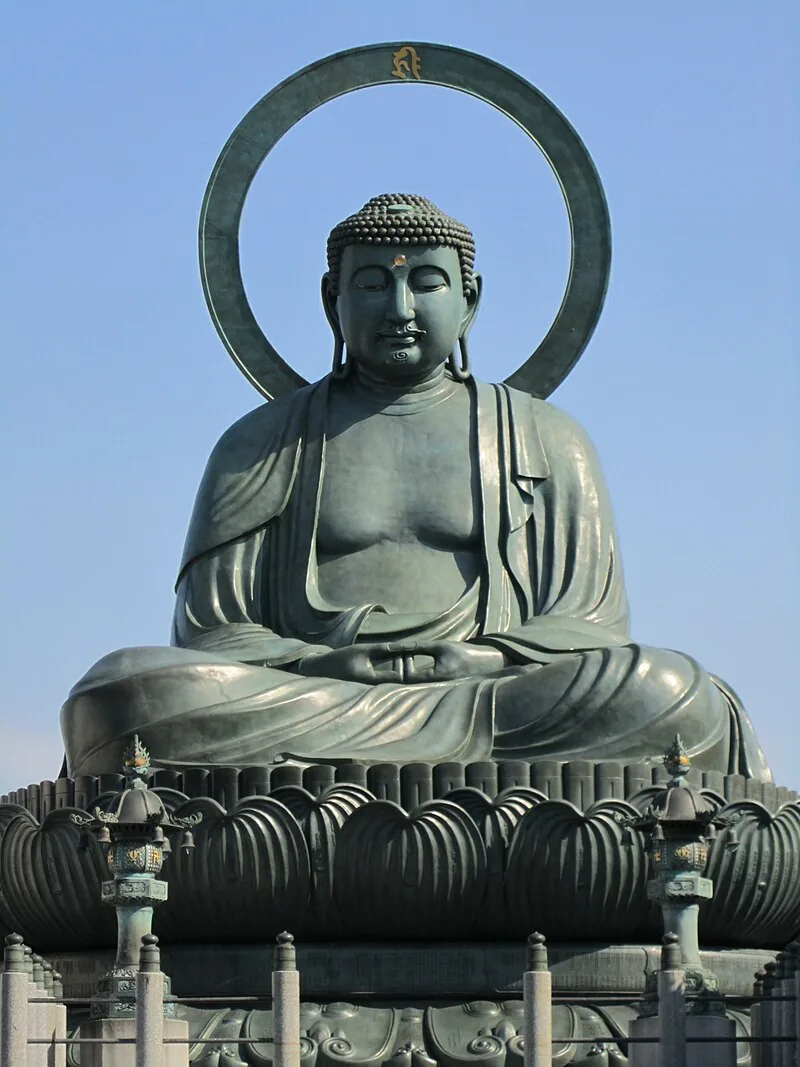
- 1745 — Original Takaoka Daibutsu (wood-and-clay version) cast
- 1873–1900 — Takaoka bronzes win medals at Vienna, Philadelphia, and Paris international expositions
- 1916 — Nōsaku founded by Nōsaku Kumekichirō, making Buddhist altar fittings and tea utensils
- 1933 — Current bronze Takaoka Daibutsu (15.85 m) completed
- 1975 — Takaoka copperware among the first 15 METI Traditional Craft Product designations
- 1997 — Zuiryū-ji designated a National Treasure
- 2002–2005 — Fourth-generation president Katsuji Nōsaku pivots the company to 100% pure-tin tableware
- 2017 — Nōsaku’s new headquarters and showroom open in the Toide industrial area of Takaoka
- 2026 — Roughly 70 to 100 foundries still active in Takaoka; Nōsaku has standalone stores in Paris, NYC, Taipei, Singapore, and Seoul
What “still being made here” actually means
The Takaoka casting industry has passed through three eras. Through the Edo period (1611–1868), workshops cast daily-use iron — pots, kettles, ploughs — for the Kaga domain economy, then expanded into Buddhist altar fittings and tea-ceremony utensils for temples and wealthy merchants nationwide. The Meiji and Taishō eras (1868–1926) reoriented the industry toward export bronzes; Takaoka pieces won medals at the Vienna 1873, Philadelphia 1876, and Paris 1900 expositions, and most of the bronze garden lanterns, temple bells, and Buddhist statues produced in Japan from that era are Takaoka-made. The postwar era brought a shrinking Buddhist-fittings market — household altar use declined with secularization — and forced a third reinvention into modern tableware, architectural metalwork, and (in Nōsaku’s specific case) 100% pure-tin pieces.
“Four centuries after Toshinaga Maeda invited seven foundry artisans from Kawachi province, roughly 70 to 100 foundries are still casting in Takaoka. The skill base is the heritage; the products it makes are allowed to change.”
Approximately 70 to 100 foundries remain active in Takaoka as of the mid-2020s, employing on the order of 2,000 to 3,000 people across the industry. Nōsaku — about 150 employees as of the mid-2020s — is one of the largest, alongside Tama-okada Shoten (大寺幸八郎商店, since 1894) and Oigo Seisakusho (老子製作所, specialized in bronze bells and lanterns), among others. Three nearby anchors are walkable from Takaoka Station for visitors: the Takaoka Daibutsu (10 minutes), Zuiryū-ji (15 minutes, National Treasure since 1997), and the preserved Edo–Meiji merchant streetscapes of Yamamachisuji and Kanayamachi.
Why pure tin, specifically
Nōsaku’s signature decision under fourth-generation president Katsuji Nōsaku, who succeeded in 2002, was to cast in 100% pure tin (Sn, atomic number 50) — not silver-plate, not pewter, not an alloy. Tin has been the third-rank precious metal in East Asian hierarchies after gold and silver, sometimes called haku-gin (白銀, “white silver”) in older Japanese sources. The properties matter for the tumbler:
Tin is also traditionally believed to “mellow” sake by adsorbing trace organic compounds. The chemistry is partially supported, though not quantified in modern peer-reviewed sensory studies — we mention it as a folk-traditional claim, not a verified one.
Seasonal context — when this tumbler gets used
In Japan the tin tumbler comes out in late spring through summer. The combination of cold beer (a chilled 350 ml can pours into the 350cc volume exactly), high heat conductivity that fogs the metallic surface within seconds, and the fact that condensation runs off rather than pooling, makes tin a recognizable summer pairing. Toyama Prefecture has a strong sake tradition supported by Tateyama snowmelt water; standout breweries include Masuizumi (満寿泉, Iwase district, Toyama City), Tateyama (立山, Tateyama-machi), Katsukoma (勝駒, Shimizu Seizaburō Shōten, same city as Nōsaku), Ginban (銀盤, Kurobe City), and Saigi-no-Tomo (祭祢, Toyama City). Katsukoma in particular is sometimes paired with Nōsaku ware in local restaurants. Cold-water fish from Toyama Bay — winter kanburi, spring hotaru-ika, year-round shiroebi — and kamaboko fish-paste loaves are the recognizable food side of the pairing.
Price snapshot across stores
The fetched data covers the Amazon JP Global Store listing. Below we list it alongside the realistic alternative purchase paths for an international reader. Prices are from May 2026 and may shift; the affiliate link routes to current data.
| Store | Variant | Price (item only) | Notes |
|---|---|---|---|
| 🇺🇸 Amazon.com (US) | Browse Japanese tin tumblers & barware | varies (USD) | Best if you’re shopping from the US — Prime shipping, USD pricing, no international customs. Amazon US carries Japanese tin tableware and comparable barware from other makers; Nōsaku’s NAJIMI 350cc itself ships from Japan (next row). |
| Amazon JP Global Store | NAJIMI 350cc, model 501341 | ¥7,900 (≈ $52 USD) | Ships to US/EU/AU/CA and many others. Sold by third-party (Kyoto’s Ginyou). Est. shipping $15–$40 to US. |
| Maker direct (nousaku.co.jp) | Full NAJIMI line and tin variants | ¥7,900 (variant-dependent) | English information is limited; international shipping available for some SKUs. Best for non-Amazon variants. |
| Proxy services (Buyee / Tenso) | Any Japanese retailer’s listing | ¥7,900 + 5–15% commission + storage | Useful only if Amazon JP Global Store does not ship to your country. |
| Nōsaku flagship stores (Paris / NYC / Taipei / Singapore / Seoul) | Walk-in inventory | Local currency, varies | Check store inventory before traveling. Pricing typically reflects local import margins. |
USD figures are estimates using a ¥150/USD baseline as of May 2026; JPY is the authoritative price. Customs duties apply over local thresholds (US de minimis is $800 at the time of writing, so a single tumbler is well under the threshold).
What it does well
Weaknesses and things to verify before buying
- Hand-wash only — no dishwasher, no microwave. Tin is soft (Mohs ~1.5) and has a low melting point (231.93°C). Steel wool, scouring pads, abrasive cleaners, and dishwasher heat will all damage the surface. This is a meaningful constraint for high-volume households.
- The surface will scratch and tarnish over time. Pure tin is unpolished and develops a patina with use. Tarnish can be polished out with baking soda paste, but if you expect a piece that looks new for years, this is the wrong material category.
- Freezer and prolonged refrigerator storage are discouraged. Pure tin can undergo a low-temperature crystalline change (the historical “tin pest” — transformation from white-tin to gray-tin) below approximately 13°C in prolonged exposure. The risk is small in practice (it requires weeks of cold) but Nōsaku still advises against freezer use.
- Not safe near open flame. Tin melts at 231.93°C — well below the temperatures of a gas-stove flame or candle. Use as a cold-drink vessel only.
- Third-party seller on Amazon JP, not Amazon-direct. The listing in the fetched data ships from the Kyoto-based tableware store Ginyou. Returns and exchanges may take longer than Amazon-direct purchases. Verify the current seller before ordering, especially for gifts.
- International shipping cost and lead time. Amazon JP Global Store shipping to the US is typically $15–$40 and arrives in 5–10 business days, but routing to some EU countries can take longer. Customs paperwork is automatic for low-value items in most destinations; verify your country’s threshold.
- The price reflects the material, not industrial scale. ¥7,900 is reasonable for a hand-cast pure-tin piece but expensive compared to a stainless-steel or glass tumbler of similar capacity. If a $10 tumbler does the same drink-holding job for you, this is not the right purchase.
Conclusion — which buyer type are you?
Other ways to approach this purchase
If you’re in the US, Canada, UK, or another Amazon-served country, see if Nōsaku NAJIMI Tin Tumbler is listed on your local Amazon. Inventory and price vary by region. If the search returns no results, scroll down to the Amazon JP Global Store option (which ships worldwide).
🏆 Editor’s Pick
- The signature tumbler of Nōsaku’s 100% tin line — the piece the maker is best known for internationally.
- 350cc is the right capacity for a Japanese 350 ml beer can or a standard highball pour — versatile across drinks.
- The “organic curved” silhouette designed by Akiko Sakai to settle into the palm is the design vocabulary that distinguishes Nōsaku from generic pewter and stainless tumblers.
This guide was assembled by the jpmono.com editorial team — a small group based in Toyama (Hokuriku region) and Nara (Kansai region), curating Japanese craft items for international readers. We do not test every item in our own kitchens; our role is to translate what Japanese makers, retailers, and craft historians say into English, and to flag international-buyer considerations (shipping, customs, care).
❓ Frequently Asked Questions
Does Amazon JP Global Store ship the NAJIMI 350cc to my country?
Can I put this tumbler in the dishwasher or freezer?
Is the tin food-safe? Does it contain lead?
How does this compare to a stainless-steel double-walled tumbler?
Is this a good gift for someone who likes Japanese craft but does not drink beer?
Will I pay customs duty when it arrives outside Japan?
Will the surface scratch or tarnish over time?
jpmono.com is curated by a Japan-based editorial team (working out of Toyama in the Hokuriku region and Nara in Kansai) and is independent. We do not take payment from the makers we feature; income comes from affiliate links. Read more about our editorial standards.
This article was researched and drafted with AI assistance, then reviewed against the maker’s listing data and public records by the jpmono editorial team. We do not physically test every product; specs are taken from the Amazon JP catalog snapshot referenced above.
Affiliate disclosure: jpmono.com may earn a commission on qualifying purchases made through links on this page, at no additional cost to you.