![HASAMI Porcelain Mug by Ishimaru Tōgei — 210 ml Modern-Minimal Daily Porcelain (¥2,200 / ≈$15 USD) [2026 Buyer’s Guide]](https://jpmono.com/wp-content/uploads/2026/05/hasami-porcelain-ishimaru-mug-where-to-buy-2026-featured-1400x1050.jpg)
The HASAMI Porcelain (波佐見ポーセリン) line is the single most internationally visible product of Japan’s 2010s ceramic design renaissance — a quietly designed, modular family of mugs, saucers, and bowls that took a 400-year-old anonymous porcelain tradition and gave it a contemporary face. The line was launched in 2012 by designer Takuhiro Shinomoto in collaboration with workshops in Hasami town, central Nagasaki Prefecture, and within five years had become a fixture at MoMA Design Store, Heath Ceramics outposts, ACE Hotel boutiques, and design-forward kitchen retailers across Europe and Australia.
This article is about the 210 ml mug made by Ishimaru Tōgei (石丸陶芸), one of the named Hasami workshops that physically produces HASAMI Porcelain pieces. The mug is the smaller of the line’s two principal mug sizes — described by HASAMI Porcelain as the “tea cup” format, distinct from the 330 ml “coffee mug” — and the listing covered here is the marigold-yellow exterior over a contrasting purple-glazed band, two of the line’s signature colors. At ¥2,200 (≈ $15 USD as of 2026-05), it is one of the most accessible entry points to contemporary Japanese porcelain currently on offer.
We wrote this guide for international readers — primarily in the US, Canada, the EU, the UK, and Australia — who have probably already seen HASAMI Porcelain on a design-store shelf and want to understand the actual provenance, the price difference between the global retailer markup and the Japan-sourced listing, and how Hasami fits into the larger map of Japanese ceramic regions before committing. Sources are Amazon JP (where the specific item is listed), Amazon US (where comparable Hasami pieces are widely stocked at higher markup), and the broader Hasami-yaki literature.
🔄 Last updated: May 16, 2026
⏱ Reading time: about 16 minutes

- Who this is for — and who should skip it
- Product overview (from published specs)
- 📍 Where this comes from — Hasami, Nagasaki, and the modern porcelain story
- Price snapshot across stores
- What it does well
- Weaknesses and things to verify before buying
- Conclusion — which buyer type are you?
- Other ways to approach this purchase
- 🏆 Editor’s Pick
- ❓ Frequently Asked Questions
- 📌 Related Japanese Crafts
Who this is for — and who should skip it
- You want a recognizable piece of contemporary Japanese tableware design at impulse-purchase pricing.
- You drink Japanese green tea, single-shot espresso, or small servings of coffee where 210 ml is enough.
- You already own (or plan to buy) HASAMI Porcelain saucers and want the modular stacking the line is designed around.
- You appreciate matte-glaze porcelain and the line’s restricted color palette (marigold, purple, navy, gray, black, white).
- You are buying a small gift for a designer-minded friend and want something legible as “Japanese craft” without being touristy.
- You drink large American-style coffee — 210 ml is small; the 330 ml HASAMI Porcelain mug is the larger format you actually want.
- You are looking for a traditional tea-ceremony piece (chawan, yunomi); HASAMI Porcelain is deliberately modern-design, not heritage-style.
- You want pictorial decoration — sometsuke cobalt motifs, floral patterns; the line is intentionally pattern-free.
- You expect a hand-signed studio piece; this is a multi-workshop production line, not a named-potter studio mug.
- You require a thick rim for outdoor / camp use; the wall is everyday-porcelain thickness, not stoneware.
Product overview (from published specs)
Specifications below are taken from the Amazon JP listing for ASIN B09HTT3ZKB as of May 16, 2026, cross-checked against HASAMI Porcelain’s published product information. Prices and stock fluctuate; check the retailer directly before purchase.
HASAMI Porcelain Mug by Ishimaru Tōgei
波佐見焼 マグカップ コップ 約210ml マリーゴールド パープル 日本製 323090232
残り6点 ご注文はお早めに · Sold by Amazon.co.jp · ASIN B09HTT3ZKB
Price and availability as of 2026-08-31 02:30 JST. The Amazon listing at the time of purchase is authoritative. jpmono.com earns a commission on qualifying purchases at no extra cost to you.
| Spec | Value | Source |
|---|---|---|
| Maker | Ishimaru Tōgei (石丸陶芸), HASAMI Porcelain manufacturing partner | Amazon JP listing |
| Brand line | HASAMI Porcelain (波佐見ポーセリン), designed by Takuhiro Shinomoto, launched 2012 | Maker direct |
| Material | White porcelain with matte exterior glaze (marigold yellow + purple band) | Amazon JP listing |
| Dimensions | ⌀ 8.2 × H 7.2 cm × W 10.2 cm (with handle) | Amazon JP listing |
| Capacity | Approximately 210 ml (smaller “tea cup” format) | Amazon JP listing |
| Weight | Approximately 220 g | Amazon JP listing |
| Origin | Hasami, Higashi-Sonogi-gun, Nagasaki Prefecture, Japan | Amazon JP listing |
| Care | Microwave-safe and dishwasher-safe; matte glaze may show fine ware marks over years | Amazon JP listing |
| JPY price | ¥2,200 (≈ $15 USD at ¥150/USD baseline, 2026-05) | Amazon JP Global Store |
| International shipping | Amazon JP Global Store ships to US / EU / UK / AU / CA. Estimated $8–$15 USD; porcelain transit breakage rate around 2%. | Amazon JP Global Store / Buyee & Tenso (proxy) |
📖 Glossary — Japanese ceramic terms used in this article
Hasami-yaki (波佐見焼) — Porcelain made in Hasami town, central Nagasaki Prefecture. Founded 1599; METI-designated Traditional Craft Product since 1978.
HASAMI Porcelain (波佐見ポーセリン) — A 2012 product line by designer Takuhiro Shinomoto, manufactured in coordination with several Hasami workshops including Ishimaru Tōgei. The capitalized “HASAMI” is the brand spelling.
Arita-yaki (有田焼) — Porcelain made in Arita, Saga Prefecture, 8 km north of Hasami across the prefectural border. Historically the more famous “luxury” sibling to Hasami’s “everyday” porcelain.
Compra bottle (コンプラ瓶, kompura-bin) — A 17th–19th century Hasami porcelain bottle used to export Japanese soy sauce and sake through the Dutch trading port of Dejima, Nagasaki. The word “compra” derives from Portuguese comprador (buyer).
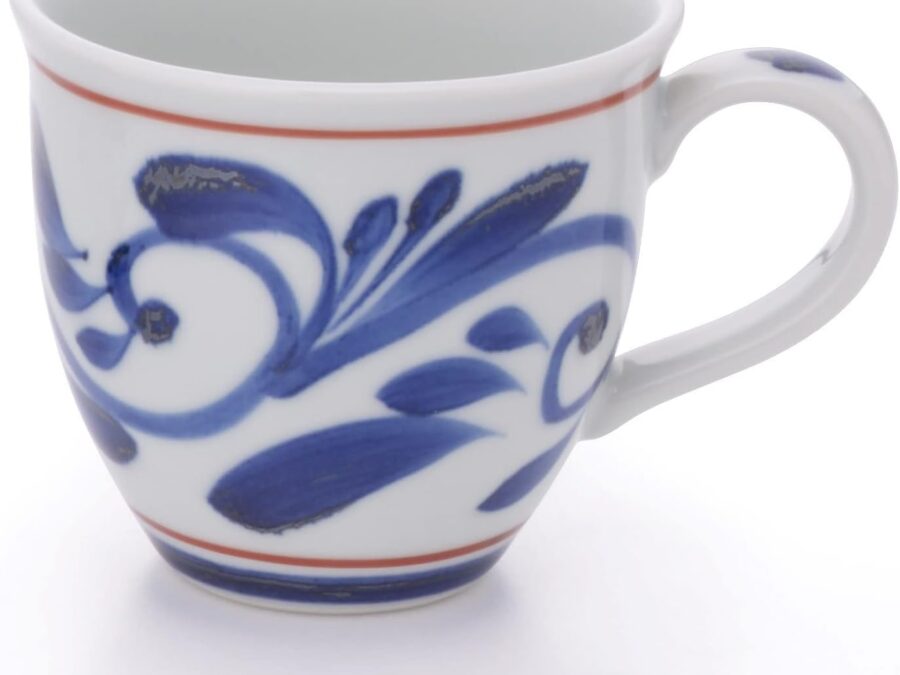
Sometsuke (染付) — Cobalt-blue underglaze decoration; the dominant decorative idiom of historical Hasami and Arita ware. HASAMI Porcelain deliberately omits sometsuke in favor of solid color.
Yunomi (湯呑) — A handle-less Japanese teacup, typically 150–250 ml. The HASAMI Porcelain 210 ml mug sits in similar capacity territory but adds a Western-style handle.
Chawan (茶碗) — The wider, low-walled tea bowl used for whisked matcha in formal tea ceremony. Not interchangeable with a mug.
METI Traditional Craft Product (国指定伝統的工芸品) — A designation administered by Japan’s Ministry of Economy, Trade and Industry, recognizing crafts with a minimum 100-year continuous tradition and primarily handmade production.
📍 Where this comes from — Hasami, Nagasaki, and the modern porcelain story

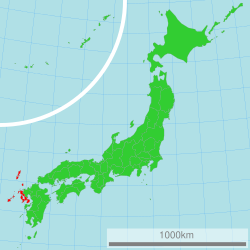
The region — Hasami, in central Nagasaki Prefecture
Hasami (波佐見) is a town of approximately 14,000 people in Higashi-Sonogi-gun, in central Nagasaki Prefecture on Kyushu’s northwest coast. It sits in a small valley immediately adjacent to Arita (有田), only 8 km north across the Saga–Nagasaki prefectural border. The two towns share the same geological clay sources, the same Edo-period craft origins, and historically shared the same export market — but they sit in different prefectures and developed sharply different brand identities in the modern era.
For international visitors orienting from the air, Hasami is about 2 hours from Fukuoka Airport (FUK) by car or bus, and 90 minutes from Nagasaki Airport (NGS). There is no direct rail; the nearest station is Arita-machi, across the border in Saga Prefecture, and most visitors continue by local shuttle or rental car.
The clay itself — historically mined from the Izumiyama deposit that Arita also drew on, today sourced from several Kyushu kaolin beds — produces a clean white porcelain that is, geologically, almost indistinguishable from Arita ware. The divergence between the two towns is historical, social, and commercial. Not material.
The historical anchor — 1599, and four centuries of quiet output
Like Arita, Hasami-yaki was founded by Korean potters brought to Kyushu during the 1592–1598 Hideyoshi invasions of Korea. The first Hasami kiln opened in 1599 under the patronage of the Ōmura clan, which controlled this part of central Nagasaki Prefecture. Yi Sam-pyeong, the founder of Arita-yaki, was associated with the Nabeshima clan in Saga; the Hasami founders were Ōmura-domain potters with similar Korean training but different daimyō patrons.
- 1599 — First Hasami kiln opens under Ōmura clan patronage; Korean potters seed the industry, 17 years before Yi Sam-pyeong founds Arita.
- 17th–19th c. — Hasami produces “compra bottles” (kompura-bin) for soy sauce and sake; exported via the Dutch trading post at Dejima to Europe.
- 1779 — Hakusan Porcelain founded — today one of the oldest continuously-operating Hasami workshops, later author of the G-Plate (1969, in MoMA’s permanent collection).
- Meiji–1990s — Hasami specializes in unbranded everyday porcelain; much output sold under the Arita or Imari brand names.
- 1946 — Saikai Tōki founded, later becoming Hasami’s largest manufacturer-distributor.
- 1978 — Hasami-yaki designated a METI Traditional Craft Product separately from Arita-yaki, formally recognizing the distinct Nagasaki-prefecture identity.
- 2012 — Designer Takuhiro Shinomoto launches HASAMI Porcelain in collaboration with Hasami workshops including Ishimaru Tōgei.
- 2015–2020 — HASAMI Porcelain stocked at MoMA Design Store, Heath Ceramics outposts, ACE Hotel shops, and design retailers in Europe and Australia.
- 2026 — About 100+ active Hasami workshops; the town is the canonical example of “21st-century Japanese craft brand-building.”
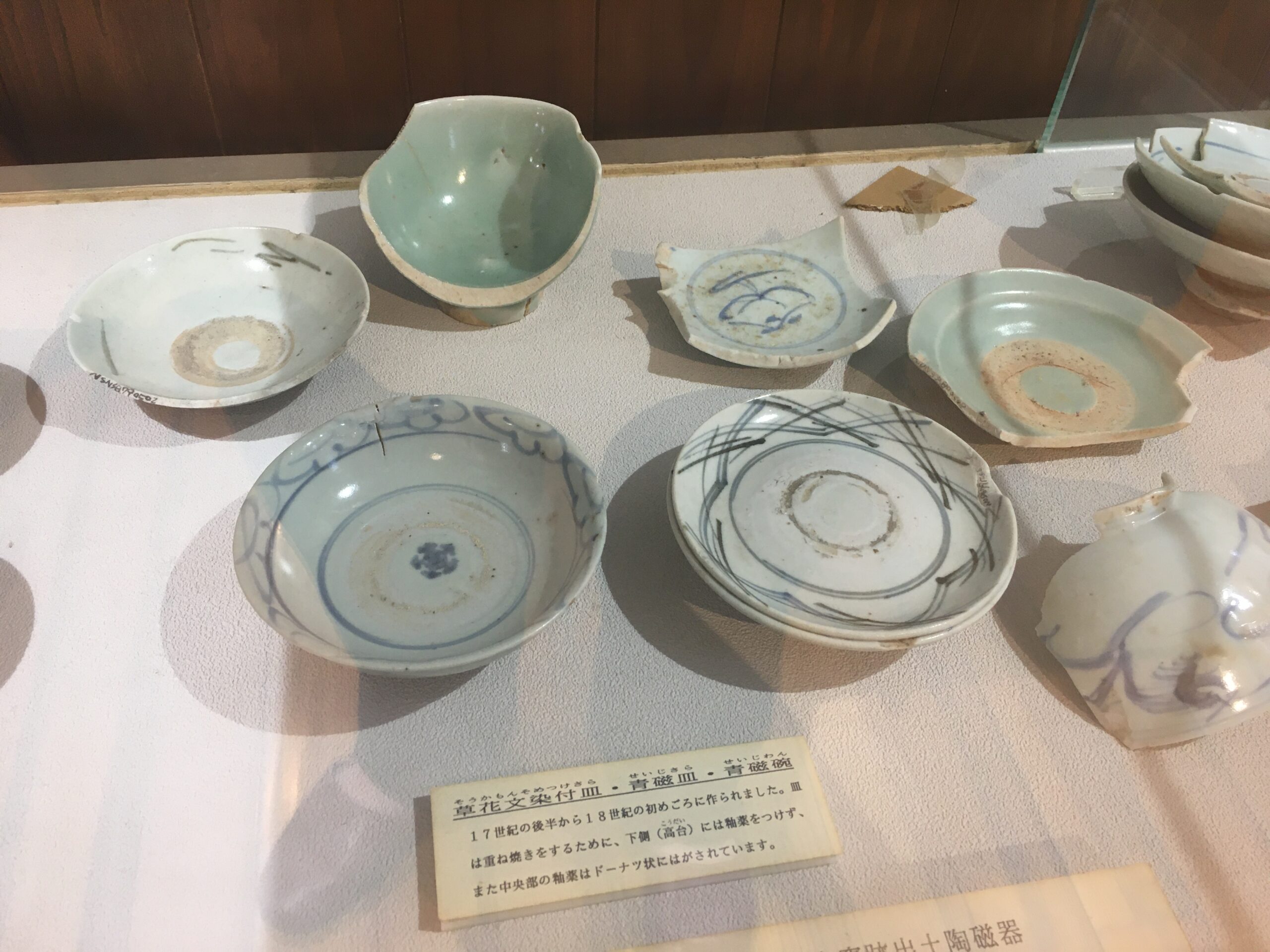
From the founding, Hasami and Arita developed in parallel — both producing white porcelain with cobalt-blue underglaze decoration, both shipping through nearby ports (Imari for Arita, Hasami’s products often re-routed through Imari as well), and both supplying the Edo-period domestic and overseas markets. The commercial divergence happened gradually across the 17th–19th centuries. Arita developed the polychrome akae (red-overglaze enamel) and iro-Nabeshima styles that commanded premium prices in Europe. Hasami focused on affordable everyday porcelain — the bulk-export compra bottle for soy sauce and sake, and unmarked bowls and plates for the Japanese domestic market.
By the 19th century the split had calcified. Arita was “luxury porcelain”; Hasami was “cheap porcelain.” Much of Hasami’s output was sold under the Arita or “Imari” brand names — its larger neighbor reaped the brand value, while Hasami workshops effectively acted as anonymous OEM producers.
“For most of its history, Hasami was the porcelain you used every day without knowing where it came from. The story of HASAMI Porcelain is the story of a 400-year-old craft that finally decided to put its own name on the box.”
The 20th century, and the 2012 repositioning
Through most of the 20th century, Hasami continued producing affordable everyday porcelain mostly without its own brand identity. Hasami pieces appeared in countless Japanese homes — anonymous white-and-blue bowls and plates produced in industrial quantities — but the “Hasami-yaki” name was largely unknown to consumers, including most Japanese consumers.
The repositioning began in 2010–2012, when designer Takuhiro Shinomoto approached Hasami workshops with a proposal: design a modern-minimal everyday tableware line using Hasami’s existing manufacturing capabilities, but with a distinctly contemporary visual identity and the Hasami name prominently on the packaging. The result was HASAMI Porcelain (波佐見ポーセリン), launched in 2012, with several defining choices:
- Clean cylindrical mug and bowl forms in three or four standard sizes.
- Modular stacking — mugs lock into saucers; bowls lock into plates.
- A deliberately restricted palette: white, black, gray, marigold, purple, navy.
- Matte exterior glaze, unusual for porcelain (which historically emphasized a glossy finish).
- Manufactured by five to seven Hasami workshops in coordination — Ishimaru Tōgei, this article’s maker, among them.
- Distributed first through Tokyo and Osaka design retailers, then internationally.
Within five years, HASAMI Porcelain had become one of the most widely stocked Japanese tableware lines globally — visible at MoMA Design Store, Heath Ceramics shops, ACE Hotel boutiques, Native & Co in London, Suite One in Sydney, and Scandinavian and continental European design retailers. The line essentially redefined what “Hasami-yaki” meant to international consumers. In parallel, other Hasami brands launched into the same modern-design space: Maruhiro’s BARBAR line, Hakusan Porcelain’s G-Plate revival, Saikai Tōki’s “Common” everyday line. Hasami transformed from anonymous OEM producer to design-forward brand center.
Ishimaru Tōgei — the workshop behind this mug
Ishimaru Tōgei (石丸陶芸) is one of the named Hasami workshops that manufactures the HASAMI Porcelain line. It has multi-generational continuity in Hasami town, producing both its own-brand pieces and partner-brand work for HASAMI Porcelain, Saikai Tōki, and other distributors. The specific mug in this article — 210 ml in marigold and purple — is one of Ishimaru’s regular production runs under the HASAMI Porcelain partnership. The piece carries the HASAMI Porcelain brand identity (cylindrical form, matte glaze, signature palette) while being physically produced at Ishimaru’s Hasami workshop.
For 2026, Hasami sits in an unusual position in the Japanese ceramic landscape. It is older than most rivals (1599 founding) but with a distinctly modern brand identity. It is geographically tiny — one valley, 8 km wide — but commercially huge in volume. And it is internationally recognizable through HASAMI Porcelain and related lines, but with limited individual potter celebrity (unlike Arita’s Kakiemon family or Kutani’s Tokuda lineage).
Visiting Hasami, and a note on what surrounds it
For readers who eventually travel: the Hasami Pottery Fair (波佐見陶器まつり) runs in early May, parallel to (and quieter than) the much larger Arita Ceramic Fair. The Nakao-yama (中尾山) district preserves a historic kiln area with active workshops open to visitors. The Hasami Tōkukan ceramic museum is small but well-curated, and explains the Hasami–Arita commercial divergence in more detail than most published histories. Nagasaki city — 90 km southwest, the former Dutch trading port through which Hasami compra bottles reached Europe — closes the loop on the export story.
Price snapshot across stores
Pricing reflects publicly listed values on May 16, 2026. The JPY figure is authoritative; USD estimates use a ¥150/USD baseline and depend on the current exchange rate.
| Store | Item / Variant | Price | Notes |
|---|---|---|---|
| 🇺🇸 Amazon.com (US) — search | Browse HASAMI Porcelain mugs and other Hasami-yaki on Amazon US | varies (USD) | Best if you’re shopping from the US — Prime shipping, USD pricing, no international customs. Amazon US carries many HASAMI Porcelain mugs and saucers (often at 1.5–2x markup over JP). Ishimaru’s exact ASIN is sourced from Japan in the next row. |
| 🇯🇵 Amazon JP Global Store | Ishimaru HASAMI Porcelain 210 ml — Marigold / Purple (B09HTT3ZKB) | ¥2,200 (≈ $15 USD) | Ships internationally from Japan. Add $8–$15 USD shipping for a single mug. Porcelain breakage in transit is roughly 2%. |
| Maker direct (HASAMI Porcelain global retailers) | Same line via MoMA Design Store (NY), Heath Ceramics (SF), Native & Co (London), Suite One (Sydney) | $22–$32 USD typical | Local stock — no international customs. The specific marigold + purple Ishimaru piece may not be stocked; closely related HASAMI Porcelain mugs usually are. |
| Proxy services (Buyee / Tenso) | Hasami workshops not on Amazon JP — direct from kiln, Hasami Pottery Fair listings, niche brands | ¥2,000–¥4,000 + proxy fee + shipping | Useful for non-HASAMI-Porcelain pieces (Maruhiro BARBAR, Hakusan G-Plate, named-potter studios). Adds 10–15% proxy fee plus consolidated international shipping. |
What it does well
Locks into HASAMI Porcelain saucers and stacks cleanly with bowls and plates from the same line — turns a single mug into the start of a coordinated table service.
At ¥2,200, the lowest-friction entry point into contemporary Japanese porcelain. The same piece sells for $22–$32 USD at most HASAMI Porcelain stockists outside Japan.
Designed for daily-use modern lifestyles. Unlike many heritage-style Japanese ceramics, the maker explicitly clears it for microwave and dishwasher use.
Made by Ishimaru Tōgei, a real named Hasami workshop with multi-generation continuity — not an anonymous OEM piece. Continuing production means individual items are replaceable if broken.
Weaknesses and things to verify before buying
- 210 ml is small for filter coffee. If you typically drink a full Western mug of coffee, the 330 ml HASAMI Porcelain “coffee mug” is the format you actually want; this 210 ml piece is best for tea, espresso, or small servings.
- Matte glaze marks over time. Matte porcelain can pick up fine scratches from forks, spoons, and dishwasher contact across years of heavy use. Not a defect — just expected behavior for matte finishes.
- Pattern-free aesthetic is intentional. Buyers who associate Japanese porcelain with sometsuke cobalt motifs or Arita’s polychrome enamels will find HASAMI Porcelain austere by comparison. That is the design intent, not a flaw.
- Shipping breakage is non-zero. Porcelain transit breakage for international Amazon JP Global Store orders runs around 2%. Pay attention to packaging on arrival; document any damage immediately for Amazon’s standard reshipment process.
- The two HASAMI Porcelain sizes are not interchangeable. The 210 ml mug pairs with one specific saucer; the 330 ml mug pairs with a different saucer. If you are building a stacked set, confirm size compatibility before ordering accessories.
- Listing colorways shift. Marigold + purple is one of several HASAMI Porcelain combinations; other ASINs cover navy, gray, black, and white. The specific color in this guide may or may not be stocked at any given moment.
- Not a tea-ceremony piece. If you are buying for formal sadō (matcha) use, you need a chawan, not a Western-style handled mug. HASAMI Porcelain is a daily-use line, not a ceremonial one.
Conclusion — which buyer type are you?
You probably want a named-potter studio piece — Hakusan’s G-Plate, a Maruhiro BARBAR set, or a non-Hasami studio mug. HASAMI Porcelain is excellent design, but production-line, not studio art.
This is your piece. ¥2,200, recognizable design, modular with the rest of the line, dishwasher-safe. Start here; add saucers and bowls later if you like it.
The Saikai “Common” mug at ¥2,000 is the cheapest Hasami option and gives you the larger 330 ml size. Different aesthetic — more casual — but a sound entry.
If you only drink large filter coffee and dislike matte glazes, skip this entirely. A 330 ml glossy stoneware mug from a different tradition serves you better than forcing a fit here.
Other ways to approach this purchase
HASAMI Porcelain pricing is stable on Amazon JP — sale discounts on this exact ASIN are rare. Bulk-set discounts (mug + saucer + bowl) occasionally appear during Amazon Prime Day in Japan.
If you are in NY, SF, LA, London, Paris, Stockholm, Melbourne, or another major design city, your nearest HASAMI Porcelain stockist (MoMA Design Store, Heath Ceramics, Native & Co, etc.) likely carries comparable pieces with no international customs.
Pair the mug with a matching saucer (¥1,000–¥1,500) for a complete tea-service unit. Adding the 330 ml mug as well gives you both daily formats from the same line.
If your kitchen has no room for another mug and the design specifically doesn’t appeal, no purchase is the correct purchase. Modern Hasami’s strength is that it is plentiful — not scarce — so there is no FOMO case.
🏆 Editor’s Pick
Ishimaru Tōgei HASAMI Porcelain Mug, 210 ml — Marigold / Purple
At ¥2,200, this is the lowest-friction entry into contemporary Japanese porcelain currently available. It carries the HASAMI Porcelain design identity that has defined Japan’s modern ceramic export look since 2012, is physically produced by Ishimaru Tōgei (a real named Hasami workshop with multi-generation continuity), comes in two of the line’s signature colors, and works in the dishwasher and the microwave. For an international buyer trying a single Japanese craft piece, there is essentially no risk at this price point.
- HASAMI Porcelain is the iconic modern Hasami brand — the design language that made Hasami internationally recognizable.
- Ishimaru Tōgei is one of HASAMI Porcelain’s named manufacturing partners — a real Hasami workshop, not anonymous OEM.
- 210 ml suits Japanese tea, espresso, or small coffee servings; pairs with HASAMI saucers for a coordinated set.
❓ Frequently Asked Questions
Is HASAMI Porcelain the same brand as Hasami-yaki?
Not exactly. Hasami-yaki (波佐見焼) is the broad 400-year-old porcelain tradition of Hasami town, Nagasaki — covering dozens of brands and workshops. HASAMI Porcelain (波佐見ポーセリン), capitalized, is a single 2012 product line by designer Takuhiro Shinomoto, manufactured in coordination with several Hasami workshops including Ishimaru Tōgei. All HASAMI Porcelain is Hasami-yaki, but not all Hasami-yaki is HASAMI Porcelain.
Will Amazon JP Global Store actually ship a single mug internationally?
Yes. Porcelain at around 220 g is well within Amazon JP’s international parcel limits, and shipping to the US, EU, UK, Canada, and Australia is standard. Expect $8–$15 USD shipping for a single mug, plus any local import VAT or duty if your order crosses the country’s de minimis threshold (typically over $200 USD aggregate). Breakage in transit is around 2% — document any damage on arrival and Amazon’s standard claim process applies.
Why is the same mug $22–$32 USD at MoMA / Heath Ceramics but ¥2,200 in Japan?
Standard retail markup. HASAMI Porcelain’s international distributors carry inventory, pay import duties, fund local marketing, and run physical retail — all of which roughly doubles the wholesale price. Buying direct from Amazon JP Global Store skips most of that, at the cost of longer shipping times and a 2% breakage risk. Neither path is wrong; choose based on what you value.
Is 210 ml enough for coffee?
For Japanese tea, espresso, a cortado, or a small pour-over, yes. For a full Western-style filter coffee, no — 210 ml is closer to a teacup than an American mug. The HASAMI Porcelain line includes a 330 ml “coffee mug” for that use; if you drink mostly large coffee, buy the 330 ml format instead.
Can I put it in the dishwasher and microwave?
Yes — the maker explicitly clears the line for both. The matte exterior glaze may pick up fine ware marks from forks and spoons across years of heavy use, but this is expected behavior for matte porcelain and does not affect food safety or structural integrity.
How is Hasami-yaki different from Arita-yaki?
Geologically, almost not at all — the two towns sit 8 km apart, share clay sources, and were both founded by Korean potters at the end of the 16th century. The difference is commercial and historical: Arita developed polychrome luxury porcelain for export to Europe and commanded premium prices; Hasami specialized in affordable everyday porcelain (including the 17th–19th century compra bottles for soy sauce export). The 2012 HASAMI Porcelain repositioning gave Hasami a contemporary brand identity distinct from Arita’s heritage-luxury image.
If I want to visit Hasami, what is worth seeing?
The Hasami Pottery Fair in early May (around 150 stalls, quieter than the parallel Arita Ceramic Fair), the Nakao-yama historic kiln district with active workshops open to visitors, and the small Hasami Tōkukan ceramic museum. Most visitors combine Hasami with Arita and Nagasaki city. There is no direct rail to Hasami; arrive by car or by local shuttle from Arita station.
jpmono.com is curated by a Japan-based editorial team (working out of Toyama in the Hokuriku region and Nara in Kansai) and is independent. We do not take payment from the makers we feature; income comes from affiliate links. Read more about our editorial standards.
This article was drafted with AI assistance and reviewed by the jpmono editorial team. Specs, prices, and availability reflect publicly listed values on May 16, 2026 and may have changed; verify at the retailer before purchasing.
Affiliate disclosure: jpmono.com may earn a commission on qualifying purchases made through links on this page, at no additional cost to you.