![Hakata-Ori Silk Necktie ‘Kenjō-gara’ by Sanui Orimono — 780-Year Fukuoka Brocade Tradition (¥8,910 / ≈$59 USD) [2026 Buyer’s Guide]](https://jpmono.com/wp-content/uploads/2026/05/sanui-hakata-ori-necktie-kenjogara-where-to-buy-2026-featured-252x1050.jpg)
Hakata-ori (博多織) is the silk-brocade weaving tradition of Hakata in northern Fukuoka Prefecture — practiced continuously since 1241, when the Zen monk Shōichi Kokushi (聖一国師) returned from study in Song-dynasty China with two compatriots who had learned silk-weaving technique. METI designated it a Traditional Craft Product in 1976. The weave’s signature is structural rather than decorative: thick warp threads packed with fine wefts produce a textile that is simultaneously stiff and supple, originally suited for the samurai sword-belts (chōnaka) that needed to grip a scabbard without slipping, then for ceremonial obi sashes, and now also for modern Western neckties.
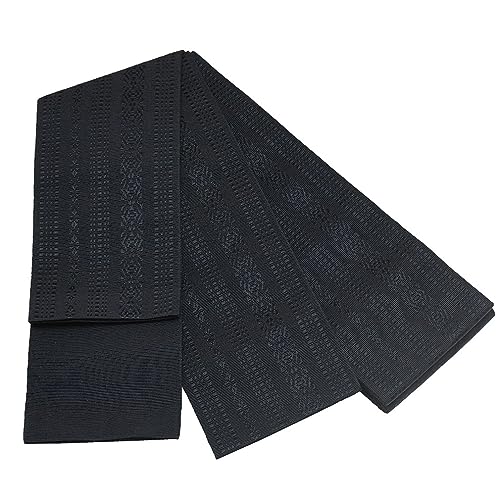
Of the roughly ten active weavers still working in the Fukuoka district under the coordination of the Hakata-Ori Industry Cooperative, Sanui Orimono (サヌイ織物) is one of the named modern workshops. The tie under review here uses the classical “kenjō-gara” (献上柄, “tribute pattern”) — the canonical Hakata design adopted in 1600 when the Kuroda clan, rulers of Fukuoka domain, made Hakata-ori a tribute (kenjō) to the Tokugawa shogunate.
This guide is for international readers considering a wearable piece of Japanese craft for business or formal use — a navy silk necktie at ¥8,910 (≈$59 USD as of May 2026) that ships internationally via Amazon JP Global Store. We cover what to expect, how it compares to other named Hakata pieces and to alternate Japanese craft accessories already reviewed on this site, and where the shopping paths actually lead from outside Japan.
🔄 Last updated
⏱️ ~12 min read
🇯🇵 Made in Fukuoka

- Who this is for — and who should skip it
- Product overview (from published specs)
- 📍 Where this comes from — Hakata, Fukuoka, and 780 years of brocade
- Which finish should you choose?
- Price snapshot across stores
- What it does well
- Weaknesses and things to verify before buying
- Conclusion — which buyer type are you?
- Other ways to approach this purchase
- 🏆 Editor’s Pick
- ❓ Frequently Asked Questions
- 📌 Related Japanese Crafts
Who this is for — and who should skip it
- Want a silk necktie with a documented Japanese craft pedigree for business or wedding wear
- Appreciate textiles where the pattern is woven into the cloth (brocade) rather than printed on top
- Prefer subdued, traditional menswear — the navy kenjō-gara reads as conservative dress
- Are buying a gift for someone who values provenance and would notice the woven striping
- Plan to keep the tie for years and care for it accordingly (dry-clean, hang to store)
- Want bold colors, novelty motifs, or printed graphics — kenjō-gara is a small geometric stripe
- Need a fully machine-washable tie for daily commuter use
- Prefer the softer drape of Italian foulard or English woven silk — Hakata-ori is structurally firmer
- Are sensitive to dry-clean-only garments or live somewhere with limited dry-cleaning access
- Have a strict budget under ~$40 USD for an accessory tie
Product overview (from published specs)
Pricing and availability below are based on the Amazon JP listing snapshot taken on May 16, 2026. Live pricing may have shifted since the writing date — always verify at the retailer before purchasing.

Hakata-Ori Silk Necktie 'Kenjō-gara' by Sanui Orimono
[サヌイ織物] 博多織 ネクタイ 斜め 献上柄 紺/工芸品 60g
通常2~3日以内に発送します。 · Sold by D-style shop · ASIN B08HRHZWK3
Price and availability as of 2026-08-31 02:30 JST. The Amazon listing at the time of purchase is authoritative. jpmono.com earns a commission on qualifying purchases at no extra cost to you.
| Source | Item | Price | Notes |
|---|---|---|---|
| 🇺🇸 Amazon.com (US, search) | Browse Japanese silk neckties & Hakata-ori | varies (USD) | Best if shopping from the US — Prime shipping, USD pricing, no customs. Sanui’s exact tie ships from Japan (next row). |
| 🇯🇵 Amazon JP Global Store | Sanui Orimono Hakata-ori necktie, navy kenjō-gara (B08HRHZWK3) | ¥8,910 (≈$59 USD) | Ships internationally from Japan; ~60 g item, $5–10 USD shipping per listing. |
| Maker direct | Sanui Orimono (sanui-orimono.jp) | Varies by line | Japanese-language site; international shipping not always offered. Use a proxy if no English checkout. |
| Proxy services (Buyee / Tenso) | Forwarding from any JP shop | Item price + ¥1,000–¥3,000 proxy fee + intl shipping | Useful when an item is JP-only and Amazon JP Global Store doesn’t carry it. Slower than Amazon JP. |
| Spec | Value |
|---|---|
| Maker | Sanui Orimono (サヌイ織物), Fukuoka |
| Pattern | Kenjō-gara (献上柄, “tribute pattern”), navy |
| Material | 100% silk, Hakata-ori brocade weave |
| Dimensions | Standard necktie, approximately 145 cm long × 8 cm at widest |
| Weight | ~60 g |
| Made in | Fukuoka, Japan |
| Care | Dry-clean only; hang for storage; roll for travel |
| Designation | METI Traditional Craft Product (1976), tradition since 1241 |
📚 Glossary — Hakata-ori terms (click to expand)
Hakata-ori (博多織) — Silk-brocade weaving tradition from Hakata, the historic merchant quarter of present-day Fukuoka City. Distinguished by thick warp threads and fine wefts producing a stiff-but-supple textile. METI Traditional Craft Product since 1976.
Kenjō-gara (献上柄, “tribute pattern”) — The canonical Hakata pattern: alternating thin and thick stripes with two recurring motifs (the dokko ritual implement and the hanazara flower-tray). Adopted as the official tribute pattern by the Kuroda clan to the Tokugawa shogunate in 1600.
Chōnaka (帯中) / kōnaka — The samurai sword-belt traditionally woven from Hakata-ori. The textile’s stiffness held a scabbard securely without slipping.
Obi (帯) — The wide sash worn with a kimono. Hakata-ori obi are prized for the audible “kishimi” creak as the fabric is tightened.
Shōichi Kokushi (聖一国師, 1202–1280) — Hakata-born Zen monk who studied in Song China and returned in 1241 with knowledge of weaving, ceramics, and noodle-making. Credited as the founder of the Hakata-ori tradition.
Kuroda clan (黒田氏) — Daimyō rulers of Fukuoka domain from 1600 to 1871, who formalized Hakata-ori as a regional industry under domain patronage.
METI Traditional Craft Product (経済産業大臣指定伝統的工芸品) — A designation by Japan’s Ministry of Economy, Trade and Industry recognizing crafts with at least 100 years of regional production tradition.
📍 Where this comes from — Hakata, Fukuoka, and 780 years of brocade

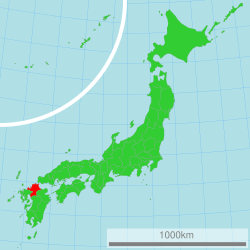
Hakata’s geography is the reason its weaving tradition exists at all. Hakata Bay opens onto the Genkai Sea, which separates Japan from the Korean peninsula by roughly 200 km of water. From the 7th century onward, this was Japan’s primary diplomatic and trading port — the landing point for monks, scholars, and merchants moving between the archipelago and the East Asian continent. Whatever new technique arrived from China or Korea typically reached Hakata before it reached Kyoto.
One such arrival was Shōichi Kokushi (聖一国師), born in 1202 in nearby Suruga and ordained as a Rinzai Zen monk. He studied in Song-dynasty China from 1235, and when he returned to Hakata in 1241 he came back with more than scriptures: he brought knowledge of silk-weaving technique, ceramic-firing methods, and noodle-milling — the last credited as the origin of Hakata’s udon and soba tradition. His companion Mitsuda Yaezō (満田弥三右衛門) developed the silk-weaving knowledge into what would become Hakata-ori over the following generations.
-
1241 — Shōichi Kokushi returns from Song China to Hakata with weaving, ceramic, and milling techniques. Mitsuda Yaezō begins refining the silk-weaving method. -
15th c. — The Mitsuda family’s descendants further refine the weave, producing the distinctive thick-warp / fine-weft structure that defines Hakata-ori. Used for samurai sword-belts (chōnaka). -
1587 — Toyotomi Hideyoshi pacifies Kyūshū; Hakata is rebuilt as a major mercantile city under his direct rule. -
1600 — Following the Battle of Sekigahara, Kuroda Nagamasa is granted Fukuoka domain. His clan presents Hakata-ori obi as annual tribute (kenjō, 献上) to the Tokugawa shogunate. The presented design becomes “kenjō-gara” — the canonical Hakata pattern. -
Edo period (1603–1868) — Kenjō-gara obi and sword-belts are produced under domain patronage; the weave becomes synonymous with Hakata in samurai households across Japan. -
1976 — METI designates Hakata-ori a Traditional Craft Product (経済産業大臣指定伝統的工芸品). -
2026 — Roughly ten active Hakata weavers — including Sanui Orimono — continue production under the Hakata-Ori Industry Cooperative.
The kenjō-gara pattern itself is more than a stripe. It combines two recurring motifs — the dokko, a ritual Buddhist implement representing severance of worldly attachments, and the hanazara, a small flower-tray — alternating between thick and thin stripes (in the classical reading, “parent” and “child” stripes, said to symbolize family continuity). The thick warp threads carry the pattern; the fine wefts compress it. The result is a textile that holds a knot crisply when tied as a necktie or grips a scabbard as a sword-belt, yet drapes smoothly enough to wrap a kimono obi.
“The Hakata-ori weave is roughly 780 years old — older than Tokugawa rule, older than the Edo period itself, and older than most European silk traditions still practiced today.”
Continuity matters here. Per the Hakata-Ori Industry Cooperative, fewer than a dozen workshops are now actively weaving — far below the late-Edo peak — and each remaining maker, including Sanui Orimono, holds the technique by direct apprentice lineage. When you buy a Sanui kenjō-gara necktie, you are buying from one of the surviving inheritors of a craft that predates the founding of most Western capitals’ guilds.
Which finish should you choose?
This piece is listed in 10 finishes. The photos below are the actual 色 options on the listing right now — pick the one you want and confirm it on the product page before ordering, since hand-finished wares vary slightly piece to piece.
![Hakata-Ori Silk Necktie 'Kenjō-gara' by Sanui Orimono — 780-Year Fukuoka Brocade Tradition (¥8,910 / ≈$59 USD) [2026 Buyer's Guide] — シルバー finish](https://m.media-amazon.com/images/I/410sUHia0OL._SL500_.jpg)
![Hakata-Ori Silk Necktie 'Kenjō-gara' by Sanui Orimono — 780-Year Fukuoka Brocade Tradition (¥8,910 / ≈$59 USD) [2026 Buyer's Guide] — エンジ(桐箱入り) finish](https://m.media-amazon.com/images/I/31Mx1yJvrUL._SL500_.jpg)
![Hakata-Ori Silk Necktie 'Kenjō-gara' by Sanui Orimono — 780-Year Fukuoka Brocade Tradition (¥8,910 / ≈$59 USD) [2026 Buyer's Guide] — オリーブ(桐箱入り) finish](https://m.media-amazon.com/images/I/41u4SyvK6FL._SL500_.jpg)
![Hakata-Ori Silk Necktie 'Kenjō-gara' by Sanui Orimono — 780-Year Fukuoka Brocade Tradition (¥8,910 / ≈$59 USD) [2026 Buyer's Guide] — パープル finish](https://m.media-amazon.com/images/I/41ws+rdQkGL._SL500_.jpg)
![Hakata-Ori Silk Necktie 'Kenjō-gara' by Sanui Orimono — 780-Year Fukuoka Brocade Tradition (¥8,910 / ≈$59 USD) [2026 Buyer's Guide] — 青(桐箱入り) finish](https://m.media-amazon.com/images/I/31URvh0Jj4L._SL500_.jpg)
![Hakata-Ori Silk Necktie 'Kenjō-gara' by Sanui Orimono — 780-Year Fukuoka Brocade Tradition (¥8,910 / ≈$59 USD) [2026 Buyer's Guide] — ゴールド finish](https://m.media-amazon.com/images/I/41-gxISK0LL._SL500_.jpg)
Price snapshot across stores
Pricing as of May 16, 2026. JPY is the authoritative price. USD figures are approximate at a ¥150/USD baseline rate.
| Store | Item / Variant | Price (JPY + USD est.) | Notes |
|---|---|---|---|
| 🇺🇸 Amazon.com (US) | Browse Japanese silk neckties & Hakata-ori | Varies (USD) | Best if you’re shopping from the US — Prime shipping, USD pricing, no international customs. Amazon US carries Japanese silk neckties from several makers; Sanui Orimono’s exact kenjō-gara piece is sourced from Japan (next row). |
| 🇯🇵 Amazon JP Global Store | Sanui Orimono Hakata-ori necktie, navy kenjō-gara (B08HRHZWK3) | ¥8,910 (≈$59 USD) | Ships internationally from Japan; ~60 g item, shipping typically $5–10 USD per listing. The sourced listing for this guide. |
| Maker direct | Sanui Orimono (sanui-orimono.jp) | Varies by line | Japanese-language site, broader range of patterns and colors. International checkout is not always supported — use a proxy service if needed. |
| Proxy services (Buyee / Tenso) | Forwarding from Sanui direct or any JP boutique | Item price + ¥1,000–¥3,000 proxy fee + intl shipping | Use this path for variants not listed on Amazon JP Global Store. Adds 1–3 weeks to delivery and a markup on shipping. |
What it does well
Weaknesses and things to verify before buying
- Dry-clean only. Silk brocade cannot be machine-washed, and water spotting is permanent. If you live somewhere with limited dry-cleaning access, the tie’s care cost over its lifetime will add up.
- The pattern is subtle. Kenjō-gara is a small repeating geometric stripe. From across a meeting room it reads as “a navy tie” — the brocade detail is visible only at conversational distance. Buyers expecting an obvious motif may be disappointed.
- Firmer drape than Italian silk. Hakata-ori’s structural stiffness is by design, but if you’re accustomed to soft Italian foulards or English ancient-madder ties, the firmness may feel unusual at first.
- One width only. The listed dimensions (~145 cm × 8 cm) are a standard Japanese cut. International buyers used to extra-long ties (152+ cm) or slim cuts (6 cm) will not find those options in this specific listing.
- Color is limited to navy in this listing. Other Sanui kenjō-gara colorways exist (indigo, wine, brown), but availability on Amazon JP Global Store is intermittent. If a specific color matters, plan to use a proxy.
- Pricing snapshot only. ¥8,910 reflects the listing on May 16, 2026. Silk prices fluctuate with raw-material cost; verify before purchase.
- Customs / VAT for high-value EU and UK orders. The item itself is under typical de-minimis thresholds for the US, but EU customers may see VAT applied on import. Check your country’s threshold (often €150 / £135) before ordering.
Conclusion — which buyer type are you?
Other ways to approach this purchase
🏆 Editor’s Pick
❓ Frequently Asked Questions
Does this necktie ship outside Japan?
Is silk Hakata-ori durable enough for daily business wear?
What makes kenjō-gara different from other Hakata patterns?
How do I care for a silk Hakata-ori necktie?
Is this a suitable gift for a non-Japanese recipient?
Why is woven silk brocade more expensive than printed silk?
How does Sanui Orimono compare to other named Hakata weavers?
jpmono.com is curated by a Japan-based editorial team (working out of Toyama in the Hokuriku region and Nara in Kansai) and is independent. We don’t take payment from the makers we feature; income comes from affiliate links. Read more about our editorial standards.
🤖 This article was researched and drafted with AI assistance from product spec sheets and the cited historical sources, then reviewed by a Japan-based editor before publication. Specs, prices, and availability reflect public listings on the writing date and may have changed since.
Affiliate disclosure: jpmono.com may earn a commission on qualifying purchases made through links on this page, at no additional cost to you.