![Shimazu Satsuma Kiriko ‘Jewel’ Two-Color Sake Cup — Edo-Era Kagoshima Cut Glass, Revived 1985 (¥29,700 / ≈$198 USD) [2026 Buyer’s Guide]](https://jpmono.com/wp-content/uploads/2026/05/satsuma-kiriko-shimazu-jewel-sake-cup-where-to-buy-2026-featured.jpg)
Satsuma Kiriko (薩摩切子) is the luxury cut-glass tradition founded in 1851 by Lord Shimazu Nariakira at his Shūseikan industrial complex in Kagoshima — the southern tip of Kyushu, at the edge of the Japanese archipelago. The original kilns ran only 26 years before the Satsuma Rebellion of 1877 destroyed the workshops and dispersed the craftspeople; many of those refugees moved north to Tokyo and seeded what we now recognize as colored Edo Kiriko. The Satsuma line itself then lay dormant for 108 years.
The revival began in 1985 at the same Sengan-en estate where Nariakira’s original workshop had stood, run by Shimazu Kōgyō (the modern Shimazu-family company). Distinguished from Edo Kiriko by its signature nishoku-gise (二色衣, “two-color overlay”) — two colors of glass layered before cutting, producing distinctive bokashi (gradient) effects when the cuts reveal the underlying color — Shimazu’s current line carries forward the canonical 1850s palette of lapis, crimson, green, gold-amber, and indigo.
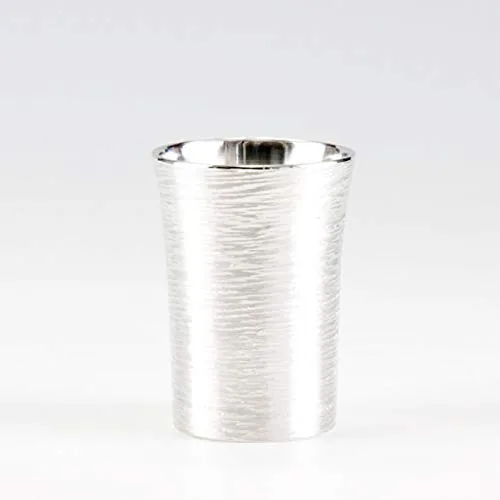
This guide covers the Shimazu Satsuma Kiriko “Jewel” (寿恵瑠) two-color sake cup in lapis-and-green — at ¥29,700 (approximately $198 USD as of May 2026) it is the entry tier to Shimazu-direct production. The article walks the 175-year arc from Lord Nariakira to today’s Sengan-en kilns, the distinction between Satsuma and Edo Kiriko, and the practical realities of buying a fragile glass piece internationally.
🔄 Last updated:
⏱️ Read time: ~14 min
🏷️ Category: Japanese Craft / Glass

- Who this is for — and who should skip it
- Product overview (from published specs)
- Which finish should you choose?
- 📦 Shipping & where to buy from outside Japan
- Price snapshot across stores
- What it does well
- Weaknesses and things to verify before buying
- 📍 Where this comes from — place, era, and the craft tradition
- Conclusion — which buyer type are you?
- Other ways to approach this purchase
- 🏆 Editor’s Pick
- ❓ Frequently Asked Questions
- 📌 Related Japanese Crafts
Who this is for — and who should skip it
- Collect 19th-century Japanese craft and want a piece tied directly to the Shimazu daimyō line
- Already own an Edo Kiriko piece and want to compare the parent Satsuma technique (nishoku-gise)
- Are buying a one-piece tasting cup for premium sake (junmai daiginjō at the 45 ml pour size)
- Want presentation-box-grade gift packaging from a named historical workshop
- Have $200-ish USD and are not yet ready to step up to the ¥40,000+ glasses
- Want a daily-use sake cup — the cut edges are fragile, and dishwashers will damage them
- Are buying for cold-sake or whisky pours (125 ml is closer; see the cut01 line at ¥37,400–¥39,600)
- Need a matched pair — this listing is a single cup
- Are uncomfortable with international shipping for fragile glass (3–5% transit breakage)
- Prefer the iconic crimson (kurenai) — this listing is lapis-and-green; crimson appears in the cut01 line
Product overview (from published specs)
Specifications below are taken from the Amazon JP listing for B0GSCY7CTZ as of the writing date. Live pricing may have shifted since.
Shimazu Satsuma Kiriko 'Jewel' Two-Color Sake Cup
島津薩摩切子 二色酒盃 寿恵瑠 (ジュエル) 薩摩切子 二色衣 薩摩ガラス工芸 鹿児島 (ルリ緑)
残り1点 ご注文はお早めに · Sold by RAIRAI(ライライ) · ASIN B0GSCY7CTZ
Price and availability as of 2026-08-31 02:30 JST. The Amazon listing at the time of purchase is authoritative. jpmono.com earns a commission on qualifying purchases at no extra cost to you.
| Spec | Detail (per listing) |
|---|---|
| Maker | Satsuma Glass Crafts (薩摩ガラス工芸) — Shimazu Kōgyō, Sengan-en, Kagoshima |
| Product line | “Jewel” (寿恵瑠) two-color sake cup, nishoku-gise (二色衣) |
| Material | Hand-cut crystal glass — clear inner layer, lapis-blue (ruri 瑠璃) + green outer overlays |
| Dimensions | Approximately H 4.2 × ⌀ 6 cm; ~45 ml capacity |
| Weight | Approximately 130 g |
| Made in | Kagoshima City, Kagoshima Prefecture, Japan (Sengan-en workshop) |
| Price (JPY) | ¥29,700 (≈ $198 USD as of May 2026, ¥150/USD baseline) |
| Packaging | Formal presentation box with Shimazu provenance documentation |
| International shipping | Amazon JP Global Store to US/EU/AU/CA; ~$20-40 USD; ~3-5% transit breakage rate for glass |
| ASIN | B0GSCY7CTZ |
Prices in USD are approximate and depend on the current exchange rate. The JPY figure on the Amazon JP listing is the authoritative price.
📖 Glossary — key terms used in this article
Satsuma Kiriko (薩摩切子) — the Kagoshima cut-glass tradition founded by Lord Shimazu Nariakira in 1851; characterized by deep wheel-cut patterns through colored overlay glass.
Nishoku-gise (二色衣) — literally “two-color clothing.” The signature Satsuma technique of layering two colors of glass over a clear core before cutting. The cuts reveal both colors at different depths, producing a gradient (bokashi) effect at every facet.
Bokashi (ぼかし) — a graduated color transition. In Satsuma Kiriko, the soft visual fade where the cut depth crosses from one colored layer into the next.
Kiriko (切子) — Japanese term for cut glass; literally “cut piece.” Both Satsuma Kiriko and Edo Kiriko fall under this umbrella.
Edo Kiriko (江戸切子) — the Tokyo cut-glass tradition founded in 1834 (17 years before Satsuma Kiriko). Originally worked clear glass only; absorbed colored-overlay technique after 1877 when refugee Satsuma craftspeople fled north.
Shimazu Kōgyō (島津興業) — the modern Shimazu-family company that operates Sengan-en, runs Satsuma Glass Crafts, and revived the Satsuma Kiriko tradition in 1985.
Sengan-en (仙巌園) — the historic Shimazu-family summer estate in Kagoshima, 5 km north of Kagoshima Station, where the original 1851 Shūseikan workshop stood and where today’s Satsuma Glass Crafts kiln still operates.
Shimazu Nariakira (島津斉彬, 1809-1858) — 28th lord of Satsuma; founder of Satsuma Kiriko; one of the leading reform-minded daimyō of late-Edo Japan.
Shūseikan (集成館) — Nariakira’s integrated industrial complex at Sengan-en, encompassing a reverberatory furnace, glass works, textile mill, and porcelain workshop. The original Satsuma Kiriko kiln was a Shūseikan facility.
Kurenai (紅) — crimson; the rarest and most iconic Satsuma Kiriko color, produced with copper oxide and demanding precise firing.
Ruri (瑠璃) — lapis-blue, cobalt-colored. One of the canonical 1850s Satsuma colors and the primary outer layer on this “Jewel” cup.
Which finish should you choose?
This piece is listed in 3 finishes. The photos below are the actual 色 options on the listing right now — pick the one you want and confirm it on the product page before ordering, since hand-finished wares vary slightly piece to piece.
![Shimazu Satsuma Kiriko 'Jewel' Two-Color Sake Cup — Edo-Era Kagoshima Cut Glass, Revived 1985 (¥29,700 / ≈$198 USD) [2026 Buyer's Guide] — 蒼黄緑 finish](https://m.media-amazon.com/images/I/41O8m4eo5fL._SL500_.jpg)
![Shimazu Satsuma Kiriko 'Jewel' Two-Color Sake Cup — Edo-Era Kagoshima Cut Glass, Revived 1985 (¥29,700 / ≈$198 USD) [2026 Buyer's Guide] — ルリ金赤 finish](https://m.media-amazon.com/images/I/41XUSrocXsL._SL500_.jpg)
📦 Shipping & where to buy from outside Japan
Glass shipping internationally is workable but requires patience. Shimazu Kōgyō packages this cup in heavy double-boxed protection inside the formal presentation box; transit breakage on Amazon JP Global Store shipments runs approximately 3–5% by historical observation. If a piece arrives damaged, Amazon JP’s standard return process applies, but the replacement is a fresh international shipment — figure on a 3–4 week round-trip in that scenario.
Amazon JP Global Store ships this 130 g item to the US, EU, AU, CA, and most major destinations. Shipping costs run approximately $20–40 USD depending on destination and protection class. Direct purchase from the Sengan-en e-commerce site is possible for international buyers but the workshop typically prices in JPY at parity with Amazon JP and shipping is comparable.
For customs, declare as “hand-cut decorative glassware.” Glass household items are not restricted personal-import under US, EU, AU, or CA customs regimes, though VAT/sales-tax thresholds apply (e.g., EU import VAT applies above €150; US de minimis is $800 federal).
Price snapshot across stores
| Store | Item / Variant | Price | Notes |
|---|---|---|---|
| 🇺🇸 Amazon.com (US) | Browse Japanese cut-glass sake cups | varies (USD) | Best if you’re shopping from the US — Prime shipping, USD pricing, no international customs. Amazon US carries Edo Kiriko and assorted Japanese cut-glass alternatives. The specific Shimazu “Jewel” piece is sourced from Japan (next row). |
| 🇯🇵 Amazon JP Global Store | Shimazu “Jewel” — lapis & green (B0GSCY7CTZ) | ¥29,700 (≈ $198 USD) | Ships internationally from Japan. ~$20-40 USD shipping. Double-boxed packaging; 3-5% transit breakage rate is typical for glass. |
| Maker direct (Sengan-en) | Full Satsuma Glass Crafts catalog | ¥29,700 (parity) | On-site sales at Sengan-en in Kagoshima, plus international shipping by request. Sometimes lists pieces not yet on Amazon JP. |
| Proxy services (Buyee / Tenso) | Any Japan-listed Satsuma Kiriko piece | ¥29,700 + proxy fee + reshipping | Useful if Amazon JP Global Store does not ship to your country or if you want to combine multiple JP listings. Adds 10–15% to total cost. |
What it does well
Weaknesses and things to verify before buying
- Dishwashers will damage the cut edges. Hand-wash is mandatory. Mechanical agitation and high-temperature rinse cycles micro-fracture the cut facets over repeated cycles. Per the listing’s care notes, polish with a soft cloth.
- Thermal shock risk. Pouring hot sake (kanzake at 45–50°C) directly into a chilled cup, or vice versa, concentrates stress at the cut edges. Bring the cup to room temperature before any temperature transition.
- International transit breakage runs 3–5%. Glass shipped internationally has measurable damage rates. Amazon JP’s protection class for fragile items is reasonable but not perfect. Inspect the package on arrival and document any damage before opening fully.
- Single cup, not a pair. The listing covers one cup. If you want a matched pair, the B07C9YRPT4 mini-cup pair (from a different Kagoshima workshop) runs ¥27,500 — but it lacks the Shimazu-direct provenance.
- Color preference matters. This listing is the lapis-and-green pairing. If you specifically want crimson (kurenai), the Shimazu cut01 crimson at ¥39,600 is the closest Shimazu-direct equivalent — but it is a 125 ml cold-sake glass, not a 45 ml sake cup, and uses single-overlay rather than nishoku-gise.
- Color fading risk in direct sunlight over decades. The colored layers are pigmented and slowly fade in direct sunlight over very long timescales. If displayed open in a sunny window, rotate the cup occasionally to even out exposure. For collectors, the original presentation box is the recommended storage.
- Pricing snapshot only. Per the data notes, the Amazon JP listing snapshot is the source of truth as of writing; live pricing may have shifted since May 2026. Verify on the listing before purchase.
📍 Where this comes from — place, era, and the craft tradition

The region — Kagoshima, southern Kyushu
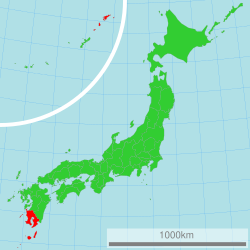
Kagoshima (鹿児島) is a city of approximately 600,000 people at the southern tip of Kyushu, on the Pacific (Kagoshima Bay) coast. Mount Sakurajima — one of Japan’s most active volcanoes — dominates the view across the bay from central Kagoshima, with daily ash plumes that periodically blanket the city. Kagoshima Airport (KOJ) carries international connections to Seoul, Shanghai, and Taipei; by rail the city sits 2.5 hours from Fukuoka (Hakata) on the Kyushu Shinkansen and 5 hours from Tokyo via Tokaido-Sanyo and Kyushu Shinkansen.
The Satsuma Glass Crafts workshop sits at the Sengan-en (仙巌園) estate — the historic Shimazu-clan summer residence — 5 km north of Kagoshima Station, reachable by city bus. The estate itself is open daily 9:00–17:00 (admission ¥1,000) and includes the original 1851 Shūseikan workshop site, the Shōko Shūseikan museum (with surviving 19th-century Satsuma Kiriko pieces), and the active modern kiln where visitors can watch cutters at work.
Geographically, Kagoshima Bay’s location at the southern tip of Kyushu placed it at the forefront of Japan’s contact with the outside world through the 16th–19th centuries. Portuguese, Dutch, and Chinese traders reached Kagoshima before any other Japanese port; the Shimazu daimyō, who ruled Satsuma province, were unusually open to foreign technology. This is the geographical foundation of Satsuma Kiriko: a daimyō with international contacts, a port with foreign technology access, and the political will to fund advanced craft experimentation.
Kagoshima is also mythically the “beginning” of Japan in the Kojiki (712 CE) — Ninigi-no-Mikoto’s descent from the heavens onto Takachiho-no-mine is variously located at Takachiho in northern Miyazaki and at Takachiho-no-mine (1,574 m) on the Kagoshima–Miyazaki border. The Kagoshima version places the imperial-line founding at Mount Takachiho-no-mine.
The historical anchor — 1851, Lord Shimazu Nariakira
Satsuma Kiriko has a precise founding date: 1851 (Kaei 4). In that year, Shimazu Nariakira (島津斉彬, 1809–1858), the 28th lord of Satsuma, established a glass workshop at his Shūseikan (集成館) industrial complex in Kagoshima.
Nariakira was an exceptional figure in late-Edo Japan. He was one of the small group of daimyō who recognized that Japan needed to modernize technologically to resist Western imperialism; he established the Shūseikan as a Japan-first integrated industrial complex, with a reverberatory furnace for cast iron, a glass works, a textile mill, a porcelain workshop, and a Western-style ship-building yard. The strategic motivation was modern weaponry and industry. The cultural side product was an explosion of craft innovation.
-
1834 — Edo Kiriko founded in Tokyo by Kaga-ya Kyūbei (clear glass only, predates Satsuma by 17 years) -
1851 — Lord Shimazu Nariakira founds the Satsuma Kiriko kiln at the Shūseikan complex -
1856–1858 — Peak production: nishoku-gise developed; canonical palette of crimson, lapis, green, gold-amber, indigo established -
1858 — Lord Nariakira dies (suspected poisoning, never confirmed); successor abandons the costly glass workshop -
1877 — Satsuma Rebellion (Saigō Takamori’s uprising) destroys Kagoshima and the Shūseikan; surviving cutters flee to Tokyo, modernize Edo Kiriko -
1877–1985 — 108-year dormancy. Pieces survive in Tokyo National Museum, Shōko Shūseikan, and private collections -
1985 — Shimazu Kōgyō revives the tradition; Satsuma Glass Crafts established at Sengan-en, with technique reconstructed from museum pieces -
2002 — Satsuma Kiriko designated a Kagoshima-prefecture Traditional Craft -
2010s onward — International export through luxury retailers; pieces enter the British Museum and MFA Boston collections -
2026 — Satsuma Glass Crafts at Sengan-en is the central Shimazu-line workshop; Yamashita Kōgei and other Kagoshima workshops operate alongside it
The Satsuma glass workshop combined three technical inputs. First, Chinese colored-glass technology, brought to Kagoshima via Ryūkyū (Okinawa) trade — Chinese craftsmen had been producing colored overlay glass for centuries, and Nariakira hired specialists to teach the technique. Second, European glass-cutting, with Western samples reaching Kagoshima through Dutch traders, leading to commissioned Japanese reverse-engineering of wheel-cutting equipment. Third, Japanese decorative aesthetics — the workshop’s lead designer drew on Japanese textile and ceramic motifs for the cut patterns.
The result, by 1856–1858, was Satsuma Kiriko: clear crystal glass with one or two layers of colored glass overlaid, then deeply wheel-cut to reveal the underlying color. The signature technique — nishoku-gise (二色衣, “two-color overlay”) — placed two different colors of glass on top of clear, producing the characteristic Satsuma bokashi (ぼかし, gradient) effect when the cuts revealed both colors at different depths.
The canonical Satsuma Kiriko color palette developed under Nariakira:
- Kurenai (紅, crimson) — the rarest and most iconic, colored with copper oxide and requiring precise firing temperature
- Ruri (瑠璃, lapis-blue) — cobalt-colored; the primary outer layer on this “Jewel” cup
- Midori (緑, green) — chrome- or iron-colored; the second outer layer on this cup
- Kin-aka (金赤, gold-amber) — with traces of gold
- Ai (藍, indigo)
- Murasaki (紫, violet) — manganese-colored
Production in the 1856–1858 period was small — perhaps a few hundred pieces — but the quality and Shimazu provenance made the pieces prestige diplomatic gifts.
Nariakira’s death and the long decline (1858–1877)
Lord Nariakira died in 1858. The cause was suspected poisoning by political rivals within the Shimazu clan, though never confirmed. His successor, his half-brother Hisamitsu, did not share Nariakira’s industrial-craft enthusiasm. The Shūseikan complex continued to operate, but the glass workshop’s output declined steadily. By the early 1870s, Satsuma Kiriko production had effectively ended; surviving craftspeople retired or relocated.
The final blow came in 1877 with the Satsuma Rebellion — Saigō Takamori’s failed uprising against the new Meiji government. The fighting destroyed much of Kagoshima city; the Shūseikan complex was burned; and the surviving Satsuma Kiriko craftspeople fled north to Tokyo, where they joined the developing Edo Kiriko workshops in Sumida-ku and Kōtō-ku.
“Modern Edo Kiriko’s overlay-and-cut style — distinct from the original 1834 clear-glass Edo Kiriko — is the result of a technical transfer from defeated Satsuma craftspeople after 1877. The Tokyo tradition we now buy descends from the Kagoshima one that was destroyed.”
The 108-year dormancy (1877–1985)
From 1877 to 1985, Satsuma Kiriko effectively did not exist as a continuous tradition. Surviving pieces accumulated in museum collections — Tokyo National Museum holds the major institutional collection; Sengan-en’s Shōko Shūseikan preserves pieces at the original workshop site; the Kagoshima Prefectural Museum and various private collections (including Shimazu family heirlooms and foreign dignitary collections) hold the rest. During this period, Satsuma Kiriko was a historical curiosity rather than a living craft. Edo Kiriko, having absorbed the technique, was the only Japanese cut-glass tradition in continuous production.
The 1985 revival
The modern revival began in 1985, when Shimazu Kōgyō (島津興業) — the Shimazu family company that operates Sengan-en and various Shimazu-related cultural assets — established Satsuma Glass Crafts (薩摩ガラス工芸) at the historic Sengan-en estate. The revival was carefully researched: glass historians studied surviving Satsuma Kiriko pieces in museum collections to identify the original color formulations; Edo Kiriko craftspeople (descended from the 1877 Satsuma refugees) were consulted on historical cutting techniques; and a team of glass chemists at Kagoshima University reverse-engineered the colored-glass compositions, particularly the difficult crimson (kurenai).
The first revived pieces were produced in 1985–1988; commercial production began in earnest in the 1990s.
The 1985 revival was unusual in Japanese craft history for the depth of its historical reconstruction. Unlike crafts that maintain continuous lineage (Kobaien sumi since 1577, Tokoname-yaki since the 12th century), Satsuma Kiriko required scholarly forensics to recover the technique. The result is that modern Satsuma Kiriko is both authentic — reconstructed from period pieces — and distinct from its 19th-century original, since the reconstruction was informed by Edo Kiriko’s continuous development. In 2026, Satsuma Glass Crafts at Sengan-en is the central workshop; smaller named workshops (Yamashita Kōgei, Kameida Glass, others) operate elsewhere in Kagoshima Prefecture.
The product — Shimazu “Jewel” nishoku-gise sake cup
The “Jewel” (寿恵瑠, suzeru) is one of Shimazu Kōgyō’s signature contemporary Satsuma Kiriko pieces. The cup is 45 ml — sized for a single sake tasting — and features the canonical nishoku-gise technique: clear inner crystal, with lapis-blue and green outer layers cut in a multi-faceted pattern that reveals both colors and the underlying clear glass at different depths.
For an international buyer, the product carries direct Shimazu provenance (produced at Sengan-en, the original 1851 workshop location, by the Shimazu family company); the authentic 1851 color palette (lapis and green were both in the original 1856–1858 Satsuma set); the authentic nishoku-gise technique that defines Satsuma Kiriko versus Edo Kiriko; and formal presentation packaging with Shimazu-branded box and provenance documentation.
Visiting Sengan-en
Sengan-en (仙巌園) is open daily 9:00–17:00; admission ¥1,000. The estate includes the original 1851 Shūseikan workshop site, the Shōko Shūseikan museum (with surviving 19th-century Satsuma Kiriko pieces displayed alongside Shimazu-family artifacts), and the active Satsuma Glass Crafts workshop where visitors can watch cutters at work. Sakurajima volcano is a 15-minute, ¥200 ferry from Kagoshima Port; hiking trails on the lower slopes are open year-round. Ibusuki onsen, with its famous sand-bath hot springs, is one hour south of Kagoshima.
Conclusion — which buyer type are you?
Other ways to approach this purchase
🏆 Editor’s Pick
Shimazu Satsuma Kiriko “Jewel” (寿恵瑠) Two-Color Sake Cup — Lapis & Green (B0GSCY7CTZ)
¥29,700 (≈ $198 USD as of May 2026)
- Shimazu Kōgyō direct production — the Shimazu family company that revived Satsuma Kiriko in 1985 at the original 1851 workshop site
- Nishoku-gise (二色衣) two-color overlay — the signature technique that distinguishes Satsuma from Edo Kiriko
- The most accessible Shimazu-direct entry point; the cold-sake glasses run ¥37,400–¥39,600, the Two-Color Cloth line runs ¥40,700–¥55,000
❓ Frequently Asked Questions
What is the difference between Satsuma Kiriko and Edo Kiriko?
Is this dishwasher-safe?
Can I use this for hot sake (kanzake)?
Does Amazon JP Global Store ship this internationally?
Why is this lapis-and-green pairing the recommended one?
Can I visit the workshop?
Is the crimson (kurenai) available in this Jewel line?
jpmono.com is curated by a Japan-based editorial team (working out of Toyama in the Hokuriku region and Nara in Kansai) and is independent. We do not take payment from the makers we feature; income comes from affiliate links. Read more about our editorial standards.
📝 AI-assistance note: this article was drafted with AI-assisted research from the Amazon JP listing snapshot and editorial knowledge of Satsuma Kiriko history; all factual claims about pricing, dimensions, and listing details were taken from the verified data file as of May 16, 2026, and may shift with subsequent listing updates. Historical context cross-references Shimazu Kōgyō and Sengan-en published materials.
Affiliate disclosure: jpmono.com may earn a commission on qualifying purchases made through links on this page, at no additional cost to you.