![Tsubame Tsuiki Copper Sake Warmer (Chirori) by Sinkoukinzoku — Hand-Hammered 330ml in Niigata’s Coppersmith Town (¥15,400 / ≈$103 USD) [2026 Buyer’s Guide]](https://jpmono.com/wp-content/uploads/2026/05/sinkoukinzoku-tsubame-tsuiki-chirori-where-to-buy-2026-featured-1265x1050.jpg)
The Sinkoukinzoku SN-21 (新光金属 SN-21) is a 330 ml hand-hammered copper chirori — a sake-warming vessel — made in Tsubame (燕市), in central Niigata Prefecture on the Sea of Japan coast. At ¥15,400 (approximately $103 USD as of May 2026 at a ¥150/USD baseline), it sits in the entry tier of real Tsubame tsuiki (燕鎚起銅器), the hand-hammered copperware tradition that has been continuously practiced in Tsubame since 1816, when the founding workshop Tamagawa-dō (玉川堂) opened its doors. Tsubame tsuiki was designated a METI Traditional Craft Product (伝統的工芸品) in 1981.
What distinguishes this chirori from the machine-spun copper pieces in the ¥3,000–¥5,000 bracket is the tsuiki technique itself — literally “rising by hammer.” A single sheet of copper is raised into a seamless three-dimensional vessel through tens of thousands of precise hammer strikes over several days. There is no cutting, no welding, no folding. The visible texture across the body is the hammer mark (kankome 鎚目), which is the tactile signature of the tradition. Sinkoukinzoku is a named Tsubame workshop, which is the principal way to verify that a piece is authentic Tsubame tsuiki rather than a generic Asian-import copper imitation.
This guide, written from a Japan-based editorial perspective with desks in Toyama (Hokuriku) and Nara (Kansai), walks through who Tsubame is, why hand-hammered copper is the traditional sake-warming material, where Sinkoukinzoku sits in the Tsubame workshop hierarchy, and how an international reader can actually buy this piece. The reference data is the Amazon JP listing snapshot for ASIN B0GJ9JW5M6 as of May 16, 2026; live pricing may have shifted since the writing date.
🔄 Last updated
⏱ About 16 min read
📍 Edited from Toyama & Nara

- Who this is for — and who should skip it
- Product overview (from published specs)
- 📍 Where this comes from — place, era, and the craft tradition
- The region on the map — Niigata Prefecture and the Echigo Plain
- The historical anchor — 1816, Tamagawa Tarōsuke, and the Tamagawa-dō workshop
- The tsuiki technique — what “rising by hammer” actually means
- The chirori and the Japanese sake-warming culture
- What “still being made in Tsubame” actually means
- Visiting Tsubame — for the curious traveler
- 📦 Shipping & where to buy from outside Japan
- Price snapshot across stores
- What it does well
- Weaknesses and things to verify before buying
- Conclusion — which buyer type are you?
- Other ways to approach this purchase
- 🏆 Editor’s Pick
- ❓ Frequently Asked Questions
- 📌 Related Japanese Crafts
Who this is for — and who should skip it
- Drink warm sake (nuru-kan, jō-kan, atsu-kan) and want a temperature-precise warming vessel.
- Want a verifiable Tsubame tsuiki piece without paying the ¥40,000+ Tamagawa-dō direct-workshop premium.
- Are buying a thoughtful gift in the ¥10,000–¥20,000 (≈$70–$135 USD) range for a sake-enthusiast recipient.
- Appreciate objects with continuous, documented craft lineage (Tsubame copperware, since 1816; METI-designated in 1981).
- Are willing to hand-wash, dry immediately, and let a patina develop over years of use.
- Only drink sake cold (the chirori’s thermal advantage is wasted on chilled pours).
- Serve groups larger than two — 330 ml is single-serving (one gō); larger gatherings need multiple vessels or a tokkuri ladder.
- Want a dishwasher-safe everyday piece (copper requires hand-wash and immediate drying).
- Prefer the deeper austerity of unglazed ceramic tokkuri (Bizen, Karatsu, Iga) — those are a different aesthetic tradition.
- Want the absolute top tier of Tsubame tsuiki — for that, the Tamagawa-dō direct-workshop chirori at ¥40,000+ is the canonical premium.
Product overview (from published specs)
The table below summarizes the Amazon.co.jp listing for ASIN B0GJ9JW5M6 as of May 16, 2026. Material and form specifications reflect Sinkoukinzoku’s published product information. Live Amazon JP pricing may have shifted since the writing date — verify at the retailer before purchase.
Tsubame Tsuiki Copper Sake Warmer (Chirori) by Sinkoukinzoku
新光金属 SN-21 新鎚起銅器 銅製 手打ち チロリ 酒たんぽ 1合 330ml ギフト プレゼント
残り1点 ご注文はお早めに · Sold by 越後黄金屋 · ASIN B0GJ9JW5M6
Price and availability as of 2026-08-31 02:30 JST. The Amazon listing at the time of purchase is authoritative. jpmono.com earns a commission on qualifying purchases at no extra cost to you.
| Spec | Detail |
|---|---|
| Model | SN-21 |
| Form | Chirori (チロリ) / sake-tanpo (酒たんぽ) — sake-warming vessel with handle and pouring spout |
| Capacity | 1-gō (一合) / approximately 330 ml — the canonical Japanese single-serving sake volume |
| Dimensions | Approximately ⌀ 8 cm × H 13 cm (with handle) |
| Weight | Approximately 200–250 g |
| Material | Hand-hammered solid copper (純銅 jundō), single-sheet construction via the tsuiki technique. Interior may be tin-lined for sake contact — verify per piece. |
| Origin | Tsubame City, Niigata Prefecture, Japan |
| Maker | Sinkoukinzoku (新光金属) — a named Tsubame workshop at the entry-mid tier of Tsubame tsuiki |
| Tradition | Tsubame tsuiki dōki (燕鎚起銅器) — METI Traditional Craft Product, designated 1981 |
| Listing price (Amazon JP) | ¥15,400 (≈ $103 USD as of May 2026) |
| Seller | Sinkoukinzoku on Amazon JP — Amazon JP Global Store eligible (ships internationally) |
Source: Amazon.co.jp listing as of May 16, 2026 (ASIN B0GJ9JW5M6). USD figures are estimates at a ¥150/USD baseline; the JPY price is authoritative. Only the Amazon JP listing snapshot is available; live pricing may have shifted since the writing date.
📖 Glossary — Japanese terms used in this article
Tsuiki (鎚起) — literally “rising by hammer.” A copper-forming technique in which a flat copper sheet is raised into a seamless vessel through tens of thousands of hammer strikes. No cutting, welding, or folding.
Tsubame tsuiki dōki (燕鎚起銅器) — Tsubame hand-hammered copperware. METI-designated Traditional Craft Product since 1981. The only Japanese craft producing hand-hammered copperware at internationally recognized quality.
Chirori (チロリ) / sake-tanpo (酒たんぽ) — the canonical Japanese sake-warming vessel. Filled with cold sake, then immersed in a hot-water bath; copper conducts heat fast and evenly, warming the sake without scorching.
Gō (合) — a traditional Japanese volume unit. 1-gō ≈ 180 ml as a dry rice measure, but in the sake-vessel context 1-gō chirori typically hold 300–330 ml (a single drinker’s session pour). 10 gō = 1 shō (升).
Kankome (鎚目) — “hammer mark.” The visible, tactile dimpling on the copper surface where the hammer struck. The signature visual texture of Tsubame tsuiki.
Yu-zōke (湯漬け) — “hot-water immersion.” The traditional sake-warming method: the chirori is set into a pot of hot water (typically 55–65 °C) for 2–5 minutes until the sake reaches the desired temperature.
Atsu-kan (熱燗) / jō-kan (上燗) / nuru-kan (ぬる燗) — the sake-warming temperature scale. Hot (50 °C) / high warm (45 °C, standard everyday) / tepid (40 °C). See the full scale below.
Shokunin (職人) — a craftsperson trained through long apprenticeship; the word implies vocation more than employment.
Tamagawa-dō (玉川堂) — the founding Tsubame tsuiki workshop, established in 1816 by Tamagawa Tarōsuke. Still operating in its 7th generation; the historical and prestige anchor of the entire Tsubame tradition.
Tsubame-Sanjō (燕三条) — the modern stainless-steel cluster formed by Tsubame and the adjacent Sanjō City, internationally famous today for GLOBAL knives, Misono knives, and stainless tableware. A separate, later tradition from tsuiki.
📍 Where this comes from — place, era, and the craft tradition

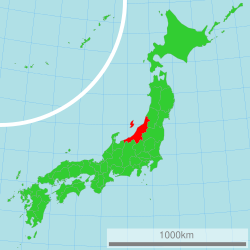

The region on the map — Niigata Prefecture and the Echigo Plain
Niigata Prefecture (新潟県) sits on the Sea of Japan coast of central-northern Honshū, in what historical geography called the Echigo Province (越後国). The prefecture is dominated by the Echigo Plain, a broad alluvial basin formed by the Shinano River — at 367 km the longest river in Japan — and the Agano River. The plain produces some of Japan’s most celebrated short-grain rice (Koshihikari was developed here in the 1950s) and, by direct consequence of that rice, some of Japan’s most celebrated sake (Hakkaisan, Kubota, Koshi-no-Kanbai, Niigata-bijin).
Tsubame City (燕市, approximately 80,000 residents) sits in the central Echigo Plain at the confluence of the Shinano and Naka rivers. Both were navigable through the Edo period, providing transport access for raw materials and finished goods — copper ingots arriving by river, finished kettles and chirori shipping out. For an international reader: Tsubame is about 250 km northwest of Tokyo, about 2 hours by Joetsu Shinkansen plus a short transfer to the local Yahiko Line; 40 minutes south of Niigata city; and 5 km north of the adjacent Sanjō City, with which it forms the modern Tsubame-Sanjō industrial cluster. The closest international airport is Niigata Airport (KIJ), about 50 km north.
Two geographic features shaped the local metalworking economy. First, heavy snowfall — two to three meters annually in the inland foothills — historically forced indoor winter work, which suited the patient, indoor labor of hammer-shaping copper. Second, the river-port access made Tsubame a natural distribution center long before rail. By the late Edo period, Tsubame was already a recognized small-tool town producing nails, awls, and farm implements; the shift into copperware was a refinement of an existing metalworking ecology, not a new industry built from nothing.
The historical anchor — 1816, Tamagawa Tarōsuke, and the Tamagawa-dō workshop
-
1600s–1700s — Edo-period Tsubame emerges as a metalworking town producing nails, awls, and small farm tools — the skill base from which copperware later grows. -
1816 (Bunka 13) — Tamagawa Tarōsuke founds Tamagawa-dō (玉川堂), the first dedicated copperware workshop in Tsubame, after apprenticing with Sendai-domain coppersmiths. Tsubame tsuiki begins. -
~1830 — Tamagawa-dō reaches ~500 finished pieces/year through systematic apprentice training and becomes the dominant Japanese copperware producer. -
1873 — Tamagawa-dō pieces win a gold medal at the Vienna World’s Fair; Tsubame copperware enters international export markets through Yokohama and Kobe. -
1920s–1940s — Tsubame metalworking diversifies into stainless steel; the seeds of the postwar Tsubame-Sanjō stainless cutlery industry are planted alongside the older copper tradition. -
Postwar — Tsubame becomes globally synonymous with stainless steel cutlery (GLOBAL by Yoshikin, Misono, Tsubame-Sanjō dishware). Copper tsuiki continues at the named-workshop level (Tamagawa-dō, Sinkoukinzoku, Gyokusen-dō, Uesho) at premium prices. -
1981 — Tsubame tsuiki dōki (燕鎚起銅器) designated a METI Traditional Craft Product (伝統的工芸品). -
2026 — Sinkoukinzoku SN-21 chirori (1-gō / 330 ml) sits at ¥15,400 on Amazon JP — the entry tier of authentic Tsubame tsuiki.
Tsubame tsuiki has a precise founding date: 1816 (Bunka 13). In that year, Tamagawa Tarōsuke (玉川太郎助), a Tsubame metalworker, established the first dedicated copperware workshop in the town. He had learned the copper-hammering technique by traveling to Sendai (in modern Miyagi Prefecture) and apprenticing with the Date-clan copperware workshops that had been operating there for roughly 150 years.
Tamagawa brought the technique back to Tsubame and founded Tamagawa-dō (玉川堂) — the workshop that, two centuries later, still operates as the historical anchor of Tsubame tsuiki. Tamagawa-dō is currently in its 7th generation of family ownership; the workshop has held formal Living National Treasure (人間国宝) status across multiple generations.
The key innovation of Tamagawa-dō was scale. Before 1816, Sendai-style copperware was made in small batches by a few specialized craftspeople; Tamagawa-dō introduced systematic apprentice training, raw material consolidation, and quality control that allowed the workshop to produce roughly 500 finished pieces per year (versus about 50 for the Sendai workshops). By around 1830, Tamagawa-dō was the dominant Japanese copperware producer, and the Tsubame name began to spread beyond the Echigo region.
“The Tsubame tsuiki tradition is two hundred years old — younger than Wedgwood, older than every European hand-hammered copperware workshop still in business. The technique has not been mechanized in two centuries. It cannot be.”
The tsuiki technique — what “rising by hammer” actually means
The term tsuiki (鎚起) literally means “rising by hammer.” It describes the way a copper sheet is raised from flat into three-dimensional form through hammer strikes alone — no cutting, no welding, no folding. A single piece of copper sheet, typically 0.8–1.5 mm thick, is shaped into the final vessel through tens of thousands of precise hammer strikes over the course of several days. The technique has three core stages:
- Hekuri-uchi (へくり打ち) — rough-shaping the flat sheet into a basic dome using a heavy hammer. The copper work-hardens during this; the workshop reheats and anneals periodically to maintain workability.
- Kankome-uchi (鎚目打ち) — precision hammer-work to define the final shape. The hammer marks (kankome 鎚目) become the visible texture of the finished piece.
- Migaki (磨き) — final polishing of the surface. Some pieces leave the kankome texture visible; others polish to mirror smoothness.
For a 1-gō chirori like the SN-21, the process takes three to four days of work and involves an estimated 30,000–50,000 hammer strikes. The result is a seamless copper vessel with no joins anywhere — water-tight without solder, structurally strong, and visually distinct from machine-spun copper at any examination distance. This is also why Tsubame tsuiki commands premium pricing: a Tamagawa-dō teapot at ¥80,000–¥200,000 is hand-formed across days of labor by a single craftsperson, while a machine-spun copper teapot at ¥5,000 takes minutes of CNC time.
The chirori and the Japanese sake-warming culture
The chirori (チロリ) — also called sake-tanpo (酒たんぽ) — is the canonical Japanese sake-warming vessel. It is filled with cold sake, then immersed in a hot-water bath (yu-zōke 湯漬け) for two to five minutes; copper conducts heat quickly and evenly, warming the sake without scorching. Copper’s high thermal conductivity (~398 W/m·K, roughly 25 times that of stainless steel) makes the warming process predictable: about two minutes in 60 °C water yields ~45 °C sake reliably. A ceramic tokkuri takes four to six minutes for the same temperature, and the result is less consistent because ceramic conducts heat unevenly.
The choice of vessel material matters for the same reason it matters in any heat-exchange context. A chirori is, in engineering terms, a small immersion heat exchanger; copper is the standard material because it transfers heat fast without local hot-spots. For an international reader interested in sake culture, the chirori is the canonical tool, and Tsubame’s hand-hammered copper chirori is the canonical chirori.
What “still being made in Tsubame” actually means
Tsubame tsuiki survived the 20th century by surviving stainless steel. The post-war Tsubame-Sanjō stainless industry — driven by American military procurement of stainless-steel cutlery in the Occupation period and by the global rise of stainless tableware in the 1960s — eclipsed the copper tradition in commercial volume by orders of magnitude. Tsubame is internationally famous today for stainless steel: roughly 90% of Japanese stainless-steel cutlery is made in the Tsubame-Sanjō cluster, including GLOBAL knives by Yoshikin, Misono knives, and Tsubame-Sanjō-branded dishware sold worldwide.
The named copper workshops — Tamagawa-dō (the 1816 founding workshop, in its 7th generation), Sinkoukinzoku, Gyokusen-dō, Uesho, and a small handful of others — survived alongside the stainless industry at a much smaller production volume. Combined, the named tsuiki workshops produce a few thousand finished pieces per year across all forms (chirori, teapot, kettle, tea-accessory). That is the entire global output of authentic Tsubame tsuiki. By comparison, the Tsubame-Sanjō stainless industry produces millions of pieces per year.
Sinkoukinzoku (新光金属, literally “New-Light Metal”) sits at the entry-mid price tier of this surviving copper tradition. The workshop produces chirori, copper kettles, tea accessories, and decorative vessels using traditional hand-hammering techniques. The SN-21 chirori (this article’s subject) is one of Sinkoukinzoku’s most-purchased products on Amazon JP; the 1-gō capacity at the ¥15,400 price point hits the sweet spot for an enthusiast looking to step up from machine-spun copper toward genuine Tsubame craftsmanship without paying the ¥40,000+ Tamagawa-dō workshop-direct premium.
Visiting Tsubame — for the curious traveler
For readers who travel to Japan and want to see the tradition first-hand: the Tsubame Industrial Museum (燕市産業史料館) holds a comprehensive collection of Tsubame metalworking history, from Edo nails to modern stainless, with permanent exhibits on the tsuiki technique. Free admission. Tamagawa-dō offers workshop tours by advance booking, with English-speaking guides available; the historical workshop building dates to the early Meiji era. The annual Tsubame Industrial Festival (燕市産業まつり) in September features workshop demonstrations and direct sales. The adjacent Sanjō City — 5 km south — is the kitchen-knife town producing Tojiro, GLOBAL, and other internationally known brands; the two cities are routinely visited together as the “Tsubame-Sanjō” craft cluster. Niigata city — 40 minutes north — is the Sea of Japan port and the gateway to the rice-growing Echigo Plain.
📦 Shipping & where to buy from outside Japan
The SN-21 chirori is listed as Amazon JP Global Store eligible — Amazon JP will route the parcel to most major destinations (US, Canada, UK, EU, Australia, much of East Asia). At an estimated 250 g packaged, the chirori is well under all common de minimis customs thresholds (US $800; most EU countries €150), so duties are rarely triggered. Estimated international shipping is roughly $10–$25 USD to North America and Europe; the calculated total appears at Amazon JP checkout before payment. Copper is an unrestricted personal import in all major jurisdictions — no CITES or food-contact-certification issues apply to a hand-hammered copper vessel of this type.
For regions Amazon JP Global Store does not reach, the standard workarounds are proxy services such as Buyee or Tenso (which buy the item on a Japanese address and forward it internationally; expect a few hundred to ~¥1,000 in service fees plus consolidated shipping) or specialty Japanese-craft retailers in your region. Direct shipping from Sinkoukinzoku, Tamagawa-dō, and Gyokusen-dō is available via specialty retailers and the workshops’ own websites — useful when a specific piece is out of stock on Amazon JP.
Price snapshot across stores
The chirori sits in the Amazon JP listing at ¥15,400; the table below shows the consumer-facing options for an international buyer. The “Amazon US (search)” row is included for readers in North America who want to compare the chirori against other Japanese sake-warming vessels available on .com (Sinkoukinzoku’s exact SN-21 is sourced from Amazon JP — second row).
| Store | Item | Price (JPY & USD est.) | Notes |
|---|---|---|---|
| 🇺🇸 Amazon.com (US) | Browse Japanese sake warmers & copper chirori | varies (USD) | Best if you’re shopping from the US — Prime shipping, USD pricing, no international customs. Sinkoukinzoku’s exact SN-21 isn’t individually stocked on .com, but Amazon US carries comparable Japanese sake-warming vessels (copper chirori from other makers, ceramic tokkuri, electric warmers) useful for comparing form factors. Sinkoukinzoku’s exact piece ships from Japan (next row). |
| Amazon JP Global Store | Sinkoukinzoku SN-21 chirori, 1-gō / 330 ml | ¥15,400 (≈ $103 USD) | The sourced listing for this article. Sold by Sinkoukinzoku on Amazon JP; ships internationally from Japan with an estimated $10–$25 USD shipping to US/EU. |
| Maker direct (sinkoukinzoku.com or specialty retailers) | Sinkoukinzoku SN-21 chirori | Unconfirmed — check maker site | International shipping via specialty Japanese-craft retailers; English information limited. Useful when the Amazon JP listing is out of stock. |
| Proxy services (Buyee / Tenso) | Sinkoukinzoku SN-21 chirori | ¥15,400 + proxy fee + shipping | Workable for destinations Amazon JP Global Store does not cover. Adds a service fee (typically a few hundred to ~¥1,000 yen) plus consolidated shipping; useful if you also want to bundle other JP-only items. |
Prices and stock fluctuate. USD figures are estimates at ¥150/USD as of May 2026; the JPY price is authoritative. Verify current pricing at the retailer before purchase.
What it does well
Weaknesses and things to verify before buying
- Single-purpose vessel. The chirori warms sake; that is its job. If you only drink sake cold (chilled daiginjō, hiyaoroshi), the thermal advantage is wasted — a tokkuri or a tin cup is a more flexible buy.
- Not dishwasher- or microwave-safe. Copper requires hand-washing in hot water (mild soap acceptable), and the piece must be dried immediately and thoroughly — copper tarnishes when left damp. The microwave is incompatible with any metal vessel.
- Acidic contents react with copper. Do not use the chirori for citrus juice, vinegar drinks, or any acidic liquid for prolonged contact. Sake is mildly acidic but in the safe range for short warming sessions; longer exposure causes verdigris formation.
- Interior lining varies per piece. Some Sinkoukinzoku chirori have a tin-lined interior (which protects the copper from prolonged sake contact); others are bare copper. The Amazon JP listing does not always specify lining state — verify on receipt and treat as bare-copper if unmarked.
- Patina is permanent. Copper darkens over years of use. In the traditional Japanese aesthetic this is considered desirable (the piece is “growing into itself”); in a “bright-and-shiny” aesthetic it can look tarnished. If the latter matters, you will need to polish periodically with copper polish or the traditional lemon-and-salt method.
- 1-gō is one drinker’s pour. For two or more drinkers, plan on a second chirori or accept that the warming cycle runs twice per session.
- International shipping cost is real. Amazon JP Global Store displays the calculated rate at checkout. Confirm the total before paying — the ¥15,400 chirori may land at ¥17,000–¥19,000 total with shipping to North America or Europe.
Conclusion — which buyer type are you?
Other ways to approach this purchase
🏆 Editor’s Pick
¥15,400 (≈ $103 USD as of May 2026) · ~200–250 g · ⌀ 8 × H 13 cm · hand-hammered solid copper · made in Tsubame, Niigata.
Why we would start with this chirori, of all the Tsubame tsuiki pieces available:
- The chirori is the single most-recognized Tsubame tsuiki form internationally — copper-warmed sake is a defining Japanese drinking ritual.
- Sinkoukinzoku is a named Tsubame workshop with documented production lineage; the visible kankome hammer texture confirms hand-hammering.
- 1-gō (330 ml) is the canonical Japanese single-serving sake volume — the right size for the household sake-warming ritual.
- At ¥15,400 it sits in the entry tier of real Tsubame tsuiki — well above the ¥3,000–¥5,000 machine-spun imitations, comfortably below the ¥40,000+ Tamagawa-dō workshop-direct premium.
Prices and stock subject to change. Verify on Amazon JP Global Store at the time of purchase.
❓ Frequently Asked Questions
Will this ship to my country from Amazon JP?
How do I actually warm sake with a chirori?
What is the difference between Sinkoukinzoku and Tamagawa-dō?
How do I care for a hand-hammered copper chirori?
Why copper specifically for warming sake?
Is the SN-21 a suitable gift for someone who already drinks sake?
How do I tell a real Tsubame tsuiki piece from a machine-spun copper imitation?
This guide was assembled by the jpmono.com editorial team — a small group based in Toyama (Hokuriku region) and Nara (Kansai region), curating Japanese craft items for international readers. We do not test every item in our own kitchens; our role is to translate what Japanese makers, retailers, and craft historians say into English, and to flag international-buyer considerations (shipping, customs, care).
jpmono.com is curated by a Japan-based editorial team (working out of Toyama in the Hokuriku region and Nara in Kansai) and is independent. We do not take payment from the makers we feature; income comes from affiliate links. Read more about our editorial standards.
Editorial note: this article was drafted with the assistance of an AI writing tool, then reviewed and fact-checked against the Amazon.co.jp listing snapshot for ASIN B0GJ9JW5M6 dated May 16, 2026, and against published material on Tsubame tsuiki dōki and the founding of Tamagawa-dō. Historical and geographic claims are drawn from the editorial spec’s data notes.
Affiliate disclosure: jpmono.com may earn a commission on qualifying purchases made through links on this page, at no additional cost to you.