![Kōshū Inden Bifold Wallet by Inden-ya — 400-Year Lacquered Deer-Leather from Yamanashi (¥14,850 / ≈$99 USD) [2026 Buyer’s Guide]](https://jpmono.com/wp-content/uploads/2026/05/indenya-koshu-inden-bifold-wallet-where-to-buy-2026-featured-1127x1050.jpg)
Kōshū inden (甲州印伝) is a uniquely Japanese leather craft from Yamanashi Prefecture — chrome-tanned deer leather decorated with raised urushi (Japanese lacquer) patterns applied through paper stencils. The technique arrived in Japan during the 16th and 17th centuries along Indo-Portuguese trade routes, which is the origin of the name indo-den (印度伝, literally “transmission from India”). It was designated a METI Traditional Craft Product in 1987 and has been produced continuously in and around the castle town of Kōfu for more than four hundred years.
Inden-ya (印傳屋), founded in Kōfu in 1582, is the oldest and most prestigious house in the field. Now in its 14th generation, the family workshop still relies on the same essential method: chrome-tanned deer skin laid flat, perforated paper stencils placed over it, and black or colored urushi pressed through the openings by hand. The lacquer dries raised, slightly tactile to the fingertip, and considerably more durable than dye-printed motifs on conventional cow leather.
This guide covers the No. 2006 bifold wallet in Inden-ya’s classic amime (網目, “net”) pattern — black urushi on black deer leather, ¥14,850 (≈ $99 USD at the time of writing). It is one of Inden-ya’s most-purchased entry-to-mid pieces. We cover the spec sheet, the historical and regional context, the pattern alternatives in the same catalog, and the international shipping picture from Amazon JP, and we indicate which buyer profiles fit and which do not.
🔄 Last updated: May 16, 2026
⏱ Read time: ~10 min
🇯🇵 Yamanashi · Kōfu

- Who this is for — and who should skip it
- Product overview (from published specs)
- 📍 Where this comes from — Kōfu, Yamanashi, and 400 years of Kōshū inden
- Which finish should you choose?
- Price snapshot across stores
- What it does well
- Weaknesses and things to verify before buying
- Conclusion — which buyer type are you?
- Other ways to approach this purchase
- 🏆 Editor’s Pick
- ❓ Frequently Asked Questions
- 📌 Related Japanese Crafts
Who this is for — and who should skip it
- Want a daily wallet that telegraphs Japanese without being loud about it (monochrome black-on-black; subtle raised motif).
- Prefer compact bifold geometry over long wallets or card cases.
- Value provenance — a 440-year-old maker still operating in its founding city.
- Are looking for a gift in the ¥10,000–¥20,000 (≈ $66–$133) bracket with verifiable craft heritage.
- Are willing to wipe with a soft dry cloth and skip the leather conditioner.
- Need a high-capacity wallet that holds 10+ cards and a long-bill compartment.
- Use cards in pockets exposed to rain or sweat for long periods — urushi tolerates incidental moisture, not soaking.
- Want a flashy logo or hardware (Inden-ya places no external branding on this model).
- Prefer cow-leather patina and conditioner rituals — deer leather + urushi ages differently.
- Want a more affordable item — comparable inden bifolds from less-established makers run around half this price.
Product overview (from published specs)
The table below reflects what is currently visible on the Amazon JP listing and Inden-ya’s own catalog references. JPY is the authoritative price; the USD figure is an estimate at a ¥150/USD baseline (mid-2026).
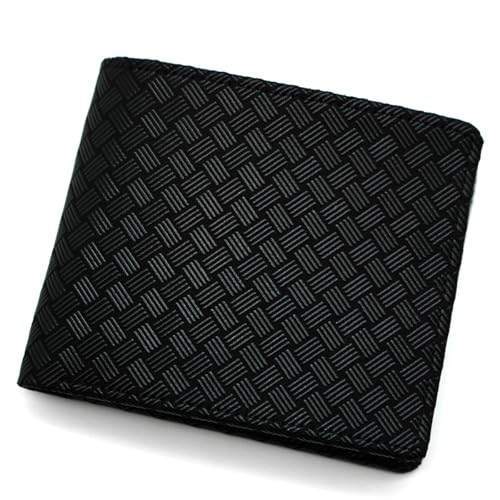
Kōshū Inden Bifold Wallet by Inden-ya
[印傳屋] いんでんや 印伝 二つ折り財布 コインケース 小銭入れ メンズ 鹿革 伝統工芸品 日本製 No.2006 ([1-158] 黒地-黒漆 網代編)
通常3~4日以内に発送します。 · Sold by petitark · ASIN B0DK6W3DCL
Price and availability as of 2026-08-31 02:30 JST. The Amazon listing at the time of purchase is authoritative. jpmono.com earns a commission on qualifying purchases at no extra cost to you.
| Field | Value |
|---|---|
| Maker | Inden-ya (印傳屋), Kōfu, Yamanashi · founded 1582 |
| Model | No. 2006 bifold wallet, amime (網目, “net”) pattern |
| Material | Chrome-tanned deer leather (鹿革) + stenciled urushi (Japanese lacquer) |
| Color | Black-on-black (black urushi on black deer leather) |
| Folded dimensions | Approximately 11 × 9 cm (standard JP bifold size) |
| Weight | Approximately 90 g |
| Made in | Kōfu, Yamanashi Prefecture, Japan |
| Designation | METI Traditional Craft Product (since 1987, category: Kōshū inden) |
| Price (Amazon JP) | ¥14,850 (≈ $99 USD as of May 2026) |
| International shipping | Amazon JP Global Store — ships internationally. Deer leather is not CITES-listed; unrestricted personal import to most destinations. |
Note: only the Amazon JP listing snapshot is available for this build; live pricing and stock may have shifted since the writing date. Verify at the linked store before purchasing.
📖 Glossary — key terms in this article
- Inden (印伝)
- Japanese craft of decorating chrome-tanned deer leather with raised urushi-lacquer patterns through paper stencils.
- Kōshū inden (甲州印伝)
- Inden produced in the historical Kōshū region (modern Yamanashi Prefecture). The locus of the tradition; designated METI Traditional Craft in 1987.
- Indo-den (印度伝)
- “Transmission from India” — the etymological origin of inden, reflecting arrival via Indo-Portuguese trade routes in the late 16th and 17th centuries.
- Urushi (漆)
- Sap of the Japanese lacquer tree (Toxicodendron vernicifluum), polymerized into a hard, water-resistant film. Used here as a raised pattern on leather, not as a coating.
- Amime (網目)
- “Net” or “mesh” — a geometric repeating motif of crossed diagonal lines. One of Inden-ya’s classic, gender-neutral patterns.
- Shika-gawa (鹿革)
- Deer leather. Lighter and more flexible than cow leather, with a distinctive soft hand; favored for inden because the urushi adheres cleanly to its tight grain.
- METI Traditional Craft Product (経済産業大臣指定伝統的工芸品)
- Japan’s national designation for crafts with at least 100 years of continuous practice, made by hand using traditional materials in a recognized production area.
- Kōfu (甲府)
- Capital city of Yamanashi Prefecture, founded as the castle town of Takeda Shingen’s domain in the 16th century. About 130 km west of Tokyo by JR Chūō line.
📍 Where this comes from — Kōfu, Yamanashi, and 400 years of Kōshū inden

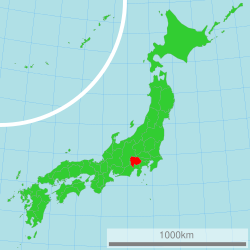
Kōfu is the prefectural capital of Yamanashi, set in a flat basin between the Akaishi (Southern Alps) range and the Misaka mountains, with Mt. Fuji visible from much of the city on clear days. Historically the seat of the Takeda clan during the Sengoku period, it was developed as a castle town in the late 16th century and retained that status through the Edo period as a Tokugawa-administered direct domain. The combination of mountain isolation, year-round access to clean water from the Fuji-Kōfu aquifer, and a craft-friendly samurai patron class created the conditions under which a leather-and-lacquer industry could establish itself away from the larger production centers of Edo, Kyoto, and Osaka.
The technique itself is older than its current name. Decorated leatherwork on deer skin appears in early-Edo records, but the word indo-den (印度伝, “transmission from India”) only came into use after Portuguese, Spanish, and Dutch trading ships brought stenciled and dyed leather samples from South Asia into Japan via Nagasaki in the late 16th and early 17th centuries. Local artisans in Kōfu adapted the visual vocabulary, substituted the more abundant local deer leather for the original goat or sheepskin, and switched the surface treatment to urushi — which they already had centuries of experience with from the lacquerware trade.
-
1582 — Inden-ya founded in Kōfu by the Uehara family; one of the oldest continuously operating craft houses in Japan. -
Early 17th c. — Indo-Portuguese trade introduces stenciled-leather samples through Nagasaki; the term indo-den (印度伝) enters Japanese usage. -
Edo period (1603–1868) — Inden is used extensively for samurai armor lacing, sword scabbard wraps, tobacco pouches, and luggage fittings. -
Meiji era (1868–1912) — With the samurai class dissolved, inden makers reposition into the civilian luxury market: wallets, card cases, handbags, and accessories. -
1987 — Kōshū inden formally designated a METI Traditional Craft Product (経済産業大臣指定伝統的工芸品). -
2000s–2010s — Inden-ya expands flagship retail beyond Kōfu — Tokyo (Aoyama), Kyoto, and Osaka — and partners with contemporary designers on limited series. -
2026 — Inden-ya is in its 14th family generation; the No. 2006 bifold remains one of the most-purchased entry-mid pieces in the catalog.
The continuity case is straightforward: the same family, in the same city, has been making the same category of object for 444 years. The technique is not industrially scalable — each stencil is positioned and pressed by hand, the urushi cures over days, and the deer leather is sorted and selected piece by piece — which is the reason inden remains a small-batch, regional craft rather than a national or international brand. The METI designation in 1987 was less a moment of revival than a formal acknowledgement of a continuity already in place.
“Inden-ya was founded in 1582 — older than the Edo period itself, older than every European luxury house, older than the unification of Japan under the Tokugawa shogunate. Four centuries later, the same family is still pressing the same urushi through the same kind of paper stencil in the same prefecture.”
For an international reader: Yamanashi is not a place most visitors encounter on a first trip to Japan. It sits between Tokyo and the Japan Alps, and is better known abroad for Mt. Fuji and its wineries than for craft. The fact that Inden-ya remains anchored in Kōfu — rather than relocating to Tokyo for retail reasons — is itself a piece of information about the maker.
Which finish should you choose?
This piece is listed in 10 finishes. The photos below are the actual 色 options on the listing right now — pick the one you want and confirm it on the product page before ordering, since hand-finished wares vary slightly piece to piece.
![Kōshū Inden Bifold Wallet by Inden-ya — 400-Year Lacquered Deer-Leather from Yamanashi (¥14,850 / ≈$99 USD) [2026 Buyer's Guide] — [71-180] 黒地-グレー漆 杉綾 finish](https://m.media-amazon.com/images/I/51cAZ+n7mBL._SL500_.jpg)
![Kōshū Inden Bifold Wallet by Inden-ya — 400-Year Lacquered Deer-Leather from Yamanashi (¥14,850 / ≈$99 USD) [2026 Buyer's Guide] — [1-177] 黒地-黒漆 輪繋ぎ小 finish](https://m.media-amazon.com/images/I/41MCMeDv+sL._SL500_.jpg)
![Kōshū Inden Bifold Wallet by Inden-ya — 400-Year Lacquered Deer-Leather from Yamanashi (¥14,850 / ≈$99 USD) [2026 Buyer's Guide] — [14-007] 紺地-白漆 ひょうたん finish](https://m.media-amazon.com/images/I/51aWQJM6ErL._SL500_.jpg)
![Kōshū Inden Bifold Wallet by Inden-ya — 400-Year Lacquered Deer-Leather from Yamanashi (¥14,850 / ≈$99 USD) [2026 Buyer's Guide] — [1-007] 黒地-黒漆 ひょうたん finish](https://m.media-amazon.com/images/I/41OOhO+YJrL._SL500_.jpg)
![Kōshū Inden Bifold Wallet by Inden-ya — 400-Year Lacquered Deer-Leather from Yamanashi (¥14,850 / ≈$99 USD) [2026 Buyer's Guide] — [1-003] 黒地-黒漆 亀甲 finish](https://m.media-amazon.com/images/I/41AQ5JbMLAL._SL500_.jpg)
![Kōshū Inden Bifold Wallet by Inden-ya — 400-Year Lacquered Deer-Leather from Yamanashi (¥14,850 / ≈$99 USD) [2026 Buyer's Guide] — [14-008] 紺地-白漆 とんぼ finish](https://m.media-amazon.com/images/I/41RNbr2azWL._SL500_.jpg)
![Kōshū Inden Bifold Wallet by Inden-ya — 400-Year Lacquered Deer-Leather from Yamanashi (¥14,850 / ≈$99 USD) [2026 Buyer's Guide] — [21-008] 黒地-赤漆 とんぼ finish](https://m.media-amazon.com/images/I/41paSLjQhaL._SL500_.jpg)
![Kōshū Inden Bifold Wallet by Inden-ya — 400-Year Lacquered Deer-Leather from Yamanashi (¥14,850 / ≈$99 USD) [2026 Buyer's Guide] — [14-004] 紺地-白漆 青海波 finish](https://m.media-amazon.com/images/I/51qUVHN8NlL._SL500_.jpg)
![Kōshū Inden Bifold Wallet by Inden-ya — 400-Year Lacquered Deer-Leather from Yamanashi (¥14,850 / ≈$99 USD) [2026 Buyer's Guide] — [14-118] 紺地-白漆 波うろこ finish](https://m.media-amazon.com/images/I/51XY6kItMyL._SL500_.jpg)
Price snapshot across stores
Prices and stock fluctuate. The values below reflect what was visible at the time of writing; verify at the link before purchasing. JPY is authoritative; USD figures are approximate at a ¥150/USD baseline.
| Store | Item / Variant | Price | Notes |
|---|---|---|---|
| 🇺🇸 Amazon.com (US) | Browse Japanese inden & deer-leather wallets | varies (USD) | Best if you’re shopping from the US — Prime shipping, USD pricing, no international customs paperwork. Amazon US carries other Japanese leather-craft sellers; Inden-ya’s specific No. 2006 ships from Japan (next row). |
| 🇯🇵 Amazon JP Global Store | Inden-ya No. 2006 bifold, amime black-on-black (asin B0DK6W3DCL) | ¥14,850 (≈ $99 USD) | Ships internationally from Japan. ~90 g — international shipping typically $8–$15 USD. Deer leather is not CITES-listed; standard personal-import to US/EU/AU. |
| Maker direct (Inden-ya) | No. 2006 across all stencil patterns and colorways | ¥14,850 base | Inden-ya operates flagship stores in Kōfu, Aoyama (Tokyo), Kyoto, and Osaka, and an official online shop. International shipping is limited; most buyers outside Japan use Amazon JP Global Store or a proxy. |
| Proxy services (Buyee / Tenso) | Any Inden-ya retailer page | ¥14,850 + handling | Useful if you want a specific pattern not on the Amazon JP Global Store listing. Adds ¥500–¥1,500 handling plus international shipping; expect 1–3 weeks longer. |
What it does well
Weaknesses and things to verify before buying
- Capacity is modest. A bifold of roughly 11 × 9 cm typically holds 6–8 cards plus a single bill compartment. If you currently carry 12+ cards, this will not be a clean swap.
- Urushi tolerates incidental moisture, not soaking. Spec literature is explicit that the wallet should be wiped with a dry soft cloth, not conditioned and not exposed to prolonged moisture. Pocket carriers in heavy rain or perspiration-prone climates should plan accordingly.
- Lacquer pattern wear is normal over years. The raised urushi develops a subtle sheen and, eventually, can wear thin at the highest-contact points (corners, the inner fold). This is expected behavior; Inden-ya’s repair service exists precisely for this.
- Pattern selection on Amazon JP is narrower than the maker’s own catalog. The Amazon JP listing currently surfaces a limited subset of colorways. Tonbo, asanoha, ume, and kiku patterns may require Inden-ya’s own site or a proxy service.
- International shipping cost is on top of the JPY price. Expect roughly $8–$15 USD for an item this light to most major destinations via Amazon JP Global Store; faster methods cost more. Customs is typically waived under most personal-import de minimis thresholds at the ¥14,850 price point, but verify against your country’s current rules.
- Live pricing may have shifted. The price snapshot was taken at the time of writing; Inden-ya occasionally adjusts pricing on the maker side, and Amazon JP listings can move several percent in either direction. Always verify at the linked store before purchasing.
Conclusion — which buyer type are you?
Other ways to approach this purchase
🏆 Editor’s Pick
Inden-ya Kōshū Inden Bifold Wallet No. 2006 — Amime (Net) Pattern, Black-on-Black
The default recommendation for anyone wanting one credible Kōshū inden item. The oldest and most prestigious inden maker (founded 1582), in their classic black-on-black amime stencil, at ¥14,850 (≈ $99 USD). Subtle enough for daily office use and durable enough to outlast most cow-leather wallets at the same price point.
- Maker: Inden-ya, Kōfu (founded 1582 · 14th generation).
- Material: chrome-tanned deer leather + stenciled urushi (METI-designated Kōshū inden).
- Workmanship tier: entry-mid of Inden-ya’s own line — the most commonly purchased model.
❓ Frequently Asked Questions
Will the urushi lacquer pattern wear off with daily use?
The raised urushi is cured to a hard polymer film, so it does not flake off under normal handling. Over years of daily carry, the highest-contact points (outer corners and the inner fold) can develop subtle wear and a softer sheen. Inden-ya offers a repair service that re-applies the stencil at the affected points; pricing varies by extent of wear.
Can the wallet get wet?
Urushi itself is water-resistant once cured — that is part of why it was historically used on samurai armor — but the underlying chrome-tanned deer leather should not be soaked. Incidental rain or moisture wiped off promptly with a dry soft cloth is fine. Do not apply leather conditioner; conventional conditioners can interact with the urushi surface.
Does Amazon JP Global Store actually ship the wallet internationally?
Yes. The listing for asin B0DK6W3DCL is enrolled in Amazon JP Global Store, which ships to the US, EU, UK, Australia, and most other major destinations. Approximate shipping cost is $8–$15 USD for an item of this weight (~90 g). Deer leather is not CITES-listed, so there are no special wildlife-import restrictions; check your country’s general personal-import threshold for customs.
How does Kōshū inden differ from other Japanese leather goods?
Most Japanese leather goods use cow leather and either dye-printed or embossed surface patterns. Kōshū inden is specifically chrome-tanned deer leather decorated with raised, stenciled urushi (Japanese lacquer). The result is lighter in hand, with a tactile pattern you can feel with the fingertip, and a different aging behavior — urushi develops sheen rather than the classic cow-leather patina.
Are other patterns and colorways available?
Yes. The same No. 2006 wallet body is produced in tonbo (dragonfly), asanoha (hemp leaf), ume (plum blossom), kiku (chrysanthemum), and several other stenciled patterns, in a range of urushi colors. Amazon JP typically surfaces a narrower selection than Inden-ya’s own catalog; the maker’s flagship stores or a proxy service are the way to reach uncommon patterns.
What sets Inden-ya apart from other inden makers?
Inden-ya is the oldest continuously operating inden maker (founded 1582, currently 14th generation), and is generally recognized as the senior house of the tradition. Smaller Kōshū inden makers produce technically comparable goods at lower prices; Inden-ya commands a premium for the brand continuity, the consistency of its quality control, and the availability of its repair service.
Is the deer leather ethically sourced?
Inden-ya sources chrome-tanned deer leather from established suppliers; deer leather is not CITES-listed and is widely used in Japan as a byproduct of population-management hunting in mountainous areas. If sourcing specifics matter to you, the maker’s own site and customer service answer detailed material-origin questions directly.
jpmono.com is a Japan-based curation site (editorial centers in Toyama, Hokuriku region, and Nara, Kansai region) introducing high-quality Japanese household objects to international readers. We focus on items with verifiable craft heritage and clear international shipping paths. We do not physically test every product (we work from maker’s published specs and source listings), and we do not take payment from the makers we feature; income comes from affiliate links. Read more about our editorial standards.
Editorial note: this article was drafted with AI assistance from published Amazon JP listing data and the maker’s public record, then reviewed by the jpmono editorial team. Specifications, prices, and availability statements reflect the data snapshot at the time of writing and may have changed since.
Affiliate disclosure: jpmono.com may earn a commission on qualifying purchases made through links on this page, at no additional cost to you.