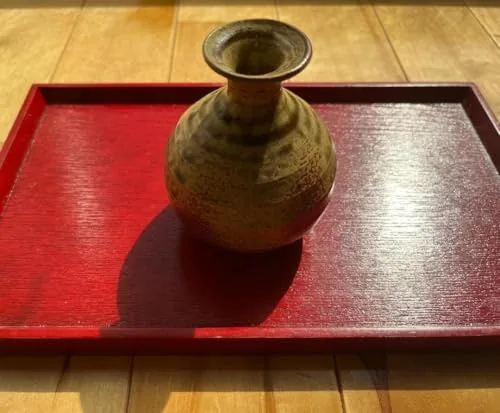
![Tamba Tachikui-yaki Yunomi: Six Ancient Kilns Ash-Glaze Teacup [2026]](https://jpmono.com/wp-content/uploads/2026/06/tamba-tachikui-yaki-yunomi-where-to-buy-2026-featured.jpg)
A Tamba Tachikui-yaki yunomi (丹波立杭焼湯呑, “Tamba Tachikui-ware teacup”) is a wood-fired stoneware tea cup from Tachikui, a pottery hamlet in Tamba-Sasayama, inland Hyōgo Prefecture. The clay is dug locally, thrown on the wheel, and fired for days in a climbing kiln. Tamba ware is one of Japan’s Rokkoyo (六古窯, “Six Ancient Kilns”) — the small group of kiln towns that have potted continuously since the late Heian and Kamakura eras, roughly eight centuries ago.
What makes a Tamba cup recognizable is haiyu (灰釉, “ash glaze”) — a natural glaze nobody paints on. During the multi-day firing, wood ash drifts through the kiln, settles on the clay, and fuses into a glassy skin of greens, browns, and reds. Combined with the iron-rich, reddish body, the result is a surface that the fire, not the potter, finishes. No two cups come out alike, which is exactly the appeal for a daily tea cup you want to keep using rather than display.
This guide is written for an international reader deciding whether a wood-fired Japanese stoneware yunomi is worth importing — what it is, where it sits in Japan, how to buy it from outside the country, and what to verify before you pay. A note on data: at the time of writing, only the Amazon JP Global Store listing snapshot was available for the specific cup highlighted here; live pricing and stock may have shifted since this date, and the fetched dataset returned no US-listed equivalent.
🔄 Updated: May 31, 2026
⏱️ Read time: ~9 min
Tachikui kiln · Tamba-Sasayama, Hyōgo
![Tamba Tachikui-yaki Yunomi: Six Ancient Kilns Ash-Glaze Teacup [2026]](https://m.media-amazon.com/images/I/31vSXegs3OL._SL500_.jpg)
- Who this is for — and who should skip it
- Product overview (from published specs)
- Where this comes from
- Price snapshot across stores
- What it does well
- Weaknesses and things to verify before buying
- Conclusion — which buyer type are you?
- Other ways to approach this purchase
- 🏆 Editor’s Pick
- ❓ Frequently Asked Questions
Who this is for — and who should skip it
- Want a daily tea cup with a one-of-a-kind, fire-finished surface
- Appreciate wood-fired stoneware over uniform factory glaze
- Like the Mingei (folk-craft) idea of beauty in everyday-use objects
- Are collecting or comparing across Japan’s Six Ancient Kilns
- Don’t mind variation in color and weight from piece to piece
- Need every cup in a set to match exactly
- Want a lightweight, thin-walled porcelain feel
- Expect dishwasher/microwave guarantees without checking the listing
- Are unwilling to pay international shipping from Japan
- Prefer painted decoration over natural kiln effects

Product overview (from published specs)
The table below reflects what was available at the time of writing. The specific cup is sourced from the Amazon JP Global Store listing (ASIN B0FNRNR9P9); the fetched dataset returned no individual Amazon US (.com) listing, which is normal for hand-finished Japanese stoneware. Where a value was not present in the data, it is marked rather than guessed.
Tamba Tachikui-yaki Yunomi
丹波立杭焼 丹水窯 湯呑 3点 灰釉掛け 2客は栞 共紙箱付 1客は箱無し 全
通常6~7日以内に発送します。 · Sold by POP★TOYマーケット【送料無料】 · ASIN B0FNRNR9P9
Price and availability as of 2026-08-31 02:30 JST. The Amazon listing at the time of purchase is authoritative. jpmono.com earns a commission on qualifying purchases at no extra cost to you.
| Attribute | Detail (per listing snapshot) |
|---|---|
| Item | Yunomi (teacup), stoneware |
| Ware / tradition | Tamba-yaki / Tamba Tachikui-yaki (one of the Six Ancient Kilns) |
| Origin | Tachikui, Tamba-Sasayama, Hyōgo Prefecture, Japan |
| Glaze | Haiyu (natural wood-ash glaze); yohen kiln effects |
| Firing | Wood-fired, multi-day kiln (Tachikui) |
| Body color | Warm reddish stoneware (iron-rich local clay) |
| Capacity / dimensions | Unconfirmed — check the live listing |
| Microwave / dishwasher | Unconfirmed — check manufacturer/listing |
| ASIN (Amazon JP) | B0FNRNR9P9 |
| Price | Not shown in fetched data — verify on the listing |
Spec sheets for hand-finished pottery are routinely sparse. The data suggests treating capacity, weight, and care labels as listing-dependent — confirm them on the page before you buy, especially if the cup is a gift.
📖 Glossary — key Japanese craft terms
Yunomi (湯呑) — a tall, handle-less Japanese teacup for everyday green tea, as opposed to the wider, shallower chawan used in tea ceremony.
Tamba-yaki / Tamba Tachikui-yaki (丹波焼 / 丹波立杭焼) — stoneware fired at Tachikui in Tamba-Sasayama, Hyōgo.
Rokkoyo (六古窯, “Six Ancient Kilns”) — Bizen, Shigaraki, Echizen, Seto, Tokoname, and Tamba: the kiln traditions with continuous production since medieval Japan.
Haiyu (灰釉, “ash glaze”) — a glaze formed when wood ash lands on the clay during firing and melts into the surface, rather than being applied by hand.
Yohen (窯変, “kiln change”) — unplanned color and texture effects produced by flame, ash, and heat inside the kiln.
Anagama (穴窯) — an early single-chamber tunnel kiln dug into a slope.
Noborigama (登窯, “climbing kiln”) — a stepped, multi-chamber kiln built up a slope; reached Tamba around the Momoyama–Edo transition.
Mingei (民藝, “folk craft”) — the early-20th-century movement, led by Yanagi Sōetsu, that valued the beauty of ordinary handmade everyday objects.

Where this comes from

Tachikui is a small valley hamlet in Tamba-Sasayama, in the inland north-central part of Hyōgo Prefecture. It is not a coastal city; it is hill country, the kind of place where a pottery industry takes root because the two things a kiln needs — workable iron-rich clay and a steady supply of firewood — were both within reach. The local clay is what gives Tamba its warm, reddish stoneware body.
Tamba is one of Japan’s Rokkoyo, the Six Ancient Kilns, alongside Bizen, Shigaraki, Echizen, Seto, and Tokoname. These are the kiln traditions that have potted continuously since medieval Japan rather than being revived later. Tamba’s production reaches back to the late Heian and Kamakura eras — about the 12th century — which puts roughly eight hundred years of firing behind the cup in your hand.
- ~12th c. — Potting begins at Tachikui in the late Heian–Kamakura era; anagama tunnel kilns fire unglazed stoneware.
- 13th–15th c. — Tamba produces tsubo jars and storage vessels for seeds, tea, and sake; natural ash glaze emerges from the wood firing.
- ~1600 (Momoyama–Edo) — The noborigama climbing kiln arrives; the Tamba potter’s wheel turns counter-clockwise, a local quirk.
- Edo period — Tea-ware and everyday vessels broaden the glaze palette.
- 1920s–1930s — The Mingei folk-craft movement (Yanagi Sōetsu, Kawai Kanjirō) praises Tamba as a model everyday pottery.
- Today — Dozens of working kilns remain in the Tachikui Sue-no-Sato district, still firing after roughly 800 years.
The signature look comes from how the firing works. Early Tamba used the anagama, a single tunnel kiln dug into the slope. From the Momoyama–Edo transition the noborigama, a stepped climbing kiln, took over. In either kiln, a firing runs for days, and wood ash circulates the whole time. Where that ash settles, it melts into haiyu — natural ash glaze — leaving green, brown, and red kiln effects (yohen) that vary across the surface and from cup to cup.
“No two haiyu surfaces are alike — in Tamba, the kiln, not the painter, finishes the cup.”
The continuity is the real selling point. The Tachikui Sue-no-Sato district still holds dozens of active kilns, and the Mingei movement’s praise in the early 20th century — Yanagi Sōetsu and Kawai Kanjirō among its champions — cemented Tamba’s reputation as pottery made to be used, not shelved. Tamba also sits inside Hyōgo’s wider monozukuri (ものづくり, “making things”) culture: the same prefecture produces Banshu Miki edge tools and the Banshu soroban abacus, both covered in separate guides linked above.
Price snapshot across stores
The fetched dataset did not include a confirmed price for ASIN B0FNRNR9P9, so the JPY figure is marked as listing-dependent rather than estimated. USD figures elsewhere in this guide are approximate (¥150/USD baseline as of mid-2026); the JPY price on the listing is the authoritative one.
| Store | Item / variant | Price (JPY + USD est.) | Notes |
|---|---|---|---|
| 🇺🇸 Amazon US (search) | Browse Japanese stoneware yunomi & tea cups | varies (USD) | Best if you’re shopping from the US — Prime shipping, USD pricing, no international customs. Amazon US carries Japanese stoneware cups from various makers for comparison; this exact Tamba cup is sourced from Japan (next row). |
| 🇯🇵 Amazon JP Global Store | Tamba Tachikui-yaki yunomi (ASIN B0FNRNR9P9) | Check listing (price not in fetched data) | Ships internationally from Japan. This is the sourced listing for the exact cup in this guide. |
| Maker direct | Tachikui Sue-no-Sato kilns / district shops | Varies by kiln | Individual Tachikui kilns sell their own work; international shipping is not guaranteed and varies by workshop. |
| Proxy services (Buyee / Tenso) | Forwards Japan-only listings abroad | Item price + proxy fee + forwarding | Useful when a kiln or shop ships only within Japan; adds a service fee and a second shipping leg. |
Prices in USD are approximate and depend on the current exchange rate. Always confirm the live JPY price and stock at the retailer before purchasing.
What it does well
Weaknesses and things to verify before buying
- Appearance varies from the photo. Ash-glaze and kiln effects are inherent to the process — the cup you receive will not match the listing image exactly. If you need a precise match, this is a poor fit.
- Dimensions and capacity were not in the fetched data. Confirm the size on the listing, especially if you want a specific tea volume.
- Care labels unconfirmed. Microwave and dishwasher suitability were not stated in the data; wood-fired stoneware is often best hand-washed. Verify before assuming.
- Price not shown in the snapshot. The fetched dataset returned no confirmed price for ASIN B0FNRNR9P9 — check the live JPY price before buying.
- International shipping cost and customs. Importing from Japan adds shipping (often $15–$40 to the US/EU) and possible customs duties above local thresholds.
- Matching a set is harder. Because each piece differs, assembling a uniform set of several cups takes more effort than buying factory tableware.
Conclusion — which buyer type are you?
Other ways to approach this purchase
🏆 Editor’s Pick
❓ Frequently Asked Questions
Will my cup look like the photo?
Does it ship internationally?
Is it dishwasher and microwave safe?
What is haiyu (ash glaze)?
How is Tamba different from Bizen or Shigaraki?
Is it a good gift?
jpmono.com is curated by a Japan-based editorial team (working out of Toyama in the Hokuriku region and Nara in Kansai) and is independent. We don’t take payment from the makers we feature; income comes from affiliate links. We don’t physically test every product — we read maker specs and source listings. Read more about our editorial standards.
This article was prepared with AI assistance and reviewed against the available listing data. Specs, pricing, and availability were not independently lab-tested; verify details on the retailer’s page before purchasing.
Affiliate disclosure: jpmono.com may earn a commission on qualifying purchases made through links on this page, at no additional cost to you.