![Hyuga Hamaguri Clam Shell Go Stones: Miyazaki’s White Igo Set [2026]](https://jpmono.com/wp-content/uploads/2026/05/hyuga-hamaguri-clam-shell-go-stones-where-to-buy-2026-featured.jpg)
On the Pacific-facing Hyuga-nada coast of Miyazaki Prefecture, in the city of Hyuga on the eastern edge of Kyushu, craftsmen have been cutting the world’s most prized white go stones from clam shells since the Meiji era. The stones in this set are sliced from thick hamaguri (蛤, “clam”) shells, then paired with black Nachiguro (那智黒) slate to make a complete igo (囲碁, “the game of Go”) set — one half of the set from the Kyushu coast, the other half quarried in Kumano, on the far side of the country.
White go stones are one of the quietest luxuries in Japanese craft. To the eye they look like simple discs, but a connoisseur reads them the way a jeweler reads a diamond: by the fineness and straightness of the curved striations left by the clam’s growth lines, which show on the edge of each stone. Those lines are why Hyuga shell stones, graded Yuki (雪, “snow”), Tsuki (月, “moon”), and Jitsuyo (実用, “practical”), remain the standard against which every other white stone is measured. As Western interest in Go surged after AlphaGo, demand for the real thing followed.
This guide, written from a Japan-based editor’s desk in Toyama and Nara, is for the player or gift-buyer outside Japan who wants to understand what separates a shell set from a glass or plastic one — what the grades mean, why the black and white stones are different materials, how a 361-stone set is shipped abroad, and how this object sits among Japan’s other traditional tabletop tools. Data note: only the spec-level listing identity (ASIN B0BHDCWGD3) was available at the time of writing; the fetched Amazon snapshot returned no live price, product photo, or detailed spec fields, so figures below are indicative and must be verified on the listing.
🔄 Last updated:
⏱️ Read time: ~9 min
![Hyuga Hamaguri Clam Shell Go Stones: Miyazaki's White Igo Set [2026]](https://m.media-amazon.com/images/I/51jObNKvU7L._SL500_.jpg)
- Who this is for — and who should skip it
- Product overview (from published specs)
- 📍 Where this comes from — place, era, and the craft tradition
- Price snapshot across stores
- 📦 Shipping & where to buy from outside Japan
- What it does well
- Weaknesses and things to verify before buying
- Conclusion — which buyer type are you?
- Other ways to approach this purchase
- 🏆 Editor’s Pick
- ❓ Frequently Asked Questions
Who this is for — and who should skip it
- Play Go seriously and want the tactile click and weight of natural shell stones
- Care about craft provenance and want a set that is actually made in Japan, not a generic import
- Are buying a milestone or retirement gift and want an heirloom-grade object
- Already own a kaya or katsura board and want stones to match it
- Understand that a real shell set is a connoisseur item, not a beginner’s first purchase
- Just want a cheap set to learn the rules — glass or plastic stones are a fraction of the cost
- Need an exact price before deciding (this listing’s live price was not in our dataset)
- Expect the white stones to be machine-uniform — natural shell varies stone to stone
- Play mostly on a phone or computer and rarely set up a physical board
- Cannot accommodate possible international shipping cost and customs on a heavy set

Product overview (from published specs)
The table below reflects what could be confirmed from the spec and the maker tradition. Where the fetched listing snapshot was empty, the cell says so plainly rather than guessing.
Hyuga Hamaguri Clam Shell Go Stones
囲碁 日向特製蛤碁石那智黒碁石 28号 徳用 厚み7.5mm 将碁屋ミニ椿油付き
残り1点 ご注文はお早めに · Sold by 将棋囲碁専門店 将碁屋 · ASIN B0BHDCWGD3
Price and availability as of 2026-08-31 02:30 JST. The Amazon listing at the time of purchase is authoritative. jpmono.com earns a commission on qualifying purchases at no extra cost to you.
| Attribute | Detail |
|---|---|
| Item | Hyuga hamaguri (clam shell) white go stones, Yuki / Tsuki grade, paired with Nachiguro slate black stones — full igo set |
| White stone material | Natural hamaguri clam shell, cut perpendicular to the growth lines |
| Black stone material | Nachiguro slate, quarried in Kumano (Wakayama) |
| Set size | Full set — 361 stones total (181 black, 180 white) for the 19×19 board |
| Grade | Yuki / Tsuki (the two higher grades; see grade comparison below) |
| Origin | Hyuga, Miyazaki Prefecture, Kyushu (white stones); Kumano, Wakayama (black slate) |
| Stone thickness / weight | Unconfirmed — not present in fetched data; verify on listing |
| Storage | Unconfirmed (bowls/case may or may not be included) — verify on listing |
| ASIN | B0BHDCWGD3 |
| Price | Unavailable in dataset — check live price on the Amazon JP Global Store listing |
Sources: spec listing identity (ASIN, keyword) + maker-tradition fact base in the article brief. The fetched Amazon US search and JP listing snapshot returned no live price, image, or measured spec fields at the time of writing; treat measurements above as indicative.
📖 Glossary — key terms in this guide
- Igo (囲碁) — the Japanese name for Go, the territory-capture board game played on a 19×19 grid.
- Hamaguri (蛤) — the thick-shelled clam whose shell is sliced into white go stones.
- Yuki / Tsuki / Jitsuyo (雪 / 月 / 実用) — “snow / moon / practical,” the grade names that rank white stones by how fine and straight their shell striations are.
- Nachiguro (那智黒) — the black slate, quarried in the Kumano region of Wakayama, traditionally used for the black stones.
- Hyuga-nada — the stretch of Pacific Ocean off Miyazaki’s east coast, the source water for the local clam-shell industry.
- Shokunin (職人) — a craftsperson who has trained for years in a single specialized skill, such as cutting and rounding shell stones.
📍 Where this comes from — place, era, and the craft tradition

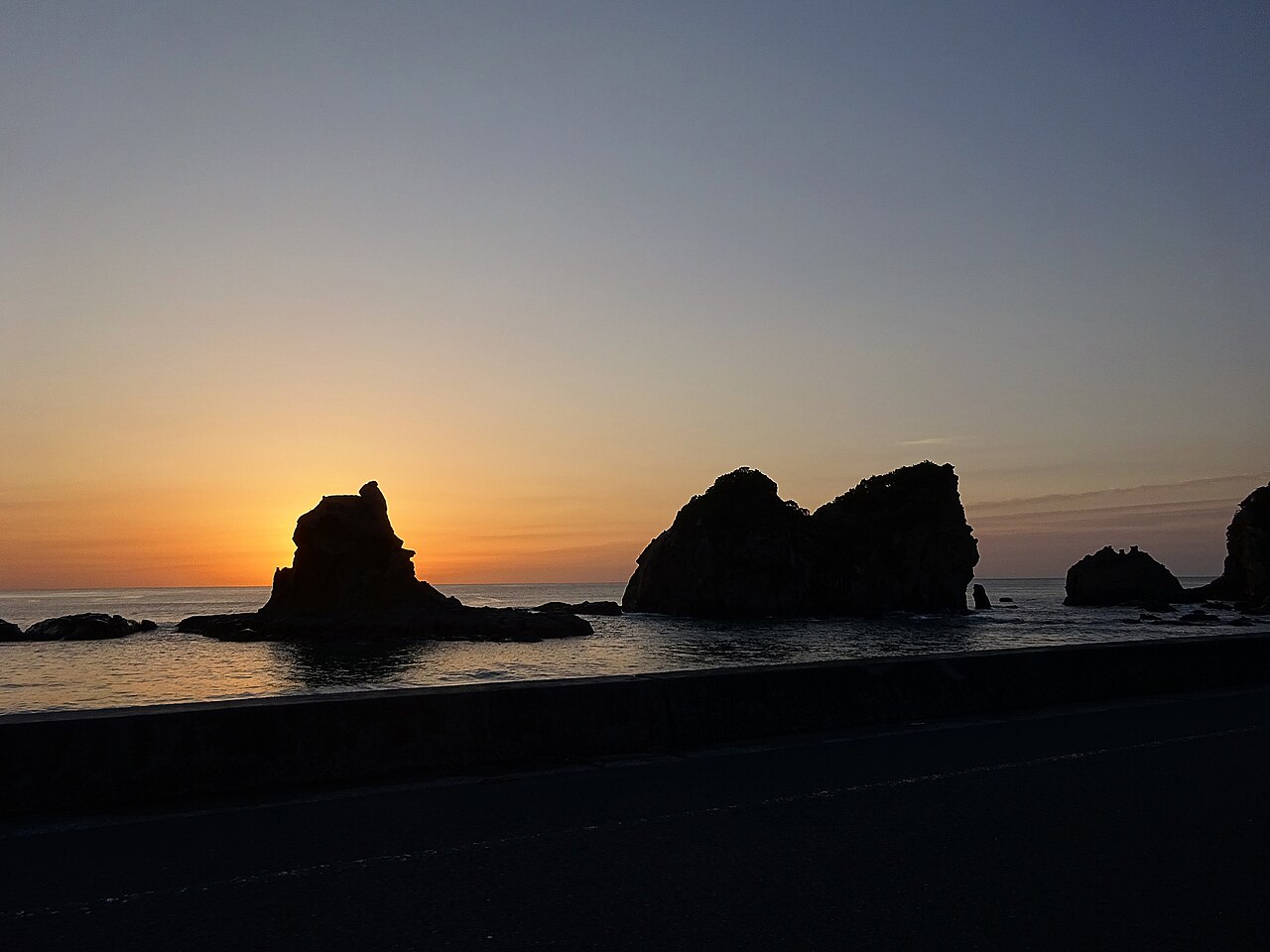
Hyuga is a port city on the Hyuga-nada — the open Pacific that runs along Miyazaki’s eastern shore. It is a warm, humid stretch of southeastern Kyushu, well away from the country’s historical political centers, and that distance is part of the story: this is a craft that grew not from court patronage but from what the sea left on the beach.
The white-stone industry took root here in the Meiji era, when local craftsmen began cutting stones from the thick Oga and Mehari clam shells washed up along the Pacific coast. The technique is exacting. A shell is sliced perpendicular to its growth lines, so the curved striations the clam laid down over its life appear on the edge of each finished stone.
Those striations are the whole grading system. The finer and straighter the lines, the higher the grade — Yuki (snow) at the top, then Tsuki (moon), then Jitsuyo (practical) for everyday play.
-
Edo period & earlier — Go is long established as one of Japan’s classic board games, played on a 19×19 grid. -
Meiji era (1868–1912) — Hyuga craftsmen begin cutting white stones from thick local clam shells on the Hyuga-nada coast. -
2004 — The Sacred Sites and Pilgrimage Routes in the Kii Mountain Range (the Kumano region, source of Nachiguro slate) are inscribed by UNESCO. -
March 2016 — AlphaGo defeats Lee Sedol; worldwide interest in Go rises sharply. -
May 2017 — AlphaGo defeats Ke Jie; the game’s international profile grows further. -
2026 — Hyuga remains Japan’s primary source of connoisseur-grade hamaguri white stones.
What makes a finished igo set unusual is that it is a meeting of two distant places. The white stones are Pacific-coast Kyushu; the black Nachiguro slate is quarried in Kumano, on the Kii Peninsula in Wakayama, a region best known internationally for its UNESCO-listed pilgrimage routes. A complete set therefore carries materials from opposite ends of Japan.
“A white go stone is read the way a jeweler reads a gem — not by its face, but by the curved lines on its edge, written there by a clam over the course of its life.”
The continuity case is straightforward: despite cheaper glass and plastic substitutes flooding the global market, Hyuga shell stones remain the connoisseur standard, and the cutting work is still done by specialist shokunin on the Miyazaki coast. It is an evergreen craft good rather than a fashion item — distinct from Yamagata’s Tendo shogi pieces and Hyogo’s Banshu soroban among Japan’s traditional tabletop tools, but cut from the same instinct: that an everyday object can be made to the highest possible standard.

Price snapshot across stores
The fetched dataset did not include a live price for this listing. Verify the current figure at the retailer before buying; the JPY price on the Amazon JP Global Store listing is the authoritative one for this specific set.
| Store | Item / variant | Price (JPY + USD est.) | Notes |
|---|---|---|---|
| 🇺🇸 Amazon.com (US) | Browse Japanese go stones & igo sets | varies (USD) | Best if you’re shopping from the US — Prime shipping, USD pricing, no international customs. Amazon US carries Go boards, bowls, and starter stone sets for comparison; the exact Hyuga shell set is sourced from Japan (next row). |
| 🇯🇵 Amazon JP Global Store | Hyuga hamaguri Yuki/Tsuki set + Nachiguro black (ASIN B0BHDCWGD3) | Price unavailable in dataset — verify on listing | The sourced listing for this specific set. Ships internationally from Japan to most major destinations. |
| Maker direct | Hyuga shell-stone workshops | Varies — not in dataset | Some Hyuga workshops sell direct, often by grade and thickness. Useful for matching a specific board, but may not ship abroad — verify. |
| Proxy services (Buyee / Tenso) | Any JP listing that doesn’t ship to your country | Item price + forwarding fee | Forwards a domestic-only Japanese listing to your address. Adds a service fee and a second shipping leg; budget for both. |
Prices and availability fluctuate; figures are indicative only. Prices in USD are approximate and depend on the current exchange rate (¥150/USD baseline as of mid-2026). The JPY price on the JP listing is authoritative for this specific set.
📦 Shipping & where to buy from outside Japan
The Amazon JP Global Store generally ships household goods like go stone sets internationally to most major destinations, with shipping shown at checkout. A full 361-stone set is dense and heavy, so expect a higher shipping figure than a small item — roughly in the $15–$40 range to the US or EU, and more to other regions, with customs duties possible over your local import threshold.
If a specific listing or a maker-direct page does not ship to your country, a proxy service such as Buyee or Tenso can forward it — at the cost of a service fee and a second shipping leg. Confirm the destination list and the final landed cost before ordering, since heavy stone sets are where shipping surprises happen.
What it does well
Weaknesses and things to verify before buying
- No confirmed price in our dataset. The fetched snapshot returned no live figure, so you must check the JP listing before committing. Shell sets span a wide range by grade.
- Grade and stone count must be confirmed. “Shell stones” alone says little; verify the grade (Yuki/Tsuki/Jitsuyo), thickness, and that it is a full 361-stone set rather than a partial or display set.
- Natural variation is expected. Genuine shell stones differ slightly in striation and tone from stone to stone. Buyers expecting machine-perfect uniformity will be disappointed — that variation is the point.
- Bowls and board are often separate. A stone set may or may not include storage bowls, and almost certainly does not include a board. Confirm exactly what is in the box.
- Weight drives shipping and customs. A full set is heavy; international shipping and possible duties can add meaningfully to the landed cost. Budget for it before you order.
- Care matters. Shell is a natural material; verify the maker’s cleaning and storage guidance rather than treating the stones like glass.
Conclusion — which buyer type are you?
Other ways to approach this purchase
🏆 Editor’s Pick
❓ Frequently Asked Questions
Are white go stones really made from clam shells?
Yes. The white stones in this tradition are sliced from thick hamaguri (clam) shells, a craft rooted in Hyuga, Miyazaki since the Meiji era. The shell is cut perpendicular to its growth lines, so the curved striations show on the stone’s edge.
What do the Yuki, Tsuki, and Jitsuyo grades mean?
They rank white stones by how fine and straight the shell striations are. Yuki (“snow”) is the top grade, Tsuki (“moon”) is upper-mid, and Jitsuyo (“practical”) is the everyday grade. Higher grades cost more; the set in this guide is Yuki/Tsuki.
Why are the black stones a different material?
The black stones are traditionally Nachiguro slate, quarried in Kumano in Wakayama Prefecture. Pairing white Hyuga shell with black Kumano slate means a finished set brings together materials from two distant regions of Japan.
How many stones come in a full igo set?
A complete set holds 361 stones — 181 black and 180 white — one for every intersection on the 19×19 board. Black has one more because Black plays first.
Does Amazon JP Global Store ship go stones internationally?
The Amazon JP Global Store generally ships household goods like go stone sets to most major destinations, with shipping shown at checkout. Because a full set is heavy, expect a higher shipping figure and possible customs duties. If a listing won’t ship to you, a proxy like Buyee or Tenso can forward it.
How do I care for shell go stones?
Shell is a natural material, so follow the maker’s specific cleaning and storage guidance rather than treating the stones like glass. Our dataset did not include detailed care instructions for this listing, so verify them with the seller.
How is this different from Tendo shogi pieces or Banshu soroban?
All three are traditional Japanese tabletop tools, but from different places and crafts: Tendo (Yamagata) makes shogi pieces, Banshu (Hyogo) makes the soroban abacus, and Hyuga (Miyazaki) cuts go stones from clam shell. Each is the recognized center for its own object.
jpmono.com is curated by a Japan-based editorial team (working out of Toyama in the Hokuriku region and Nara in Kansai) and is independent. We don’t take payment from the makers we feature; income comes from affiliate links. We don’t physically test every product — we read maker specs and source listings. Read more about our editorial standards.
This article was drafted with AI assistance and reviewed against the available source data. Where live price, images, or measured specs were absent from the dataset, the article states so rather than estimating; please verify all figures at the retailer before purchasing.
Affiliate disclosure: jpmono.com may earn a commission on qualifying purchases made through links on this page, at no additional cost to you.