![Mino-yaki Oribe Square Plate: Momoyama Green-Glaze Tea Ware [2026]](https://jpmono.com/wp-content/uploads/2026/06/mino-yaki-oribe-square-plate-where-to-buy-2026-featured.jpg)
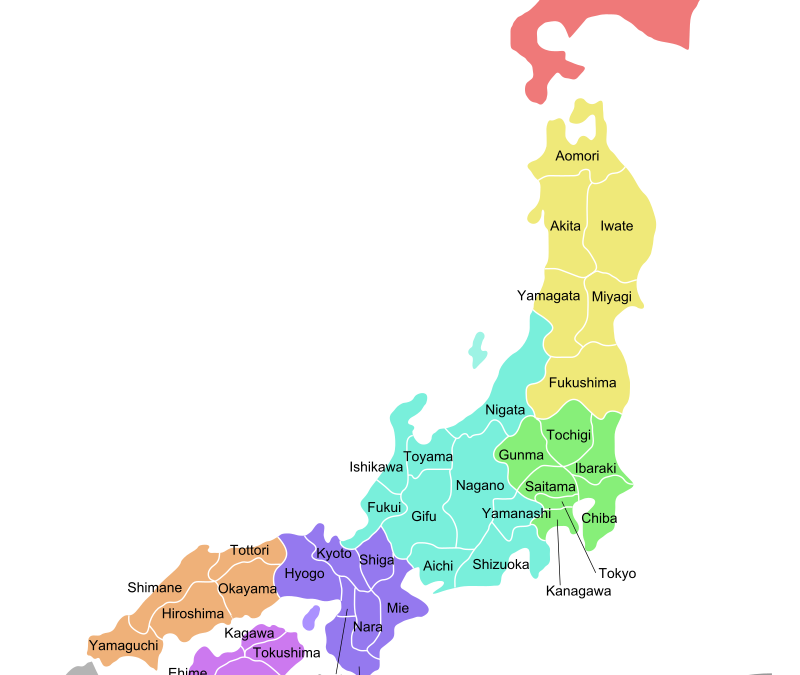
An Oribe (織部) square plate is one of the most recognizable shapes in Japanese tableware: a low, often deliberately off-square dish glazed in a deep copper green, frequently paired with a panel of iron-oxide brushwork — combs, grasses, lattices, or geometric marks — set against a creamy field. It comes from Mino-yaki (美濃焼, “Mino ware”), the pottery of the Tōnō district in eastern Gifu Prefecture, centered on the cities of Toki, Tajimi, and Mizunami. By volume, this is the largest ceramic-tableware region in Japan, supplying close to half of all domestic tableware.
What makes the Oribe style matter is not the volume, though — it is the history. The green-glaze, asymmetric aesthetic was born in the Momoyama period of the late 16th century, during a revolution in tea ceramics, and it is named for the daimyō tea master Furuta Oribe (古田織部), a disciple of Sen no Rikyū who championed deliberately distorted, playful forms over Rikyū’s austere symmetry. A square Oribe plate is, in effect, a household-scale echo of that 400-year-old break with convention.
This guide is written for international readers comparing Japanese ceramic tableware — covering what the Oribe square plate (kakuzara) actually is, where it comes from, how to buy it from outside Japan, and how it sits next to other regional wares we have reviewed. The specific item profiled is sourced from an Amazon Japan listing (ASIN B06WWPJMJC); pricing data was thin at the time of writing, which we flag plainly below.
🔄 Updated
⏱️ About 11 min read

- Who this is for — and who should skip it
- Product overview (from published specs)
- Where this comes from — Gifu, the Tōnō kilns, and Oribe
- Price snapshot across stores
- What it does well
- Weaknesses and things to verify before buying
- Conclusion — which buyer type are you?
- Other ways to approach this purchase
- 🏆 Editor’s Pick
- ❓ Frequently Asked Questions
Who this is for — and who should skip it
- Want a single statement plate with real historical lineage, not a mass-printed pattern.
- Appreciate asymmetry, hand-finish marks, and the deep matte-to-glossy copper green of Oribe glaze.
- Plate Japanese, kaiseki, or modern fusion food and want a dark, contrasting ground for it.
- Already own neutral white ware and want one accent piece with character.
- Are comfortable buying a stoneware item from Japan and verifying care instructions.
- Need a perfectly uniform, matched dinner set — Oribe varies piece to piece by design.
- Want a guaranteed dishwasher- and microwave-safe item without checking the listing.
- Prefer bright, light, airy tableware — copper green reads dark and earthy.
- Are shopping strictly on price; volume white Mino ware is far cheaper.
- Expect same-day domestic shipping — these are sourced from Japan with longer transit.
Product overview (from published specs)
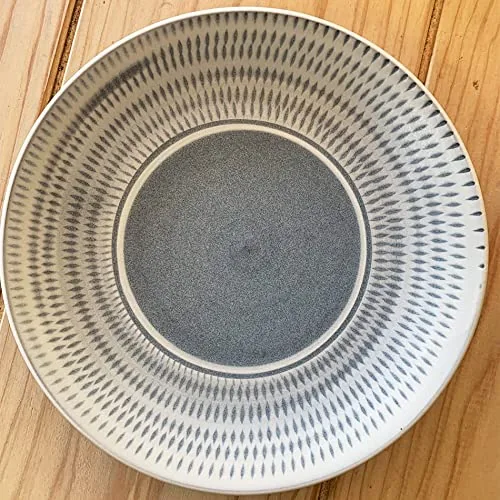
The data available for this specific listing was thin at the time of writing. Only the Amazon Japan listing reference (ASIN B06WWPJMJC) was on hand; the Amazon US search returned no individual match, and live pricing was unavailable. The table below records what is verifiable and marks the rest as unconfirmed rather than guessing.
Mino-yaki Oribe Square Plate
美濃焼 山作窯 さんま皿 長皿 長角皿 サビ織部 520-0068a
残り12点 ご注文はお早めに · Sold by Amazon.co.jp · ASIN B06WWPJMJC
Price and availability as of 2026-08-31 02:30 JST. The Amazon listing at the time of purchase is authoritative. jpmono.com earns a commission on qualifying purchases at no extra cost to you.
| Attribute | Detail | Source |
|---|---|---|
| Type | Square plate (kakuzara, 角皿) | Listing / spec |
| Ware | Mino-yaki, Oribe style | Listing / spec |
| Glaze / décor | Copper-green oribe glaze with iron-oxide brushwork | Spec note |
| Material | Glazed stoneware (ceramic) | Ware category |
| Origin | Toki / Tajimi, Gifu Prefecture (Tōnō district) | Spec note |
| Dimensions / weight | Unconfirmed — check the listing before buying | — |
| Care (dishwasher / microwave) | Unconfirmed — check the listing before buying | — |
| Reference ASIN | B06WWPJMJC (Amazon JP Global Store) | Spec |
Sources: Amazon US search (primary, moonill-20) returned no individual match; Amazon JP Global Store (secondary, moonill-22, sourced listing); maker / ware-category references. Specs not present in the data are marked unconfirmed rather than estimated.
📖 Glossary — key terms in this article
- Mino-yaki (美濃焼) — “Mino ware,” the pottery of the Tōnō district of eastern Gifu; by volume the largest tableware-ceramic region in Japan.
- Oribe (織部) — a Momoyama-era style marked by copper-green glaze, asymmetric “warped” forms, and iron-oxide brushwork; named after the tea master Furuta Oribe.
- Furuta Oribe (古田織部) — daimyō and tea master (1544–1615), a disciple of Sen no Rikyū who favored deliberately distorted, playful forms.
- Shino (志野) — sister Momoyama style: thick, white feldspathic glaze.
- Ki-Seto (黄瀬戸) — yellow-glazed Momoyama Mino style.
- Setoguro (瀬戸黒) — black-glazed Momoyama Mino style.
- Kakuzara (角皿) — a square or rectangular plate.
- Anagama / ōgama (穴窯 / 大窯) — a single-chamber climbing kiln, and the larger kiln type whose adoption enabled the Momoyama output boom.
- Tōnō (東濃) — the eastern Mino district (Toki, Tajimi, Mizunami) where the kilns concentrate.
Where this comes from — Gifu, the Tōnō kilns, and Oribe

Gifu is a landlocked prefecture in the Chūbu region of central Japan, straddling the watershed between the Sea of Japan and the Pacific. Its southern Tōnō district — Toki, Tajimi, and Mizunami — sits on hills rich in the sedimentary clays that potters need, close enough to Nagoya’s port and the old Nakasendō highway to move finished ware to market. That combination of raw material, fuel from surrounding forests, and trade access is why pottery took root here and never left.

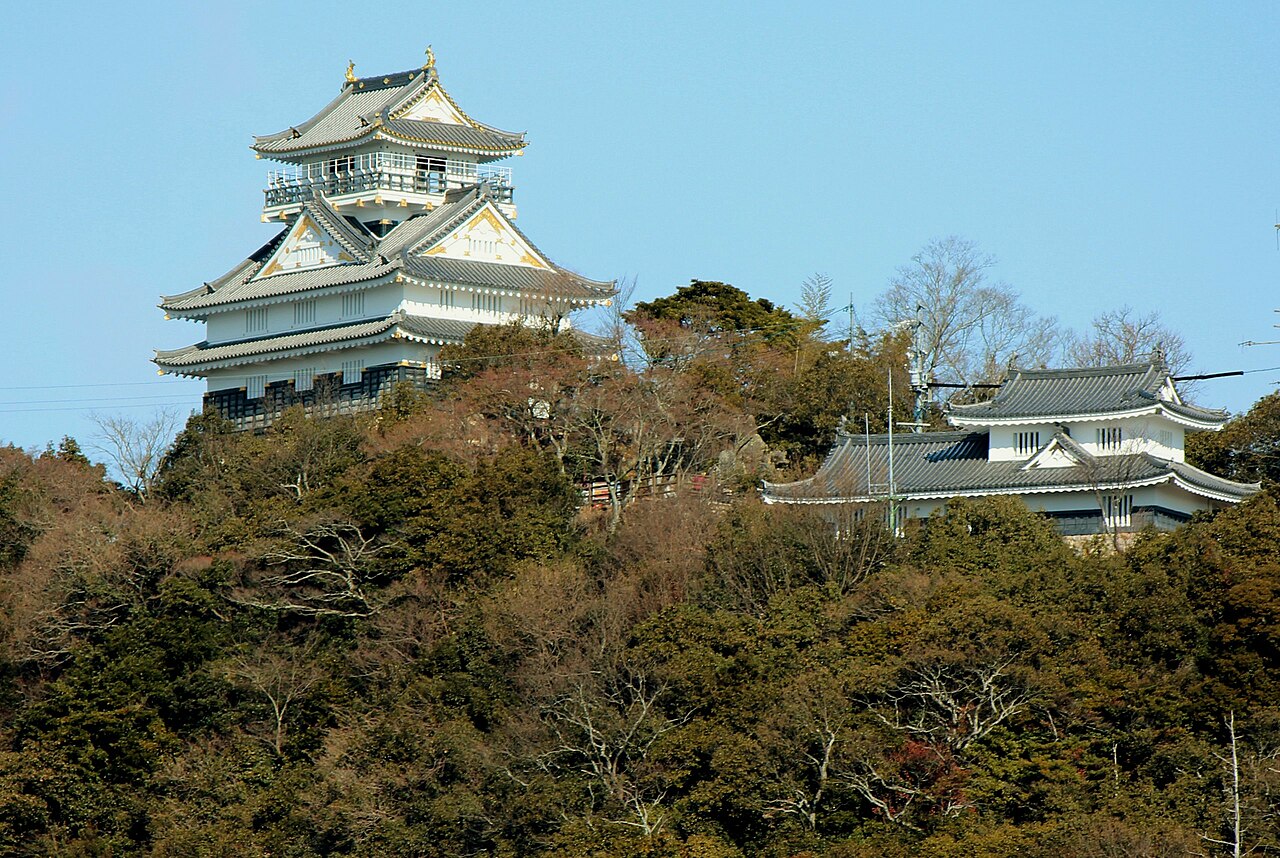
The historical anchor is the Momoyama period of the late 16th century. This was the age of the warlord Oda Nobunaga, whose seat — Gifu Castle, atop Mt. Kinka — overlooks the prefecture’s central plain. Under the patronage of warlord tea culture, Mino potters shifted from the single-chamber anagama to the larger ōgama kiln, and that increase in firing capacity coincided with a creative explosion. Four signature styles emerged almost together: Oribe (copper green, warped forms, iron-oxide brushwork), Shino (thick white glaze), Ki-Seto (yellow), and Setoguro (black).
Oribe ware takes its name from Furuta Oribe, a daimyō and tea master who studied under Sen no Rikyū. Where Rikyū prized austere symmetry and restraint, Oribe pushed the opposite direction — toward deliberately distorted, asymmetric, playful forms, bold green glaze, and graphic brush décor. A square Oribe plate that looks slightly “off” is not a defect; it is the whole point of the style.
- 7th c. — Sue-ware potting traditions established across the Mino/Owari region.
- 14th c. — Kokeizan Eiho-ji founded in Tajimi; Zen-temple tea culture takes hold in the district.
- Late 16th c. — Momoyama tea-ceramic revolution; shift from anagama to ōgama kilns; Oribe, Shino, Ki-Seto, and Setoguro styles emerge.
- 1544–1615 — Lifetime of Furuta Oribe, the tea master who gives the green-glaze style its name.
- Edo period — Mino kilns broaden from tea ware to everyday domestic tableware for a growing market.
- 20th c. — Tono kilns industrialize; Mino grows into Japan’s largest tableware-ceramic region, supplying close to half of domestic output.
- Today — Modern Mino kilns combine the Momoyama tea heritage with everyday wares widely exported, including to the US.
The continuity case is unusual for being industrial rather than boutique. Mino did not survive as a handful of heritage workshops; it scaled. By volume it remains the largest ceramic-tableware region in Japan, supplying close to half of all domestic tableware — which is why so much of the “plain Japanese ceramic” in everyday use, here and abroad, is quietly Mino ware without saying so.

“A square Oribe plate that looks slightly off-kilter is not a flaw in the firing — it is a 400-year-old argument, made by a tea master, that beauty does not have to be symmetrical.”
The same Gifu landscape that fed the kilns still defines the prefecture’s character. On the Nagara River, cormorant fishing (ukai) — a practice roughly 1,300 years old — continues each summer, a reminder that the rivers and clays which shaped the craft economy are still in use. An Oribe plate carries a little of that geography to the table.

Other Japanese ceramic and tea-ware pieces we have reviewed — useful for placing the Oribe square plate against different regions, kilns, and forms.
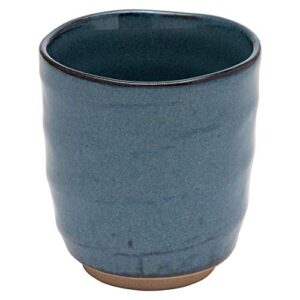 Shitoro-yaki yunomi (Shizuoka, Chubu pottery)
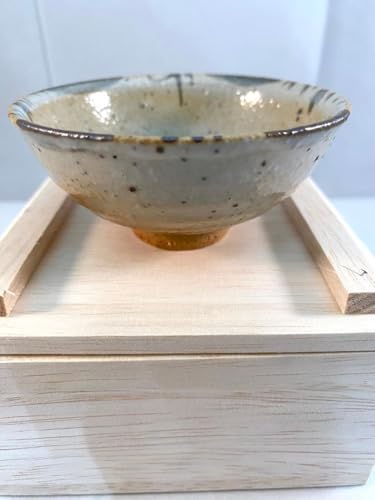 Karatsu E-Garatsu guinomi (Momoyama tea ware)
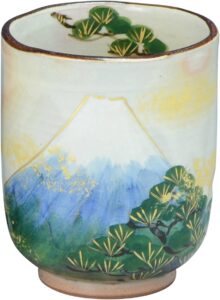 Aito Kyoyaki Shunzan yunomi
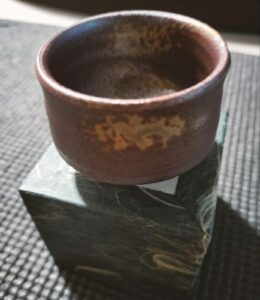 Tamba Tachikui-yaki guinomi
Bizen ware beer mug
Arita sometsuke porcelain mug
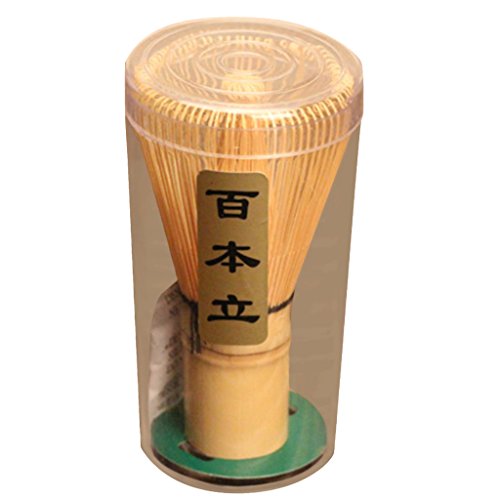 Takayama chasen matcha whisk
Price snapshot across stores
JPY is the authoritative price; USD figures are approximate estimates at a ¥150/USD baseline as of mid-2026. Live pricing for the specific listed item was unavailable at the time of writing — verify at the retailer before purchasing.
| Store | Item / Variant | Price (JPY / USD est.) | Notes |
|---|---|---|---|
| 🇺🇸 Amazon.com (US) — search | Browse Japanese Mino-yaki & Oribe tableware | varies (USD) | Best if you’re shopping from the US — Prime shipping, USD pricing, no international customs. Amazon US carries Japanese ceramic plates and Mino tableware from several makers, useful for comparing glaze, size, and price tiers. The exact profiled plate is sourced from Japan (next row). |
| 🇯🇵 Amazon JP Global Store | Mino-yaki Oribe square plate (ASIN B06WWPJMJC) | Check listing — price unavailable at writing | The sourced listing for the specific item. Ships internationally from Japan to most major destinations via the Global Store. |
| Maker direct | Tōnō / Toki / Tajimi kilns & pottery shops | Varies | Many Mino kilns sell through their own or regional shops; international shipping varies by maker and often requires a forwarder. |
| Proxy services (Buyee / Tenso) | Any JP listing not shipping to your country | Item + forwarding fee | Use when a domestic-only JP listing won’t ship directly; adds a service/forwarding fee and a second leg of transit. |
Prices in USD are approximate and depend on the current exchange rate. Always verify the current price and stock at the retailer via the affiliate link before purchasing.
What it does well
Weaknesses and things to verify before buying
- Thin listing data. Exact dimensions, weight, and care ratings were unconfirmed at the time of writing — check the live listing before you rely on a specific size.
- Piece-to-piece variation. Oribe glaze pooling, brushwork, and slight warping vary by piece; this is intended, but it means no two plates match exactly.
- Color reads dark. The copper green is earthy and can look heavier in person than on a bright product photo; not ideal if you want light, airy tableware.
- Care is unconfirmed. Glazed stoneware is often hand-wash-preferred; do not assume dishwasher or microwave safety until the listing states it.
- Pricing visibility. Live price was unavailable; confirm the total — including any international shipping — before committing.
- Shipping and customs. Ceramics are fragile and heavy for their size; international shipping cost and breakage risk are real, and orders above local thresholds may incur duties.
Conclusion — which buyer type are you?
Other ways to approach this purchase
🏆 Editor’s Pick
❓ Frequently Asked Questions
What is Oribe ware, and why is it green?
Oribe is a Mino-yaki style from the late-16th-century Momoyama period, named after the tea master Furuta Oribe. Its signature deep green comes from a copper-based glaze, usually paired with iron-oxide brush décor and deliberately asymmetric forms.
Where is Mino-yaki made?
In the Tōnō district of eastern Gifu Prefecture — chiefly the cities of Toki, Tajimi, and Mizunami. By volume it is the largest ceramic-tableware region in Japan, supplying close to half of all domestic tableware.
Can I buy this from outside Japan?
Yes. The specific item is sourced from the Amazon JP Global Store (ASIN B06WWPJMJC), which ships internationally to most major destinations. US-based shoppers can also browse comparable Mino/Oribe tableware on Amazon.com, or use a proxy service like Buyee or Tenso for JP-only listings.
Is the Oribe square plate dishwasher- and microwave-safe?
Care ratings were unconfirmed in the available data. Glazed stoneware is often hand-wash-preferred, so do not assume dishwasher or microwave safety until the live listing states it explicitly.
Why does each plate look slightly different?
Variation is intrinsic to the style. Oribe glaze pools unevenly, the iron-oxide brushwork is applied by hand, and slight warping is intentional — the Momoyama aesthetic prized asymmetry over uniformity. Expect each piece to be individual rather than identical.
How does it compare to other Japanese ceramics we cover?
Oribe shares the Momoyama tea-ware lineage with Karatsu E-Garatsu, but it is defined by green glaze rather than iron painting on a pale ground. It differs again from the rustic unglazed Bizen, the blue-and-white porcelain of Arita, and the wood-fired Tamba and Shitoro wares. See the comparison box above for direct links.
jpmono.com is curated by a Japan-based editorial team (working out of Toyama in the Hokuriku region and Nara in Kansai) and is independent. We don’t take payment from the makers we feature; income comes from affiliate links. We don’t physically test every product — we read maker specs and source listings.
This article was prepared with AI assistance and reviewed against the available product data and source notes. Specifications not present in that data are marked unconfirmed rather than estimated.
Affiliate disclosure: jpmono.com may earn a commission on qualifying purchases made through links on this page, at no additional cost to you.