![Amidaike Daikoku Awa-okoshi (あみだ池大黒 粟おこし, boxed assortment with Iwa-okoshi) — Osaka’s Edo-era crisp puffed-rice-and-sugar okoshi confection [2026 Guide for International Readers]](https://jpmono.com/wp-content/uploads/2026/07/amidaike-daikoku-awa-okoshi-where-to-buy-2026-featured.jpg)
- What it is: A boxed assortment of okoshi (おこし) — hardened puffed rice bound with sugar and starch syrup, perfumed with ginger and sesame — pairing the light awa-okoshi and the dense iwa-okoshi.
- Made in: Osaka (Nishi-ku, Amidaike district), Kansai — by Amidaike Daikoku, a confectioner founded in 1805, working with a sweet whose Osaka lineage runs through the entire Edo period.
- Price band: Everyday souvenir-confection pricing (see the live listing for the current figure — no price was in our snapshot).
- Best for: Curious readers who want to taste two centuries of Osaka’s most historic sweet in one shelf-stable, giftable box.
- Skip if: You dislike very hard, crackly textures, or you want a soft, fresh Japanese sweet to eat the same day.
- Shipping: shelf-stable and sealed; ships internationally from Amazon Japan — jump to our pick ↓
Okoshi is one of the oldest sweets Japan still eats — its ancestor sat on aristocratic and temple confection lists more than a thousand years ago, long before chocolate or caramel reached the country. Reduced to its essentials, it is puffed rice, sugar, and starch syrup pressed into a slab and left to set hard. That description sounds austere, and the eating is exactly that: dry, crackly, and clean, closer to old-fashioned rock candy than to any modern soft dessert.
Its spiritual home is Osaka, the merchant city that Edo-period Japan nicknamed tenka no daidokoro (“the nation’s kitchen”). Amidaike Daikoku (あみだ池大黒), founded in 1805 in the Amidaike district of what is now Nishi-ku, Osaka, is the house most closely tied to the sweet. Its two signatures are iwa-okoshi (岩おこし, “rock” okoshi, made from finely crushed rice for a very hard, dense snap) and awa-okoshi (粟おこし, a lighter grain that resembles millet, or awa), both scented with ginger and sesame.
This guide is written for international readers who have never encountered okoshi and want to understand what they would actually be ordering. We cover what awa-okoshi and iwa-okoshi are and how they differ, the history of the Amidaike Daikoku house and of okoshi in Osaka, how the confection keeps and travels, and how to buy a boxed assortment through Amazon Japan’s Global Store — with an Amazon US search path first for readers who prefer to shop domestically.
📅 Published:
🔄 Updated:
⏱️ Read time: ~9 min

- Who this is for — and who should skip it
- Product overview (from published specs)
- 📦 Shipping & where to buy from outside Japan
- Price snapshot across stores
- What it does well
- 📍 Where this comes from — place, era, and the craft tradition
- Weaknesses and things to verify before buying
- Conclusion — which buyer type are you?
- Other ways to approach this purchase
- 🏆 Editor’s Pick
- ❓ Frequently Asked Questions
Who this is for — and who should skip it
- Like very hard, dry, crackly textures — think brittle or old-style rock candy.
- Want to taste a genuinely historic Japanese confection, not a modern novelty.
- Need a shelf-stable, individually wrapped gift that survives a long shipment.
- Enjoy a warm ginger-and-sesame finish over a clean sugar sweetness.
- Want one box that explains Osaka’s okoshi culture through two contrasting styles.
- Prefer soft, moist sweets and dislike anything that snaps or shatters.
- Have dental sensitivity — iwa-okoshi in particular is deliberately rock-hard.
- Want a fresh, eat-today wagashi rather than a dry, long-keeping one.
- Dislike ginger or sesame, which flavor both styles.
- Need a precise live price before ordering (see the caveat below).
ℹ️ Live pricing and some pack specifics weren’t in our snapshot — the linked Amazon listing is authoritative, and unconfirmed attributes are marked “—” or “see listing” below.
Product overview (from published specs)
Based on the maker’s product identity and the listing, the assortment pairs Amidaike Daikoku’s two core okoshi styles in an individually wrapped, boxed format. Because our fetched snapshot did not include a live price or a confirmed piece count, those cells read “see listing.” The table below leads with the consumer-facing Amazon US search path, then the Amazon Japan Global Store listing where this specific item is sourced.
Amidaike Daikoku Awa-okoshi (あみだ池大黒 粟おこし, boxed assortment with Iwa-okoshi)
あみだ池大黒 大阪おこし700 1箱 箱入り 詰め合わせ24枚入り ミニ岩おこし16枚 ミニ粟おこし8枚 和菓子 米菓
通常3~4日以内に発送します。 · Sold by R&Sショップ · ASIN B0DS97RN26
Price and availability as of 2026-08-31 02:30 JST. The Amazon listing at the time of purchase is authoritative. jpmono.com earns a commission on qualifying purchases at no extra cost to you.
| Source | What you get | Confirmed detail |
|---|---|---|
| 🇺🇸 Amazon.com (US) — search | Browse Japanese okoshi & okoshi-style rice confections | Varies (USD) — comparable makers, not this exact box |
| 🇯🇵 Amazon JP Global Store (sourced listing) | Amidaike Daikoku awa-okoshi + iwa-okoshi boxed assortment, individually wrapped | ASIN B0DS97RN26 — price: see listing |
| Maker direct | Amidaike Daikoku official catalog (Japanese) | Domestic shipping focus — international via proxy |
| Composition | Rice, sugar, starch syrup (mizuame), sesame, ginger | Plant-based — no dairy, egg, or meat |
| Keeping | Fully dry, sealed, individually wrapped | Room-temperature, long best-by window |
📖 Glossary — key terms
- Okoshi (おこし) — a dry confection of steamed-then-dried puffed rice bound with sugar and starch syrup. The word puns on 起こす (okosu, “to raise / rouse”), so it is given as an auspicious, celebratory gift.
- Awa-okoshi (粟おこし) — the lighter grade, its fine grain resembling millet (awa).
- Iwa-okoshi (岩おこし) — the “rock” grade, made from finely crushed rice for a hard, dense snap.
- Mizuame (水飴) — clear starch syrup used as the binder that holds the puffed rice together.
- Tenka no daidokoro (天下の台所) — “the nation’s kitchen,” the Edo-period nickname for Osaka as Japan’s commercial and food-distribution hub.
- Wagashi (和菓子) — traditional Japanese confections; okoshi is one of the oldest surviving types.
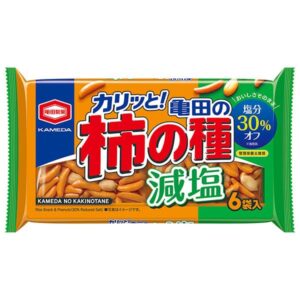

Kameda Kaki no Tane (亀田の柿の種, 6-bag box) — Niigata’s rice-cou…
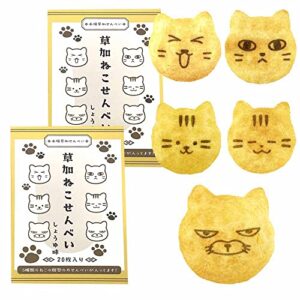

Soka Senbei (草加煎餅, individually-wrapped assortment box) — Sa…
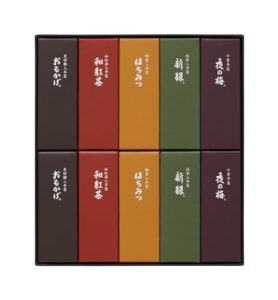

Toraya Small Yokan (Ko-gata Yōkan, 10-Bar Assorted Box) — Ja…
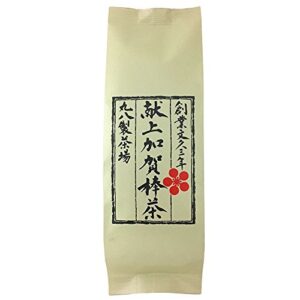

Maruhachi Seichajo Kenjo Kaga Bocha (献上加賀棒茶, sealed bag/tin)

Hoshino Seichaen Yame Matcha (星野製茶園 八女抹茶, sealed 30–40g tin)

Osaka Karaki Sashimono Rosewood Tea Tray: Joined Hardwood Ob…
Okoshi sits comfortably beside Osaka’s other dry, keeping specialties and pairs naturally with roasted twig tea or matcha — the linked guides cover the crackers, sweets, tea, and serving ware in that same everyday-Japanese register.
📦 Shipping & where to buy from outside Japan
Okoshi is one of the easier Japanese foods to import: it is fully dry, sealed, and individually wrapped, so it does not spoil in transit and carries a long best-by window. Amidaike Daikoku’s boxed assortment is listed on the Amazon Japan Global Store, which ships to 65+ countries — including Canada, the UK, and Australia, alongside the US and most of the EU.
As a room-temperature food item with a printed best-by date, it is intended for small personal quantities. Amazon estimates and collects any import fees at checkout for most destinations, so the price you approve already reflects likely customs and duties. Confirm AmazonGlobal International Shipping eligibility for your country before you order — food items can carry destination-specific rules.
Two other routes exist. Amazon US carries comparable Japanese okoshi and dry rice confections from other makers if you prefer domestic, USD-priced shopping with Prime speed. And proxy services (Buyee / Tenso) can forward an order from Amidaike Daikoku’s own Japanese catalog if you want a size or box not carried on the Global Store.
International shipping on a single boxed confection typically runs about $15–$40 to the US and EU, and similar to Canada, the UK, and Australia, with import fees estimated at checkout. Prices in USD are approximate and depend on the current exchange rate.
Price snapshot across stores
| Store | Item / variant | Price (JPY + USD est.) | Notes |
|---|---|---|---|
| 🇺🇸 Amazon.com (US) | Browse Japanese okoshi & rice-and-sugar confections | varies (USD) | Best if you’re shopping from the US — Prime shipping, USD pricing, no international customs. Amazon US carries okoshi and dry rice confections from various Japanese makers; Amidaike Daikoku’s exact box ships from Japan (next row). |
| 🇯🇵 Amazon JP Global Store | Amidaike Daikoku awa-okoshi + iwa-okoshi boxed assortment (ASIN B0DS97RN26) | see listing (¥ authoritative) | Ships internationally from Japan to 65+ countries — including Canada, the UK and Australia — with import fees estimated at checkout. This is the sourced listing for the exact item. |
| Maker direct | Amidaike Daikoku official catalog (JP) | see maker site | Widest box selection, but oriented to domestic shipping; pair with a proxy for overseas delivery. |
| Proxy services (Buyee / Tenso) | Forwarded from maker or JP retailer | item + forwarding fee | Useful for box sizes or seasonal variants not on the Global Store; adds a service fee and a second shipping leg. |
USD figures are approximate (≈ ¥150/USD as of mid-2026); the JPY price on the listing is the authoritative one. Prices and stock fluctuate — check the affiliate link for current data.
What it does well
- 🏠 Storage: keep at room temperature, away from humidity — moisture softens the crisp snap.
- ⏳ Shelf life: fully dry and sealed, with a long printed best-by window; individually wrapped pieces stay fresh once the box is opened.
- 🌱 Allergens / diet: plant-based (rice, sugar, starch syrup, sesame, ginger); contains sesame — check the package for the maker’s full allergen statement.
- 🍵 Serving: pairs naturally with roasted twig tea (bocha), matcha, or green tea; the ginger note cuts a bitter brew nicely.
“Fully dry, sealed, and individually wrapped, okoshi keeps for months at room temperature — which is exactly why it has been an Osaka souvenir for two centuries.”
📍 Where this comes from — place, era, and the craft tradition

Osaka sits on Osaka Bay at the mouth of the Yodo River, on the Seto Inland Sea side of western Japan. It is the anchor of the Kansai region, a short train ride from the old capitals of Kyoto and Nara. That location made it a natural hub for water-borne trade long before the modern era — rice, sugar, and other goods flowed into the city’s canals and out again across the country.
In the Edo period (1603–1868), Osaka earned the nickname tenka no daidokoro — “the nation’s kitchen” — as the country’s central market for rice and provisions. A dense merchant culture grew up around that trade, and with it a demand for durable, giftable sweets that could survive travel. Okoshi, dry and long-keeping by nature, fit the city’s commercial rhythm perfectly and became an Osaka specialty.
-
710–794 — Nara period: an okoshi ancestor appears among court and temple sweets, one of Japan’s oldest confection types. -
794–1185 — Heian period: okoshi-style sweets feature in aristocratic confection lists. -
1603–1868 — Edo period: Osaka becomes tenka no daidokoro, and okoshi is established as a merchant-city specialty. -
1805 — Amidaike Daikoku is founded (Bunka 2) in the Amidaike district of what is now Nishi-ku, Osaka. -
19th century — The house’s two signatures take form: hard, dense iwa-okoshi from finely milled rice, and lighter awa-okoshi, both scented with ginger and sesame. -
2026 — Amidaike Daikoku still makes and sells okoshi as an Osaka souvenir, now boxed and individually wrapped for international readers.
Amidaike Daikoku was founded in 1805 — Bunka 2 in the Japanese era count — in the Amidaike area of what is today Nishi-ku, Osaka. Its name ties it directly to that district, and more than two centuries later it remains the maker most closely identified with the sweet. The two products it is known for, iwa-okoshi and awa-okoshi, are the same two styles paired in this box.
There is a small piece of wordplay worth knowing. “Okoshi” puns on 起こす (okosu), “to raise” or “to rouse” — as in raising one’s fortunes. That auspicious reading is why okoshi has long been given as a celebratory gift, and it is part of why the sweet endured as an Osaka souvenir rather than fading as tastes changed.
The eating experience is distinct from almost any Western sweet. It is hard and crisp — iwa-okoshi deliberately so — with a dry, crackly bite somewhere between a candy and a rice cracker. The sweetness is clean rather than rich, and the ginger-and-sesame perfume gives a warm finish. It is a confection that rewards slow eating with tea, which is exactly how Osaka has treated it for generations.
Weaknesses and things to verify before buying
- It is genuinely hard. Iwa-okoshi in particular has a forceful snap; readers with dental sensitivity should approach it carefully or lean on the lighter awa-okoshi.
- Not a soft, fresh sweet. If you expect a moist wagashi, okoshi’s dry, crackly texture will feel unfamiliar — it is closer to old-style rock candy.
- Contains sesame; check the full allergen list. The confection is plant-based, but sesame is present; confirm the maker’s package statement for other allergens before gifting.
- No live price in our snapshot. Our fetched data did not include a current figure or a confirmed piece count — verify both on the listing before ordering.
- Ginger-and-sesame flavor is a fixed character. There is no plain-sugar version here; if you dislike ginger, this is not the sweet for you.
- Food-import rules vary by country. Confirm AmazonGlobal eligibility and any destination food restrictions at checkout for your country.
Conclusion — which buyer type are you?
Other ways to approach this purchase
🏆 Editor’s Pick
❓ Frequently Asked Questions
What is the difference between awa-okoshi and iwa-okoshi?
Awa-okoshi (粟おこし) is the lighter style, with a fine grain that resembles millet (awa). Iwa-okoshi (岩おこし) is made from more finely crushed rice, packed denser and harder — the name means “rock.” Both are flavored with ginger and sesame; the assortment pairs them so you can taste the contrast.
Does it ship outside Japan?
Yes. The Amazon Japan Global Store ships to 65+ countries, including Canada, the UK, Australia, the US, and most of the EU. Because okoshi is fully dry and sealed, it travels well; confirm AmazonGlobal eligibility and any food-import rules for your country at checkout, where import fees are also estimated.
How long does okoshi keep?
It has a long best-by window. The confection is fully dry, sealed, and individually wrapped, so it stays crisp at room temperature for months and remains fresh after the box is opened. Keep it away from humidity, which softens the snap.
Is it suitable for a vegetarian or vegan gift?
The core ingredients — rice, sugar, starch syrup, sesame, and ginger — are plant-based, with no dairy, egg, or meat. It does contain sesame, so check the maker’s full allergen statement on the package before gifting to anyone with an allergy.
Why is okoshi given as a gift?
The word “okoshi” puns on 起こす (okosu), “to raise” or “to rouse” — as in raising one’s fortunes. That auspicious reading has made it a traditional celebratory gift in Osaka for generations, and its long shelf life makes it practical to send.
How does it compare to senbei or yokan?
Okoshi is sweet and crackly, made from sugar-bound puffed rice — unlike savory rice crackers (senbei) or the soft, dense red-bean jelly of yokan. If you want to compare, the cross-links above cover Soka senbei, Kameda’s kaki-no-tane, and Toraya’s small yokan.
jpmono.com is a Japan-based curation site, with editorial centers in Toyama (Hokuriku region) and Nara (Kansai region), introducing Japanese household objects and specialties to international readers. We focus on items with verifiable heritage and clear international shipping paths. We do not physically test every product (we read maker’s specs and source listings); affiliate links support the editorial work. Read more about our editorial standards.
This article was drafted with AI assistance and reviewed against the source listing before publication. Product specifics, pricing, and shipping eligibility should be confirmed on the live listing at the time of purchase.
Affiliate disclosure: jpmono.com may earn a commission on qualifying purchases made through links on this page, at no additional cost to you.