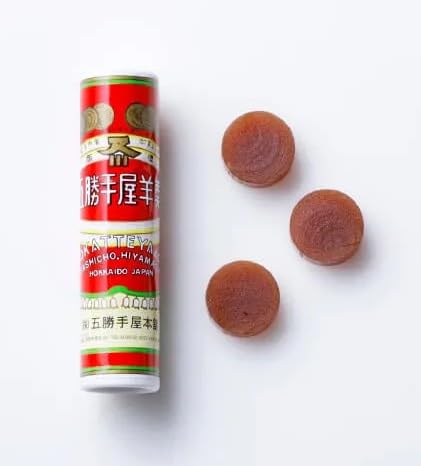
![Gokatteya Honpo Marukan Yokan (五勝手屋 丸缶羊羹, 5-tube box) — the string-cut kintoki-bean yokan from Esashi, the old herring port of southwestern Hokkaido [2026 Guide for International Readers]](https://jpmono.com/wp-content/uploads/2026/09/gokatteya-marukan-yokan-where-to-buy-2026-featured.jpg)
- What it is: yokan (羊羹, firm sweet bean jelly) sold in cylindrical paper tubes — you push the base up and slice a disc with the string tucked under the lid, sold here as a multi-tube gift box.
- Made in: Esashi, Hiyama District, Hokkaido — by Gokatteya Honpo (五勝手屋本舗), an independent confectioner founded in 1870.
- What makes it unusual: the paste is built on kintoki (金時, red kidney beans) instead of adzuki, giving a cleaner, less earthy sweetness.
- Price band: gift-box confectionery — check the live listing, as pricing was not in our data snapshot.
- Best for: readers who want a shelf-stable, plant-based Japanese sweet that survives long-haul shipping and splits neatly into individual gifts.
- Skip if: you dislike firmly set, straightforwardly sweet confections, or you need something that keeps for a year.
- Shipping: shelf-stable and shipped at room temperature from Amazon Japan — jump to our pick ↓
Esashi’s warehouses filled with herring before the island around them was called Hokkaido. Through the Edo period this small port on the Japan Sea coast of the southwestern tail of the island grew rich on nishin (鰊, herring) and on the kitamaebune (北前船) coastal ships that ran down the Japan Sea to Kanazawa and Osaka and came back loaded with Kansai goods, Kansai money, and Kansai confectionery technique. Sugar arrived in Esashi by sea, and so did the craft of using it.
Gokatteya Honpo (五勝手屋本舗) has made sweets in that town since 1870 — Meiji 3, two years after the Meiji era began and one year after the island was formally renamed Hokkaido. Its signature Marukan Yokan (丸缶羊羹, “round-tube yokan”) breaks two conventions of the genre at once. The bean paste is made from kintoki (金時), a red kidney bean, rather than the adzuki that defines almost all Japanese yokan, which produces a brighter, cleaner sweetness with less of the deep earthiness the category usually carries. And it is not sold as a slab in a box: it comes as a cylindrical paper tube with a length of string coiled under the lid. You push the base disc upward, loop the string around the extruded column, pull, and a clean round slice falls off. No knife, no cutting board, no plate.
That format, invented for convenience in Japan, turns out to be close to ideal for international ordering. Each tube is individually sealed, the confection is plant-based (beans, sugar, and agar — no dairy, egg, or meat), it travels and stores at room temperature, and its best-by window is measured in months rather than the days that most fresh wagashi allow. This guide covers what the product actually is, how Esashi came to have an Edo-period sweets culture on an island otherwise associated with modern dairy confectionery, how the boxed multi-tube set compares with the maker’s flat nagashi yokan block, and what to verify before ordering from outside Japan.
🔄 Last updated: September 7, 2026
⏱️ Read time: about 11 minutes
🇯🇵 Esashi, Hokkaido
- Who this is for — and who should skip it
- Product overview (from published specs)
- 📍 Where this comes from — place, era, and the craft tradition
- 📌 How does it compare?
- 📦 Shipping & where to buy from outside Japan
- Price snapshot across stores
- What it does well
- Weaknesses and things to verify before buying
- Conclusion — which buyer type are you?
- Other ways to approach this purchase
- 🏆 Editor’s Pick
- ❓ Frequently Asked Questions
Who this is for — and who should skip it
- Want a Japanese sweet that survives international shipping without refrigeration or fragile packaging.
- Are buying gifts and want a set that splits into several self-contained portions rather than one large item.
- Eat plant-based — the core ingredients are beans, sugar, and kanten (寒天, agar), with no dairy, egg, or meat.
- Have found ordinary adzuki yokan too heavy or too earthy and want the lighter kintoki-bean profile.
- Enjoy objects with a mechanism — the push-up tube and string cutter is the part most first-time buyers remember.
- Need a long pantry life — best-by dates on unopened tubes are typically measured in months, not years.
- Prefer soft, low-sugar, or lightly set desserts; yokan is dense and unambiguously sweet by design.
- Are shopping for someone avoiding sugar or legumes for dietary reasons.
- Want a single large block to slice at home — the flat nagashi yokan (流し羊羹) suits that better than the tubes.
- Cannot confirm that food items ship to your destination; eligibility is decided at checkout, not by us.
Product overview (from published specs)
ℹ️ Live pricing was not present in our data snapshot for this item — the linked listing is authoritative, and unconfirmed attributes are marked below rather than guessed.
| Attribute | Detail | Source |
|---|---|---|
| Product | Marukan Yokan (丸缶羊羹), multi-tube gift box — commonly sold as a 5-tube or 10-tube set | Amazon JP Global Store (sourced listing) |
| Maker | Gokatteya Honpo (五勝手屋本舗), founded 1870 (Meiji 3), independent | Maker direct |
| Made in | Esashi Town, Hiyama District, Hokkaido | Maker direct |
| Bean base | Kintoki (金時, red kidney bean) — not adzuki; paler color, cleaner and less earthy sweetness | Maker direct |
| Core ingredients | Beans, sugar, kanten (寒天, agar) — fully plant-based; no dairy, egg, or meat | Maker direct |
| Format | Cylindrical sealed paper tube; base disc pushes up, string stored under the lid cuts each slice | Maker direct |
| Also in the line | Nagashi yokan (流し羊羹) — a flat block for slicing at home | Maker direct |
| Storage | Room temperature, away from direct sunlight; chilling hardens the surface | Maker direct |
| Best-by | Listed in months for unopened tubes — read the exact date on the live listing and the packaging | Amazon JP Global Store |
| Net weight / tube count | Unconfirmed in our snapshot — check the live listing (box sizes differ between 5-tube and 10-tube sets) | — |
| Price | Unconfirmed at time of writing — see the live listing; prices and stock fluctuate | — |
| Item ID (ASIN) | B0GV7XTLJP | Amazon JP Global Store |
📖 Glossary — the Japanese terms used in this article
- yokan (羊羹) — a firm confection of sweetened bean paste set with agar, sliced and eaten in small pieces, usually with tea.
- marukan (丸缶) — literally “round tube/can”; Gokatteya’s cylindrical package format with the push-up base and string cutter.
- nagashi yokan (流し羊羹) — “poured yokan,” the conventional flat block form, sliced with a knife at home.
- kintoki (金時) — a red kidney bean used here in place of adzuki, giving a lighter, less earthy paste.
- adzuki (小豆) — the small red bean behind most Japanese sweet bean paste.
- kanten (寒天) — agar, the seaweed-derived setting agent that makes yokan firm and sliceable; it is not gelatin, which is why the product is plant-based.
- wagashi (和菓子) — Japanese traditional confectionery as a category.
- kitamaebune (北前船) — the Edo-period coastal trading ships that ran the Japan Sea route between Hokkaido and Osaka, carrying goods, money, and technique in both directions.
- nishin (鰊) — herring; the fishery that made Esashi wealthy.
- Esashi Oiwake (江差追分) — the folk song that originates in Esashi and is among the best-known in Japan.
📍 Where this comes from — place, era, and the craft tradition

Hokkaido is the northernmost of Japan’s main islands, and most of what international readers know about its food is modern: dairy, butter cookies, soft-serve, corn, crab. Esashi does not fit that picture. It sits on the Japan Sea side of the narrow southwestern peninsula that reaches down toward Honshu, in Hiyama District — a stretch of coast that faces west, away from Sapporo and away from the Pacific ports, and looks straight down the shipping lane that carried Edo-period Japan’s bulk trade.
That orientation is the whole story. Esashi’s wealth came from nishin — herring — and from the kitamaebune ships that worked the Japan Sea route between Hokkaido and Osaka. Herring, kelp, and marine products went south. Rice, textiles, sugar, merchant capital, and confectionery technique came north. A port town on this route did not develop in cultural isolation at the edge of the country; it developed as the far end of a line running through Kanazawa to Osaka, which is to say as an outpost of Kansai commercial culture.
“Sugar reached Esashi by sea, and so did the craft of using it — which is how a herring port on the Japan Sea ended up with an Edo-period sweets culture older than the name Hokkaido.”
The town’s name for the district — 五勝手 (Gokatte), which the confectioner took as its own — is traditionally traced to settlers from the Kaga domain, in what is now Ishikawa Prefecture. That is another Hokuriku thread rather than a Hokkaido one. The same southward orientation shows up in the town’s cultural inventory: the Ubagami Daijingu Togyosai (姥神大神宮渡御祭) is regarded as Hokkaido’s oldest festival, and Esashi Oiwake, one of the most widely known folk songs in Japan, originates here.
-
Edo period — Esashi’s herring fishery fills the town’s warehouses; the port becomes one of the wealthiest points on Japan’s northern frontier. -
Edo period — Kitamaebune ships link Esashi to Kanazawa and Osaka down the Japan Sea, importing sugar, refined confectionery technique, and merchant culture. -
Edo period — The Ubagami Daijingu Togyosai takes root in Esashi and is today regarded as Hokkaido’s oldest festival; the folk song Esashi Oiwake originates in the same town. -
1869 — The island is formally renamed Hokkaido — by which point Esashi already had generations of merchant history behind it. -
1870 (Meiji 3) — Gokatteya Honpo is founded in Esashi, taking its name from the local place name 五勝手, traditionally traced to Kaga-domain settlers. -
Modern era — The cylindrical Marukan Yokan with its push-up base and string cutter becomes the maker’s nationally recognized signature. -
2026 — Gokatteya Honpo remains an independent local confectioner in Esashi, still built on kintoki beans rather than adzuki.
What “still being made here” means in this case is narrower and more specific than in most craft categories. Gokatteya Honpo is not one of a dozen surviving workshops in a designated craft district; it is a single independent confectioner that has operated in one small port town since 1870 and is known nationally for one format. The continuity is in the product decision rather than in an industry: the choice of kintoki over adzuki, and the tube-and-string package, have both been kept rather than modernized away.
The seasonal fit is worth noting for anyone planning gifts. Yokan is a year-round wagashi, but its natural companion is tea served hot, and a single sliced disc is the standard size for a Japanese tea break — small, sweet enough to balance a bitter cup, and eaten in two or three bites. It is also a conventional omiyage (souvenir) purchase in Japan, which is precisely why the multi-tube box exists: it is designed to be broken apart and distributed.
📌 How does it compare?
Yokan is designed to be eaten with tea, so the most useful comparisons are what you would serve alongside it — plus one other shelf-stable, sealed Japanese snack that travels the same way.
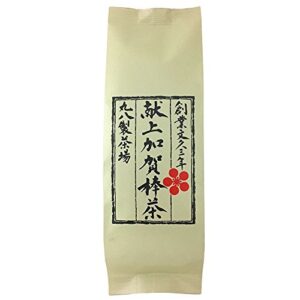

Maruhachi Seichajo Kenjo Kaga Bocha (献上加賀棒茶, sealed bag/tin)

Hoshino Seichaen Yame Matcha (星野製茶園 八女抹茶, sealed 30–40g tin)
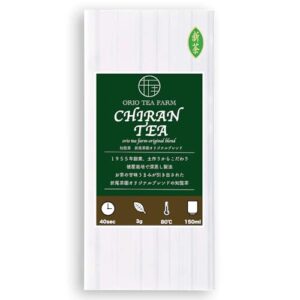

Chiran-cha Deep-Steamed Sencha (知覧茶 深蒸し煎茶, sealed 100g bag)
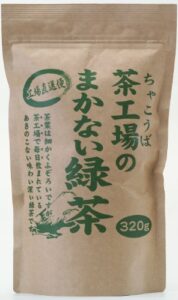

Ooigawa Chaen Fukamushi Sencha (大井川茶園 深蒸し煎茶, sealed foil bag)
🍵
Kenichi Shizen Noen Yamato-cha Sencha (健一自然農園 大和茶, sealed)
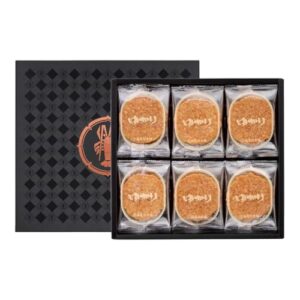

Bankaku Sohonpo Yukari Ebi Senbei (坂角総本舗 ゆかり, individually sealed)
📦 Shipping & where to buy from outside Japan
The Marukan Yokan is a shelf-stable food item stored and shipped at room temperature, which puts it in the easier half of the Japanese-food import problem: there is no cold chain to maintain and no fragile ceramic to cushion. The realistic path from outside Japan is the Amazon Japan Global Store, which ships to 65+ countries including Canada, the UK, and Australia, with import fees estimated and generally collected at checkout. Our country-specific notes for Canada, the UK, and Australia cover the customs thresholds for each.
Food is the one category where destination eligibility genuinely varies. Some countries restrict or require declarations on imported foodstuffs, and a listing that ships to one address may be blocked for another. Amazon resolves this at checkout rather than on the product page, so the only reliable test is to add the item to your cart with your real shipping address entered.
Shipping cost for a boxed set of this size typically lands in the same band as other small, light Japan-to-overseas parcels — roughly $15–$40 to the US, EU, Canada, the UK, and Australia, depending on the carrier option chosen at checkout. Because each tube is individually sealed and the contents are dense and firm, transit damage is a smaller concern here than with most confectionery.
Proxy services such as Buyee or Tenso are the fallback if the Global Store listing does not ship to your country. They add their own fee and a domestic Japan leg, and they will not resolve a destination-side food restriction — but they do open up the maker’s full line and Japanese-domestic sellers who do not export directly.
Price snapshot across stores
| Store | Item / Variant | Price | Notes |
|---|---|---|---|
| 🇺🇸 Amazon.com (US) | Browse Japanese yokan & wagashi | varies (USD) | Best if you are shopping from the US — Prime shipping, USD pricing, no international customs. Amazon US carries yokan and other shelf-stable Japanese sweets from several makers, useful for comparing bean types and portion formats. Gokatteya’s own tubes are sourced from Japan (next row). |
| 🇯🇵 Amazon JP Global Store | Marukan Yokan multi-tube gift box (ASIN B0GV7XTLJP) | See live listing — not in our snapshot | Ships internationally from Japan to 65+ countries — including Canada, the UK, and Australia — with import fees estimated at checkout. This is the sourced listing for the exact item in this guide; confirm the best-by date shown before ordering. |
| Maker direct | Full Gokatteya Honpo line, including the flat nagashi yokan block | Varies (JPY) | Widest selection and freshest stock, but the ordering flow is Japanese-language and generally assumes a domestic address. Practical only when paired with a forwarding service. |
| Proxy services (Buyee / Tenso) | Domestic Japanese listings, incl. seasonal and set variations | Item price + service fee + forwarding | Use only if the Global Store listing does not ship to your country. Adds cost and transit time, and does not override destination-side food import rules. |
Prices and stock fluctuate; the figures shown on the linked listings at the time you read this are authoritative. Where a USD figure appears elsewhere on this site alongside a JPY price, it is an approximate conversion at a ¥150/USD baseline as of mid-2026, and the JPY price is the real one.
What it does well
Push the base disc up, loop the string stored under the lid, pull, and a clean disc separates. It requires no knife, no board, and no plate, which makes it genuinely practical at a desk, on a train, or in a hotel room.
Kintoki kidney beans in place of adzuki give a brighter, cleaner sweetness. Readers who have tried yokan once and found it too heavy have a real reason to try this one rather than a repeat of the same profile.
Sealed tubes, room-temperature storage, dense contents, and a best-by window measured in months. Compared with most fresh wagashi, this is one of the few categories that arrives intact after a long-haul parcel journey.
A multi-tube box is effectively several separate gifts in one purchase. Each tube is individually sealed and self-contained, so it can be handed out one at a time without repackaging.
- 🌡️ Storage: room temperature, away from direct sunlight — no refrigeration needed while sealed.
- ❄️ Refrigeration: only after opening, and only if you must — chilling hardens the surface of the yokan.
- 🧵 Cutting: push the base disc upward and slice with the string stored under the lid; no knife required.
- 📅 Best-by: check the date printed on the packaging and shown on the live listing; unopened tubes are commonly listed months out, not years.
- 🌱 Dietary: beans, sugar, and kanten (agar) — plant-based, with no dairy, egg, or meat in the core recipe. Check the listing’s ingredient panel for the exact set you order.
Weaknesses and things to verify before buying
- The best-by window is short by pantry standards. Unopened tubes are commonly listed with dates a few months out rather than a year or more. If the box is intended as a gift for a specific future date, confirm the printed date before ordering — this is the single most common disappointment with imported Japanese sweets.
- Pricing and exact set contents were not in our data snapshot. Marukan Yokan is sold in more than one box size, commonly 5-tube and 10-tube. Verify the tube count, net weight, and price on the live listing rather than assuming from the photo.
- Food shipping eligibility is destination-dependent. Some countries restrict food imports or require declarations, and Amazon confirms eligibility only at checkout with your real address entered. A listing that ships to one country may be blocked for another.
- It is unambiguously sweet and firmly set. Yokan is not a light dessert; it is a dense, sugar-forward confection intended in small slices with tea. Readers expecting something closer to a mousse or a soft jelly will be surprised.
- The tube format limits presentation. Slices come out as small rounds. If you want the wide rectangular pieces that appear in Japanese tea-ceremony photography, the maker’s flat nagashi yokan block is the correct product, not the tubes.
- Refrigeration is a common user error. Chilling hardens the surface and changes the texture. The instinct to refrigerate anything sweet and moist works against this product.
- Ingredient verification is on you for allergen or dietary purposes. The core recipe is beans, sugar, and agar, but seasonal or assorted sets may differ. Read the ingredient panel on the specific set you are ordering rather than relying on the general description.
Conclusion — which buyer type are you?
Take the larger multi-tube box. It arrives as a presentable gift set, breaks apart into individual sealed portions, and covers several recipients from one order and one shipping charge.
The 5-tube box is the natural starting point: enough to share, small enough to finish inside the best-by window, and the format that shows off the string-cut mechanism.
Order the smallest set the listing offers, or the flat nagashi yokan block, which delivers more confection per unit of packaging. One international shipping charge is the fixed cost either way, so pick the size you will actually eat.
If you need a long shelf life, avoid sugar or legumes, or want a savory Japanese snack instead, this is not the purchase. Sealed rice crackers or a tea from the comparison box above will serve you better.
Other ways to approach this purchase
Confectionery listings rotate stock rather than discount it. If the visible best-by date is close, waiting for the next restock is usually better value than buying on sale — freshness is the variable that matters here, not price.
The maker’s flat nagashi yokan is the alternative for readers who want one larger piece to slice at home. It loses the string mechanism, and once opened it is a single item rather than several sealed portions.
International shipping is charged per parcel, so pairing the box with tea from the same order spreads the cost. Points and gift-card balances apply on the Amazon Japan side as usual.
If your destination restricts food imports, or nobody in the household eats sweet bean paste, there is no version of this purchase that works. Non-food Japanese gifts avoid the customs question altogether.
🏆 Editor’s Pick
❓ Frequently Asked Questions
How do you actually cut the Marukan Yokan?
Push the disc at the base of the paper tube upward so the yokan extrudes from the top, then take the length of string stored under the lid, loop it around the exposed column, cross the ends, and pull. A clean round slice separates. No knife or cutting board is needed, which is the reason the format exists.
How is this different from ordinary yokan?
Two ways. The bean paste is made from kintoki (金時), a red kidney bean, instead of the adzuki used in almost all yokan, which gives a paler color and a cleaner, less earthy sweetness. And it is sold in a cylindrical push-up paper tube with a string cutter rather than as a flat slab in a box.
Is it vegan or vegetarian?
The core recipe is beans, sugar, and kanten (寒天, agar) — plant-based, with no dairy, egg, or meat. Agar is seaweed-derived, not gelatin. That said, seasonal and assorted sets can differ, so read the ingredient panel on the specific listing you order.
How long does it keep, and should I refrigerate it?
Unopened tubes are commonly listed with a best-by date several months out and are stored at room temperature, away from direct sunlight. Check the exact date on the live listing and on the packaging rather than relying on a general figure. Refrigerate only after opening, and only if necessary — chilling hardens the surface of the yokan.
Can it be shipped to my country?
The Amazon Japan Global Store ships to 65+ countries including Canada, the UK, and Australia, with import fees estimated at checkout. Food items are the category where eligibility varies most by destination, so add the item to your cart with your real address entered — Amazon confirms whether it can ship there at checkout, not on the product page.
Why does a Hokkaido town have an Edo-period sweets tradition?
Esashi grew wealthy on herring fishing and on the kitamaebune coastal shipping route that connected the town to Osaka via the Japan Sea. Those ships brought back sugar, refined confectionery technique, and merchant culture, so the town’s commercial life was tied to Kansai and Hokuriku rather than to inland Hokkaido. Gokatteya Honpo was founded there in 1870.
Should I buy the tubes or the flat block?
Buy the tubes if you are shipping internationally, sharing with several people, or want the string-cut format. Buy the flat nagashi yokan (流し羊羹) block if you want one larger piece to slice into rectangular portions at home and are not concerned about dividing it into sealed gift units.
jpmono.com is curated by a Japan-based editorial team (working out of Toyama in the Hokuriku region and Nara in Kansai) and is independent. We do not take payment from the makers we feature; income comes from affiliate links. We do not physically test every product — we read maker specifications and source listings, and we say so when data is thin.
🤖 This article was drafted with AI assistance and edited by a Japan-based human editor. Product facts are drawn from maker information and source listings available at the time of writing; where data was unavailable, that is stated rather than estimated.
Affiliate disclosure: jpmono.com may earn a commission on qualifying purchases made through links on this page, at no additional cost to you.