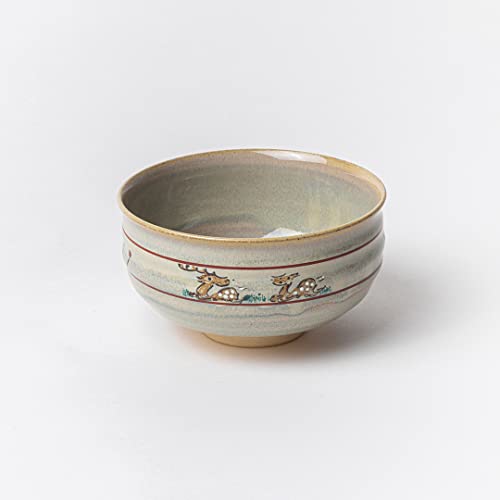
- What it is: A single Akahada-yaki matcha bowl with Nara-e decoration, listed by the seller as a matcha bowl, latte bowl, tonsui and soup bowl.
- Made in: Japan — Akahada-yaki, the pottery tradition of Nara’s Akahada district (model KONCH1-A, name Kōgetsu).
- Price band: ¥7,991 (≈ $53 USD) for one bowl as of 2026-11-21; verify on the listing.
- Best for: Someone who wants one bowl with a regional Nara identity and a soft, warm-toned glaze for home matcha.
- Skip if: You need a matched pair, a published capacity, or dishwasher-safe everyday ware.
- Shipping: ships internationally from Amazon Japan — jump to our pick ↓
On the western side of Nara, the dense temple town gives out into a district called Akahada, where potters have painted figures and seasonal motifs onto soft, warm-toned glaze for centuries. The bowl in this article comes from that tradition: a low-fired earthenware matcha chawan (抹茶茶碗, “matcha tea bowl”) with decoration in the Nara-e style, listed as made in Japan under the name Kōgetsu (鴻月).
Akahada-yaki is one of the smaller Japanese pottery names an international buyer is likely to meet, and that is part of its character. Where Shigaraki and Tamba are broad regional traditions with many workshops, Akahada is a district-scale craft tied to one old capital, one temple town, and a painting style that carries the look of Nara rather than the look of a modern studio line. The clay body is typically low-fired earthenware, not porcelain, which is why these bowls feel gentle in the hand instead of glassy.
This guide is for readers weighing one specific bowl: what the listing actually states, what it leaves unstated, how the price compares with other paths to a matcha bowl, how the piece should be cared for, and whether a Nara-e bowl is the right first purchase or the wrong one. Comparisons with Shigaraki, Tamba, and other Nara crafts run through the middle of the article.
Updated
Read time ~10 min

- Who this is for — and who should skip it
- Product overview (from published specs)
- 📍 Where this comes from — place, era, and the craft tradition
- What it does well
- Weaknesses and things to verify before buying
- Conclusion — which buyer type are you?
- Other ways to approach this purchase
- Which finish should you choose?
- Price snapshot across stores
- 📦 Shipping & where to buy from outside Japan
- 🏆 Editor’s Pick
- ❓ Frequently Asked Questions
Who this is for — and who should skip it
- You practice matcha at home and want a bowl with a specific regional identity, not a generic café bowl.
- You are drawn to Nara-e decoration — figures, landscapes, and seasonal motifs painted over a warm glaze.
- You prefer the softer, slightly rustic feel of low-fired earthenware to the ring of porcelain.
- You want one bowl that can also serve as a latte bowl, a tonsui for dipping sauce, or a soup bowl.
- You are buying a gift for someone with a connection to Nara, its temples, or its deer park.
- You need a matched pair or a set for guests — this listing is one bowl.
- You want dishwasher-safe, microwave-safe everyday ware with a published care label.
- You need an exact capacity or diameter before ordering; the listing does not state either.
- You are not prepared to hand-wash and dry a porous, low-fired piece.
- You need guaranteed stock — availability was down to two bowls at the time of writing.
Product overview (from published specs)
ℹ️ The snapshot behind this article held the Amazon JP listing only, so live pricing and some attributes were not in our data — the linked listing is authoritative, and unconfirmed fields are marked below.
Akahada-yaki Matcha Chawan
鴻月 赤膚焼 抹茶茶碗 抹茶碗 奈良絵 茶道具 日本製 かわいい ラテボウル とんすい スープボウル KONCH1-A
残り2点(入荷予定あり) · Sold by Amazon.co.jp · ASIN B0BNLCBN66
Price and availability as of 2026-11-21 09:12 JST. The Amazon listing at the time of purchase is authoritative. jpmono.com earns a commission on qualifying purchases at no extra cost to you.
| Item | Matcha chawan (抹茶茶碗); also listed as latte bowl, tonsui, and soup bowl |
|---|---|
| Craft | Akahada-yaki (赤膚焼) |
| Decoration | Nara-e (奈良絵) — the painting style is named in the listing; the method used on this individual bowl is not stated |
| Material | Low-fired earthenware (typical of the tradition); material is not spelled out in the listing |
| Maker / brand as listed | Kōgetsu (鴻月) |
| Model number | KONCH1-A |
| Piece count | One bowl — not a set |
| Size / capacity | Unconfirmed — check the listing |
| Weight | — |
| Made in | Japan |
| Condition | New |
| Price | ¥7,991 (≈ $53 USD) as of 2026-11-21; verify on the listing |
| Availability | 2 left, more expected (残り2点・入荷予定あり) at the time of writing |
Sources: the Amazon JP listing snapshot taken 2026-11-21 09:05 JST (seller Amazon.co.jp), plus the general craft description used throughout this article. No maker-direct catalogue page or US listing for this exact bowl was available in the snapshot.
Glossary — Japanese tea and pottery terms
- Chawan (茶碗): A tea bowl. In tea practice the word usually means a bowl wide and deep enough to whisk matcha in.
- Matcha (抹茶): Stone-milled powdered green tea, whisked with hot water rather than steeped.
- Akahada-yaki (赤膚焼): The pottery of the Akahada district in present-day Nara city. The characters read literally as “red skin”.
- Nara-e (奈良絵): A Nara-associated painting style applied to ceramics here as painted figures, landscapes, and seasonal motifs over a warm-toned glaze.
- Low-fired earthenware: Clay fired at a lower temperature than porcelain or stoneware. It stays porous and soft-feeling rather than vitrified and glassy.
- Tonsui (とんすい): A small dipping bowl, often used at the table for sauces or condiments.
- Glaze: The glassy or semi-matte layer fused onto the clay surface. Akahada glazes are typically soft and warm-toned rather than bright.
📍 Where this comes from — place, era, and the craft tradition
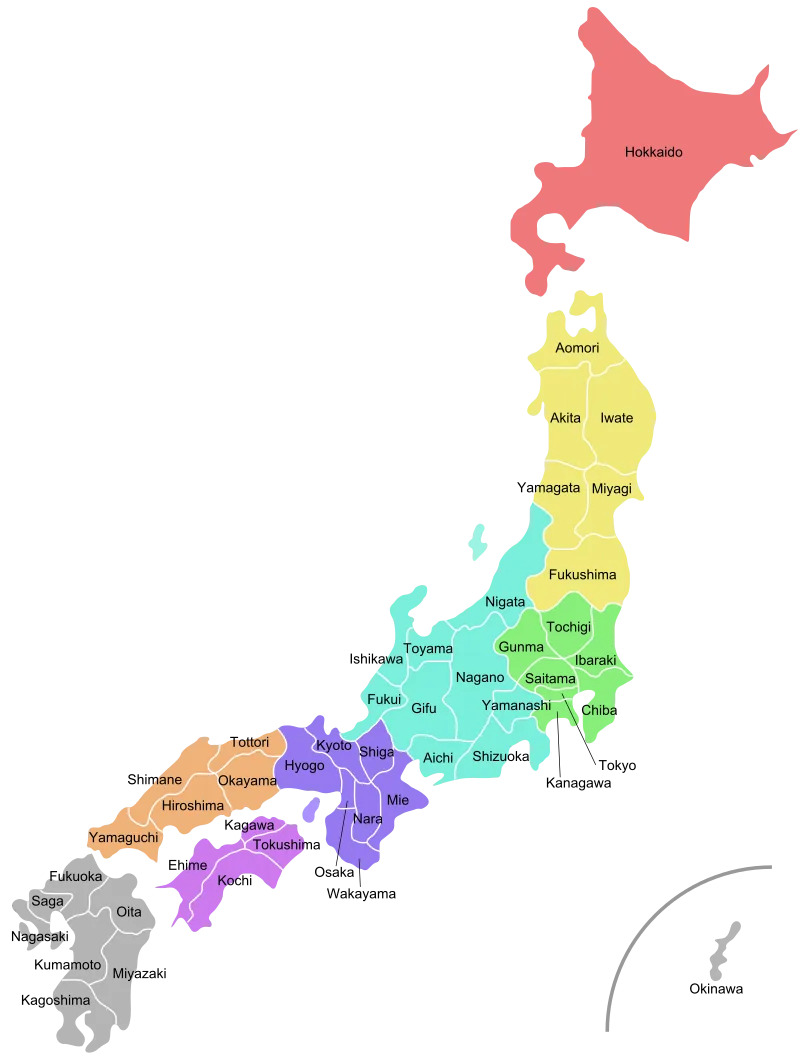
Nara occupies the northern part of the Nara Basin, an inland plain in the Kansai region surrounded by low hills and higher mountains. It has no port and no great river running through its center, and its importance has never rested on trade geography. The city grew because institutions were placed there: the court first, then the great temples that stayed after the court left. Akahada is a district on the city’s western side, where the dense temple town loosens toward the edge of the basin.

Nara was Japan’s capital from 710 to 794. During that stretch the imperial court, the major temples, and the workshops that served them were concentrated in what is now the center of the city. Tōdai-ji, Kasuga Taisha, and Yakushi-ji all belong to that landscape. When the capital moved to Kyoto in 794, the temples did not move with it, and Nara settled into a long second life as a religious and ceremonial town rather than a political one.

That dense temple town is the reason tea practice and tea utensils have long been part of local life. A city full of monasteries, ceremonies, and visitors needs vessels — for offerings, for hospitality, for the ordinary business of serving tea to guests. The Akahada kilns are usually placed in the late 16th century, in the Azuchi-Momoyama period, when tea-ceremony wares were being produced in and around Nara. The commonly told story is that the workshops grew out of that local demand rather than out of a single grand commission.
-
710 — Nara (Heijō-kyō) becomes the imperial capital. -
752 — The Great Buddha of Tōdai-ji is consecrated, anchoring the temple town. -
794 — The capital moves to Kyoto; Nara’s temples remain and the town keeps its ceremonial life. -
Late 1500s — The Akahada kilns take shape in the Azuchi-Momoyama period, making tea wares in and around Nara. -
2026 — The kilns remain small, family-scale workshops with limited output; this listing dates from November 2026.
The kilns themselves belong to the Akahada district of present-day Nara city, on the western side — the same quarter of the city that holds Yakushi-ji and its pagoda. It is a short trip from the central temples, but far enough from the busiest streets to be a distinct neighborhood rather than a temple annex.

Akahada-yaki is best known for Nara-e, a decorative approach in which figures, landscapes, and seasonal motifs are painted over soft, warm-toned glazes. The subjects belong to the old capital’s visual world — the deer of Nara Park are among the motifs associated with the style, alongside flowers and small scenes. Because the body is typically low-fired earthenware rather than high-fired porcelain, the finished bowl reads as gentle and slightly rustic rather than glossy.

“Nara-e is painting first and decoration second: the motif sits over the glaze, so the bowl reads as a small picture before it reads as a vessel.”
Today the Akahada kilns are small, family-scale workshops, and output is limited. That scale is the honest context for a bowl like this one: it is not a mass-market line with a dozen coordinated pieces, and the listing for it is a single item rather than a catalogue. For a buyer, that cuts both ways — less choice, but also a clearer sense of what the piece is.
What it does well
- 🍽️ Dishwasher: hand-wash is the safe default for low-fired earthenware; the listing gives no dishwasher instruction.
- ♨️ Microwave: not stated in the listing — avoid it unless the seller confirms the bowl is microwave-safe.
- 🧴 Daily care: rinse promptly after use, wash with a soft cloth and mild detergent, and dry thoroughly before storing so the porous body does not hold moisture.
- 🌡️ Temperature: warm the bowl gradually with lukewarm water before hot tea, and avoid pouring boiling water into a cold bowl or moving it between hot and cold suddenly.
- 🔧 Repairs: no repair or re-coating service is mentioned in the listing; a chip on low-fired ware is usually a cosmetic loss rather than something a maker will restore.
Weaknesses and things to verify before buying
- It is one bowl, not a set. If you want a pair for guests or a full matcha service, you will need to buy two, and the listing’s stock was down to two at the snapshot.
- No size or capacity is published. The listing does not state a diameter, height, or volume, which matters if you intend to use it as a latte bowl or soup bowl rather than for matcha.
- The painting method for this piece is not confirmed. Nara-e is traditionally hand-painted, but the listing names the style without saying how this individual bowl was decorated. If hand-painting is the reason you are buying, ask the seller.
- Low-fired earthenware is the more fragile choice. It chips and stains more readily than porcelain and is not the right material for rough daily handling.
- No care label. Dishwasher and microwave guidance is absent, so assume hand-wash and no microwave until told otherwise.
- Thin stock and a single seller. Availability read “2 left, more expected” at the time of writing; there is no second listing for the same model in the snapshot.
- Price is upper-mid for a single bowl. At ¥7,991 before shipping and import fees, it sits above plain café-grade bowls and below collector-grade chawan.
Conclusion — which buyer type are you?
Other ways to approach this purchase
Which finish should you choose?
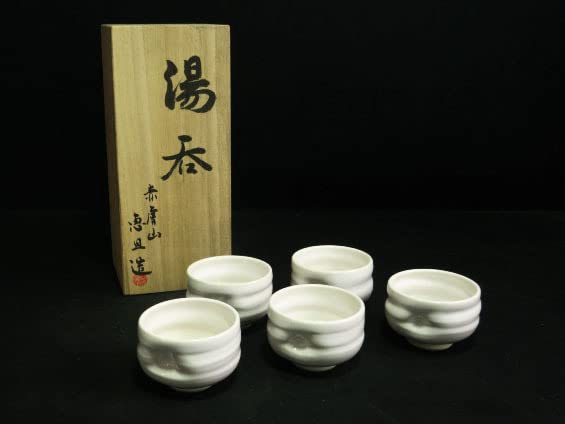
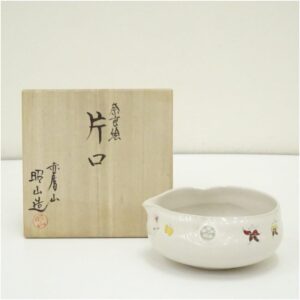
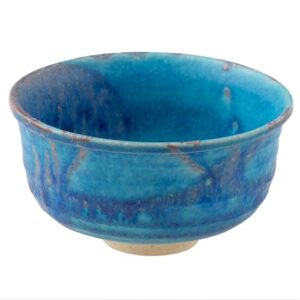
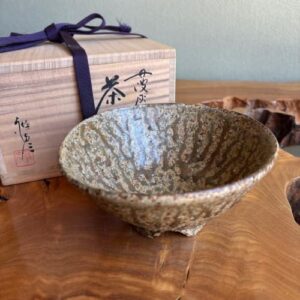
This piece is listed in 3 colours. The photos below are the actual colour options on the listing right now — pick the one you want and confirm it on the product page before ordering, since hand-finished wares vary slightly piece to piece.


Other jpmono guides on Nara crafts and Japanese tea bowls, for readers weighing shape, material, and tradition.
Price snapshot across stores
| Store | Item / variant | Price | Notes |
|---|---|---|---|
| 🇺🇸 Amazon US (search) | Browse Japanese matcha bowls & tea ware | varies (USD) | Best if you are shopping from the US — Prime shipping, USD pricing, no international customs. Amazon US carries Japanese tea ware from several makers; this Akahada-yaki bowl ships from Japan (next row). |
| 🇯🇵 Amazon JP Global Store | Kōgetsu Akahada-yaki matcha chawan, Nara-e (KONCH1-A) | ¥7,991 (≈ $53 USD as of 2026-11-21) | Ships internationally from Japan to 65+ countries — including Canada, the UK and Australia — with import fees estimated at checkout. 2 left at the time of writing; verify on the listing. |
| Maker direct (Akahada workshops) | Similar Akahada-yaki bowls and small wares | varies | No official online store for this listing was confirmed in our snapshot; local Nara shops and craft fairs are the usual route for workshop-direct pieces. |
| Proxy services (Buyee / Tenso) | Any Akahada-yaki bowl from Japanese shops | item price + proxy fee | Useful for shops that do not ship abroad; adds handling, consolidation, and extra transit time. |
Prices in USD are approximate and depend on the current exchange rate. The yen figure on the listing is the authoritative one. Availability and shipping rules can change without notice.
📦 Shipping & where to buy from outside Japan
- Amazon JP Global Store ships to 65+ countries including Canada, the UK and Australia. Import fees are usually estimated and collected at checkout for most destinations.
- Typical shipping cost for a single bowl runs roughly $15–$40 to the US, the EU, Canada, the UK, and Australia, depending on the speed you choose.
- Customs: orders above your local de minimis threshold can attract duty or tax; Amazon’s checkout estimate covers most cases, but keep the invoice for your records.
- Alternatives: workshop-direct purchases through Nara shops, or a proxy service such as Buyee or Tenso if a Japanese retailer will not ship abroad.
- Packaging: low-fired pottery benefits from double-boxing; if the outer carton arrives crushed, photograph it before opening.
🏆 Editor’s Pick
This is the bowl the article is built around: a single Akahada-yaki matcha chawan with Nara-e decoration, listed as made in Japan under the name Kōgetsu and the model number KONCH1-A. The listing presents it as a matcha bowl that also works as a latte bowl, tonsui, and soup bowl.
- It is a specific Akahada-yaki piece from Nara, not a generic bowl with a regional label attached.
- The seller lists four uses, so it can serve tea practice and everyday kitchen duty.
- Stock was thin at the snapshot — two bowls — so the listing is the place to confirm current price and availability.
❓ Frequently Asked Questions
Is this bowl hand-painted?
Nara-e is traditionally a hand-painted decorative style. The listing names Nara-e but does not state whether this individual bowl is painted by hand or decorated another way, so confirm the method with the seller before buying if it matters to you.
Can I use it for lattes, soup, or as a dipping bowl?
The listing itself describes the bowl as a matcha bowl, a latte bowl, a tonsui (dipping bowl) and a soup bowl, so the seller presents it as multipurpose. Capacity and dimensions are not stated in the listing, so check the size before relying on it for large drinks or servings.
Is it dishwasher or microwave safe?
The listing does not give dishwasher or microwave instructions. Low-fired earthenware is generally hand-washed and kept away from sudden temperature changes, so treat this bowl as hand-wash only unless the seller confirms otherwise.
Does it come as a set?
No. The listing is for a single bowl, model KONCH1-A. It is not described as a pair or a set, so buy two if you want a matching pair for guests.
Does Amazon Japan ship this to Canada, the UK, or Australia?
Amazon JP Global Store ships to more than 65 countries, including Canada, the UK and Australia, with import fees usually estimated at checkout. Availability and destination rules can change, so check the shipping line on the listing for your address.
How much is ¥7,991 in US dollars?
At a baseline of about ¥150 to the US dollar, ¥7,991 is roughly $53 USD. The exact amount depends on the exchange rate your card uses on the day of purchase, and the yen price on the listing is the authoritative one.
What should I do if the bowl arrives damaged?
Keep the box and packing materials and use the returns or replacement process shown on your order page. Low-fired pottery can chip in transit, so photograph the packaging before you unpack fully if the outer box looks crushed.
jpmono.com is curated by a Japan-based editorial team (working out of Toyama in the Hokuriku region and Nara in Kansai) and is independent. We do not take payment from the makers we feature; income comes from affiliate links. Read more about our editorial standards.
This article was drafted with AI assistance and reviewed by the jpmono editorial team. Product details are taken from the linked Amazon.co.jp listing; where a detail is not stated in that listing, the article says so rather than filling the gap.
Affiliate disclosure: jpmono.com may earn a commission on qualifying purchases made through links on this page, at no additional cost to you.