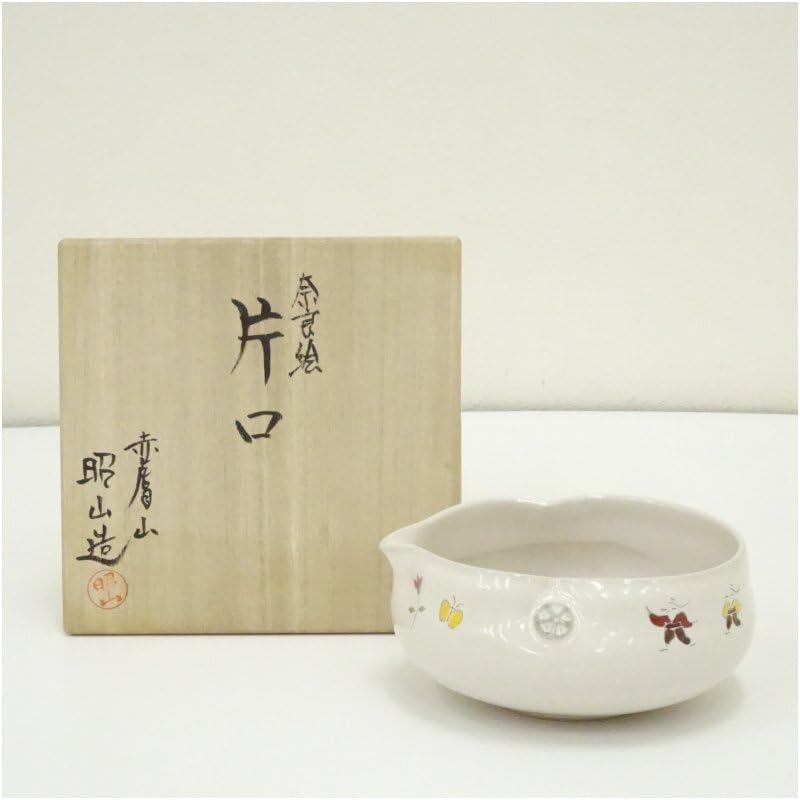
- What it is: A single spouted sake pourer (katakuchi) in Akahada-yaki, painted in the Nara-e style — the listing names the maker as 大塩昭山 and includes a tomobako box.
- Made in: Nara city, Nara Prefecture (Kansai) — Akahada-yaki, a Nara pottery tradition whose kilns in the Akahada district are generally dated to the late 16th century.
- Price band: No price is displayed on the listing at the time of writing, and it currently shows as out of stock — check the live page for both.
- Best for: Someone building a sake or tea table around Nara ceramics who can wait for a restock.
- Skip if: You need a vessel in hand this month, or you will not buy without listed dimensions and capacity.
- Shipping: Amazon JP’s Global Store ships to 65+ countries, including Canada, the UK, and Australia — jump to our pick ↓
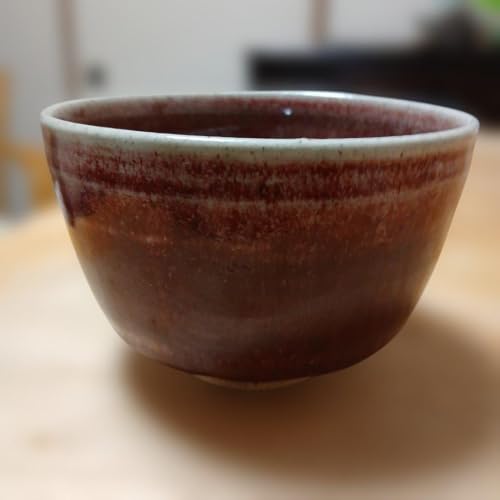
The clay beneath Akahada-yaki is red, and the glaze fired over it is a warm ivory-cream. That pairing is the whole first impression of the ware: a red body softened by a pale, low-shine surface, quiet enough that a few brushstrokes of Nara-e have room to speak.
This article is about one specific piece: an Akahada-yaki Nara-e katakuchi listed on Amazon Japan, described on its listing title as made by 大塩昭山 and supplied with a tomobako box. A katakuchi is a spouted vessel — the shape that lets you pour sake, or tea, from the table rather than from a bottle. In Akahada’s soft glaze, that shape reads as table-side rather than ceremonial.
The guide covers where the craft comes from, what the listing actually states and what it leaves out, how the piece compares with other Japanese pourers and cups, what shipping looks like for readers outside Japan, and who should wait for a restock. Prices and stock are volatile, so the linked listing is always the authoritative source.
🔄 Last updated November 17, 2026
⏱️ About 8 min read

- Who this is for — and who should skip it
- Product overview (from published specs)
- Price snapshot across stores
- What it does well
- Weaknesses and things to verify before buying
- Conclusion — which buyer type are you?
- Other ways to approach this purchase
- 🏆 Editor’s Pick
- ❓ Frequently Asked Questions
- 📍 Where this comes from — Nara, the old capital
- 📦 Shipping & where to buy from outside Japan
Who this is for — and who should skip it
- Pour sake for two or three people at a time and prefer a vessel you pass rather than a bottle you lift.
- Want a Nara piece with a named maker on the listing and a signed tomobako box for storage or gifting.
- Already own, or plan to own, a set of sake cups and want one pouring vessel to anchor it.
- Are comfortable buying Japanese ceramics from an overseas listing where size details come from the seller, not the page.
- Value a restrained Nara-e motif over dense, brightly decorated porcelain.
- Need the piece in hand now — the listing shows it as out of stock.
- Cannot buy without a confirmed capacity in milliliters or a listed height and width.
- Want a dishwasher-safe, everyday workhorse rather than a soft-glazed pottery piece.
- Are shopping for a boxed gift with a fixed delivery date.
- Prefer a pourer with a handle, a lid, or a filter built in.
Product overview (from published specs)
ℹ️ The listing snapshot is thin: no price was displayed, the seller field was not returned, and the item shows as out of stock. Everything below is either stated in the listing title or marked as unconfirmed.
Akahada-yaki Nara-e Katakuchi Sake Pourer
赤膚焼 大塩昭山造 奈良絵片口 共箱 インテリア 食器
現在在庫切れです。 · ASIN B0H28ZVZQ1
Price and availability as of 2026-11-17 06:20 JST. The Amazon listing at the time of purchase is authoritative. jpmono.com earns a commission on qualifying purchases at no extra cost to you.
| Attribute | What the listing states |
|---|---|
| Craft | 赤膚焼 — Akahada-yaki |
| Form | 片口 — katakuchi, a spouted pouring vessel |
| Decoration | 奈良絵 — Nara-e |
| Maker named in the title | 大塩昭山造 — made by 大塩昭山 |
| Box | 共箱 — tomobako, the wooden box that carries the maker’s inscription |
| Listing category | インテリア 食器 — interior and tableware |
| Dimensions and capacity | Not stated — unconfirmed |
| Hand-painted or transfer | Not stated — unconfirmed |
| Condition (new or used) | Not stated — unconfirmed |
| Price | None displayed at the time of writing |
| Availability | 現在在庫切れです — currently out of stock |
| Seller | Not returned in the snapshot |
Because the listing names the maker and supplies a tomobako, the attribution of this piece rests on those two statements rather than on a spec sheet. Treat the clay body and glaze color as craft-level descriptions of Akahada-yaki in general, not as measured claims about this individual pourer. Only the Amazon JP listing snapshot was available; live pricing may have shifted since the writing date, and the page may show a different seller once restocked.
📖 Glossary — the Japanese terms used in this article
- Akahada-yaki (赤膚焼)
- Pottery from the Akahada district of Nara city, generally dated to the late 16th century and known for a soft ivory-cream glaze over reddish clay.
- Nara-e (奈良絵)
- The soft overglaze painting associated with Nara decoration — restrained floral, bird, and landscape motifs rather than dense porcelain-style ornament.
- Katakuchi (片口)
- A bowl or jug with one side drawn out into a pouring lip. Used at the table for sake or tea, and easier to pass than a narrow-necked bottle.
- Tomobako (共箱)
- The wooden box that accompanies a piece and carries the maker’s inscription — in this listing, part of what supports the maker attribution.
- Heijo-kyo (平城京)
- The 8th-century capital laid out at Nara, from which the city’s temple and shrine culture grew.
Other jpmono guides cover the same Nara tradition, a neighboring lacquer craft, and three pourers and cups from other Japanese kilns. Use them to compare form, glaze character, and region before deciding.
Price snapshot across stores
| Store | Item / variant | Price | Notes |
|---|---|---|---|
| Amazon US (search) | Browse Japanese sake pourers and Nara-style ceramics | Varies (USD) | Best if you are shopping from the US — Prime shipping, USD pricing, no international customs step. Amazon US carries Japanese ceramics from other makers; this Akahada piece is sourced from Japan (next row). |
| Amazon JP Global Store | Akahada-yaki Nara-e katakuchi by 大塩昭山, with tomobako | No price displayed; out of stock | Ships internationally from Japan to 65+ countries — including Canada, the UK, and Australia — with import fees estimated at checkout. |
| Maker direct | — (no direct sales page confirmed) | — | No maker website was returned for this piece in the sources used here. Unconfirmed — ask the seller if you need provenance paperwork. |
| Proxy services (Buyee / Tenso) | Same listing, forwarded | Varies with service fees | Useful only if the Global Store will not ship to your address. Expect a handling fee plus international freight, and no consolidated customer support between the two parties. |
Prices in USD are approximate and depend on the current exchange rate. JPY is the authoritative figure for any Japanese listing. With no price shown on this listing, no conversion is possible at the time of writing.
What it does well
- 🍽️ Dishwasher: no care instructions are given on the listing — hand-washing is the conservative default for soft-glazed pottery.
- ♨️ Microwave: not stated. Avoid unless the seller or maker confirms it is safe.
- 🧴 Daily care: rinse soon after use with warm water and mild soap, then dry promptly rather than leaving it to stand wet.
- 📦 Storage: keep the tomobako dry and use it for storage; packing the piece back into its box is the simplest protection for the spout.
Weaknesses and things to verify before buying
- No price, and no stock. The listing reads 現在在庫切れです (currently out of stock) and shows no price at all, so there is nothing to compare on cost today.
- No dimensions or capacity. Nothing in the listing says how tall the pourer stands or how much it holds. A katakuchi can range from a single-serving size to a serving vessel for a table, and the difference matters.
- Decoration technique is unconfirmed. Nara-e is traditionally painted over the glaze, but the listing does not state whether this piece is hand-painted or transfer-decorated.
- Condition is not stated. The presence of a tomobako is noted in the title, but the listing does not say whether the piece is new, old stock, or previously owned.
- Seller details were not returned. The snapshot had no seller field, so the party actually shipping the piece is unknown until the listing is live again.
- A spout is a fragile point. Narrow drawn lips chip more readily than a plain rim; packing and shipping matter more for this shape than for a cup.
Conclusion — which buyer type are you?
Other ways to approach this purchase
🏆 Editor’s Pick
- The listing names both the craft (赤膚焼) and the motif (奈良絵), so the piece is identifiable as Nara ware rather than generic stoneware.
- The maker’s name, 大塩昭山, and the word 造 appear in the title, which is the strongest attribution signal the listing offers.
- The tomobako (共箱) travels with the piece and keeps that attribution with the object.
⚠️ The listing currently reads 現在在庫切れです (out of stock) and displays no price. The buttons below open the live pages, where stock, seller, and price are shown.
❓ Frequently Asked Questions
Is the Akahada-yaki Nara-e katakuchi in stock right now?
At the time of writing, the Amazon JP listing states 現在在庫切れです (currently out of stock) and displays no price. Stock can change without notice, so check the live listing before ordering.
What comes with the piece?
The listing title describes a single Akahada-yaki Nara-e katakuchi made by 大塩昭山 and supplied with a tomobako (共箱), the wooden box that carries the maker’s inscription. No other items are named in the title.
Is the Nara-e decoration hand-painted?
The listing does not say. Nara-e is traditionally painted over the glaze, but whether this particular piece is hand-painted or transfer-decorated is unconfirmed, so ask the seller before buying if that matters to you.
What size is it, and how much does it hold?
The listing gives no dimensions, capacity, or weight. Treat those figures as unconfirmed until the seller or maker supplies them.
Can it go in the dishwasher or microwave?
The listing carries no care instructions. For soft-glazed pottery, hand-washing in warm water with mild soap and drying promptly is the conservative routine; heat and harsh detergents are best avoided unless the maker confirms otherwise.
Does Amazon Japan ship it to Canada, the UK, or Australia?
Amazon JP’s Global Store ships to more than 65 countries, including Canada, the UK, and Australia, with import fees estimated at checkout. Whether this specific listing is available depends on restock.
📍 Where this comes from — Nara, the old capital
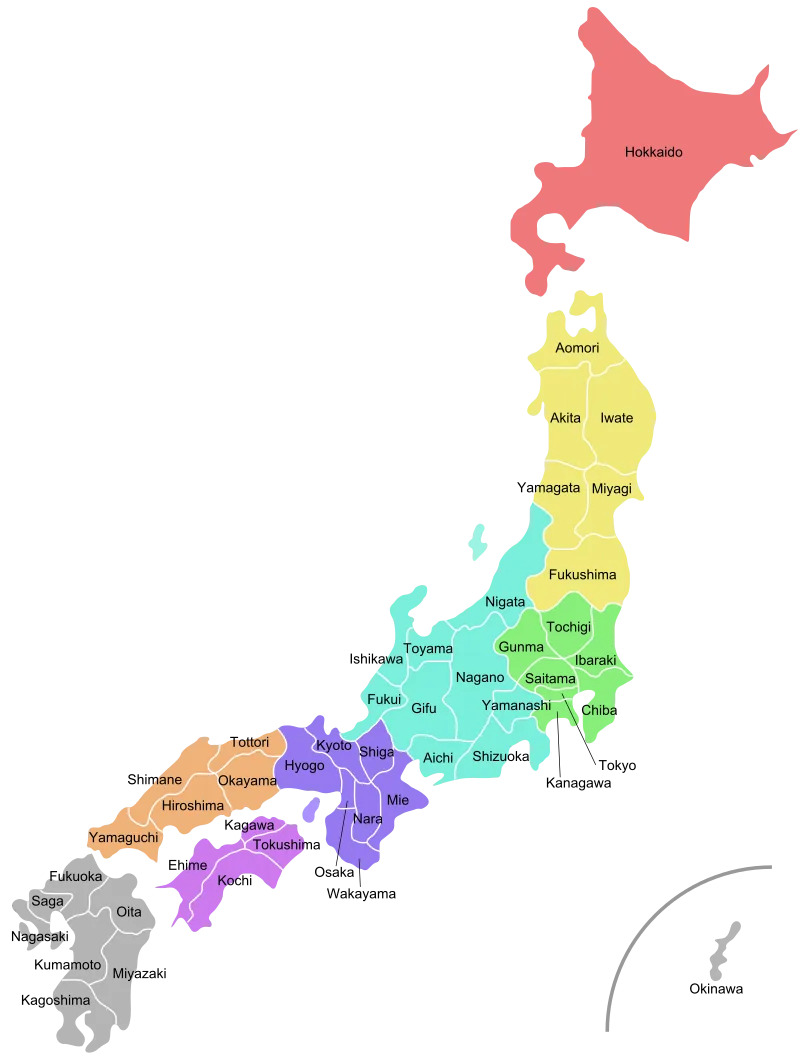
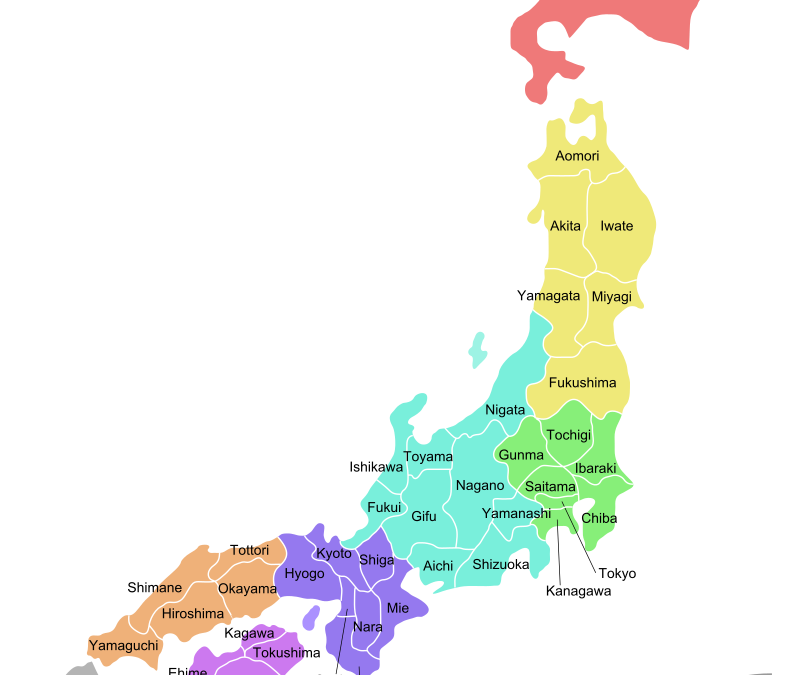
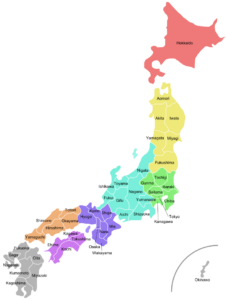
Nara city sits in the Kansai region of central Honshu, in a basin surrounded by low hills, under an hour by train from Kyoto and roughly the same from Osaka. It is the capital of Nara Prefecture, and for most of the 8th century it was the seat of the imperial court. The difference between Nara and a modern industrial pottery town is that the craft here grew inside a temple economy: the city’s customers were monasteries, shrines, and the tea rooms that served them.

Nara became Japan’s capital in 710, when the court established Heijo-kyo on the grid plain that now holds the city center. The court remained until 784, when it moved away — first to Nagaoka and then, in 794, to Kyoto, which stayed the imperial capital for more than a thousand years. During those decades, Nara absorbed the continental learning, Buddhist institutions, and workshop skills that shaped the rest of Japanese craft history. Todai-ji’s Great Buddha was consecrated in 752, and the temple and shrine town that grew around it and around Kasuga Taisha became the setting for the city’s tea and craft culture.
- 710 — The imperial court moves to Heijo-kyo, and Nara becomes the capital.
- 752 — The Great Buddha of Todai-ji is consecrated.
- 8th century — The Shosoin repository is assembled at Todai-ji, preserving craft objects of the period.
- 784 — The court leaves Nara; the temple town remains and keeps its workshops.
- Late 16th century — The Akahada kilns are generally dated to this period in the commonly told account.
- 2026 — Akahada workshops are still firing Nara-e wares for the table, including pieces like this katakuchi.
The Akahada kilns, in the district that gives the ware its name, are generally dated to the late 16th century. The commonly told account places their start at the end of that century; the exact founding year and the identity of the first potters are not settled in the sources used here. What the ware itself shows is a consistent technical choice: a red clay body under a warm ivory-cream glaze, soft enough that the surface reads matte rather than glassy.

Nara-e is where the city’s setting shows up most clearly. The painting is soft and sparse: floral subjects, birds, landscape fragments, and open glaze around them. It is the opposite of the dense, allover ornament that porcelain workshops elsewhere in Japan could produce. On a katakuchi, that restraint works in the vessel’s favor — a small pourer with a few brushed motifs reads as a decorated object without becoming a display piece.

“The point of Akahada is not how much decoration a piece can carry, but how little it needs: red clay, ivory glaze, and a few strokes of Nara-e.”
Continuity in the Akahada district is a workshop story rather than a factory story. Kilns still operate in the area, and pieces still come to market under individual maker names — the listing in this article is one of them, with 大塩昭山 given as the maker and a tomobako supplied alongside. Current workshop counts and succession figures for the district are not published in the sources used here, so the honest measure of continuity is the object itself: a red-clay body, a soft pale glaze, and Nara-e decoration still being made for the table.

A katakuchi belongs to the part of Nara’s culture that is easiest to miss. The city’s monuments are monumental; its table culture is small-scale — tea, sake, and a few vessels passed around a low table. A pourer with a soft glaze and a restrained motif is the object that carries that side of the city out of the temple district and onto a dinner table anywhere.
📦 Shipping & where to buy from outside Japan
Amazon JP’s Global Store ships household ceramics to more than 65 countries, including Canada, the UK, and Australia. Shipping for a single pottery piece typically falls in the $15–$40 range depending on destination and speed, and Amazon estimates or collects import fees at checkout for most destinations. For orders above local thresholds, customs treatment varies by country; the checkout estimate is the figure to rely on.
The caveat for this specific piece is availability, not shipping. Because the listing is out of stock, the international shipping path only becomes usable once the item returns. If the Global Store page does not reopen, a proxy service can forward the same listing from Japan, at the cost of a handling fee and a longer transit window.
jpmono.com is curated by a Japan-based editorial team working out of Toyama in the Hokuriku region and Nara in Kansai, and is independent. We do not take payment from the makers we feature; income comes from affiliate links. We do not physically test every product — we read maker specifications and source listings. Read more about our editorial standards.
This article was drafted with AI assistance and reviewed by our editorial team. Product details are drawn from the source listing and public craft information; unconfirmed attributes are marked as such in the text.
Affiliate disclosure: jpmono.com may earn a commission on qualifying purchases made through links on this page, at no additional cost to you.