![Kumano Fude Makeup Brush 5-Piece Starter Set by Cosmedo — Hand-Made Hiroshima Brush Tradition (¥7,800 / ≈$52 USD) [2026 Buyer’s Guide]](https://jpmono.com/wp-content/uploads/2026/05/cosmedo-kumano-fude-makeup-brush-set-where-to-buy-2026-featured.jpg)
Kumano Fude Makeup Brush 5-Piece Starter Set by Cosmedo — Hand-Made Hiroshima Brush Tradition (¥7,800 / ≈$52 USD) [2026 Buyer’s Guide]
Kumano fude (熊野筆) is the makeup-brush tradition of Kumano, a small inland town of about 24,000 people in southern Hiroshima Prefecture. The town produces approximately 80% of all Japanese-made brushes and supplies the OEM brushes behind premium global cosmetics lines including Hakuhōdō, Chikuhōdō, and Koyudo. The tradition is roughly 200 years old, was designated a METI Traditional Craft Product (国指定伝統的工芸品) in 1975, and is best known internationally for the uncut-tip technique (kebari-zukuri, 毛羽作り) that gives the brushes their characteristic softness on skin.
This 5-piece starter set by Cosmedo (匠の化粧筆コスメ堂) — a Kumano-based maker that distributes its house brand on Amazon JP — bundles face, cheek, eyeshadow, lip, and brow brushes with a zippered brush case for ¥7,800. At about $52 USD it is one of the most accessible entries to real, hand-made Kumano fude. Premium Kumano pieces from Hakuhōdō or Chikuhōdō routinely sit in the ¥15,000–30,000 range; this set is the price point at which an international beauty enthusiast can comfortably try the tradition for the first time.
This guide is written for international readers who have seen “Made in Japan” on a premium makeup brush and wanted to understand what that actually means. We cover the 200-year arc from calligraphy brushes for the Kumano-pilgrim school system to today’s global cosmetics industry, the specific reasons this 5-piece set is the right entry point, where to buy from outside Japan, and how it compares against other Japanese-craft articles we have published on jpmono.com.
🔄 Last updated: May 16, 2026
⏱️ Reading time: ~14 min
🇯🇵 Kumano · Hiroshima

- Who this is for — and who should skip it
- Product overview (from published specs)
- 📦 Shipping & where to buy from outside Japan
- Price snapshot across stores
- 📍 Where this comes from — place, era, and the craft tradition
- What it does well
- Weaknesses and things to verify before buying
- Conclusion — which buyer type are you?
- Other ways to approach this purchase
- 🏆 Editor’s Pick
- ❓ Frequently Asked Questions
- 📌 Related Japanese Crafts
Who this is for — and who should skip it
- Want to try real Kumano-made brushes for the first time without committing ¥15,000+ to a Hakuhōdō or Chikuhōdō set
- Need a complete daily-makeup set — face, cheek, eyeshadow, lip, brow — rather than a single show-piece brush
- Use mostly powder products (foundation powder, blush, eyeshadow) where natural goat hair excels
- Want wooden handles and a metal ferrule rather than the plastic-handle “Kumano-style” sets sold at the same price tier
- Are buying a gift for a beauty-focused friend, where the brush-case packaging matters
- Are a professional makeup artist needing specialized geometries (fan brushes, kabuki brushes, contour-specific shapes)
- Apply primarily cream or liquid foundations — natural goat hair absorbs liquid and is hard to fully clean
- Are a collector hunting a specific brand-name (Hakuhōdō Z-series, Chikuhōdō Z-4) rather than a Kumano-made starter set
- Need more than five brushes (concealer, smudger, brow comb) — step up to the 8-piece set
- Require synthetic vegan brushes — this set uses natural goat hair
Product overview (from published specs)
Kumano Fude Makeup Brush 5-Piece Starter Set by Cosmedo
匠の化粧筆コスメ堂 熊野筆 メイクブラシセット 5本 + ブラシケース スターターセットプラス ブラック S505-C04K
在庫あり。 · Sold by 匠の化粧筆コスメ堂 · ASIN B001ADU7OA
Price and availability as of 2026-08-31 02:30 JST. The Amazon listing at the time of purchase is authoritative. jpmono.com earns a commission on qualifying purchases at no extra cost to you.
| Spec | Detail (per Amazon JP listing as of May 16, 2026) |
|---|---|
| Brand / maker | Cosmedo (匠の化粧筆コスメ堂) — Kumano fude maker |
| Model | S505-C04K (Black) — Starter Set Plus |
| ASIN | B001ADU7OA |
| Composition | Face brush · cheek/blusher brush · eyeshadow brush · lip brush · brow brush + zippered brush case |
| Hair | Natural goat hair (山羊毛) with uncut tips (kebari-zukuri) |
| Handles / ferrule | Real wooden handles, metal ferrules — not AS-resin / ABS plastic |
| Weight | Approximately 150 g (5 brushes + case) |
| Made in | Kumano, Aki-gun, Hiroshima Prefecture, Japan |
| Price | ¥7,800 (≈ $52 USD at ¥150/USD as of May 2026) |
| Authoritative listing | Amazon JP Global Store (ships to US/EU/AU/CA) |
Sources: Amazon US search (primary path, moonill-20 tag) + Amazon JP Global Store listing for B001ADU7OA (secondary, sourced listing, moonill-22 tag) + Cosmedo product description. USD figures are approximate and depend on the current exchange rate.
📖 Glossary — key Japanese terms used in this article
- fude (筆)
- Brush — historically a calligraphy brush, today also the makeup brush. Kumano fude covers both.
- kebari-zukuri (毛羽作り)
- “Uncut tip” technique — the natural taper of each goat-hair strand is preserved by selecting and bundling hairs by their natural length. The brush tip is never trimmed. Gives Kumano brushes their signature softness.
- yamagoya-zukuri (山子作り)
- Pyramidal hair-stacking — the inner-bundle method that controls brush body shape.
- toko-zukuri (床作り)
- Inner-core binding — determines how much pigment or ink the brush carries.
- shokunin (職人)
- Craftsperson — typically an apprentice-trained artisan working in a small workshop. An experienced Kumano shokunin produces 30–50 finished brushes per day.
- METI (経済産業省)
- The Japanese Ministry of Economy, Trade and Industry. Designates Traditional Craft Products (伝統的工芸品) using strict origin and technique criteria. Kumano fude was designated in 1975.
- OEM
- Original Equipment Manufacturer — Kumano brush makers (Hakuhōdō especially) manufacture the brushes that get sold under premium global brand names such as Chanel, Dior, Suqqu, and MAC.
📦 Shipping & where to buy from outside Japan
Cosmetic brushes are unusually international-shipping-friendly: low weight, no liquids, no batteries, and goat hair has no CITES restrictions. The 5-brush set with case weighs about 150 g packaged.
- Amazon JP Global Store: ships this set to the US, EU, UK, Canada, Australia, and most major destinations. Estimated shipping $8–$20 USD depending on speed; no transit damage on brushes because the case protects them. Direct ASIN: B001ADU7OA.
- Amazon US (amazon.com): Kumano fude has substantial direct coverage from Hakuhōdō, Chikuhōdō, Koyudo and smaller brands. Cosmedo specifically is less common on .com, but if you would rather buy in USD with Prime shipping you can browse comparable Japanese brushes through the Amazon.com search link in the price table below.
- Hakuhōdō direct: Beverly Hills retail location and global online ordering through hakuhodo-usa.com — useful if you want the absolute premium tier rather than the Cosmedo entry tier.
- Specialty retailers: Beautylish and other r/MakeupAddiction-recommended retailers carry Kumano brushes in the US and EU.
- Proxy services (Buyee / Tenso): useful if you want to consolidate several Japan-only items in one shipment, or if your destination is outside Amazon JP Global Store’s standard countries.
- Customs: cosmetic brushes are unrestricted personal import in all major jurisdictions. US de minimis is $800; EU is €150 — most single sets ship duty-free.
Price snapshot across stores
| Store | Item / Variant | Price | Notes |
|---|---|---|---|
| 🇺🇸 Amazon.com (US) | Browse Japanese Kumano-fude makeup brushes | varies (USD) | Best if you’re shopping from the US — Prime shipping, USD pricing, no international customs. Amazon US carries hand-made Japanese makeup brushes from Hakuhōdō, Chikuhōdō, Koyudo, and Tanseido — useful for comparing brand tiers, hair types, and price ranges. Cosmedo’s exact S505-C04K is sourced from Japan (next row). |
| 🇯🇵 Amazon JP Global Store | Cosmedo Starter Set Plus, S505-C04K (B001ADU7OA) | ¥7,800 (≈ $52 USD) | Ships internationally from Japan. Authoritative listing for the specific item in this guide. JPY price is authoritative; USD figure is approximate at ¥150/USD. |
| Maker direct (Cosmedo) | Same starter set | ¥7,800 (Japan-only) | Cosmedo’s own site sells the same SKU but typically does not ship outside Japan. Useful if you have a Japanese forwarding address. |
| Proxy services (Buyee / Tenso) | Same starter set + other Japan-only items | ¥7,800 + proxy fee + international shipping | Worth it if you are consolidating multiple Japan-only purchases. For this single 150 g item, Amazon JP Global Store is usually cheaper. |
Prices and stock fluctuate. Verify at the retailer before purchasing. Only the Amazon JP listing snapshot was available for this writing; live pricing may have shifted since May 16, 2026.
📍 Where this comes from — place, era, and the craft tradition

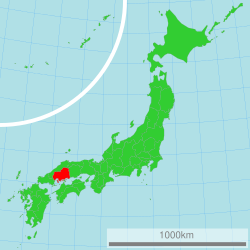
The region — Kumano, in southern Hiroshima Prefecture
Kumano (熊野) is a town of approximately 24,000 people in Aki-gun, in southern Hiroshima Prefecture (広島県), on Japan’s main island of Honshu. The town sits in a small inland valley about 20 km southeast of Hiroshima city center, in the hills above Hiroshima Bay. The geography itself is unremarkable — small valley, low hills, modest river — but the economic concentration is exceptional. Approximately 80% of all Japanese-made brushes, both calligraphy and makeup, come from this single town. In industry shorthand it is simply called Fude-no-miyako (筆の都, “Brush Town”).
For international-reader geography: Kumano is 25 minutes from Hiroshima Station by bus (¥570 fare). From Tokyo, the trip is about four hours via Tōkaidō-Sanyō Shinkansen to Hiroshima followed by the bus into the valley. From Osaka, the same path takes about 1.5 hours. The closest international airport is Hiroshima Airport (HIJ), roughly 45 km southeast.
The central visitor destination in the town is the Fude no Sato Kōbō (筆の里工房, “Brush Village Studio”) museum, with workshop tours, brush-making demonstrations, and direct sales from over twenty Kumano makers. Of the town’s 24,000 residents, approximately 2,500 — roughly one in ten — work in brush-related occupations.
The historical anchor — 1830s, the Nara training
Kumano fude has a relatively recent founding compared to other Japanese crafts. The tradition begins in the 1830s, late in the Edo period, when Kumano was a poor mountain farming community in the Hiroshima domain. The land was infertile and the population grew faster than the rice fields. Kumano men routinely traveled for off-season work — typically to the Yoshino region of Nara or to Osaka — to supplement family income.
In Nara, several Kumano men learned fude-zukuri (筆造り, calligraphy-brush making) from Nara fude masters. Nara had been the major Japanese fude-making region since at least the Heian period; it is the historical anchor for both the sumi-ink and the fude-brush traditions (see our companion article on Kobaien Nara sumi for the ink side of that history). The Kumano workers returned home with the technique and started making brushes locally.
The craft anchored quickly because four conditions aligned. Goat hair was already farmed locally for other purposes, so the supply chain existed. The Hiroshima domain’s official school system needed calligraphy brushes in volume. Kumano’s mountain villages had ample winter labor when farming was idle. And the distance from Nara prevented Nara-brand competition at the regional retail level.
By 1846, the Hiroshima Domain — then ruled by the Asano clan — officially registered Kumano fude production and ordered that all domain-school calligraphy brushes be sourced from Kumano. That guaranteed market consolidated the local industry.
-
1830s — Founding period: Kumano farmers travel to Nara to learn fude (calligraphy-brush) making from Nara masters and bring the craft back to Kumano, where local samurai sponsor the workshops. -
1846 — Hiroshima Domain (Asano clan) officially registers Kumano fude production and orders all domain-school calligraphy brushes from Kumano. -
1868–1912 — Meiji period: Kumano supplies the entire Japanese public-school calligraphy-brush market. By 1900, Kumano produces about 70% of Japanese fude. -
1960s — Cosmetic-brush pivot. As Japanese school calligraphy demand declines and cosmetic-brush demand grows, Kumano makers diversify into makeup brushes using their existing goat-hair sourcing and brush-making expertise. -
1974 — Hakuhōdō is founded and positions itself as a premium cosmetic-brush maker rather than a generic Kumano workshop. -
1975 — Kumano fude is designated a METI Traditional Craft Product (国指定伝統的工芸品). -
1980s–2000s — Kumano brush makers (Hakuhōdō especially) become OEM suppliers for premium global cosmetics houses — Chanel, Dior, Suqqu, MAC. -
2010s onward — Kumano brands launch direct-to-consumer channels in the US and EU. Hakuhōdō opens a Beverly Hills retail location. -
2026 — Approximately 2,500 Kumano residents — roughly 10% of the town’s population — still work in brush-related occupations. The kebari-zukuri (uncut-tip) technique is essentially unchanged from the late Edo period.
Meiji-era dominance and the standardization of technique
The Meiji opening of Japan in 1868 created the modern Japanese public school system, with mandatory calligraphy lessons for all elementary-school students. Kumano was perfectly positioned. By 1900, Kumano supplied approximately 70% of all calligraphy brushes used in Japanese schools, at production volumes of perhaps one to two million brushes per year.
The industry was organized into a cottage system — roughly 200 family workshops, each specializing in particular brush sizes or hair types, distributed through a Hiroshima-based wholesale network. By the 1920s, the Kumano economy was about 60% brush-making.
This is the period in which the Kumano techniques were standardized:
- Kebari-zukuri (毛羽作り, “uncut tip”): the signature technique. The natural taper of goat hair is preserved by selecting and bundling hairs by their natural length; the tip is never cut. The result is a brush that feels uniformly soft on skin or paper, in contrast to cut-tip brushes whose edges are stiffer and more scratchy.
- Yamagoya-zukuri (山子作り): stacking hair bundles in pyramidal layers to control the brush body shape.
- Toko-zukuri (床作り): the inner-core binding technique that determines how much pigment or ink the brush carries.
- Kakitsuke (掛け付け): attaching the brush to the handle with rice paste, then tightening with a metal ferrule.
Each step is hand-done. A single experienced Kumano shokunin produces 30–50 finished brushes per day.
“The ‘Made in Japan’ line on a $30 brush from a major cosmetics house typically means, more specifically, ‘made in Kumano’ — and very likely ‘made on the same bench as a calligraphy brush sold to a Hiroshima schoolchild fifty years earlier.'”
The cosmetic-brush pivot (1960s onward)
The pivot from calligraphy to cosmetics started in the 1960s under two simultaneous pressures. Japanese school-calligraphy demand was declining as students moved to pencils and ballpoint pens. At the same time, Japanese cosmetic-brush demand was growing as the makeup market expanded.
Kumano makers realized their existing goat-hair sourcing and brush-making expertise transferred almost directly to makeup brushes. Goat hair — too soft for serious calligraphy, but ideal for blending makeup pigments — became the primary product.
Hakuhōdō (白鳳堂, founded 1974) was the most important pivot-era company. Founded by Takamoto Yutaka, Hakuhōdō explicitly positioned itself as a premium cosmetic-brush maker rather than a generic Kumano workshop. By the 1990s, Hakuhōdō was the OEM partner for several global cosmetics houses, supplying brushes that were then sold under Chanel, Dior, Suqqu, and MAC labels.
The pattern proliferated. Today, Kumano-made brushes sit physically in millions of premium makeup palettes worldwide as OEM components.
Modern Kumano — METI designation and global presence
Kumano fude was designated a METI Traditional Craft Product (国指定伝統的工芸品) in 1975 — the same wave of designations that covered Echizen washi (1976), Echizen knives (1979), and Arita-yaki (1977). The designation covers both calligraphy and makeup brushes produced in Kumano using traditional hand-techniques.
Cosmedo — the maker of this set
Cosmedo (匠の化粧筆コスメ堂, “Takumi-no-keshōfude Cosmedo”) is a Kumano-fude maker focused on the entry-and-mid-tier price point of the makeup-brush market. The company explicitly positions itself as the Kumano fude that is accessible to non-collectors — premium-brand quality at prices workable for a beauty enthusiast trying genuine Japanese brushes for the first time.
Cosmedo’s manufacturing is hand-done in Kumano, using the same kebari-zukuri (uncut-tip) technique as the premium brands. The 5-piece starter set in this article (S505-C04K) is the company’s most-purchased product — a complete makeup-brush set in the price range where a first-time Kumano-fude buyer can comfortably commit.
The specific 5-piece composition (face / cheek / eyeshadow / lip / brow) is the minimum complete daily-makeup set. Adding more brushes — concealer, smudger, brow comb, mascara fan brushes — requires the 8-piece premium set at ¥12,000. Buying single-brush items is also workable but typically more expensive per-brush.
What it does well
Weaknesses and things to verify before buying
- Natural-hair only: not suitable for vegan buyers, and absorbent on liquid or cream products. Powder products (foundation powder, blush, eyeshadow) are the right match.
- Initial hair shedding is normal: Kumano-fude brushes typically shed a small amount of loose hair in the first few uses. Excessive shedding after 8–12 years is a sign for replacement; light shedding early on is not a defect.
- Drying orientation matters: never store brushes head-up while drying. Water wicks into the ferrule and can loosen the rice-paste binding that holds the hair. Lay flat or hang head-down.
- Cosmedo brand recognition is lower outside Japan: Hakuhōdō and Chikuhōdō have stronger international name recognition. If you specifically want the brand prestige of a Hakuhōdō Z-series, this set will not satisfy that.
- The 8-piece set is only ¥4,200 more: if you already know you want specialty brushes (concealer, smudger, brow comb), buying the 8-piece set up front is more economical than upgrading later.
- Color choice limited: the set ships in black (S505-C04K). Other colorways are not currently listed on Amazon JP.
- Care commitment: deep-cleaning every 1–2 months with a mild brush shampoo is required to keep the hair soft. With care, a Kumano set lasts 10–15 years of daily use; without it, the hair stiffens and the brush effectively wears out in 2–3.
Conclusion — which buyer type are you?
Other ways to approach this purchase
🏆 Editor’s Pick
If you are buying real Kumano fude for the first time and want a complete daily set, this is the pick we would put in your hands. Five core brushes (face, cheek, eyeshadow, lip, brow) plus a zippered case, hand-made in Kumano with the kebari-zukuri technique, on real wooden handles rather than plastic — at the price tier where the gamble is workable.
- Complete daily-makeup kit — no missing core brushes
- Real wooden handles and metal ferrules at a price tier where most competitors use plastic
- Hand-made in Kumano using the same uncut-tip technique as the ¥15,000+ premium-brand sets
- Bundled brush case — protects the set in storage and travel, doubles as gift packaging
❓ Frequently Asked Questions
Does this set ship internationally from Japan?
Yes — Amazon JP Global Store ships Cosmedo’s S505-C04K starter set to the US, EU, UK, Canada, Australia, and most major destinations. Estimated shipping is $8–$20 USD depending on speed. The 150 g packaged weight and the zippered brush case mean transit damage is rare.
How is Cosmedo different from Hakuhōdō or Chikuhōdō?
All three are Kumano-based makers using the same kebari-zukuri (uncut-tip) hand-technique. Hakuhōdō (founded 1974) and Chikuhōdō (founded 1962) sit at the premium tier with single brushes from ¥3,000 to over ¥25,000, are widely collected, and serve as OEM suppliers to global cosmetics houses. Cosmedo focuses on the entry-and-mid tier — Kumano-made quality at price points where a first-time buyer can comfortably try the tradition.
Can I use these brushes with cream or liquid foundations?
Technically yes, but it is not recommended. Natural goat hair absorbs liquids and is hard to fully clean — the residue stiffens the brush and shortens its life. The brushes are designed for powder cosmetics: powder foundation, blush, eyeshadow, brow powder. If your routine is primarily cream- or liquid-based, look at synthetic Japanese brush lines instead.
How long does a Kumano-fude brush set last?
With proper care — wipe after each use, deep-clean every 1–2 months with mild brush shampoo, dry flat or head-down — a Kumano set lasts roughly 10–15 years of daily use. Without consistent cleaning, the hair stiffens and the brush effectively wears out in 2–3 years. Occasional light hair shedding throughout the brush’s life is normal; replace when shedding becomes heavy, typically after 8–12 years.
Are there any customs issues importing makeup brushes from Japan?
Cosmetic brushes are unrestricted personal import in all major jurisdictions. Goat hair is not subject to CITES restrictions. The US de minimis threshold is $800 per shipment and the EU is €150, so a single ¥7,800 brush set typically ships duty-free. Always verify against your local customs rules before ordering large multi-item shipments.
Should I get the 5-piece set or the 8-piece True Selection set?
The 5-piece set (¥7,800) is the minimum complete daily-makeup kit. The 8-piece True Selection set (¥12,000) adds concealer, smudger, and brow-comb brushes, and upgrades the face brush to a kuroso black-dyed goat-hair piece. If you know you want specialty brushes, the 8-piece set is more economical than upgrading later. If you are unsure, the 5-piece set covers the core 90% of daily routines and leaves room to add Hakuhōdō or Chikuhōdō single pieces later for specific roles.
Can I visit Kumano to buy brushes in person?
Yes. The Fude no Sato Kōbō (筆の里工房, “Brush Village Studio”) museum in Kumano runs daily from 10:00–17:00 with workshop tours, brush-making demonstrations, and direct sales from over twenty Kumano makers. Admission is ¥500. The town also runs an annual Kumano Brush Festival in September with discounted sales. Getting there: 25-minute bus from Hiroshima Station (¥570). Hiroshima itself is about four hours from Tokyo and 1.5 hours from Osaka by Shinkansen.
jpmono.com is curated by a Japan-based editorial team (working out of Toyama in the Hokuriku region and Nara in Kansai) and is independent. We don’t take payment from the makers we feature; income comes from affiliate links. Read more about our editorial standards.
🤖 This article was drafted with AI assistance based on the Amazon JP product listing for B001ADU7OA, Cosmedo’s published product information, and our editorial research on the Kumano-fude tradition. Specifications and prices reflect the listing snapshot as of May 16, 2026.
Affiliate disclosure: jpmono.com may earn a commission on qualifying purchases made through links on this page, at no additional cost to you.