![Hota-ori Cotton Waffle-Weave Bath Towel from Takamatsu: Where to Buy [2026]](https://jpmono.com/wp-content/uploads/2026/05/japan-map-regions-and-prefectures-800x1050.png)
- What it is: A 100% cotton bath (and face) towel woven in Hota-ori — Takamatsu’s 330-year-old waffle weave, whose lifted, gapped threads trap air to stay breathable and quick-drying.
- Made in: Takamatsu, Kagawa (Shikoku) — a guarded domain craft since around 1689 (the Genroku era).
- Price band: Mid-range for artisanal Japanese cotton towels.
- Best for: readers who want one breathable, fast-drying towel that works in both a humid summer and a dry winter.
- Skip if: you want a thick, plush, deep-pile hotel towel — Hota-ori is deliberately light and textured, not fluffy.
- Shipping: ships internationally from Amazon Japan — jump to our pick ↓
In 1689, in the castle town of Takamatsu, a weaver named Kitagawa came home from Kyoto with a loom trick he was not supposed to share: raise a few warp threads at regular intervals, leave a gap where the cloth would normally close, and the fabric fills with tiny pockets of air. The result is a bumpy, three-dimensional cotton that breathes in the Shikoku heat, holds warmth in winter, dries fast, and refuses to wear out. The name says it plainly — 保多 (hota), roughly “keeps abundantly, lasts well.”
For most of its life this cloth was a secret. The Takamatsu domain, ruled by a branch of the Matsudaira clan, claimed Hota-ori as goryu-ori — a domain monopoly — and reserved it for samurai. The technique stayed inside Takamatsu for generations, and even now, after the weave nearly vanished in the years following World War II, only a small number of Takamatsu workshops still make it, as towels, kitchen cloths (fukin), pajamas, and mufflers.
This guide is for the reader outside Japan who wants to know what a Hota-ori bath towel actually is, whether the waffle texture suits them, and what makes the textile distinctive. We cover the weave and its history, who it fits and who should pass, the care realities, and related Shikoku textiles worth comparing, from a Japan-based editor’s desk in Toyama and Nara.
🔄 Updated:
⏱️ Read time: ~9 min
ℹ️ Hota-ori is a cotton waffle-weave textile; dimensions, care details, and other specifications vary by maker.
Who this is for — and who should skip it
- Live somewhere hot and humid and want a towel that dries between uses instead of going sour.
- Prefer a light, textured, fast-drying towel over a heavy plush one.
- Value durability — this weave was named for lasting well.
- Like the idea of a single cloth that works across seasons: airy in summer, insulating in winter.
- Want a small, verifiable piece of Takamatsu craft heritage in daily use.
- Want the thick, deep-pile “hotel spa” feel — Hota-ori is thin and pebbled by design.
- Expect maximum single-pass absorbency from a dense terry towel.
- Dislike visible texture against the skin (the weave is raised, not smooth).
- Need a guaranteed live price before buying — snapshots here are indicative only.
- Want same-day domestic delivery outside Japan with no customs step.
Product overview (from published specs)
The table summarizes established characteristics of the Hota-ori weave and maker background. Where a detail varies by maker or cannot be confirmed generally, the cell reads “Unconfirmed” rather than a guess.
| Attribute | Detail | Source |
|---|---|---|
| Craft | Hota-ori (保多織) waffle weave | Maker background |
| Material | 100% cotton | Product overview |
| Form | Bath / face towel (line also includes fukin, pajamas, mufflers) | Maker background |
| Origin | Takamatsu, Kagawa (Shikoku) | Maker background |
| Signature property | Air-pocket weave: breathable, quick-drying, warm in winter, durable | Maker background |
| Dimensions / weight | — | — |
| Color options | Unconfirmed — see purchasable options below | — |
| Price | — | — |
| Source | What you get |
|---|---|
| Amazon US (search) | Browse Japanese cotton waffle towels for US-side comparison |
| Amazon JP Global Store | The specific Hota-ori item, sourced from Japan, ships worldwide |
| Maker direct | Takamatsu Hota-ori workshops (full color / form range) |
| Proxy services (Buyee / Tenso) | Route domestic-only products from Japan to your country |
📖 Glossary — key terms
- Hota-ori (保多織) — a Takamatsu cotton weave with periodically lifted, gapped threads that trap air; breathable, quick-drying, and durable.
- Goryu-ori (御留織) — a “reserved weave,” a textile whose production was restricted by the domain as a monopoly.
- Fukin (布巾) — a Japanese kitchen cloth; Hota-ori fukin are a common form of the weave.
- Genroku (元禄) — an Edo-period era (1688–1704) of cultural flowering, around when Hota-ori is dated to about 1689.
- Sanuki (讃岐) — the old province name for present-day Kagawa Prefecture.
- Matsudaira (松平) — the samurai clan (a Tokugawa branch) that ruled the Takamatsu domain and guarded the weave.
- Seto Inland Sea (瀬戸内海) — the sheltered sea between Honshu, Shikoku, and Kyushu; its warm, humid climate is the backdrop for this cloth.
Other Japanese textiles and Shikoku crafts we have covered — useful for weighing material, region, and use.
 🪭 Marugame Uchiwa (same Kagawa craft town)
 🧵 Iyo-Gasuri Cotton (Shikoku textile)
🟦 Awa Aizome Tenugui (Shikoku)
 🌾 Omi-Jofu Ramie Stole
 🧶 Kishu Nel Cotton Flannel
 🎋 Yonezawa-ori Silk Stole
🪡 Yumihama-gasuri Cotton
Where to buy
The price of a cotton waffle-weave towel varies with size, weight, finishing, and workmanship. Any USD amount used for comparison is only an exchange-rate estimate.
| Store | Item / variant | Price | Notes |
|---|---|---|---|
| 🇺🇸 Amazon.com (US) | Browse Japanese cotton waffle-weave towels | varies (USD) | Best if you’re shopping from the US — Prime shipping, USD pricing, no international customs. Amazon US carries Japanese cotton and waffle towels from several makers, useful for comparing weight and texture. This exact Hota-ori piece is sourced from Japan (next row). |
| 🇯🇵 Amazon JP Global Store | The specific Hota-ori waffle-weave towel | — | Ships internationally from Japan to 65+ countries — including Canada, the UK and Australia — with import fees estimated at checkout. This is where the specific item is sourced. |
| Maker direct | Takamatsu Hota-ori workshops — full color / form range | Varies (JPY) | Widest selection (towels, fukin, pajamas, mufflers). International shipping is workshop-dependent; a proxy may be needed. |
| Proxy services (Buyee / Tenso) | Forward a domestic-only Japanese product to your address | Item + fee + forwarding | Useful when a shop or product does not ship abroad directly; adds a service fee and a consolidation step. |
What it does well
- 🧺 Washing: typical for 100% cotton — machine-washable; follow the sewn-in care label for temperature.
- 💨 Drying: the air-pocket weave is prized for drying quickly, so line- or low-heat drying is usually enough.
- 🧴 Daily care: cotton waffle weave commonly softens and fluffs with repeated washing; heavy fabric softener is generally avoided so the raised texture and absorbency are preserved.
Care points reflect general cotton waffle-weave practice; follow the maker’s own care label for the particular towel.
Weaknesses and things to verify before buying
- Not a plush towel. Hota-ori is thin and pebbled. If you equate quality with deep terry pile, the texture will read as “thin” rather than “refined.”
- Absorbency profile differs. A waffle weave tends to wick and dry rather than soak in one heavy pass; some buyers love this, others miss a dense towel’s grab.
- Bath towel sizing varies in Japan. Check the product details before ordering.
- Price and stock not captured. Our data lacked a live figure; verify the current JPY price and availability before ordering.
- Color and set contents vary by product. Check whether you are buying a single towel or a set, and which colorway.
- Cross-border logistics. International orders add shipping time and possible import fees estimated at checkout; a proxy service may be needed for maker-direct items.
“For most of its life this was a forbidden cloth — a weave a whole domain kept to itself, worn by samurai and copied by no one for generations.”
Where this comes from

Kagawa is Japan’s smallest prefecture, tucked along the northern edge of Shikoku, the least populous of the four main islands. Its old provincial name was Sanuki. The prefecture looks across the Seto Inland Sea toward Honshu, and today the Great Seto Bridge carries road and rail over the water to Okayama. The climate here is warm, humid in summer, and famously dry the rest of the year — the kind of place where a cloth that ventilates and dries fast is not a luxury but a practical answer to the weather.

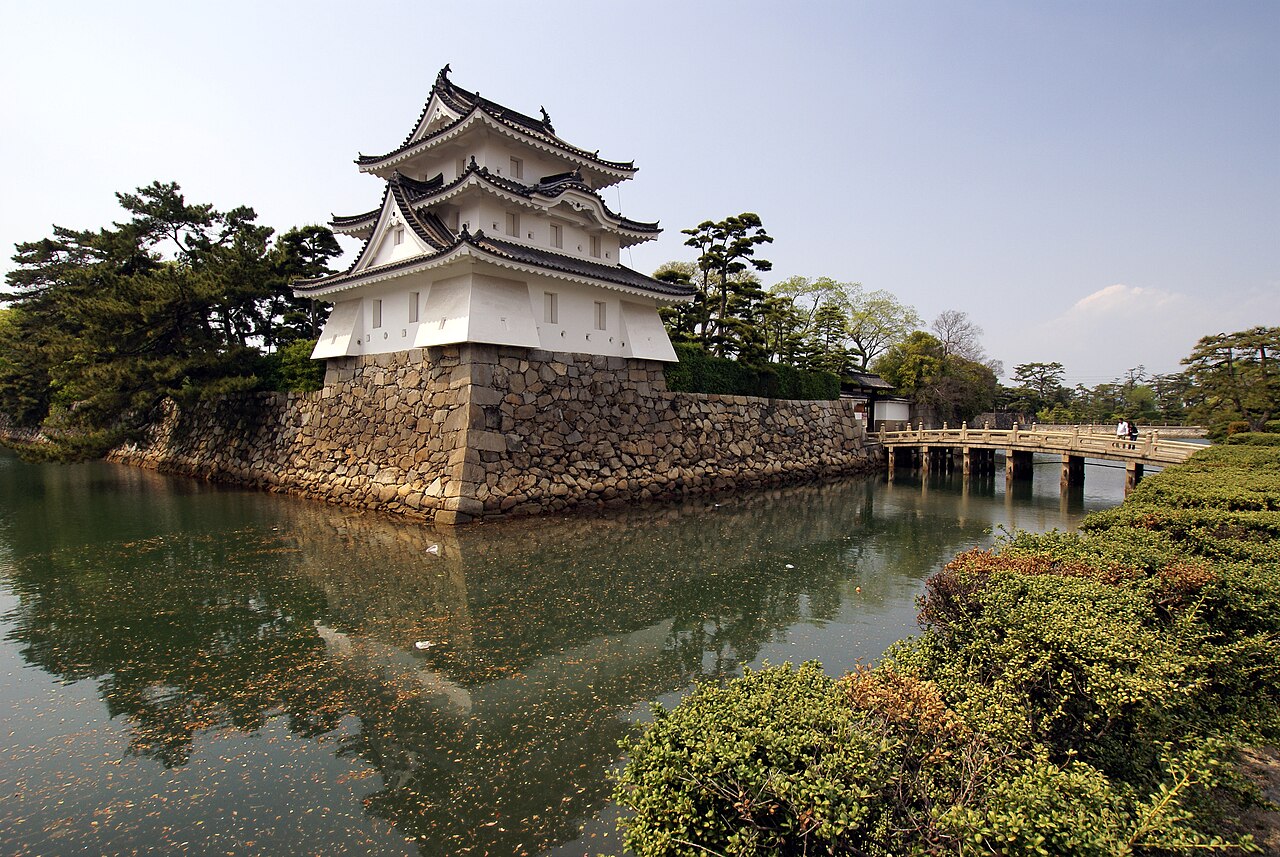
Takamatsu itself is a castle town. From the seventeenth century it was the seat of the Takamatsu domain, and from the mid-Edo period that domain was held by a branch of the Matsudaira — the clan descended from the founding Tokugawa house. The lords built at the water’s edge: Takamatsu Castle stood as a rare seaside fortress, its moats fed by the sea, and its remains survive today as Tamamo Park. Over roughly a century the same Matsudaira line laid out Ritsurin Garden, one of the largest historical gardens in Japan.
Into this world, around 1689 — the Genroku era — a Takamatsu weaver named Kitagawa is credited with introducing Hota-ori after returning from Kyoto. The domain recognized what it had and locked it down. As goryu-ori, a reserved weave, Hota-ori became a domain monopoly worn by samurai, and the technique was kept inside Takamatsu, hidden from other regions for generations. That secrecy is the reason the weave is so specifically tied to this one city rather than diffused across Japan.

- c. 1590 — Takamatsu Castle established, and the town grows as the seat of Sanuki Province.
- 1642 — A Matsudaira branch house is installed to rule the Takamatsu domain.
- c. 1689 — The weaver Kitagawa is credited with bringing Hota-ori to Takamatsu after returning from Kyoto (Genroku era).
- Edo period — Protected as goryu-ori, a domain monopoly worn by samurai; the technique stays secret.
- c. 1745 — Ritsurin Garden is completed under the Matsudaira lords after roughly a century of work.
- 1871 — The domain system is abolished after the Meiji Restoration; the monopoly ends and the weave opens up.
- After 1945 — Hota-ori nearly disappears in the years following World War II.
- Today — A small number of Takamatsu workshops keep the weave alive as towels, fukin, pajamas, and mufflers.
Kagawa’s textiles and fans did not stay put, either. Kotohira-gu — the Konpira shrine in the hills of Kagawa — was one of the great pilgrimage destinations of pre-modern Japan, and the flow of visitors across the Seto Inland Sea helped move local goods, from Marugame’s fans to Takamatsu’s cloth, out into the wider country. The prefecture’s crafts have long traveled on the back of that pilgrim and merchant traffic.
What “still being made” means here is modest and honest. Hota-ori is not a mass industry; it survives through a small number of Takamatsu workshops that carried the weave through its near-disappearance after the war. Buying a Hota-ori towel is, in a real sense, buying continuity — the same air-trapping structure that a domain once guarded, kept in production by a handful of hands in one Shikoku city.
Conclusion — which buyer type are you?
Other ways to approach this purchase
❓ Frequently Asked Questions
What exactly is Hota-ori?
Hota-ori (保多織) is a 100% cotton weave from Takamatsu in which threads are periodically lifted and left gapped, trapping air. That gives it a bumpy, three-dimensional surface that is breathable in summer, warm in winter, quick-drying, and durable. It is dated to around 1689.
How is it different from a normal terry bath towel?
A terry towel has dense looped pile that grabs and holds water in one pass. Hota-ori is thinner and pebbled; it wicks and dries fast rather than soaking heavily. Buyers who want a light, quick-drying towel prefer it; those who want thick plush pile will not.
Does it ship outside Japan?
Yes. Hota-ori cotton towels from Takamatsu makers are commonly sourced through Amazon Japan’s Global Store, which ships to 65+ countries including Canada, the UK, and Australia, with import fees estimated at checkout. For maker-direct items that ship domestically only, a proxy service such as Buyee or Tenso can forward them.
How do I wash and care for it?
As a 100% cotton cloth it is generally machine-washable; follow the sewn-in care label for temperature. The air-pocket weave dries quickly, so low-heat or line drying is usually enough, and heavy fabric softener is commonly avoided to keep the raised texture and absorbency.
Why was the weave once “secret”?
The Takamatsu domain, ruled by a Matsudaira branch house, treated Hota-ori as goryu-ori — a reserved weave and domain monopoly worn by samurai. The technique was kept inside Takamatsu for generations, which is why it is so closely tied to that one city.
What does it cost?
Cotton waffle-weave towel prices vary with size, weight, finishing, and workmanship. Compare current seller information rather than treating an unverified figure as a standard price.
Are there other Hota-ori products besides towels?
Yes. The Takamatsu workshops also make the weave as fukin (kitchen cloths), pajamas, and mufflers. A towel is simply the easiest everyday entry point, and going maker-direct usually reveals the widest selection.
jpmono.com is curated by a Japan-based editorial team (working out of Toyama in the Hokuriku region and Nara in Kansai) and is independent. We don’t take payment from the makers we feature; income comes from affiliate links. We don’t physically test every product — we describe maker specifications and the textile’s craft background. Read more about our editorial standards.
This article was drafted with AI assistance and edited against the maker background. Facts about the weave and its history are drawn from that background; details that vary by maker are marked as such.
Affiliate disclosure: jpmono.com may earn a commission on qualifying purchases made through links on this page, at no additional cost to you.