![Makita Shoten Koshu-ori Jacquard Parasol: Fujiyoshida Gunnai Silk [2026]](https://jpmono.com/wp-content/uploads/2026/06/makita-koshu-ori-jacquard-parasol-where-to-buy-2026-featured.jpg)
At the northern foot of Mt. Fuji, in the cluster of towns the Edo-period weavers called Gunnai (郡内), silk was woven so tightly that a haori lining cut from it would shimmer when the wearer turned. That cloth was called Kaiki (甲斐絹), and the district that made it — Fujiyoshida, Tsuru, and Nishikatsura, in eastern Yamanashi — is still one of Japan’s densest concentrations of weaving looms. The Makita Shoten Koshu-ori jacquard parasol is a direct descendant of that tradition: a sun-and-rain (晴雨兼用, seiu-kenyō) canopy woven on jacquard looms from two-ply Koshu-ori fabric, designed to block ultraviolet light and shed a passing shower from a single frame.
Makita Shoten (槙田商店) was founded in 1866 and is one of the flagship Gunnai weaving houses. Where most umbrella makers buy finished cloth and assemble it, Makita weaves the fabric itself — the pattern is built into the structure of the textile on the loom, not printed on afterward. That is the difference the company sells, and it is the difference an international buyer is most likely to misjudge from a thumbnail.
This guide is written for readers shopping from outside Japan who want to understand what they are actually paying for: where the cloth comes from, why “woven, not printed” matters, how to verify fiber content and dimensions before buying, and which buyer this fits — and which it does not. We cover the craft context, the published specs, the purchase paths (Amazon US search, Amazon JP Global Store, maker direct, and proxy forwarders), and the honest caveats.
🔄 Last updated: June 3, 2026
⏱️ Reading time: ~11 min

- Who this is for — and who should skip it
- Product overview (from published specs)
- 📍 Where this comes from — place, era, and the craft tradition
- Which finish should you choose?
- Price snapshot across stores
- What it does well
- Weaknesses and things to verify before buying
- Conclusion — which buyer type are you?
- Other ways to approach this purchase
- 🏆 Editor’s Pick
- ❓ Frequently Asked Questions
Who this is for — and who should skip it
- Want one canopy that handles both strong sun and a sudden shower, instead of carrying two
- Value woven jacquard pattern depth over flat printed graphics
- Appreciate documented regional craft heritage and want to know the maker by name
- Are buying a considered gift for someone who notices materials and construction
- Are comfortable verifying fiber content and dimensions on the live listing before ordering
- Need a cheap, disposable umbrella you will not mind losing
- Require a fully waterproof storm umbrella for heavy, sustained rain
- Want a large-diameter canopy to cover two people
- Expect Prime-style next-day delivery and a fixed USD price with no customs steps
- Are unwilling to hand-care a fine woven textile (no machine washing, careful drying)
Product overview (from published specs)
The fetched dataset for this item returned only the listing identifier — no live price snapshot, dimension table, or fiber breakdown was captured at the time of writing. The values below are therefore drawn from the maker’s general product description and the craft notes for the line, and the per-unit specifics (exact canopy diameter, total length, weight, and fiber percentages) should be confirmed on the live listing before purchase. We have marked every unconfirmed field rather than guess.
Makita Shoten Koshu-ori Jacquard Parasol
槙田商店折りたたみ傘 晴雨兼用 日傘 雨傘 KIRIE キリエ レディース 136493 ミステリアスブルー
残り1点 ご注文はお早めに · Sold by goodslab(グッズラボ) · ASIN B0DPHRKKZK
Price and availability as of 2026-08-31 02:30 JST. The Amazon listing at the time of purchase is authoritative. jpmono.com earns a commission on qualifying purchases at no extra cost to you.
| Attribute | Detail (per maker description) | Source |
|---|---|---|
| Item | Koshu-ori jacquard woven parasol (晴雨兼用 / sun-and-rain) | Maker direct |
| Maker | Makita Shoten (槙田商店), founded 1866, Gunnai district | Maker direct |
| Fabric | Two-ply Koshu-ori jacquard, woven in-house for pattern depth | Maker direct |
| Function | UV-cut canopy + rain resistance in one frame | Maker direct |
| Fiber content (exact %) | Unconfirmed — check the live listing | — |
| Canopy diameter | Unconfirmed — check the live listing | — |
| Weight / length | Unconfirmed — check the live listing | — |
| Origin | Fujiyoshida, Yamanashi Prefecture, Chūbu, Japan | Maker direct |
| Listing ID | ASIN B0DPHRKKZK (Amazon JP Global Store) | Fetched data |
Data note: only the Amazon JP listing identifier was available in the fetched snapshot; live pricing, dimensions, and fiber percentages may have shifted or were not captured, and should be verified at the retailer before purchasing.
📖 Glossary — Japanese craft terms used in this article
Koshu-ori (甲州織) — “Kōshū weaving,” the textile tradition of the old Kōshū province (today’s Yamanashi). A general name for the high-density woven cloth produced in the Gunnai district.
Gunnai (郡内) — the historic weaving district at the northern foot of Mt. Fuji, spanning Fujiyoshida, Tsuru, and Nishikatsura. One of Japan’s oldest silk-weaving areas.
Kaiki (甲斐絹 / 海気) — the glossy, tightly woven silk the district produced in the Edo period, prized for haori (羽織, a short formal coat) linings.
Jacquard — a loom mechanism (and the cloth made on it) that weaves complex patterns directly into the textile structure, rather than printing them on the surface afterward.
Seiu-kenyō (晴雨兼用) — “sun-and-rain combined use,” a canopy intended to serve as both a UV-blocking parasol and a light-rain umbrella.
Hatori-machi (機織りの町) — “the weaving town,” the modern branding the Gunnai/Fujiyoshida area uses for itself.
📍 Where this comes from — place, era, and the craft tradition

Yamanashi is a landlocked prefecture in central Japan, walled in by mountains: the Southern Alps to the west, the Misaka range to the south, and Mt. Fuji itself anchoring the southeastern corner. The Gunnai district occupies that southeastern shelf — a cool, well-watered highland basin around Lake Kawaguchi and the other Fuji Five Lakes, where rice agriculture was always marginal and households turned to the loom instead. Sericulture and weaving were not a romantic choice here; they were the practical answer to thin mountain soil.
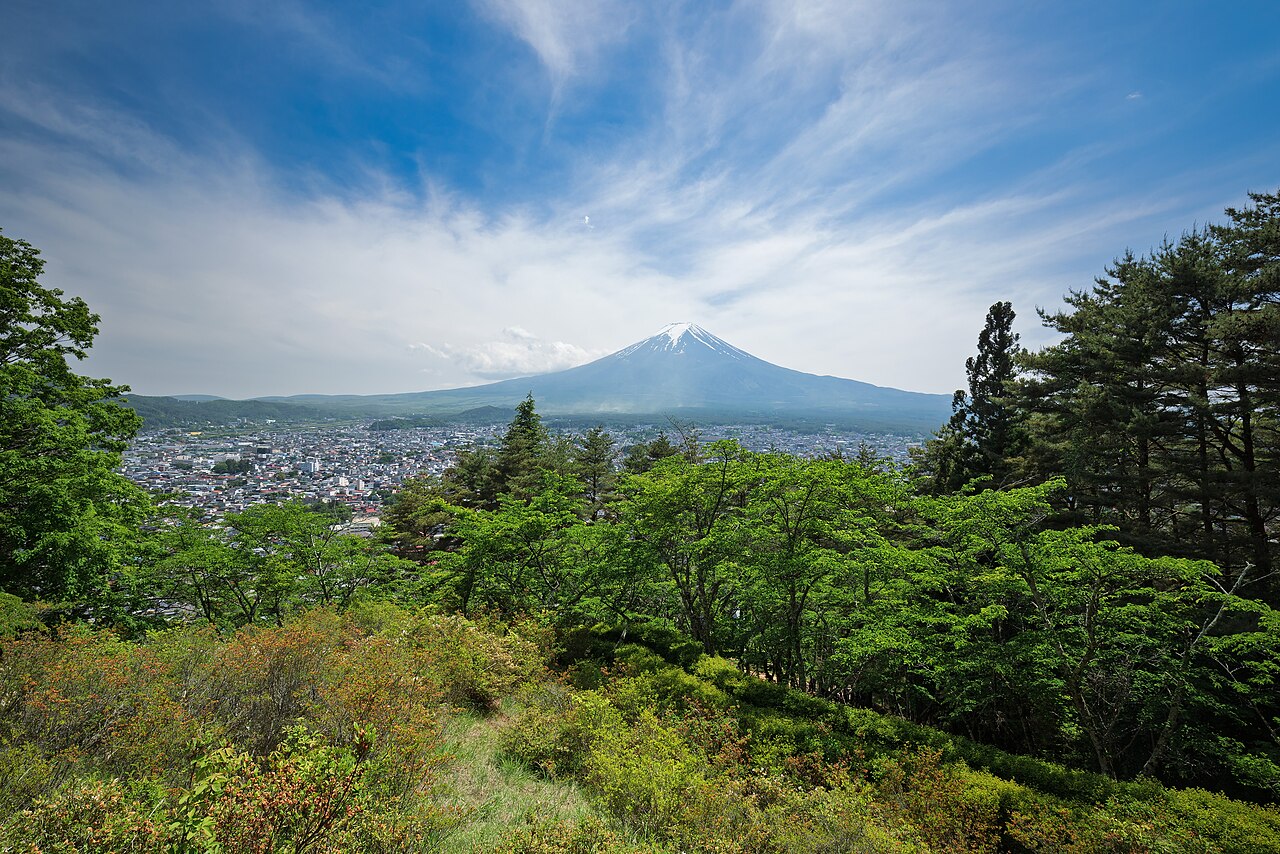
In the Edo period (1603–1868), Gunnai’s specialty was Kaiki — a glossy, exceptionally tightly woven silk. It was not an outer-display cloth but a lining: stitched inside a man’s haori, it flashed color only when the coat moved. That restraint — luxury you wore on the inside — made Kaiki a status object in Edo, and the district grew prosperous supplying it down the old highways toward the capital.
The finishing relied on the mountain itself. Soft, mineral-light snowmelt spring water from Mt. Fuji was used to wash and finish the silk, and that water is traditionally credited with the cloth’s clean luster. Whether the chemistry is exactly as folklore holds, the association is old and local: the weaving and the mountain’s water grew up together.

“Kaiki was luxury you wore on the inside — silk so tightly woven it shimmered only when the coat moved. The looms that made it are the looms that make this parasol’s cloth.”
- Edo period (1603–1868) — Gunnai weaves Kaiki, glossy high-density silk prized for haori linings, finished with Mt. Fuji spring water.
- 1866 — Makita Shoten is founded in the Gunnai district.
- Meiji era (1868–1912) — the district modernizes its looms and broadens from lining silk into high-density dress textiles.
- 20th century — Gunnai becomes Japan’s leading high-density textile and necktie producer.
- Recent decades — Makita applies its jacquard weaving to umbrellas and parasols, using two-ply Koshu-ori for pattern depth.
- Today — the area brands itself “Hatori-machi” (the weaving town); the looms still run at the foot of Mt. Fuji.
Through the 20th century the district’s tight-weave expertise migrated from kimono linings into Western dress: Gunnai became Japan’s leading producer of high-density textiles and neckties, the kind of demanding cloth where the pattern has to be woven, not printed, to read crisply. That accumulated skill is exactly what a jacquard parasol draws on. Building a design into a two-ply woven canopy is the same problem as building it into a necktie, scaled up to an umbrella’s panels.
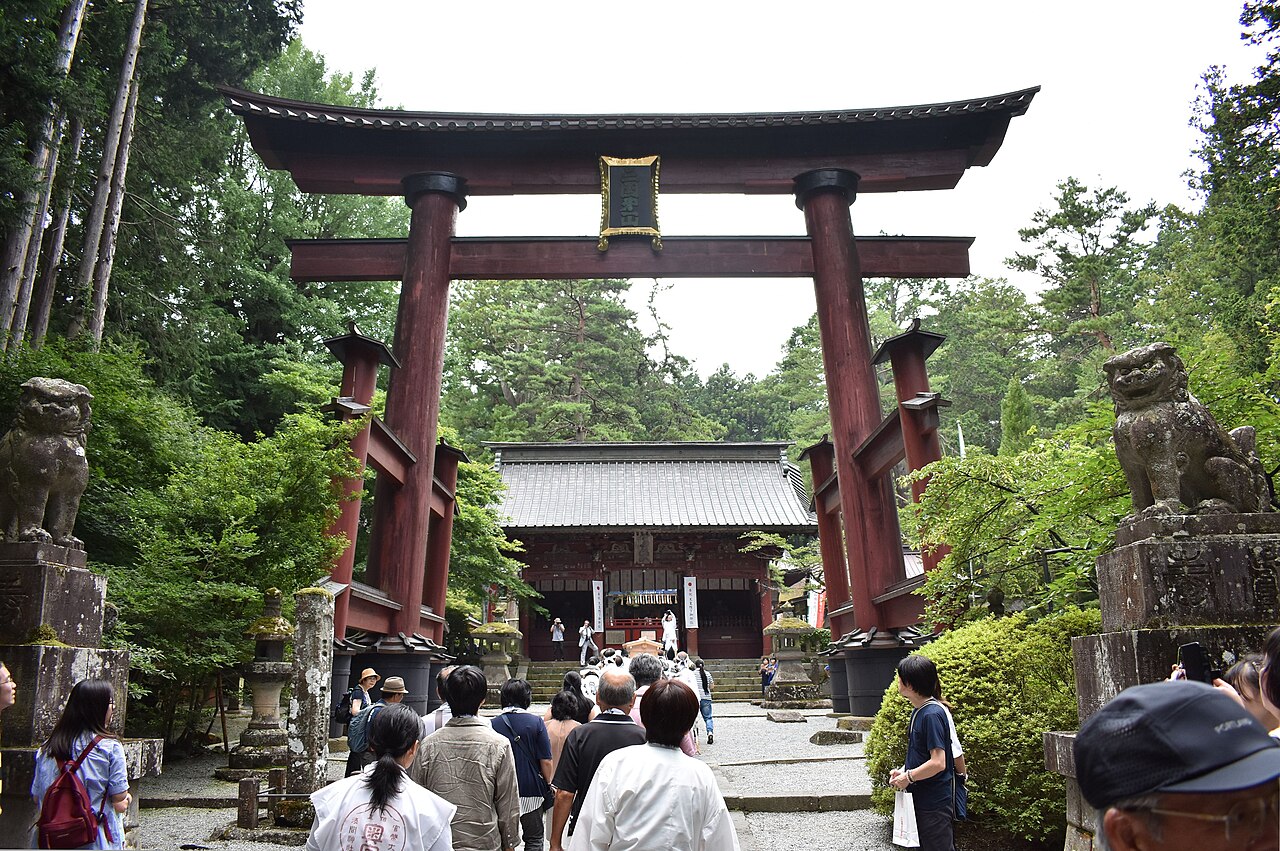
Makita Shoten, founded in 1866, is a flagship house of this district and weaves the fabric for its own umbrellas and parasols in-house. That vertical integration — loom to finished canopy under one roof — is the practical meaning of “still being made here.” The town’s self-chosen name, Hatori-machi, is not nostalgia marketing so much as an accurate description of what the streets around Fujiyoshida still do for a living.
Which finish should you choose?
This piece is listed in 3 finishes. The photos below are the actual 色 options on the listing right now — pick the one you want and confirm it on the product page before ordering, since hand-finished wares vary slightly piece to piece.
![Makita Shoten Koshu-ori Jacquard Parasol: Fujiyoshida Gunnai Silk [2026] — ピオニーピンク finish](https://m.media-amazon.com/images/I/31uls1Ol+nL._SL500_.jpg)
![Makita Shoten Koshu-ori Jacquard Parasol: Fujiyoshida Gunnai Silk [2026] — アイスブルー finish](https://m.media-amazon.com/images/I/31YQJY6LdrL._SL500_.jpg)
Other jpmono guides to Yamanashi crafts and to Japanese silk textiles — useful for placing this parasol against its neighbors in material, region, and technique.
 Koshu Inden Wallet (same prefecture)Yamanashi deerskin-and-lacquer craft
 Koshu Crystal Sphere (Yamanashi)Yamanashi’s other signature craft
Johana Shike-Ginu Silk Scarf (Chubu silk)Toyama slub-silk weaving
 Ueda Tsumugi Gamaguchi (Chubu silk)Nagano pongee silk purse
Kiryu-ori Silk NecktieGunma jacquard-woven silk
 Chichibu Meisen Silk StoleSaitama patterned silk
 Kaga Yuzen Silk ScarfIshikawa dyed-silk contrast
 Yokohama Silk ScarfKanagawa printed (vs. woven) silk
Price snapshot across stores
Pricing was not captured in the fetched data snapshot, so the table below shows the purchase paths rather than fabricated figures. Verify the live price on the listing before ordering. JPY is the authoritative currency for the specific item; any USD figure is an approximate estimate at a ¥150/USD baseline (mid-2026).
| Store | Item / variant | Price (JPY + USD est.) | Notes |
|---|---|---|---|
| 🇺🇸 Amazon US (search) | Browse Japanese parasols & sun-and-rain umbrellas | varies (USD) | Best if you are shopping from the US — Prime shipping, USD pricing, no international customs. Amazon US carries Japanese-made parasols and UV umbrellas from various makers; this specific Makita Shoten piece is sourced from Japan (next row). |
| 🇯🇵 Amazon JP Global Store | Makita Shoten Koshu-ori jacquard parasol (ASIN B0DPHRKKZK) | Not shown in fetched data — verify on listing | The sourced listing for the exact item. Ships internationally from Japan to most major destinations. |
| Maker direct | Makita Shoten official online store | Varies — check maker site | Widest pattern selection; may not ship outside Japan directly — a proxy service can bridge the gap. |
| Proxy services (Buyee / Tenso) | Forwarding from JP-only sellers | Item price + forwarding fee | Use when a pattern is sold only on a Japan-domestic store; adds handling and reships internationally. |
What it does well
The jacquard pattern is built into the two-ply Koshu-ori fabric on the loom, giving depth and dimension that a surface print cannot match.
Designed as seiu-kenyō (sun-and-rain): UV-blocking shade in summer and resistance to a passing shower, so you carry one canopy instead of two.
From a named house founded in 1866, in a district with a verifiable Edo-era silk lineage — not anonymous factory goods.
The pattern quality and maker story make it a giftable object for someone who notices materials and construction.
Weaknesses and things to verify before buying
- Fiber content is unconfirmed in this dataset. The tradition is silk, but the specific canopy’s fiber mix (silk, polyester, or a blend) was not captured here — confirm it on the live listing if natural fiber matters to you.
- Exact dimensions and weight are unconfirmed. Canopy diameter, closed length, and weight were not in the snapshot. If you need a compact folding form or a specific coverage, verify before ordering.
- Sun-and-rain ≠ storm umbrella. Seiu-kenyō canopies handle a passing shower; they are not a substitute for a fully waterproof umbrella in sustained, heavy, or wind-driven rain.
- Care is hands-on. A fine woven textile should not be machine washed and should be dried open and out of prolonged direct sun; buyers who want a throw-in-the-bag-and-forget item may find that demanding.
- Pricing and stock were not in the fetched data. Treat any figure you see as live and subject to change; the JPY listing price is the authoritative one.
- Cross-border purchase adds steps. International orders may incur customs duties above local thresholds and shipping fees the table does not predict; the Global Store or a proxy adds handling time over domestic Prime delivery.
Conclusion — which buyer type are you?
You want the named maker, the woven jacquard, and the heritage story. This is squarely your object — buy the pattern you love and treat it as a long-keeper.
You like the one-canopy-two-jobs idea and the look. A fair fit — just confirm fiber and dimensions first so the everyday practicality matches expectations.
If cost is the deciding factor, a woven artisan parasol is not the value pick. A standard UV folding umbrella will cover the function for far less.
You need a rugged storm umbrella, two-person coverage, or a disposable you will not mourn losing. This is the wrong tool — look elsewhere.
Other ways to approach this purchase
Parasols are seasonal; late-summer and end-of-season windows on the Global Store and maker site can soften the price. Watch the listing rather than buying at peak demand.
Maker outlet lines or end-of-run patterns occasionally surface at lower prices. Confirm the cloth and frame are first-quality, not seconds, before committing.
If you already hold Amazon balance or card rewards, applying them on the Global Store order offsets some of the international shipping premium.
If you only need rain protection and do not care about UV shade or woven pattern, a plain umbrella is the rational buy — there is no shame in passing.
🏆 Editor’s Pick
❓ Frequently Asked Questions
Does this parasol work for both sun and rain?
Does Amazon JP Global Store ship internationally?
What does “Koshu-ori” mean, and why two-ply?
Is the canopy actually silk?
How should I care for it?
Is it a good gift?
How is it different from a cheap UV umbrella?
jpmono.com is curated by a Japan-based editorial team (working out of Toyama in the Hokuriku region and Nara in Kansai) and is independent. We do not take payment from the makers we feature; income comes from affiliate links. We do not physically test every product — we read maker specs and source listings — and we mark unverified fields plainly rather than guess.
Editorial note: this article was prepared with AI assistance and reviewed against the fetched listing data. Specifications, pricing, and availability were unconfirmed in several fields at the time of writing and are flagged as such; always verify current details at the retailer before purchasing.
Affiliate disclosure: jpmono.com may earn a commission on qualifying purchases made through links on this page, at no additional cost to you.