![Nousaku Takaoka Tin KAGO Bendable Basket: Where to Buy [2026]](https://jpmono.com/wp-content/uploads/2026/06/nousaku-takaoka-tin-kago-bendable-basket-where-to-buy-2026-featured.jpg)
The Nousaku KAGO is a basket made of metal that you are supposed to bend with your bare hands. Cast as a flat square lattice of 100% pure tin, it arrives looking like a rigid grille — and then you press the corners up and it becomes a bowl, fold it differently and it becomes a shallow tray or a fruit dish. The material is soft enough that you reshape it whenever the use changes. Nousaku, the foundry that makes it, was founded in Takaoka in 1916 and works in the same metal-casting tradition that has defined this Toyama city since the early 1600s.
What makes the KAGO interesting for an international reader is not novelty for its own sake. Tin is genuinely too soft to hold a rigid form — historically that softness was treated as a defect that pushed makers toward alloys. Nousaku took the opposite view and made flexibility the entire design idea. The result is an object that behaves more like a textile than a casting: it adapts to what you put in it.
This guide covers where to buy the KAGO from outside Japan, how the 100% tin material actually behaves, who it suits and who should skip it, and how it compares to the other tin and metal pieces we have written about. Written from a Japan-based editor’s desk in Toyama — the prefecture where Takaoka sits — with pricing and stock figures caveated because, as noted below, only listing-level data was available at the time of writing.
🔄 Updated: June 2, 2026
⏱️ Read time: ~12 min

- Who this is for — and who should skip it
- Product overview (from published specs)
- Which finish should you choose?
- Where this comes from
- Price snapshot across stores
- 📦 Shipping & where to buy from outside Japan
- What it does well
- Weaknesses and things to verify before buying
- Conclusion — which buyer type are you?
- Other ways to approach this purchase
- 🏆 Editor’s Pick
- ❓ Frequently Asked Questions
Who this is for — and who should skip it
- Want a single serving piece that changes shape with the occasion — fruit bowl one day, bread tray the next
- Are drawn to material honesty: a metal that is soft on purpose, not hidden behind an alloy
- Already collect Japanese tin or metalwork and want a Takaoka-made anchor piece
- Like tactile objects and do not mind that the look depends on how you fold it
- Are buying a wedding, housewarming, or milestone gift with a clear story behind it
- Expect a rigid, set-and-forget bowl that never moves or flexes
- Want something dishwasher- and oven-proof for heavy daily kitchen abuse
- Are bothered by soft metal that shows fingerprints, scratches, and reshaping marks
- Need a low-cost everyday item — pure tin craft sits at a premium price point
- Want a piece that holds very hot food for long periods (tin has a low melting point)
Product overview (from published specs)
The data available for this piece is thin. The fetched dataset returned no live Amazon US listing and no current price snapshot, so the table below is built from the maker’s published material profile and the listing identity (ASIN B00B6OG71K) rather than a live price feed. Treat anything below as a starting point to verify on the listing, not a guarantee.
Nousaku Takaoka Tin KAGO Bendable Basket
NOUSAKU 能作 KAGO – ローズ 〔錫100%〕 501412
残り5点(入荷予定あり) · Sold by Amazon.co.jp · ASIN B00B6OG71K
Price and availability as of 2026-08-31 02:30 JST. The Amazon listing at the time of purchase is authoritative. jpmono.com earns a commission on qualifying purchases at no extra cost to you.
| Attribute | Detail (per maker profile / listing) |
|---|---|
| Maker | Nousaku (能作), founded 1916, Takaoka, Toyama |
| Material | 100% pure tin (suzu, 錫) — no alloy |
| Form | KAGO (籠, “basket”) — square cast lattice, shipped flat |
| Intended use | Bend by hand into a bowl, tray, or fruit dish; reshape later |
| Origin | Takaoka Dōki (高岡銅器) casting tradition, Toyama Prefecture |
| ASIN (sourced listing) | B00B6OG71K (Amazon JP Global Store) |
| Exact dimensions / weight | Unconfirmed — check the listing (varies by KAGO size) |
| Price | Unavailable at time of writing — verify current price on the listing |
Sources: Amazon US search (primary, moonill-20) + Amazon JP Global Store (secondary, moonill-22, sourced listing) + maker profile. Only the listing snapshot was available; live pricing may have shifted since the writing date.
📖 Glossary — key terms
- suzu (錫, “tin”) — a soft, low-melting white metal. Pure tin resists rust and is traditionally valued for not altering the taste of food or drink.
- KAGO (籠, “basket”) — Nousaku’s product name for the bendable lattice; the word literally means a woven basket, here cast in metal.
- Takaoka Dōki (高岡銅器, “Takaoka copperware”) — the cast-metal craft tradition of Takaoka, covering bronze, brass, and tin wares.
- shokunin (職人) — a skilled trade craftsperson; the foundry workers who pour and finish the castings.
- Maeda (前田) — the daimyō clan that ruled the Kaga domain and founded Takaoka as a castle town in 1609.
Which finish should you choose?
The KAGO is sold in more than one footprint and surface treatment — the square lattice covered here is the most flexible everyday format, while smaller and rectangular versions trade reach for a tidier table presence, and tin’s natural finish ranges from bright to a softly clouded matte depending on how it is worked. The options below are pulled from the live listing rather than described from memory.
![Nousaku Takaoka Tin KAGO Bendable Basket: Where to Buy [2026] — シルバー finish](https://m.media-amazon.com/images/I/41CbFJwUy7L._SL500_.jpg)
Related pieces we have covered — other tin, lacquer, and metal crafts worth weighing against the KAGO.
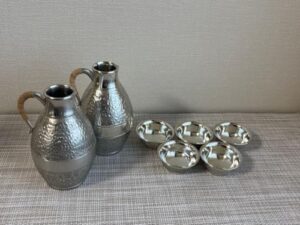 🍶 Osaka tin sake flask
Naniwa Suzuki tin tokkuri
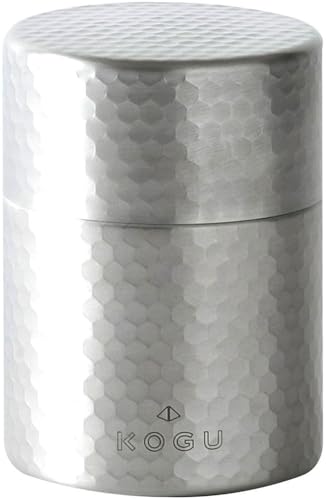 🍵 Kaikado tin tea caddy
Kyoto chazutsu canister
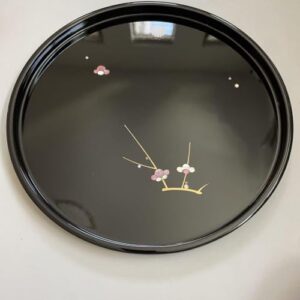 🐚 Takaoka raden lacquer box
Same city, aogai inlay
 ✨ Akita silver filigree
Ginsen-zaiku brooch
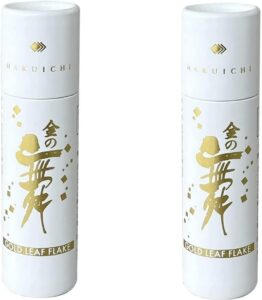 🟡 Kanazawa gold leaf
Hakuichi kinpaku
🥢 Wajima lacquer sake cups
Meoto sakazuki pair
 ✂️ Suwada nail nipper
Sanjō forged steel
Where this comes from

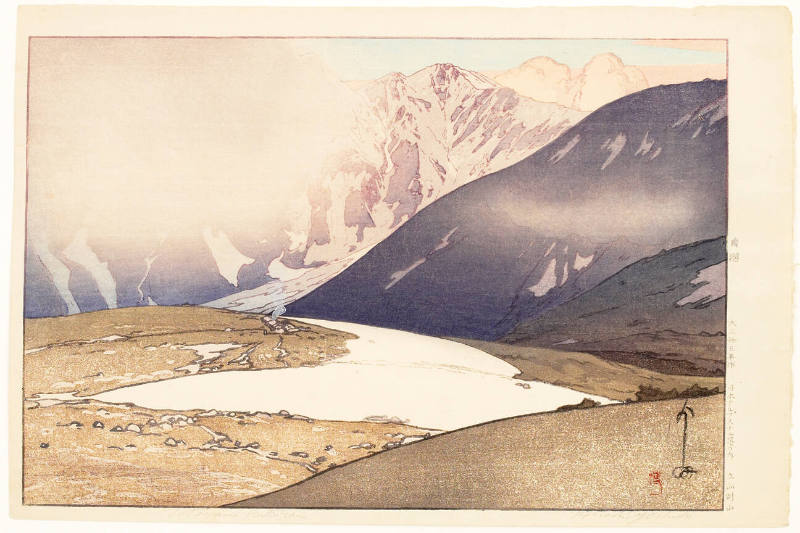
Toyama is a coastal prefecture on the Sea of Japan side of central Honshū, in the region called Hokuriku. The land is hemmed by the steep Tateyama range to the south and opens onto Toyama Bay to the north — a geography of fast rivers, deep snow, and good water that supported metalworking, paper-making, and pharmaceuticals for centuries. Takaoka, the prefecture’s second city, grew up as a river-and-port town where casting could draw on fuel, transport, and a concentrated labor of trade craftsmen.
The story of metal here begins in 1609, when Maeda Toshinaga, of the powerful Kaga domain, founded Takaoka as a castle town. Soon after, he invited seven casters to settle the district now known as Kanayamachi. Their foundries became the seed of what would grow into Takaoka Dōki — Takaoka copperware — and over the Edo period the town became Japan’s leading center for cast metalwork: temple bells, Buddhist altar fittings, and large-scale bronze.
- 1609 — Maeda Toshinaga founds Takaoka as a castle town of the Kaga domain.
- early 1600s — Seven casters are invited to settle Kanayamachi; foundries take root.
- Edo period — Foundries grow into Takaoka Dōki: temple bells, altar fittings, large bronze casting.
- 1916 — Nousaku founded in Takaoka, casting brass and bronze as a subcontractor.
- Later — Nousaku pioneers wares in 100% pure tin, turning the metal’s softness into the design.
- Today — The KAGO bendable basket ships flat and is reshaped by hand into a bowl or tray.
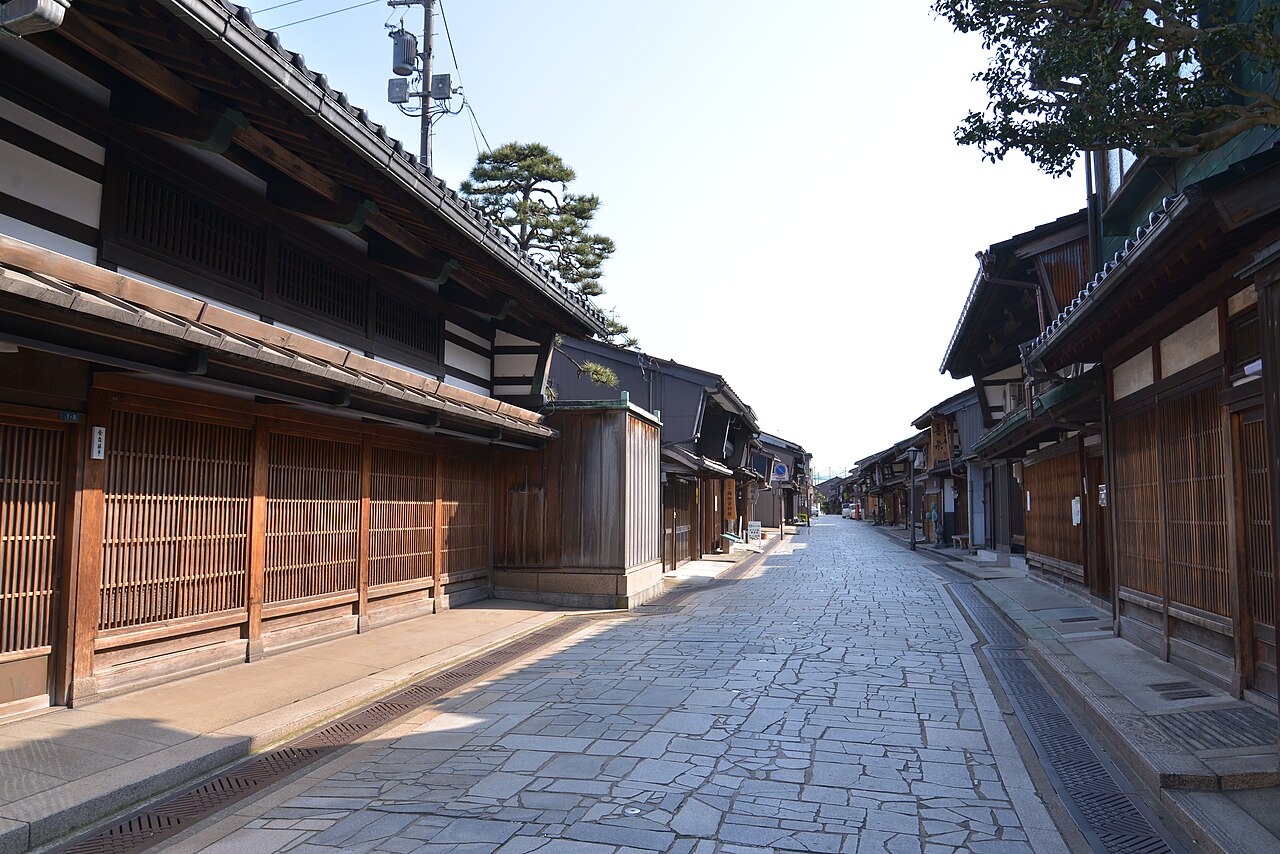
Nousaku entered this lineage in 1916, not as a famous name but as a subcontractor pouring brass and bronze for other workshops. Its turn toward 100% pure tin came later, and it was a real gamble: pure tin is so soft it cannot be made into a rigid vessel in the usual way. Most makers alloy it for exactly that reason. Nousaku instead designed around the softness, and the KAGO basket is the clearest expression of that decision.
“Nousaku did not hide tin’s softness behind an alloy. They handed it to you and said: bend it.”
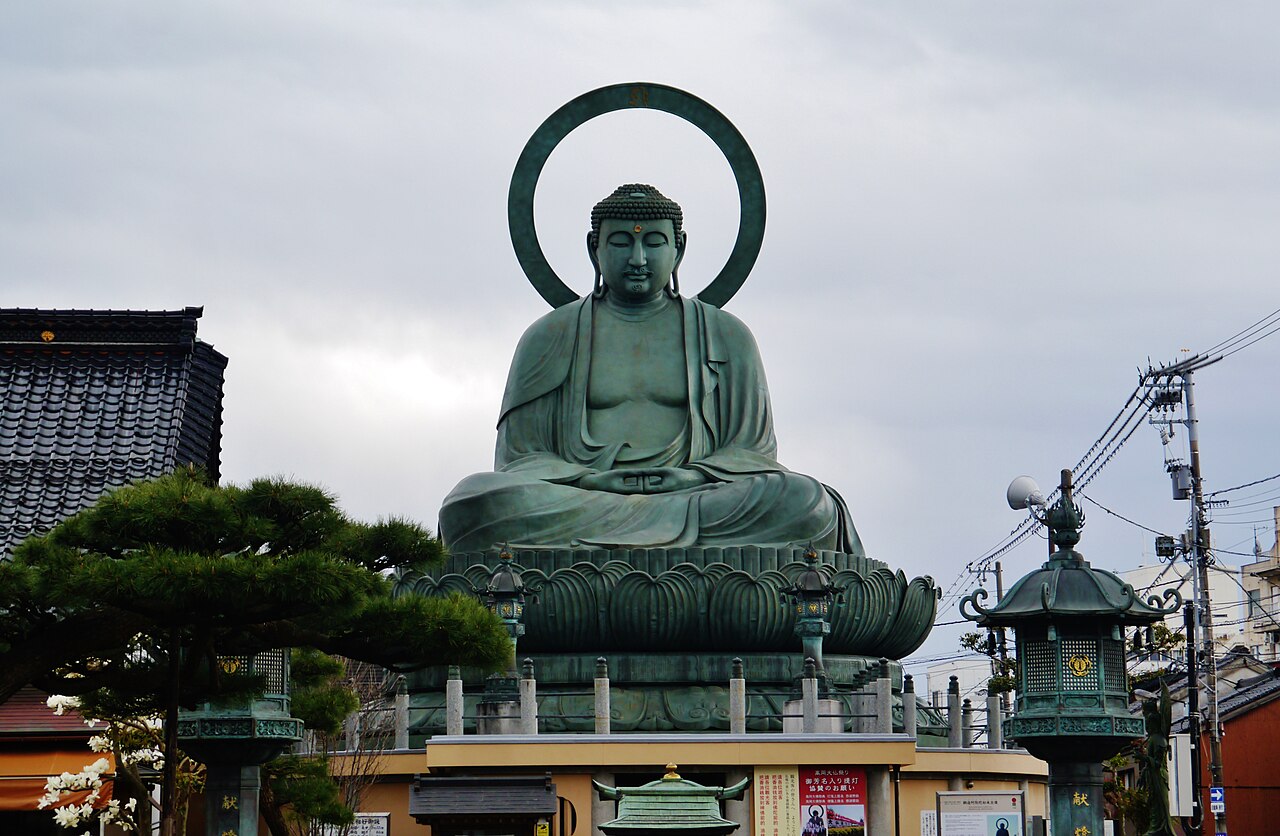
That mastery of scale is visible across the city. The bronze Takaoka Daibutsu — a Great Buddha cast locally — stands as a civic emblem of the same foundry skill, while temple bells and altar fittings from Takaoka have furnished Buddhist sites across Japan for generations. A small hand-shaped tin basket and a multi-ton bronze Buddha sit at opposite ends of one continuous craft.
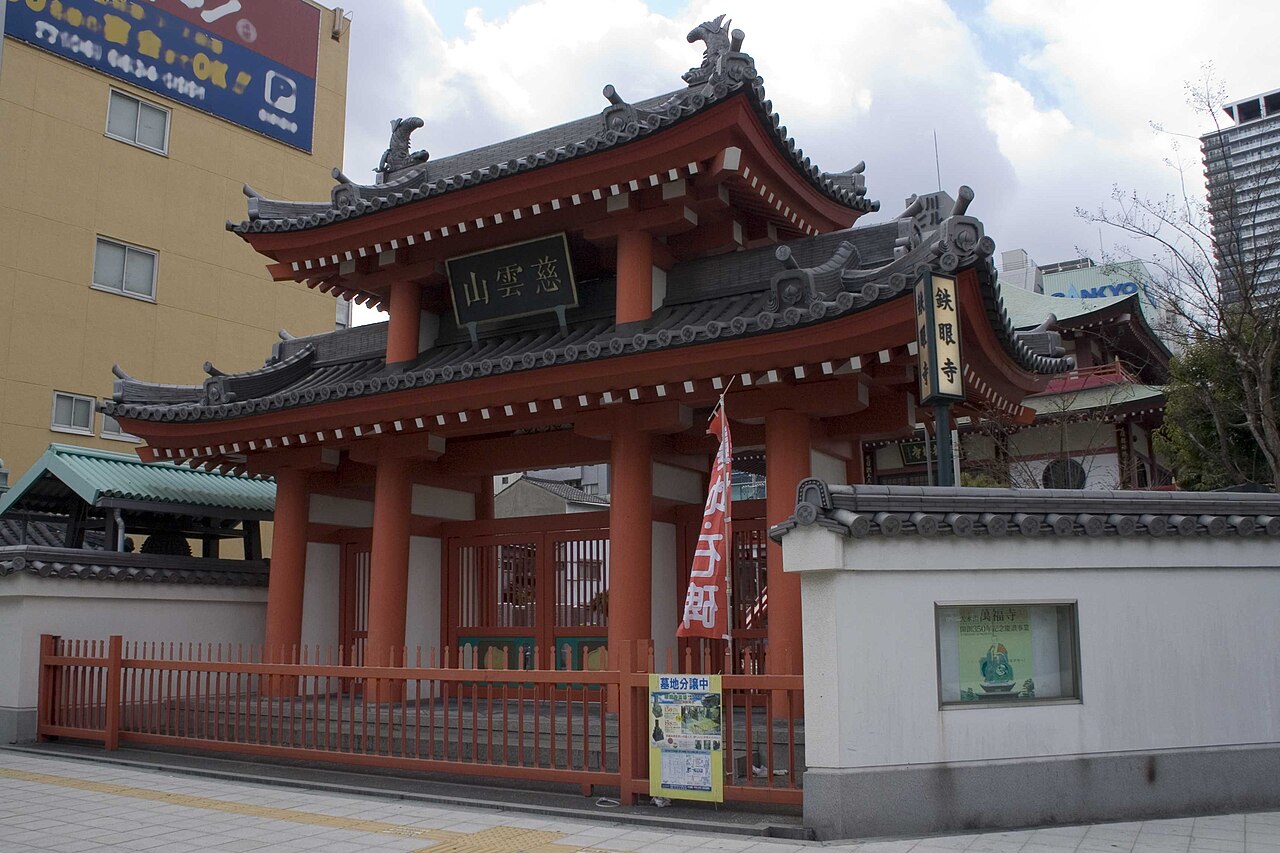
The Maeda connection is still legible in the townscape. Zuiryu-ji, a National Treasure complex, is the mortuary temple of Toshinaga himself — a reminder that the man who founded the castle town in 1609 also, in effect, founded the industry that made the KAGO possible four centuries later. When you bend this basket, you are handling the far end of a line that runs back to a daimyō’s decision to put casters in one district of one river town.
Price snapshot across stores
Live pricing for this specific listing was unavailable at the time of writing, so the table notes where to verify rather than quoting a number we cannot confirm. JPY is the authoritative currency for the sourced item; any USD figure should be read as an approximate estimate at a ¥150/USD baseline.
| Store | Item / variant | Price (JPY + USD est.) | Notes |
|---|---|---|---|
| 🇺🇸 Amazon US (search) | Browse Japanese tin & metal tableware | varies (USD) | Best if you are shopping from the US — Prime shipping, USD pricing, no international customs. Amazon US carries Japanese tin and metal home goods from various makers; Nousaku’s exact KAGO is sourced from Japan (next row). |
| 🇯🇵 Amazon JP Global Store | Nousaku KAGO square, 100% tin (ASIN B00B6OG71K) | Check listing — price unconfirmed | Ships internationally from Japan. This is the sourced listing for the exact piece in this guide. |
| Maker direct | Nousaku official catalog | See maker site | Full KAGO size and finish range; international shipping policy varies — confirm before ordering. |
| Proxy services (Buyee / Tenso) | Japan-only listings forwarded abroad | Item price + forwarding fee | Useful only if a particular size or finish is not on the Global Store; adds a service fee and a second shipping leg. |
📦 Shipping & where to buy from outside Japan
The most direct route for an international reader is the Amazon JP Global Store listing, which ships many household items to most major destinations from Japan. Shipping to the US and EU on a small, light tin basket typically runs in the lower end of the international band — plan for roughly $15–$40 depending on speed and destination, and check whether import duties apply once your order crosses your country’s de minimis threshold.
If the exact KAGO size or finish you want is listed only on a Japan-domestic page, a proxy forwarder such as Buyee or Tenso can buy it on your behalf and re-ship it, at the cost of an added service fee and a second shipping leg. There is no electrical component here, so there are no voltage or certification concerns — a tin basket carries the same way anywhere.
What it does well
Weaknesses and things to verify before buying
- It is soft — permanently. The same quality that lets it bend means it dents, scratches, and shows fingerprints. If you want a pristine, untouched look, pure tin will frustrate you.
- Low melting point. Tin softens at relatively low temperatures. Do not use it for very hot food held over time, near direct flame, or in an oven.
- Not a heavy-duty kitchen tool. Treat it as a serving and presentation piece, not a mixing bowl or a dishwasher regular — confirm care instructions on the listing.
- Price unconfirmed here. The dataset returned no live price; pure-tin Takaoka craft is generally a premium purchase, so verify the current figure on the listing before committing.
- Exact dimensions vary by version. KAGO comes in more than one size and footprint; check the specific size on the listing so the basket fits the table or shelf you have in mind.
- Repeated reshaping has limits. The metal tolerates being bent and re-bent, but it is still metal — aggressive, repeated creasing in the same spot is not what it is built for.
Conclusion — which buyer type are you?
Other ways to approach this purchase
🏆 Editor’s Pick
❓ Frequently Asked Questions
Is the KAGO basket really meant to be bent by hand?
Yes. It ships as a flat cast lattice and is designed to be reshaped by hand into a bowl, a shallow tray, or a fruit dish. Because the material is 100% pure tin, it is soft enough to bend without tools and can be reshaped again later when the use changes.
Is it really 100% tin, and is tin suitable for food?
The piece is made of pure tin with no alloy. Tin is traditionally valued for resisting rust and for not imparting a strong metallic taste, which is why it has long been used for Japanese tableware and sake vessels. For specific food-contact and care guidance, follow the instructions on the listing or the maker’s page.
Can I buy it from outside Japan?
The Amazon JP Global Store listing for this item ships internationally to most major destinations from Japan. If your preferred size or finish appears only on a Japan-domestic page, a proxy forwarder such as Buyee or Tenso can purchase and re-ship it for an added fee.
How do I care for a pure tin basket?
Treat it gently. Tin is soft, so it scratches and shows fingerprints, and it has a low melting point, so it should be kept away from direct heat, very hot food held over time, and the oven. Hand washing is the safe assumption; verify dishwasher suitability on the listing before risking it.
Will it break if I reshape it repeatedly?
The KAGO is designed to be bent and re-bent, so normal reshaping is expected and fine. It is still metal, however, so very aggressive, repeated creasing in the exact same spot is not what it is built for. Reshape with whole-hand pressure rather than sharp folds.
How much does it cost?
Live pricing was unavailable when this guide was written, so we have not quoted a figure we cannot confirm. Pure-tin Takaoka craft generally sits at a premium price point; check the current price directly on the Amazon JP Global Store listing or the maker’s catalog before purchasing.
jpmono.com is curated by a Japan-based editorial team working out of Toyama in the Hokuriku region and Nara in Kansai, and is independent. We do not take payment from the makers we feature; income comes from affiliate links. We do not physically test every product — we read maker specs and source listings. Read more about our editorial standards.
This article was prepared with AI assistance and reviewed against the source listing and maker profile by a Japan-based editor. Where data was thin or unavailable, that is stated plainly rather than filled in.
Affiliate disclosure: jpmono.com may earn a commission on qualifying purchases made through links on this page, at no additional cost to you.