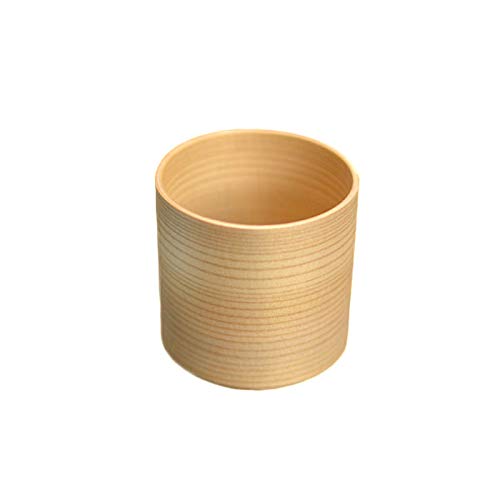
- What it is: a single sake cup bent from a thin strip of Akita cedar, with the seam stitched shut in cherry bark — the magewappa technique in an 80 cc guinomi.
- Made in: Japan — listed by Odate Kogeisha (大館工芸社) of Odate, Akita, the town most closely associated with magewappa bentwood.
- Price band: ¥2,812 for one 80 cc cup (≈ $19 USD; listing snapshot of 2026-10-24 — verify on the listing).
- Best for: a drinker who wants one honest wooden cup for sake at home and prefers a working craft object to a souvenir.
- Skip if: you need a matched set, a sealed surface, or anything that goes in a dishwasher.
- Shipping: ships internationally from Amazon Japan — jump to our pick ↓
A thin strip of Akita cedar is steamed until it goes limp, wrapped around a wooden form, and stitched shut along the overlap with a band of cherry bark. That is magewappa (曲げわっぱ), the bentwood tradition of the Odate basin in northern Akita, and the cup in this article is that technique at its smallest useful size: a guinomi of 80 cc, listed by the Odate workshop Odate Kogeisha at ¥2,812.
Magewappa is usually seen as a lunch box. The form most travelers meet first is the oval bento, or the shallow rice container that comes to the table in a ryokan, and the workshops that make those also make trays and tubs. The sake cup is the same object reduced to the span of a fist — the same bent wall, the same seam, the same bark stitch, holding 80 ml instead of a meal.
This article works from one specific listing rather than from the craft in general: what the title actually says, what the snapshot price was on October 24, 2026, how 80 cc behaves at the table, and what a buyer outside Japan should check before ordering. It also sets the cup against the alternatives worth knowing — a hinoki masu cup, a lacquered wood cup, a boxed pair — so the decision is made with context rather than in isolation.
🔄 Updated
⏱️ 9 min read
🏷️ Japanese Craft

- Who this is for — and who should skip it
- Product overview (from published specs)
- Glossary: the words on the label
- Price snapshot across stores
- 📦 Shipping & where to buy from outside Japan
- 📍 Where this comes from — the Odate basin and the bentwood trade
- What it does well
- Weaknesses and things to verify before buying
- Conclusion — which buyer type are you?
- Other ways to approach this purchase
- 🏆 Editor’s Pick — the Odate Kogeisha magewappa sake cup
- ❓ Frequently Asked Questions
Who this is for — and who should skip it
The cup is inexpensive for a hand-bent piece, but it is not a universal purchase. The split below follows what the listing states and what an 80 cc wooden cup can and cannot do.
- drink sake at home often enough that one cup earns its place in the cupboard
- already like magewappa lunch boxes and want the same craft in a smaller format
- want a light cup — thin cedar weighs almost nothing in the hand
- are buying a first Japanese wooden cup and want an entry price under $25
- enjoy objects that shift with use, from pale new wood to a darker, handled tone
- need four matching cups, or a gift that arrives in a box — this listing is one cup, with no packaging described
- want dishwasher-safe or microwave-safe drinkware; neither is stated
- expect a lacquered, glossy, or painted surface
- pour large servings and prefer a cup of 100 ml or more
- need exact weight and diameter before you commit
“The bark is not decoration. It is the joint — and on a cup this small, it is also the only ornament the object has.”
Product overview (from published specs)
ℹ️ Only the Amazon JP listing snapshot is available; live pricing may have shifted since the writing date. Values below are quoted from that listing.
Odate Magewappa Sake Cup
大館工芸社 曲げわっぱ 秋田杉 曲げぐい呑み 80cc SAKE cup 日本製
通常2~3日以内に発送します。 · Sold by 漆器かりん本舗 · ASIN B017B49F3U
Price and availability as of 2026-10-24 09:15 JST. The Amazon listing at the time of purchase is authoritative. jpmono.com earns a commission on qualifying purchases at no extra cost to you.
| Attribute | What the listing states | Source |
|---|---|---|
| Maker / brand | Odate Kogeisha (大館工芸社) | Listing title |
| Item | Magewappa guinomi (曲げぐい呑み), one cup | Listing title |
| Material | Akita cedar (秋田杉) | Listing title |
| Capacity | 80 cc (about 80 ml) | Listing title |
| Origin | Made in Japan (日本製) | Listing title |
| Surface / coating | Not stated — no lacquer or resin coating is named | Listing title |
| Weight, diameter, height | Not stated | — |
| Packaging | Not described; one cup per the title | Listing title |
| Price | ¥2,812 (≈ $19 USD at ¥150/USD) | Amazon JP, 2026-10-24 09:05 JST |
| Seller | Shikki Karin Honpo (漆器かりん本舗) | Listing |
| Dispatch | Usually ships within 2–3 days (通常2~3日以内に発送します) | Listing |
| Condition | New | Listing |
Glossary: the words on the label
Magewappa (曲げわっぱ) — bentwood
A vessel made by steaming a thin strip of wood, bending it around a form, and closing the seam with bark. In Akita the wood is cedar and the binding is cherry bark, and the same technique covers lunch boxes, rice containers, and trays.
Akita sugi (秋田杉) — Akita cedar
The cedar grown in Akita Prefecture, valued for straight grain and light weight. Those are the two properties thin bentwood needs: a strip that bends without splitting, and a finished wall that does not weigh on the hand.
Guinomi (ぐい呑み) — the small sake cup
A cup sized for a single pour and held between thumb and fingers rather than set down between sips. The usual range runs from about 50 ml to about 100 ml, so 80 ml sits comfortably in the middle.
Tokkuri (徳利) — the sake flask
The narrow-necked flask that a cup is poured from. A 180 ml tokkuri fills this cup twice with a little to spare, which is a useful way to plan a bottle for two drinkers.
Kabazaiku (樺細工) — cherry-bark work
The Akita craft of covering small wooden objects with polished cherry bark, associated with Kakunodate. Magewappa uses the same bark differently: as a binding stitched through the seam, not as a surface veneer.
Six other Japanese craft pieces covered on this site, for readers weighing a cup against a board, a coaster set, a tea caddy, or a different regional cup.
 Aomori hiba board
 Akita Kabazaiku Cherry Bark Coaster Set: Where to Buy [2026]
 Kabazaiku Cherry Bark Tea Caddy: Kakunodate’s Akita Woodwork [2026]
 Ogaki Hinoki Masu Sake Cup: Gifu Woodwork Buying Guide [2026]
 Akita Ginsen-zaiku Silver Filigree Brooch: Where to Buy [2026]Akita Hachijo Plant-Dyed Silk Necktie: Naraya’s Glowing Yellow Weave [2026]
Price snapshot across stores
Prices in the table are the ones visible at the snapshot time; JPY is the authoritative figure, and the USD numbers are estimates at roughly ¥150 to the dollar. Prices in USD are approximate and depend on the current exchange rate.
| Store | Item / variant | Price | Notes |
|---|---|---|---|
| 🇺🇸 Amazon.com (US) | Browse Japanese cedar and bentwood tableware | varies (USD) | Best if you are shopping from the US — Prime shipping, USD pricing, no international customs. Amazon US carries wooden sake cups and Japanese kitchenware from a range of makers; this exact Odate Kogeisha cup is sourced from Japan (next row). |
| 🇯🇵 Amazon JP Global Store | Odate Kogeisha magewappa guinomi, Akita cedar, 80 cc — one cup | ¥2,812 (≈ $19 USD) | Ships internationally from Japan to 65+ countries — including Canada, the UK and Australia — with import fees estimated at checkout. Sold by Shikki Karin Honpo; usually dispatched in 2–3 days. As of 2026-10-24; verify on the listing. |
| Maker direct | Odate Kogeisha workshop range — cups, lunch boxes, trays | Unconfirmed — check maker site | Useful if you want a boxed piece or a pair; direct sales channels and overseas shipping terms were not part of the snapshot. |
| Proxy services (Buyee / Tenso) | Same cup bought from a Japanese retailer that does not ship abroad | Item price + proxy fee + international shipping | Worth comparing only when a domestic retailer undercuts the Global Store price by more than the fee. Adds a second leg of shipping and a longer wait. |
📦 Shipping & where to buy from outside Japan
Amazon JP Global Store ships this listing internationally from Japan to 65+ countries, including Canada, the UK and Australia, with import fees estimated at checkout for most destinations. Delivery from dispatch is typically a week or more, since the parcel crosses customs.
Country-specific guidance, including customs thresholds and what a courier will ask for on delivery, is collected in the destination guides: Canada, the UK, and Australia. Shipping a small parcel of this size generally runs about $15–$40 depending on destination and speed. Duty thresholds differ by country, and a single cup usually falls below them, but the guides above set out where each line sits.
📍 Where this comes from — the Odate basin and the bentwood trade
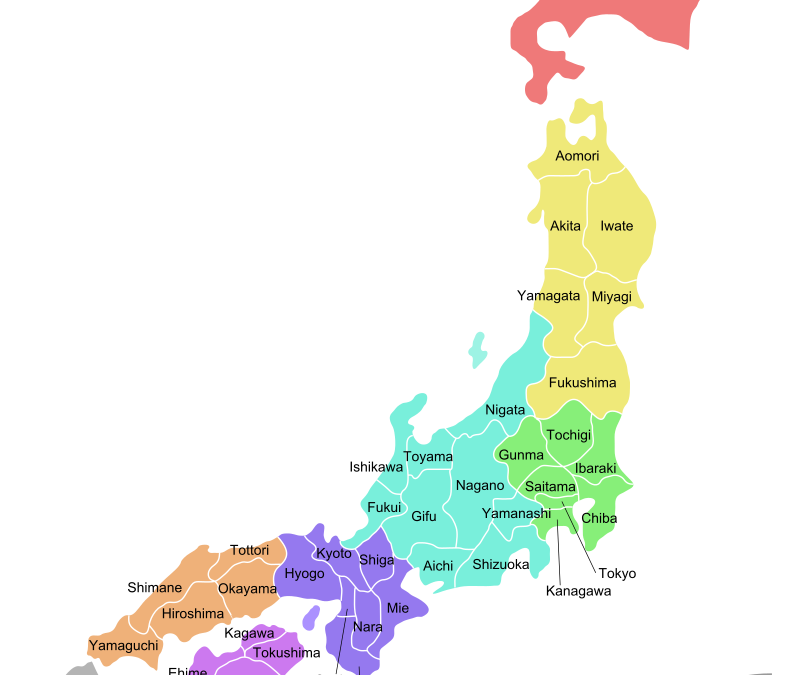
The basin on the map
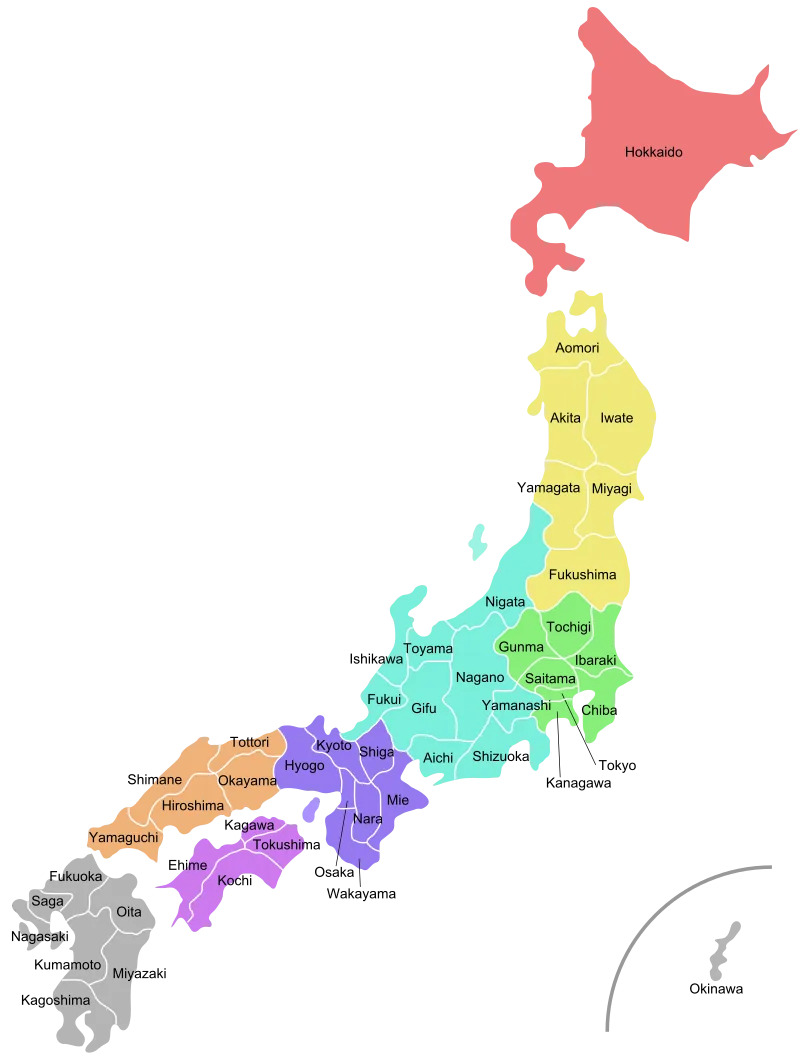
Odate sits in a basin in the far north of Akita Prefecture, on the Sea of Japan side of Tōhoku. Mountains close the basin in on most sides and the Yoneshiro River drains it; Aomori Prefecture begins just to the north. Winters here are long and heavily snowed, which sets the rhythm of any trade that depends on timber cut in the surrounding hills.
Akita runs the length of the Sea of Japan coast at the northern end of Honshū, and much of the prefecture’s interior is forest rather than open plain. Lake Towada, a caldera lake on the Akita–Aomori line, is the landmark most often used to place this corner of the map.

A castle town, and then a craft town
Odate was historically the castle town of the Odate Satake, a branch of the Satake family that held Akita domain. When the Tokugawa order settled in the early 1600s, the Satake were installed in Akita and their branch held this basin; for the following two and a half centuries Odate remained a castle town, with the castle at its centre and the town laid out around it.
The castle site is a public park today, and the town grew outward from it — a compact core, the river, and the hills coming down close on every side.

-
1603 — The Edo period begins; Japan’s castle towns settle into two and a half centuries of domain government. -
Early 1600s — The Satake family is installed at Akita; a branch holds Odate as a castle town in the northern basin. -
Edo period — Magewappa is generally traced to this span in the region, with Odate becoming its best-known centre. -
1868 — The Meiji Restoration ends the Edo period; the castle towns lose their domain function. -
1871 — Domains are replaced by prefectures; Odate becomes an ordinary town within Akita Prefecture. -
2026 — Odate workshops still bend and stitch cedar for lunch boxes, rice containers, trays — and this 80 cc sake cup.
What “still made here” means for a cup
In this part of Akita, magewappa is generally traced to the Edo period, the centuries when the basin’s cedar was worked into everyday containers. The technique did not stay with one product. Odate workshops apply the same bend-and-stitch method to lunch boxes, rice containers and trays, so the cup in this listing is a small-format piece inside a working repertoire, not a separate craft revived for the souvenir market. The listing names Odate Kogeisha (大館工芸社) as the maker, an Odate workshop working in that tradition.
Lightness is why magewappa became a lunch-box form in the first place, and lightness is the first thing a drinker notices in an 80 ml cup. It also explains the economics: a thin bent wall uses little timber and no lathe time, which is how a hand-worked piece can sit at ¥2,812 rather than at the price of a turned and lacquered vessel.
Where the cup differs from its larger siblings is tolerance. A lunch box carries rice for a few hours and is wiped dry; a cup holds liquid against the seam and the end grain every time it is used, which is why cherry bark — durable, water-resistant and slightly springy — is the traditional binding.
The material: cedar from the wooded interior
Akita sugi is prized for straight grain and light weight, the pair of qualities thin bentwood needs: a strip that bends without splitting, and a finished wall that does not weigh on the hand. The same wooded interior that supplies cedar also holds the beech forests of Shirakami-Sanchi, which straddle northern Akita and Aomori and belong to the landscape that has supplied timber crafts across the region.

How the cup is actually made
Bending is a sequence of small constraints. The strip is soaked or steamed until it yields, wrapped around a wooden form while it is still flexible, and held until it takes the curve. The overlapping ends are then stitched with cherry bark, which holds the seam closed and covers the raw edge at the same time. On a cup, that seam runs up one side, and you can feel it with a fingertip.

At the table
Eighty milliliters is one generous pour, or two restrained ones, and the cup is meant to be held rather than put down between sips. Served at room temperature or lightly chilled, cedar puts aroma in the nose before the first taste, which is the reason drinkers who otherwise use glass keep one wooden cup in the cupboard. Warm sake is a different question: the listing states no heat rating, and thin bentwood is not the vessel to experiment with.
The cup also suits a shared bottle and a small pour rather than a long drink nursed alone, which is a pattern that fits a northern winter better than a large glass does.
What it does well
Weaknesses and things to verify before buying
- Surface treatment is unspecified. The title names Akita cedar but no lacquer, urethane or oil finish. If you need a sealed, stain-resistant surface, ask the seller before ordering.
- No weight or dimensions. The listing gives capacity but not diameter, height or grams, so there is no way to judge the rim thickness or the footprint from the page.
- One cup, no box described. Buyers wanting a gift set will need a pair or a boxed piece, which this listing does not appear to be.
- Wood varies piece to piece. Grain direction and tone differ between individual cups, so the photograph is a representative example rather than the exact unit shipped.
- Dishwasher and microwave are not stated. Thin bentwood is normally washed by hand and dried promptly, and no appliance rating appears on the listing.
- Small format. 80 cc is deliberate, but a drinker who pours 120 ml servings will find it cramped; anyone serving several guests needs more than one.
- Price and stock move. ¥2,812 was the figure at 09:05 JST on October 24, 2026, sold by a third-party seller, so both price and availability can change without notice.
Conclusion — which buyer type are you?
Other ways to approach this purchase
🏆 Editor’s Pick — the Odate Kogeisha magewappa sake cup
- It is the real technique at a small scale. A steamed cedar strip, a form, and a cherry-bark seam — the same construction Odate uses for lunch boxes, sized to 80 cc.
- The price is honest for hand-work. At ¥2,812 it sits well below a full-size magewappa lunch box, so the entry cost to owning the craft stays low.
- The listing is specific and shippable. Maker, material, capacity and origin are all named; the seller dispatches in 2–3 days and the Global Store path handles international delivery.
❓ Frequently Asked Questions
Is this cup made in Japan?
The listing title ends with 日本製 (made in Japan), and the maker named on it, Odate Kogeisha (大館工芸社), is an Odate workshop working in the magewappa tradition. The listing does not print a street address or a prefectural certificate number.
What size is the cup, and how much does it hold?
The title specifies 80 cc, which is about 80 ml — one generous pour, or two restrained ones. The listing does not state weight or outer dimensions.
Is the inside lacquered or bare wood?
Not stated. The listing names Akita cedar but does not mention lacquer, urethane or any other coating, so buyers who need a sealed surface should confirm with the seller before ordering.
Can it go in a dishwasher or microwave?
The listing does not state either. Thin bentwood is normally washed by hand and dried promptly, and no heat rating appears in the snapshot, so treat both appliances as unsupported until the seller confirms.
Does Amazon Japan ship this to Canada, the UK or Australia?
Amazon JP Global Store ships internationally from Japan to more than 65 countries, Canada, the UK and Australia included, with import fees estimated at checkout. Availability and the fee estimate appear on the listing once a delivery address is set.
Is it suitable as a gift?
It is one cup, and the listing does not describe a box or a gift sleeve. For a gift, a boxed pair or a set bought directly from the maker is the safer route; a single cup works well as a small, informal present.
How does it compare with a hinoki masu cup?
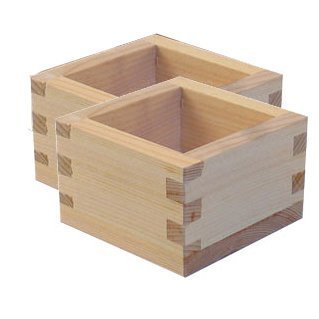
A masu is a square box-form cup of Japanese cypress, with corners and a flat bottom; this is a round bentwood cup with a single stitched seam. Both show bare wood, but the masu reads as architectural and the magewappa cup as a strip turned on itself. Capacity and price differ by listing.
jpmono.com is curated by a Japan-based editorial team, working out of Toyama in the Hokuriku region and Nara in Kansai, and is independent. We do not take payment from the makers we feature; income comes from affiliate links. Read more about our editorial standards.
Written with AI assistance and edited by the jpmono editorial team. Product facts are taken from the linked listing and the maker’s published information; prices and stock change, so confirm details on the listing before buying.
Affiliate disclosure: jpmono.com may earn a commission on qualifying purchases made through links on this page, at no additional cost to you.