![Saji Takeshi Echizen Santoku Knife — SRS13 Powdered High-Speed Steel, 180 mm Forged in Takefu (¥35,300 / ≈$235 USD) [2026 Buyer’s Guide]](https://jpmono.com/wp-content/uploads/2026/05/saji-takeshi-echizen-santoku-srs13-where-to-buy-2026-featured-2.jpg)
Saji Takeshi Echizen Santoku Knife — SRS13 Powdered High-Speed Steel, 180 mm Forged in Takefu (¥35,300 / ≈$235 USD) [2026 Buyer’s Guide]
Echizen Uchihamono (越前打刃物) is the 690-year-old forged-blade tradition of Takefu, Fukui — a five-minute drive from the Echizen washi papermaking valley featured in our previous guide. The town has been hammering iron into blades since 1337, when a master swordsmith from Kyoto named Chiyozuru Kuniyasu set up a workshop here, and the same basin now holds more than sixty active hand-forging workshops working in the same hammer-and-water-stone lineage.
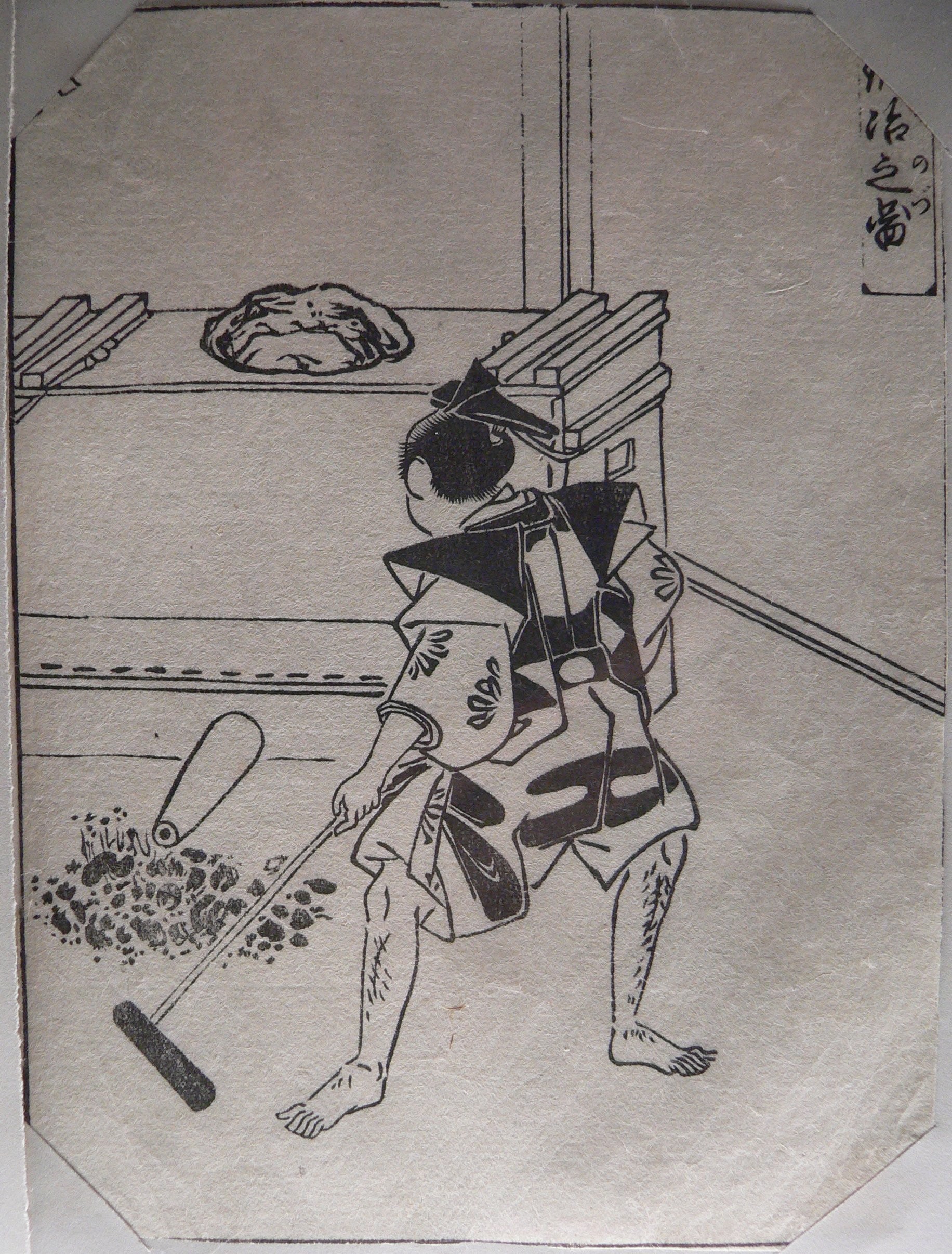
Saji Takeshi (佐治武士) is a third-generation Takefu smith and a METI-designated Traditional Craftsperson (伝統工芸士). His SRS13 santoku — Amazon JP listing ASIN B08XVKMG1Q at ¥35,300 — pairs Echizen’s hand-forging technique with a powdered high-speed steel developed locally at Takefu Special Steel, the metallurgy laboratory that sits a few hundred meters from the forges. Per the Amazon JP listing as of May 14, 2026, the blade is HRC 63, 180 mm, 225 g, with a stainless three-layer construction around the SRS13 core.
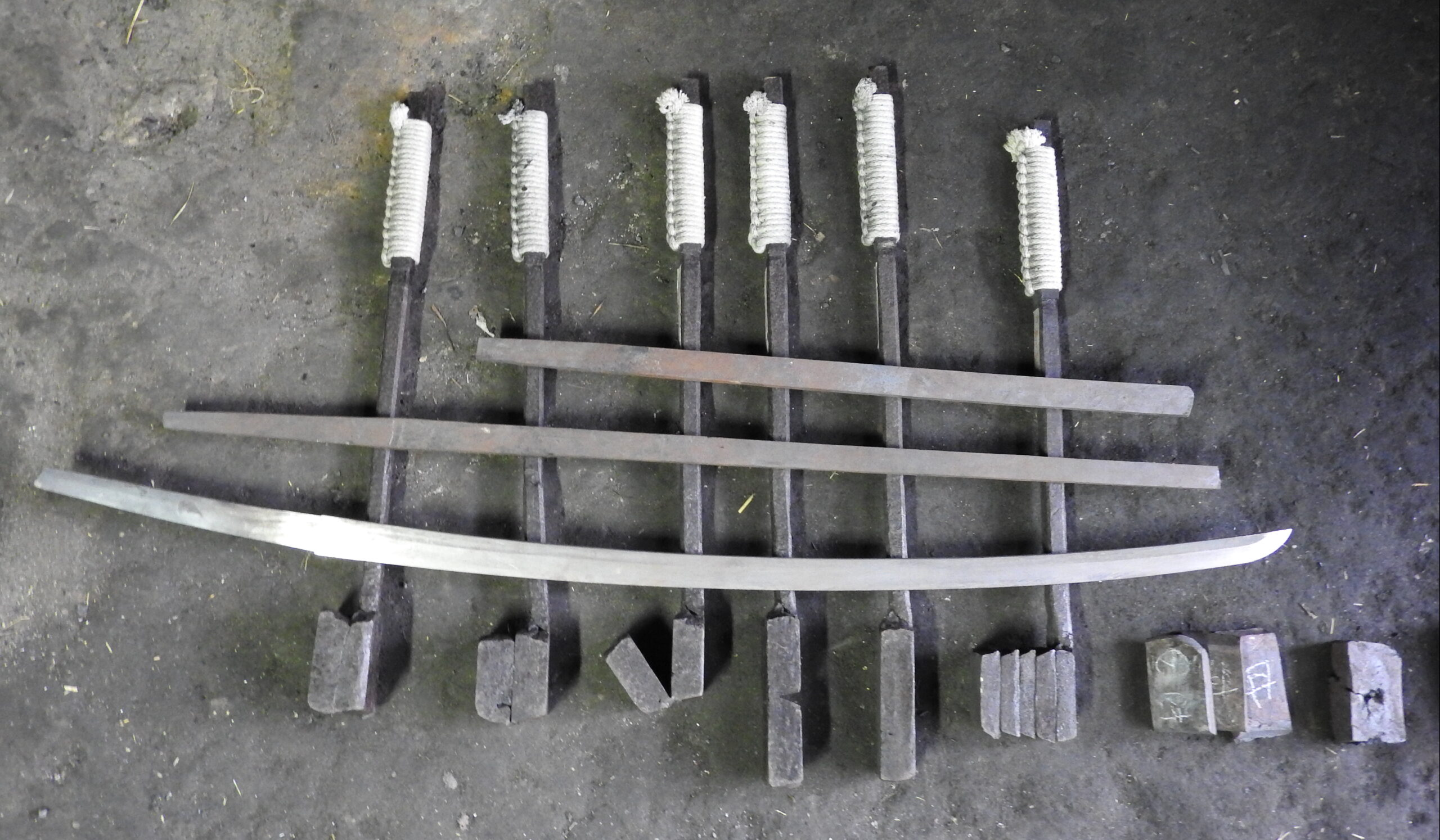
This guide walks through the seven-century forging lineage, the steel that goes into the blade, how the 180 mm santoku compares with Saji’s higher-grade variants (the iron-wood Damascus, the turquoise-handled gyuto, the VG10 W-color flagship), and the practical reality of buying a hand-forged Japanese kitchen knife from outside Japan in 2026.
Last updated:
Reading time: ~14 min
Categories: Japanese Craft · Kitchen · Fukui · Knives

- Who this is for — and who should skip it
- Product overview (from published specs)
- 📍 Where this comes from — place, era, and the craft tradition
- The region — Takefu, in central Echizen-shi, Fukui Prefecture
- The historical anchor — 1337, the swordsmith from Kyoto
- The kitchen-knife pivot — Shōwa-era to today
- The Saji workshop — three generations and counting
- SRS13 powdered high-speed steel — what it actually is
- Echizen Uchihamono next to Echizen washi — the larger picture
- 📌 How does it compare?
- 📦 Shipping and where to buy from outside Japan
- Price snapshot across stores
- What it does well
- Weaknesses and things to verify before buying
- Conclusion — which buyer type are you?
- Other ways to approach this purchase
- 🏆 Editor’s Pick — the Saji we’d start with
- ❓ Frequently Asked Questions
- 📌 Related Japanese Crafts
Who this is for — and who should skip it
- Home cooks ready to step up from a $40–80 supermarket santoku to a hand-forged piece.
- Enthusiasts who already own one or two Japanese knives and want a powdered-steel reference point.
- Readers who appreciate that the steel and the blacksmith both live within walking distance of each other in Takefu.
- Buyers comfortable with hand-washing and 6-monthly whetstone maintenance.
- Households cooking primarily vegetables, fish, and boneless meat (the santoku’s natural range).
- Brand-new cooks — ¥35,300 is a lot to spend before you know your grip preference.
- Pro-line kitchens that need a 210 mm gyuto rather than a 180 mm santoku.
- Anyone who routinely cuts frozen food, large bones, or crab shell (HRC 63 + 2 mm spine is chip-prone).
- Households that rely on a dishwasher and will not commit to hand-washing.
- Collectors after a presentation-grade gift piece — the higher Damascus variants are more photogenic.
Product overview (from published specs)
The table below reproduces the Amazon JP listing snapshot as of May 14, 2026. Saji Uchihamono does not currently operate an English-language e-commerce site; live pricing may shift between the writing date and the time you click through, so verify on the affiliate listing before purchasing.
Saji Takeshi Echizen Santoku Knife
佐治武士作『SRS13 粉末ハイス鋼 三徳包丁』黒合板ハンドル
通常6~7日以内に発送します。 · Sold by e刃物comアマゾン店 · ASIN B08XVKMG1Q
Price and availability as of 2026-08-31 02:30 JST. The Amazon listing at the time of purchase is authoritative. jpmono.com earns a commission on qualifying purchases at no extra cost to you.
| Spec | Value | Source |
|---|---|---|
| ASIN | B08XVKMG1Q | Amazon JP listing |
| Product name (JP) | 佐治武士作 SRS13 粉末ハイス鋼 三徳包丁 黒合板ハンドル | Amazon JP listing |
| Blade length | 180 mm (7.1 in) | Amazon JP listing |
| Total length | 320 mm | Amazon JP listing |
| Blade height (heel) | 49 mm | Amazon JP listing |
| Spine thickness | 2 mm | Amazon JP listing |
| Weight | 225 g | Amazon JP listing |
| Core steel | SRS13 powdered high-speed steel, HRC 63 | Amazon JP listing + Takefu Special Steel spec sheet |
| Construction | Three-layer: stainless cladding around SRS13 core (kasumi-style lamination) | Amazon JP listing |
| Edge geometry | Two-bevel (両刃 ryōba), symmetric | Amazon JP listing |
| Handle | Kuro-gōhan (黒合板, compressed resin-impregnated layered wood), stainless ferrule | Amazon JP listing |
| Maker | Saji Uchihamono, Takefu, Echizen-shi, Fukui | Maker direct |
| Price | ¥35,300 (≈ $235 USD as of May 2026) | Amazon JP listing |
| Packaging | Cardboard sleeve (no premium gift box at this price tier) | Amazon JP listing |
| International shipping | Amazon JP Global Store → US/EU/AU/CA; $15–30 USD typical | Amazon JP Global Store policy |
USD figures are approximate at a ¥150/USD baseline. The Amazon JP listing snapshot is the source of truth; live pricing may have shifted since the writing date.
📖 Glossary — key Japanese knife terms
Santoku (三徳, “three virtues”) — the all-purpose Japanese kitchen knife: short, flat-bellied, designed to handle vegetables, fish, and boneless meat with the same blade. Roughly the Japanese equivalent of the Western chef’s knife, but with a flatter cutting profile that suits push-cutting rather than rocking.
Echizen Uchihamono (越前打刃物) — “Echizen forged blades.” The METI-designated traditional craft category covering hand-forged knives, sickles, and pruning shears made in Takefu, Fukui Prefecture, using water-driven hammer and water-grindstone techniques.
SRS13 / 粉末ハイス鋼 (funmatsu hai-su-kō) — a powdered high-speed steel developed by Takefu Special Steel. Atomized molten alloy is consolidated under pressure, producing a finer carbide structure than traditional ingot-cast steel. ~1.5% carbon, ~3–4% molybdenum, ~3–4% vanadium; hardens to HRC 63.
HRC (Rockwell C) — the standard hardness scale for steel blades. HRC 60–63 is considered hard for kitchen knives; the trade-off is excellent edge retention but more brittleness against bone or hard objects.
Ryōba (両刃) — a two-bevel symmetric edge, ground equally on both sides. The international standard for Western kitchen use, in contrast to kataba (片刃), the traditional single-bevel edge of sushi knives.
Kasumi (霞) — “misty” lamination: a soft cladding metal welded around a hard core, leaving a visible boundary line along the bevel. Saji’s SRS13 santoku is a stainless-clad kasumi blade.
Dentō-kōgeishi (伝統工芸士) — Traditional Craftsperson, a personal designation granted by Japan’s Ministry of Economy, Trade and Industry (METI) to artisans who have practiced a recognized craft for at least 12 years and passed a technical examination. Saji Takeshi holds this designation in the Echizen Uchihamono category.
Kuro-gōhan (黒合板) — black compressed laminate handle: resin-impregnated layered hardwood, dyed black. Extremely water-resistant, dimensionally stable, common on working knives. Less photogenic than iron-wood or magnolia but functionally superior.
📍 Where this comes from — place, era, and the craft tradition

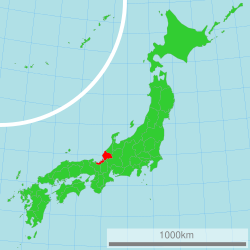
The region — Takefu, in central Echizen-shi, Fukui Prefecture
Takefu (武生) is the historical name for the central area of Echizen City (越前市) in Fukui Prefecture — the same Hokuriku-coast prefecture that produces Echizen washi. The papermaking valley of Imadate (今立) sits about 8 km east of Takefu’s downtown core; the knife-forging workshops, traditionally clustered in the Takefu Knife Village (タケフナイフビレッジ) cooperative founded in 1993, sit in the western edge of the city. The two craft villages are roughly 10 km apart, both inside the same modern city limit.
From Tokyo to Takefu the route runs about 3 hr 30 min by Hokuriku Shinkansen to Tsuruga, then 15 minutes south on the local Hokuriku line to Takefu-shin station. The closest international airports are Komatsu (KMQ, ~100 km north), Centrair Nagoya (NGO, ~180 km southeast), and Kansai International (KIX, ~210 km southwest).
The geography is the foundation of the craft cluster. Takefu sits in a wide alluvial basin where the Hino River (日野川) and several tributaries deposit clean, mineral-rich water from the Yamato Mountains to the east — water that papermakers use directly and that historically powered the water-driven hammers of the iron forges. The basin is sheltered from the worst of the Sea of Japan winter storms by the same mountains that catch the snow, giving Takefu a slightly milder microclimate than the coastal strip 30 km north.
Iron ore was not local — historically imported as tamahagane from the Chūgoku highlands to the south — but charcoal, water, and labor were abundant. The Takefu basin was the provincial capital (kokufu 国府) of Echizen Province from the late 7th century through the 15th century, which means most of the high-value crafts that arose in the region had institutional support from the provincial administration. Papermaking, lacquerware, knife-forging, and indigo dyeing all anchored here under provincial patronage in roughly the same centuries.
The historical anchor — 1337, the swordsmith from Kyoto
The founding date for Echizen blade-forging is unusually specific by Japanese craft standards: 1337 CE. In that year, according to records in Takefu’s local historical society and the Saji workshop’s own genealogical archive, a master swordsmith named Chiyozuru Kuniyasu (千代鶴国安) left Kyoto and set up a forge in the village now called Takefu. The Northern and Southern Court Wars (Nanboku-chō, 1336–1392) were displacing court-affiliated artisans out of Kyoto, and Kuniyasu was looking for clean water, abundant charcoal, and patrons. He found all three in Echizen.
“Kuniyasu came for swords; Echizen kept him for sickles. The pivot from warrior-class blades to harvest blades — within two generations — is what made the village permanent.”
Kuniyasu’s specialty was sword-making — the high-prestige craft of the era — but he also produced agricultural blades on commission. The local farmers learned the technique and gradually transitioned the workshop output from swords (which had a limited buyer pool: the warrior class) to kama (鎌, the Japanese sickle) for rice and barley harvest. Within two generations the village had developed a specialization in agricultural blades. By the end of the Muromachi period (mid-16th century), Echizen had emerged as one of three or four major Japanese blade-forging regions, alongside Sakai (堺, Osaka), Seki (関, Gifu), and the smaller Sanjō (三条, Niigata).
The Echizen specialization for the next 600 years would remain agricultural blades — primarily sickles, but also pruning shears (剪定鋏 sentei-basami), small kitchen knives, and chisels. Echizen sickles became, and remain, the dominant Japanese sickle: roughly 70 percent of all kama produced in Japan today are forged in Echizen. That is the production volume that anchored the village through the 17th–20th centuries and that supports the 60-plus active workshops still operating in Takefu in 2026.
-
Late 7th c. — Takefu becomes the kokufu (provincial capital) of Echizen Province. -
1337 — Master swordsmith Chiyozuru Kuniyasu emigrates from Kyoto to Takefu, founding the local forging lineage. -
15th–16th c. — Specialization shifts from swords to sickles (kama). Echizen ranked among the top four Japanese blade towns by the end of the Muromachi period. -
Early 20th c. — Saji Uchihamono workshop founded (first generation). -
1955 — Takefu Special Steel Co. (武生特殊鋼材) founded — putting a metallurgy laboratory in the same town as the forges. -
1970s — VG10 stainless laminate steel released; Saji’s second generation pivots from sickles to kitchen knives. -
1979 — Echizen Uchihamono designated a METI Traditional Craft Product (国指定伝統的工芸品). -
1993 — Takefu Knife Village cooperative founded by 13 workshops; public-access forge opens. -
2010s — SRS13 powdered high-speed steel released by Takefu Special Steel; Saji begins forging SRS13 santoku and gyuto. -
2026 — 60+ active workshops in Takefu; Saji Takeshi (third generation) is one of the METI-registered Traditional Craftspersons.
The kitchen-knife pivot — Shōwa-era to today
Until the mid-20th century, Echizen blacksmiths produced relatively few kitchen knives — the kitchen-knife market was dominated by Seki (machine-forged stainless production) and Sakai (single-bevel traditional sushi and sashimi knives). Echizen’s hand-forging technique was overkill for the kitchen-knife price point of the era.
The pivot happened in two phases. First, in the 1955–1970 period, the founding of Takefu Special Steel Co. (武生特殊鋼材, Takefu Tokushu Kōzai, 1955) put a metallurgical research lab in the same town as the forges. The lab developed and licensed a series of laminated stainless steels — VG10 (V金10号) in the 1970s, SG2 powdered steel in the 1990s, R-2 powdered steel in the 2000s, and SRS13 powdered high-speed steel in the 2010s. These steels exceeded the performance of traditional Aogami and Shirogami carbon steels in edge retention while solving the rust problem.
Today, more than half of the world’s premium Japanese kitchen-knife steel — including the steel in many Sakai and Seki-branded knives — actually comes from Takefu Special Steel.
Second, in the 1980s–2000s, the international Japanese-kitchen-knife boom — driven by the global rise of Japanese cuisine and the influence of chefs like Masaharu Morimoto and David Chang — created a market for hand-forged Japanese kitchen knives at $200–500 prices. Echizen workshops, with their hand-forging tradition and direct access to Takefu Special Steel’s products, were perfectly positioned. The Takefu Knife Village (タケフナイフビレッジ) cooperative was founded in 1993 by 13 workshops to consolidate marketing, train next-generation smiths, and operate a public-facing workshop where international visitors can buy directly.
Echizen Uchihamono (越前打刃物) was designated a METI Traditional Craft Product (国指定伝統的工芸品) in 1979 — covering knives, sickles, and shears made in Echizen using traditional hand-forging and water-grinding techniques. This is the same certification that covers Echizen washi (designated 1976) and Echizen lacquerware (designated 1975). Three craft designations in one city, in three consecutive years.
The Saji workshop — three generations and counting
Saji Uchihamono (佐治打刃物) is one of the dozen original workshops in the Takefu Knife Village cooperative. The current head, Saji Takeshi (佐治武士), is the third-generation owner and a METI-registered Traditional Craftsperson (伝統工芸士 dentō-kōgeishi). His grandfather founded the workshop in the early 20th century; his father took over in the mid-Shōwa era and pivoted from sickles to kitchen knives in the 1970s; Takeshi-san himself trained under his father starting around age 20 and took over the head smith role in the 2000s.
Saji has an unusual reputation in the Echizen scene for experimental steel choices. While most Takefu workshops standardize on VG10 (the well-established stainless laminate) or Aogami Super carbon steel, Saji works extensively with powdered metallurgy — R-2, SG2, and SRS13 — and has developed signature techniques for forging these notoriously difficult-to-work-with steels into clean, thin-spine, high-hardness kitchen blades.
The workshop produces in small batches; a typical month’s output across all SKUs is in the low hundreds. Hand-forging at this scale means each blade has visible variation — the hammer-mark pattern, the exact Damascus reveal, the handle wood grain. International buyers should expect their knife to be visually distinct from the Amazon product photos by 5–15 percent.
SRS13 powdered high-speed steel — what it actually is
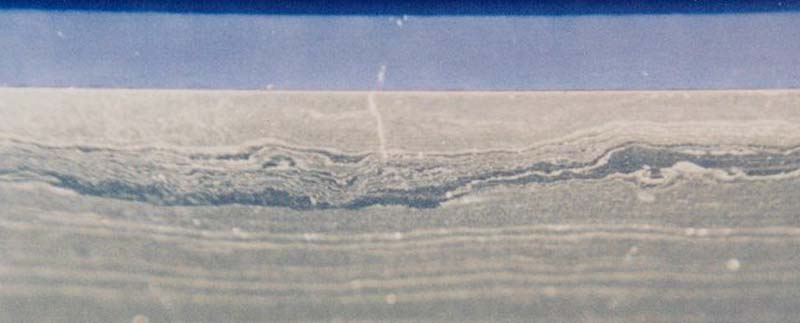
For a foreign reader who has not encountered powdered steels: SRS13 is one of a family of high-speed steels manufactured by atomizing molten alloy into fine particles, then consolidating those particles back into a solid bar under high pressure and temperature. The result is a steel with carbon content of about 1.5 percent (close to traditional Aogami Super), molybdenum and vanadium at roughly 3–4 percent each (much higher than traditional carbon steels), hardness up to HRC 63 when properly heat-treated, corrosion resistance comparable to a low-grade stainless steel, and edge retention that genuinely exceeds traditional carbon steels in side-by-side testing.
The powdered metallurgy process produces a much finer carbide structure than traditional ingot-cast steel — this is what gives powdered steels their performance edge. The trade-off is cost: SRS13 raw bar stock is roughly 3–5× the price of high-grade traditional steels. For a home kitchen, SRS13 is overkill in the sense that the edge will outlast most users’ patience for sharpening. The benefit is fewer sharpening sessions per year — a Saji SRS13 santoku used daily by a home cook typically needs serious whetstone sharpening only every 6–12 months, versus quarterly for VG10 or monthly for traditional Aogami.
Echizen Uchihamono next to Echizen washi — the larger picture
The craft town of Takefu and Imadate is, in 2026, one of the densest concentrations of METI-designated traditional crafts in Japan. Echizen washi (越前和紙) — designated 1976, a 1,500-year-old papermaking tradition. Echizen Uchihamono (越前打刃物) — designated 1979, 690-year-old blade forging. Echizen Shikki (越前漆器) — designated 1975, a 1,500-year-old lacquerware tradition based in adjacent Sabae city, 8 km north. And Echizen-yaki (越前焼) — designated 1986, 850-year-old pottery from Echizen-cho, 35 km west.
All four are within a 40 km radius and all four have been continuously practiced since the medieval period or earlier. The geography that supports this — clean water, ample winter labor, mountain charcoal, the historic provincial-capital status — is the same geography that supports each individual craft. For a foreign visitor, a Takefu day trip can plausibly include workshop tours of all four crafts. The Takefu Knife Village (open daily 10:00–17:00, free admission) sits 2 km west of Takefu-shin station, with public-access forges where you can watch hand-hammering on most weekdays. The Echizen Washi no Sato museum is 8 km east, and Sabae’s lacquerware district 8 km north.
📌 How does it compare?
Other Japanese household objects we’ve covered — useful comparison points for buyers building a coordinated Japanese kitchen or thinking about the broader regional craft picture.

Echizen Washi Goshuincho (same valley, paper rather than blade)

Kobaien Gosei Beni-bana Sumi Inkstick

Nōsaku NAJIMI Tin Tumbler 350cc
Nōsaku Gui-nomi Tin Sake Cup 90cc

Oigen Nambu Tetsubin H-200

Nagatani-en Kamado-san 3-gō
📦 Shipping and where to buy from outside Japan
Amazon JP Global Store ships the 225 g Saji SRS13 santoku to the US, EU, UK, Australia, Canada, and most major destinations. Per the listing’s shipping policy as of May 2026, expect $15–30 USD shipping and 1–2 weeks transit. The knife is packaged in a cardboard sleeve and declared as a “hand-forged kitchen knife, Japan” — no special export paperwork is required from Amazon’s side.
Customs duties are not a concern at this price point. Kitchen knives are personal-import duty-free under most major countries’ de minimis thresholds — $800 USD declared value for the United States, £135 for the UK, €150 for the EU, and AUD 1,000 for Australia. At ¥35,300 (~$235 USD) this purchase is well within all major destinations.
A few EU jurisdictions, the UK and Germany among them, apply age-18+ purchase restrictions on knives at retail. Personal mail-order import for home use is permitted, but the recipient must be 18 or older to receive the package. Saji Uchihamono does not currently operate an English-language e-commerce site; direct ordering is possible via fax or email through the Takefu Knife Village cooperative ([email protected]), though English correspondence is functional but slow (typically 1–2 weeks response). Specialty retailers in the US and EU — Korin (NYC), Bernal Cutlery (San Francisco), Knives and Stones (Australia), Knivesandtools.com (EU) — carry rotating Saji inventory at roughly 1.5–2× the Amazon JP price.
One travel note: if you happen to buy the knife in Japan in person, it cannot go in cabin baggage on your return flight. Sharp blades must be in declared checked baggage. Most international buyers receive the knife by mail and never see it at an airport.
Price snapshot across stores
| Store | Item | Price (JPY) | USD est. | Notes |
|---|---|---|---|---|
| 🇺🇸 Amazon.com (US) | Browse Japanese kitchen knives (santoku, gyuto) | varies | USD | Best if you’re shopping from the US — Prime shipping, USD pricing, no international customs. Amazon US carries hand-forged Japanese kitchen knives from Shun, Tojiro, Yoshihiro and other makers — useful for comparing geometry, price tiers, and steel types. Saji Takeshi’s exact SRS13 piece is sourced from Japan (next row). |
| Amazon JP Global Store | SRS13 santoku 180 mm, black laminate (B08XVKMG1Q) | ¥35,300 | ≈ $235 | Third-party seller fulfilled via Amazon JP; international shipping built-in to Global Store checkout. |
| Maker direct (Saji Uchihamono / Takefu Knife Village) | SRS13 santoku 180 mm — same blade | Unconfirmed — fax/email quote | — | No English e-commerce. Email [email protected] for a JPY quote; 1–2 week response. Useful for variants not on Amazon JP. |
| Proxy services (Buyee / Tenso) | SRS13 santoku 180 mm — same blade via Rakuten / Yahoo! Auction relay | Varies (¥35k–¥45k incl. fees) | ≈ $235–$300 | Adds ~10–20% fees plus domestic forwarding charges; worth using when the Amazon JP listing goes out of stock or for the higher Saji variants that don’t appear on Amazon. |
| Amazon JP Global Store — iron-wood Damascus variant | SRS13 santoku 180 mm, iron-wood (B0BJDJ59RW) | ¥48,400 | ≈ $323 | Same SRS13 blade, dressier handle and Damascus reveal; +¥13,100 over the article subject. |
Per the Amazon JP listing as of May 14, 2026. USD figures are approximate at ¥150/USD; live pricing and stock may have shifted since the writing date — always verify on the affiliate listing before purchasing.
What it does well
Weaknesses and things to verify before buying
- Hand-forging variation. Each blade has visible variation in the hammer-mark pattern, the exact Damascus reveal, and the handle wood grain. Buyers should expect their knife to be 5–15 percent visually distinct from the Amazon product photos. This is a feature, not a defect, but it is not negotiable with the seller.
- HRC 63 + 2 mm spine = chip-prone against hard objects. The thin spine and high hardness make the edge intolerant of frozen food, large bones, crab shell, and similar hard targets. The knife is engineered for produce, fish, and boneless meat — not as a general-purpose cleaver.
- Dishwasher is forbidden. SRS13 is corrosion-resistant but not corrosion-proof against dishwasher detergent and heat. The listing’s own care notes are explicit on this. If the household relies on a dishwasher, this is the wrong knife.
- Spine-notch rust. Per the care notes, the most common rust point on three-layer blades is standing water in the spine notch where blade meets handle. Dry immediately, especially in humid climates.
- No premium packaging at this tier. The black-handle SRS13 ships in a cardboard sleeve. If the knife is intended as a formal gift, budget for a separate paulownia (kiri) box or step up to the VG10 W-Color flagship which includes one.
- Sharpening setup required. The knife arrives with the factory edge but will eventually need whetstone work. Plan on a minimum 1000/6000-grit setup (the Naniwa Chosera combo is the standard entry kit). Ceramic rods and pull-through sharpeners are not appropriate for HRC 63 steel.
- Stock variability. Saji’s workshop produces in the low hundreds per month across all SKUs; Amazon JP stock can lapse for weeks at a time. If the listing is out of stock at the time of click-through, the proxy services route (Buyee / Tenso via Rakuten) is the practical alternative.
Conclusion — which buyer type are you?
Other ways to approach this purchase
🏆 Editor’s Pick — the Saji we’d start with
Why this one, not the higher-grade variants:
- Most universally useful purchase — a 180 mm santoku is the single most flexible Japanese kitchen-knife format, comfortable for cooks coming from a Western chef’s knife.
- Class-leading steel — SRS13 at HRC 63 retains an edge longer than Aogami Super while keeping stainless-grade rust resistance.
- Right tier within the line — the black-laminate handle keeps the price under ¥36k, where the iron-wood and turquoise variants step to ¥48k+ purely for cosmetics. The blade is identical.
- Genuine dentō-kōgeishi piece — Saji Takeshi is one of the registered Traditional Craftspersons of Echizen Uchihamono; this is not a factory or brand item.
❓ Frequently Asked Questions
Is this knife really hand-forged, or is “hand-forged” marketing language?
How does SRS13 compare to VG10, Aogami Super, and SG2?
Can the knife ship to my country?
How often does an SRS13 santoku need sharpening?
What whetstones do I need?
Is the cutting board choice important?
Why this Saji rather than Ryusen, Kurosaki, or Takamura?
jpmono.com is curated by a Japan-based editorial team (working out of Toyama in the Hokuriku region and Nara in Kansai) and is independent. We do not take payment from the makers we feature; income comes from affiliate links. Read more about our editorial standards.
This article was drafted with AI assistance and reviewed by the jpmono editorial team. Product specs and prices come from the Amazon JP listing snapshot at the writing date and the Takefu Special Steel published steel data sheet. Place-and-history context is drawn from Takefu municipal records and the Takefu Knife Village cooperative documentation.
Affiliate disclosure: jpmono.com may earn a commission on qualifying purchases made through links on this page, at no additional cost to you.
