![Onta-yaki Mug by Yanase Asao — 320-Year Mountain-Village Mingei Pottery from Ōita (¥9,480 / ≈$63 USD) [2026 Buyer’s Guide]](https://jpmono.com/wp-content/uploads/2026/05/yanase-asao-onta-yaki-mug-where-to-buy-2026-featured.jpg)
Onta-yaki (小鹿田焼) is the mountain-village pottery tradition of Sarayama, a single hamlet of ten households in Hita City, northwestern Ōita Prefecture, on the island of Kyūshū. Production has been continuous since 1705. The defining feature is not just the technique but the social structure that carries it: only ten family lines — Yanase (柳瀬), Sakamoto (坂本), Kuroki (黒木), and seven others — operate Onta kilns in Sarayama, and the craft passes only by birthright, never by apprenticeship. Each family fires perhaps one to two thousand pieces per year. Designated a METI Traditional Craft Product in 1995, the rare case of a single-village rather than regional designation.
Onta’s international reputation rests on two visits: the 1931 stay by Yanagi Sōetsu, founder of the mingei (民芸, “folk-craft”) movement, who wrote about Onta as the purest example of unselfconscious folk pottery; and the 1954 five-year residency of the British potter Bernard Leach, who treated Sarayama as a working temple of the mingei aesthetic. The signature surface decorations — tobikanna (飛び鉋, “jumping plane,” rhythmic chatter-marks made by a metal plane skipping across the wheel-spinning piece) and hakeme (刷毛目, “brush-mark,” white slip brushed in arc patterns) — are the visual identity of mingei pottery worldwide.
This guide focuses on a single mug by Yanase Asao (柳瀬朝夫), current head of the Yanase line and one of the ten named Onta family potters in Sarayama. The price is ¥9,480 (approximately $63 USD as of May 2026). It is currently listed on Amazon JP Global Store; the live listing may shift in availability, so readers planning to buy should verify at the linked retailer. Below, we walk through fit (who this is for and who should pass), provenance, the variant choice within Yanase’s listed mugs, a comparison against five other Japanese pottery traditions, and the practical question of how an international reader actually receives one of these in their kitchen.
🔄 Updated
⏱ Read time ~14 min

- Who this is for — and who should skip it
- Product overview (from published specs)
- 📍 Where this comes from — place, era, and the craft tradition
- 📦 Shipping & where to buy from outside Japan
- Price snapshot across stores
- What it does well
- Weaknesses and things to verify before buying
- Conclusion — which buyer type are you?
- Other ways to approach this purchase
- 🏆 Editor’s Pick
- ❓ Frequently Asked Questions
- 📌 Related Japanese Crafts
Who this is for — and who should skip it
- Want a daily-use mug with documented village-craft provenance, not factory-printed “Japan” branding.
- Already know mingei (Yanagi, Hamada, Leach) and want a piece from one of the named Sarayama families.
- Prefer matte, slip-decorated stoneware over glossy porcelain or industrial ceramics.
- Are comfortable with hand-wash care and minor piece-to-piece variation.
- Are based outside Japan and willing to pay $10–$20 international shipping plus possible customs.
- Need dishwasher- and microwave-safe ceramics (the listing recommends hand-wash; thermal shock is possible).
- Expect identical shape and finish across pieces — each is wheel-thrown and hand-decorated.
- Want a sub-$30 mug; the cost reflects single-village hereditary production, not retail margin.
- Are buying as a wedding-set match — pair-matching across separate firings is not guaranteed.
- Need next-day delivery to a US/EU address — Amazon JP Global Store ships from Japan and timing varies.
Product overview (from published specs)
The following summarizes the Amazon JP Global Store listing for the Yanase Asao mug as of May 2026. Onta pieces are not typically individually listed on Amazon.com; the comparable-craft search row exists to help US-based readers shop adjacent Japanese pottery while sourcing the Onta piece itself from Japan.

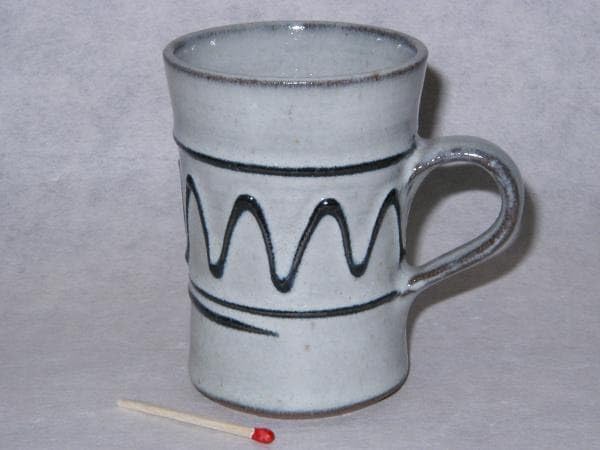
Onta-yaki Mug by Yanase Asao
柳瀬朝夫 マグカップ 小鹿田焼
通常6~7日以内に発送します。 · Sold by mokomoko-shop · ASIN B0G648V7DS
Price and availability as of 2026-08-31 02:30 JST. The Amazon listing at the time of purchase is authoritative. jpmono.com earns a commission on qualifying purchases at no extra cost to you.
| Attribute | Detail (per current Amazon JP listing) |
|---|---|
| Maker | Yanase Asao (柳瀬朝夫) — Yanase family line, Sarayama village |
| Origin | Sarayama, Hita City, Ōita Prefecture, Kyūshū, Japan |
| Tradition | Onta-yaki (小鹿田焼); founded 1705; METI Traditional Craft (1995) |
| Material | Reduction-fired local Onta clay (stoneware), white slip decoration |
| Decoration | Tobikanna (飛び鉋) or hakeme (刷毛目) — varies per piece |
| Capacity | Approximately 260–330 ml (varies per piece) |
| Weight | ~300 g |
| Price (JP listing) | ¥9,480 (≈ $63 USD as of May 2026) |
| International shipping | Amazon JP Global Store, ~$10–$20 USD to US/EU |
| Care | Hand-wash; pre-warm before tea; patina develops with use |
Only the Amazon JP Global Store listing snapshot was available at the time of writing; live pricing and stock may have shifted since.
📖 Glossary — key terms used in this article
Onta-yaki (小鹿田焼) — Pottery tradition from Sarayama hamlet in Hita, Ōita. Founded 1705 by potters invited from neighboring Koishiwara in Fukuoka. Single-village, hereditary-only production.
Mingei (民芸) — Literally “folk craft.” A movement formalized by Yanagi Sōetsu in 1925, valuing unsigned, anonymous, daily-use objects made by ordinary hands. Onta is one of its canonical examples.
Tobikanna (飛び鉋) — “Jumping plane.” A metal scraper held against the spinning wheel; the elasticity of the blade against soft clay produces rhythmic chatter-marks around the body.
Hakeme (刷毛目) — “Brush-mark.” White slip (liquid clay) brushed in sweeping arcs over the leather-hard body before glazing.
Sarayama (皿山) — Literally “plate mountain.” The Onta hamlet in the hills above Hita. Population is a few dozen; the village is reached by a narrow mountain road.
METI Traditional Craft Product (経済産業大臣指定伝統的工芸品) — Designation by Japan’s Ministry of Economy, Trade and Industry recognizing crafts meeting strict standards of regional history, material, and technique continuity.
Reduction firing (還元焼成) — Firing with restricted oxygen, which pulls oxygen out of clay and glaze chemistry, producing muted iron-grays and browns rather than bright oxide colors.
Karausu (唐臼) — Water-powered wooden trip-hammers used in Sarayama to crush local clay-stone into workable clay. The thumping sound is registered in Japan’s “100 Soundscapes” list.
📍 Where this comes from — place, era, and the craft tradition


Para A — The region on the map. Ōita Prefecture occupies the northeastern corner of Kyūshū, Japan’s southwestern main island. Hita City is at the prefecture’s western edge, near the border with Fukuoka, set in a river basin among forested hills. Sarayama — literally “plate mountain” — is a hamlet of ten households reached by a narrow mountain road roughly 15 kilometers north of central Hita. The setting matters: Onta clay is a heavy, iron-bearing claystone quarried from the slope above the village, and the local stream powers the wooden trip-hammers (karausu) that crush that stone into workable clay. The rhythmic thump of the karausu against rock has been recorded in Japan’s Ministry of Environment “100 Soundscapes of Japan” list — the sound itself is registered as part of the cultural environment. Cedar forest, water, and clay sit within walking distance of one another. The craft did not happen here by accident.
Para B — The historical anchor. Onta-yaki was founded in 1705 when potters from the neighboring Koishiwara (小石原) pottery community in Fukuoka were invited across the prefectural line to establish a kiln in Sarayama. The new kiln answered everyday needs of the surrounding mountain villages — water jars, food storage, simple tableware — and did so without any of the elite-court ambitions of Arita porcelain on the other side of Kyūshū. Production became hereditary. Three founding family names — Yanase (柳瀬), Sakamoto (坂本), Kuroki (黒木) — appear in the early records, joined by others over time, and to this day only ten family lines hold the right to operate Onta kilns in Sarayama.
-
1705 — Onta kiln founded in Sarayama by potters from Koishiwara (Fukuoka). Yanase, Sakamoto, and Kuroki families on record. -
Edo period — Production of everyday vessels for surrounding Hita mountain villages; technique passes strictly by birthright. -
1931 — Yanagi Sōetsu (柳宗悦), founder of the mingei movement, visits Sarayama and writes about Onta as the purest unselfconscious folk pottery in Japan. -
1954 — The British potter Bernard Leach takes up a five-year residency at Sarayama, working alongside the families and bringing Onta to international notice. -
1970 — Onta-yaki designated Important Intangible Folk Cultural Property (重要無形民俗文化財) by Japan’s Agency for Cultural Affairs. -
1995 — METI Traditional Craft Product designation — single-village rather than regional designation, an unusual recognition. -
2017 — Northern Kyūshū torrential rain damages Hita-region infrastructure; Sarayama kilns and karausu partially affected, restored over the following year. -
2026 — Ten families still firing in Sarayama. Yanase Asao heads the Yanase line. Annual output per family remains roughly 1,000–2,000 pieces.
The 1931 Yanagi visit and the 1954 Bernard Leach residency together did something unusual: they brought a tiny inland Kyūshū hamlet into the central narrative of twentieth-century craft theory without industrializing it. Yanagi argued that the best objects were unsigned, anonymous, and produced by ordinary hands without artistic self-consciousness, and he found Sarayama almost too perfect an illustration. Leach — who had trained with Hamada Shōji and corresponded with Yanagi for decades — treated his five years there as both apprenticeship and pilgrimage. Even today, Onta pieces are not signed with the individual potter’s mark in the way studio pottery is signed elsewhere. The maker is the family line, not the hand.
“Three centuries on, the technique still passes only by birth. Ten households, ten family lines — no apprentices, no outside potters, no franchise. The continuity is not marketing; it is the structure itself.”
Para C — What “still being made here” actually means. The hereditary-only rule is what separates Onta from almost every other Japanese pottery district. In Arita, Mashiko, Bizen, and Shigaraki, the craft circulates: outside potters move in, apprentices set up their own studios, the geography of skill is porous. In Sarayama it is not. The ten Onta family lines — Yanase, Sakamoto, Kuroki, and seven others — operate the kilns; their children may inherit the trade; outsiders may not enter it. Yanase Asao, who made the mug covered here, is the current head of the Yanase line. Each Sarayama family fires perhaps 1,000 to 2,000 pieces per year, which means the total annual production of Onta-yaki across the entire tradition is in the range of 10,000 to 20,000 pieces — small even by the standards of regional Japanese pottery. The system is fragile in the obvious ways (one family without an heir contracts the whole tradition) and durable in the less obvious ones (production has not scaled itself out of recognition over three centuries).
Para D — How it fits the year and the kitchen. Onta mugs are typically used for hot beverages — green tea, hōjicha, light coffee — and for the morning miso-soup bowl in households that own larger Onta pieces. The reduction-fired stoneware retains heat well; the rim is slightly thicker than a porcelain mug, which insulates the drinker’s lip and tends to read as comforting in cold weather. In Ōita itself, the mug sits naturally alongside the prefecture’s hot-spring culture (Beppu and Yufuin are within an hour’s drive) and the Hita cedar-and-river landscape that defines the inland region. None of this is required context to enjoy the cup. But the mug was shaped for a particular climate and rhythm, and that shape carries forward.
📦 Shipping & where to buy from outside Japan
Onta pieces are not retailed on amazon.com individually. The two practical routes for an international reader are Amazon JP Global Store (which carries the listed Yanase Asao mug and ships to most major destinations) and proxy services such as Buyee or Tenso that can buy from Japanese gallery shops on the buyer’s behalf. Maker-direct purchase from Sarayama is not practical: the families do not run online stores, and walk-in purchase at the Sarayama Onta-no-Sato Tōji-kan (小鹿田焼陶磁器館) requires in-person travel.
- Amazon JP Global Store (recommended path): ships the listed ASIN B0G648V7DS to most major destinations; the listing weight is ~300 g, shipping typically $10–$20 USD to the US/EU.
- Customs: the order value at ¥9,480 (≈ $63 USD) is below most personal-import thresholds for ceramics in the US, EU, UK, AU, and CA; check the local de minimis rule before assuming no duty applies.
- Proxy services (Buyee, Tenso): useful if the Amazon JP listing is temporarily out of stock and you want to try Japanese gallery e-commerce sites that carry Sarayama pieces. Adds 10–20% in service fees.
- Transit time: 1–3 weeks depending on destination and customs handling. Onta pieces are robust but should be inspected on arrival for thermal-shock cracks.
Price snapshot across stores
| Store | Item / variant | Price (JPY / USD est.) | Notes |
|---|---|---|---|
| 🇺🇸 Amazon.com (US) | Browse Japanese stoneware & mingei mugs | varies (USD) | Best if you are shopping from the US — Prime shipping, USD pricing, no international customs. Amazon US carries Japanese stoneware mugs from various makers, useful for comparing shape and price tier. Yanase Asao’s exact Onta piece is sourced from Japan (next row). |
| 🇯🇵 Amazon JP Global Store | Yanase Asao Onta-yaki mug (ASIN B0G648V7DS) | ¥9,480 (≈ $63 USD) | Ships internationally from Japan. ~300 g, ~$10–$20 shipping to US/EU. The authoritative listing for this exact piece. |
| Maker direct (Sarayama) | In-person at Onta-no-Sato Tōji-kan / kiln visits | — (no online store) | Sarayama families do not operate online stores. Sales are walk-in at the village and at the annual October Mingei Festival. |
| Proxy services (Buyee / Tenso) | Onta-yaki pieces from JP gallery e-commerce | +10–20% service fee | Useful when Amazon JP is out of stock. Service fee plus reshipping; reasonable for reaching gallery inventory that does not list internationally. |
USD figures are estimates at ¥150/USD as of May 2026. JPY is the authoritative price.
What it does well
Weaknesses and things to verify before buying
- Variation is not optional. Each piece is wheel-thrown and hand-decorated. Rim wobble, slight asymmetry, and per-piece variation in capacity (260 ml vs 330 ml) are expected. If you want identical pieces across a set, Onta is the wrong tradition.
- Decoration cannot be specified. The Amazon JP listing cycles between tobikanna and hakeme as Yanase fires. Buyers cannot pre-select which decoration arrives; the listing photo is illustrative.
- Hand-wash only. The maker recommends hand-wash in hot water and pre-warming before tea. Dishwasher cycles and abrupt temperature changes can crack reduction-fired stoneware.
- No microwave guarantee. The Amazon JP listing does not certify microwave safety. Iron-bearing reduction stoneware sometimes contains trace conductive elements; assume hot-water reheat instead.
- Stock is intermittent. Each Sarayama family produces perhaps 1,000–2,000 pieces per year. The Amazon JP listing may go out of stock for weeks at a time between firings. If unavailable, retry after 2–4 weeks or use a proxy service to reach JP gallery inventory.
- Pair-matching is not guaranteed. Two Yanase Asao mugs ordered separately will not be visual twins. Buyers wanting a true matched pair should look at modern factory ceramics or order both mugs at once and accept what arrives.
- Care over time. The patina that develops is a feature for mingei collectors and may read as staining to readers expecting a glossy modern finish. Calibrate expectations before purchase.
Conclusion — which buyer type are you?
Other ways to approach this purchase
🏆 Editor’s Pick
- Authentic single-village provenance. Yanase Asao is a named line, not a maker label. Onta cannot be sub-contracted; if it is Onta, it was made in Sarayama by one of ten families.
- Entry-tier price for the tradition. ¥9,480 is at the low end of named-Sarayama-line pieces; larger jars and plates run well above ¥20,000–¥40,000.
- Direct international shipping. Amazon JP Global Store delivers the listed ASIN to most US/EU/AU destinations; ~300 g, ~$10–$20 shipping. No proxy required.
❓ Frequently Asked Questions
Is Onta-yaki actually made by a different person each time?
Can the mug go in the dishwasher or microwave?
Can I choose between tobikanna and hakeme decoration?
Does Amazon JP ship the mug to the United States and Europe?
How does Onta compare with Mashiko or Bizen for a first Japanese mug?
What does the price reflect at ¥9,480?
Is the listing image exactly what arrives?
jpmono.com is curated by a Japan-based editorial team working out of Toyama (Hokuriku region) and Nara (Kansai region) and is independent. We do not take payment from the makers we feature; income comes from affiliate links. Read more about our editorial standards.
This article was drafted with AI assistance and reviewed by the editorial team. Facts are drawn from the maker’s source listing and from public records of Onta-yaki’s history; pricing and stock are based on data at the time of writing.
Affiliate disclosure: jpmono.com may earn a commission on qualifying purchases made through links on this page, at no additional cost to you.