![Kutani-yaki Seikou-gama Soba Choko Cup — Cherry-Blossom Five-Color Overglaze Porcelain from Kaga, Ishikawa (¥2,420 / ≈$16 USD) [2026 Buyer’s Guide]](https://jpmono.com/wp-content/uploads/2026/05/kutani-yaki-seikou-soba-choko-where-to-buy-2026-featured.jpg)
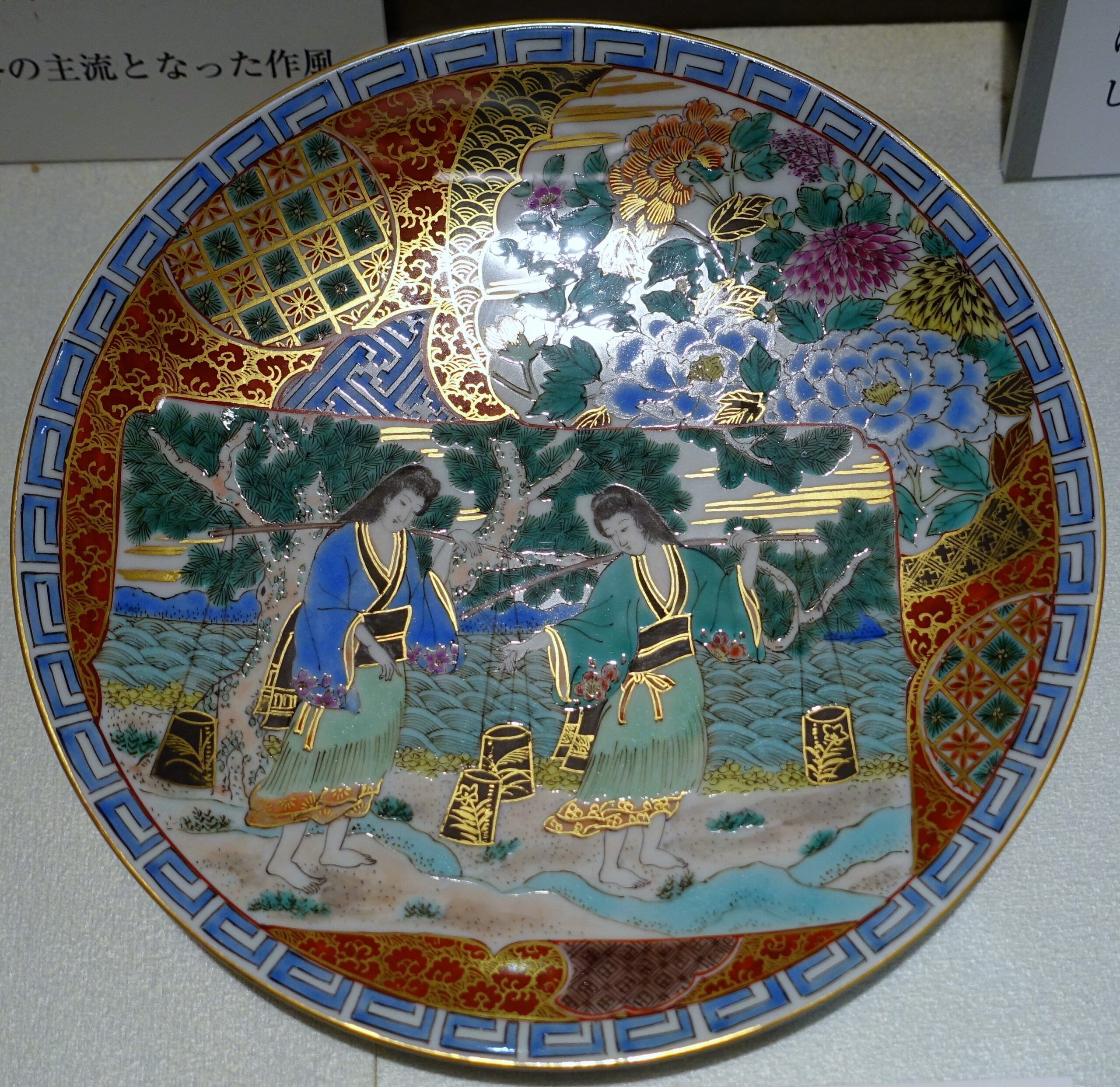
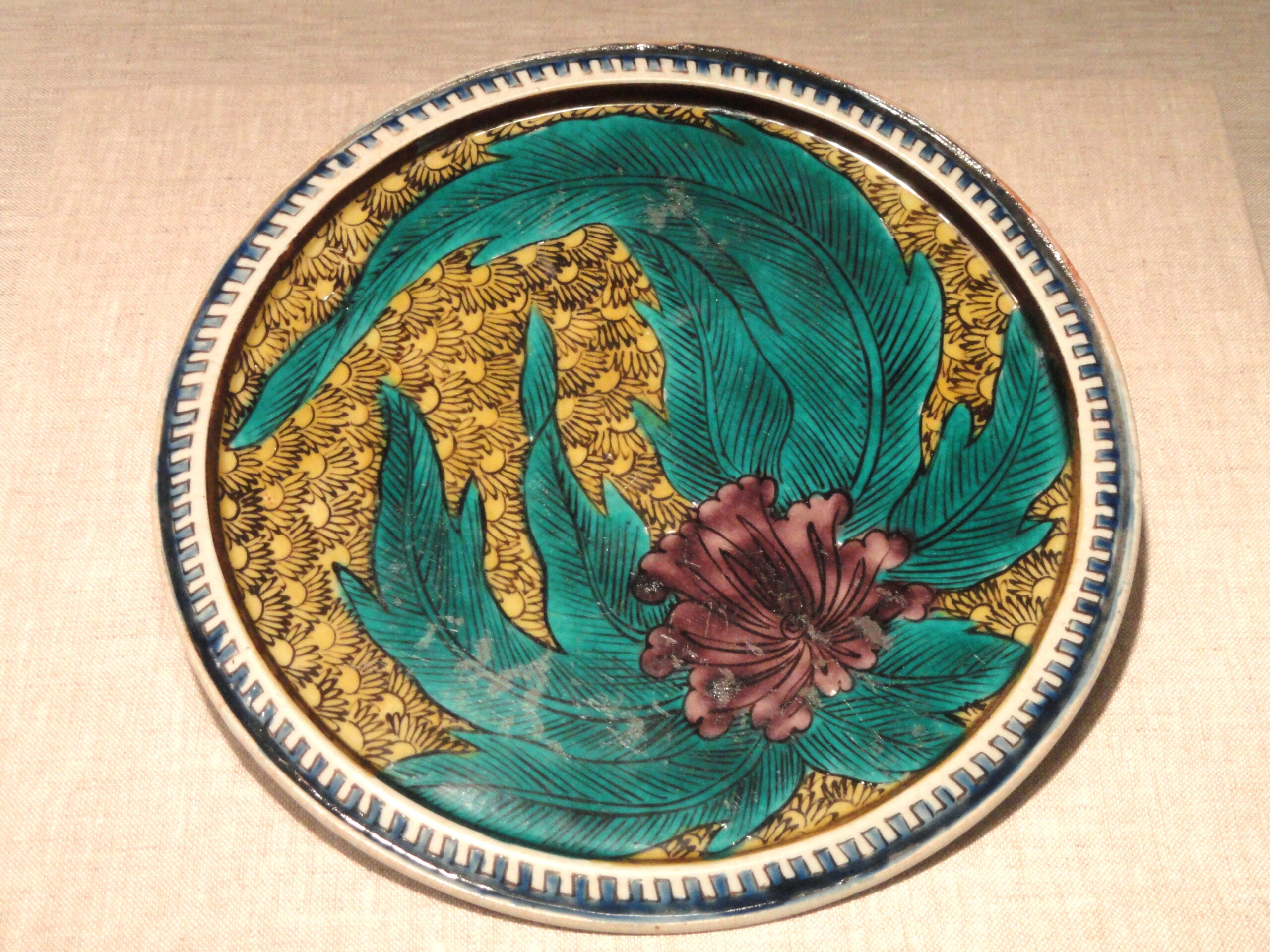
Kutani-yaki (九谷焼) is the five-color overglaze porcelain of the Kaga region in Ishikawa Prefecture, on the Sea of Japan coast of central Honshu. The tradition dates to 1655, broke off mysteriously around 1700, and was revived from 1807 in a string of named kilns whose stylistic schools — Yoshida-ya, Iida-ya, Shōzan, Eiraku — still anchor the modern Kutani vocabulary. The painted surface, dense with red, green, yellow, deep blue and purple over a white porcelain body, is the most recognizable of the three great Japanese porcelain traditions alongside Arita and Kyō-yaki.
This guide centers on a single piece: a 280 ml soba-choko (蕎麦猪口) cup from Seikou-gama (青郊窯), a Nomi-shi kiln founded in 1903 and now in its third generation. At ¥2,420 (≈ $16 USD as of May 2026), it is the lowest-stakes way to own a real named-kiln Kutani piece — the cherry-blossom and four-seasons-of-flowers pattern (SK-286) sits at the entry of Seikou-gama’s price range, and the soba-choko form is the most multi-purpose Japanese cup shape. The cup ships internationally from Amazon JP Global Store; the listing is the source of record for everything in this article.
Written for an international buyer who wants a working Japanese ceramic in the kitchen — not a gallery piece. We cover the 370-year arc of Kutani from Goto Saijiro’s Arita apprenticeship to the 1873 Vienna World’s Fair gold medal, why Seikou-gama is the right entry point among current Kaga kilns, and how to buy this cup from outside Japan via either Amazon.com (US) search or Amazon JP Global Store.
Last updated May 15, 2026
Reading time ≈ 16 min
From the Hokuriku desk · Toyama / Nara

- Who this is for — and who should skip it
- Product overview (from published specs)
- 📍 Where this comes from — Kaga, Ishikawa, and the 370-year arc of Kutani
- The region — Kaga, in the Hokuriku domain of Ishikawa
- The 1655 anchor — Goto Saijiro’s Arita apprenticeship
- 1807 onward — Saiko-Kutani and the revival kilns
- The Meiji-era export boom — and the Vienna 1873 gold medal
- The 20th century and the named-kiln tier today
- Seikou-gama — the kiln that made this cup
- The soba-choko form — a multi-use Japanese cup
- Visual heritage anchors in Kaga
- 📦 Shipping and where to buy from outside Japan
- Price snapshot across stores
- What it does well
- Weaknesses and things to verify before buying
- Conclusion — which buyer type are you?
- Other ways to approach this purchase
- 🏆 Editor’s Pick
- ❓ Frequently Asked Questions
- 📌 Related Japanese Crafts
Who this is for — and who should skip it
- Want a real named-kiln Kutani piece at entry pricing — not a tourist-grade decal
- Already own one yunomi or matcha bowl and are ready for a more multi-purpose cup
- Drink Japanese tea, cold sake, or eat ice cream and yogurt out of small ceramics
- Are starting a small Japanese ceramic collection and want a recognizable, low-risk first piece
- Appreciate hand-painted kacho (花鳥, flowers-and-birds) imagery in the traditional palette
- Need a gift-boxed pair set — this is a single cup with no presentation packaging
- Want a formal display piece worth ¥30,000+; Seikou-gama is a working-kiln tier, not Living National Treasure tier
- Run everything through a dishwasher daily — the overglaze enamel dulls over 5–10 years of heavy machine wash
- Are looking for a Western coffee mug (250 ml with handle) — a soba-choko has no handle and is shorter
- Cannot accept the ~2% international transit breakage rate on porcelain shipped from Japan
Product overview (from published specs)
The table below summarizes what is verifiable from the Amazon JP listing as of May 14, 2026, plus the two retail paths we recommend. Currency: JPY is the authoritative price; USD figures are approximate at ¥150/USD baseline.
Kutani-yaki Seikou-gama Soba Choko Cup
(在庫限り)九谷焼 青郊窯 フリーカップ そば猪口 桜 四季の花 SK-286
残り8点 ご注文はお早めに · Sold by 九谷陶芸 北山堂 · ASIN B08BLPJB26
Price and availability as of 2026-08-31 02:30 JST. The Amazon listing at the time of purchase is authoritative. jpmono.com earns a commission on qualifying purchases at no extra cost to you.
| Field | Value |
|---|---|
| Item | Kutani-yaki Seikou-gama Soba Choko / Free Cup — Sakura & Four Seasons of Flowers (SK-286) |
| Kiln | Seikou-gama (青郊窯), Nomi-shi, Ishikawa — founded 1903, third-generation potter currently leading |
| Material | Porcelain (磁器, jiki) with Goku-sai (五彩) overglaze enamel — red, green, yellow, deep blue, purple |
| Dimensions | Diameter 8 cm × height 6.5 cm (standard soba-choko form, approx. 280 ml) |
| Weight | Approximately 110 g |
| Made in | Nomi, Ishikawa Prefecture, Japan |
| Care | Microwave-safe; hand-wash recommended (dishwasher accelerates overglaze wear); stackable with cloth interleaf |
| Retail path — primary | 🇺🇸 Amazon.com (US) — search Japanese soba-choko and named-kiln Kutani for US Prime / USD pricing |
| Retail path — sourced | 🇯🇵 Amazon JP Global Store — this specific SK-286 piece at ¥2,420 (≈ $16 USD), seller Kitazan-do (北山堂), ships internationally |
| Source date | Amazon JP listing snapshot 2026-05-14. Live pricing may have shifted since. |
📖 Glossary — Japanese terms used in this article
- Kutani-yaki (九谷焼)
- “Kutani ware” — the overglaze porcelain tradition of the Kaga region of Ishikawa Prefecture, named after Kutani village where the first kiln opened in 1655.
- Goku-sai (五彩)
- “Five colors” — the Kutani overglaze palette of red, green, yellow, deep blue, and purple, painted onto the glaze then refired at lower temperature.
- Soba-choko (蕎麦猪口)
- A small cylindrical cup, originally the dipping vessel for cold soba noodles. In modern use, a universal cup for tea, sake, dessert, and small servings.
- Kacho (花鳥)
- “Flowers and birds” — the core subject matter of Kutani painting since the 18th century.
- Kinrande (金襴手)
- “Gold-brocade” — a technique that applies gold (and sometimes silver) leaf over fired overglaze pigments. The Shōzan-style Kutani that won at Vienna in 1873.
- Ko-Kutani (古九谷)
- “Old Kutani” — pieces from the original 1655–1700 production window. Auction prices today: ¥5–30 million.
- Saiko-Kutani (再興九谷)
- “Revival Kutani” — the second wave of kilns from 1807 onward that re-established the tradition.
- Kannyu (貫入)
- Fine hairline crackle in the glaze surface — an aging effect; not present in new pieces.
- Yunomi (湯呑み)
- A taller, narrower Japanese tea cup; distinct from soba-choko in proportion.
- Ningen-kokuhō (人間国宝)
- “Living National Treasure” — government designation for individuals holding important intangible cultural property, including specific ceramic techniques.
📍 Where this comes from — Kaga, Ishikawa, and the 370-year arc of Kutani

The region — Kaga, in the Hokuriku domain of Ishikawa
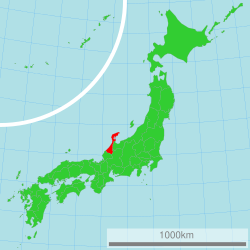
The Kutani-yaki kilns sit in the southern half of Ishikawa Prefecture (石川県), in the area historically called Kaga (加賀) — the heartland of the Maeda clan’s Edo-period domain. Modern administrative centers: Nomi-shi (能美市) and Komatsu-shi (小松市) house the largest concentration of active workshops; Kaga-shi (加賀市) further south retains some of the oldest kiln sites; Kanazawa (金沢), the prefectural capital 30 km north of Nomi, is the cultural and retail center where most international visitors first encounter Kutani.
For international-reader geography: Kaga is on the Sea of Japan coast, in the central Honshu Hokuriku region. From Tokyo, the trip is about 3 hr 30 min by Hokuriku Shinkansen to Komatsu — the line was extended to Komatsu station with the Tsuruga extension that opened in 2024. From Kyoto or Osaka the route is the JR Thunderbird to Tsuruga, then Hokuriku Shinkansen north — roughly 2 hr 30 min total. The closest international airport is Komatsu (KMQ), 5 km from the major workshops.
The cluster matters beyond Kutani. The three Hokuriku prefectures — Toyama, Fukui, Ishikawa — form a contiguous 200-km coastal strip with one of the densest concentrations of METI-designated traditional crafts in Japan. Nōsaku tin in Toyama sits 100 km north of Kaga. Echizen washi and Echizen knives in Fukui sit 50 km south. Yamanaka lacquerware and Kanazawa gold leaf round out the Ishikawa side. All within a three-hour drive of each other.
The 1655 anchor — Goto Saijiro’s Arita apprenticeship
-
1639 — Maeda Toshiharu inherits Kutani village; porcelain-stone deposits identified in the surrounding hills -
1655 — Goto Saijiro sent to Arita (Hizen) to learn porcelain technique; Ko-Kutani founded on return -
c. 1700 — Ko-Kutani kilns mysteriously cease production; the 50-year founding window closes -
1807 — Aoki Mokubei opens Kasuga-yama kiln in Kanazawa; Saiko-Kutani revival begins -
1824 — Yoshida-ya kiln revives the Ko-Kutani palette (green, yellow, deep blue, purple, no red) -
1830s–1860s — Iida-ya (fine red-line), Shōzan (gold-brocade), and Eiraku styles emerge -
1873 — Kutani-yaki wins a gold medal at the Vienna World’s Fair; European export boom begins -
1903 — Seikou-gama founded in Nomi village by Sō Seikō -
1975 — Kutani-yaki designated a METI Traditional Craft Product -
2024 — Hokuriku Shinkansen extended to Tsuruga; Komatsu station opens, cutting Tokyo–Kaga to ~3 hr 30 min -
2026 — Roughly 120–150 active Kutani kilns across Nomi, Komatsu, Kaga, and Kanazawa
Kutani-yaki has an unusually specific founding date: 1655 (Meireki 1). The lord of the Daishōji branch domain (大聖寺藩, a small offshoot of the Kaga Maeda domain) was Maeda Toshiharu (1618–1660). He had inherited Kutani village in 1639 along with the discovery of porcelain-stone deposits — pottery-grade clay rich in kaolin — in the surrounding hills. In 1655 he dispatched a vassal named Goto Saijiro (後藤才次郎) to the Arita porcelain region in Hizen (modern Saga, in Kyushu) — already 40 years into Japan’s first commercial porcelain production — for an apprenticeship.
Goto returned to Kaga around 1657 with the technique. He opened the first kiln at Kutani village (九谷村) in the Daishōji domain — the village name (literally “Nine Valleys”) would become the craft’s name. The kiln produced wares with heavy overglaze enamel painting in the five-color Goku-sai palette. The motifs were bold landscapes, kacho, and abstract patterns; the painted surfaces were dense, sometimes covering nearly the entire piece.
“The remarkable thing about original Kutani is that it ceased production around 1700, less than 50 years after founding. No one knows why with certainty — and pieces from that 50-year window are now among the most valuable Japanese ceramics ever made.”
What now-historians call Ko-Kutani (古九谷, “old Kutani”) came from that brief window. Around 1700 the kilns went dark. The Daishōji domain’s finances had deteriorated. Operating expenses may have exceeded commercial returns. Pigment imports from Nagasaki may have become unsustainable. Some historians argue the kiln moved underground or relocated; others argue it simply went bankrupt. Major Ko-Kutani plates and bowls now sell at auction for ¥5–30 million ($35,000–$200,000+). For the next hundred years, Kutani village made nothing.
1807 onward — Saiko-Kutani and the revival kilns
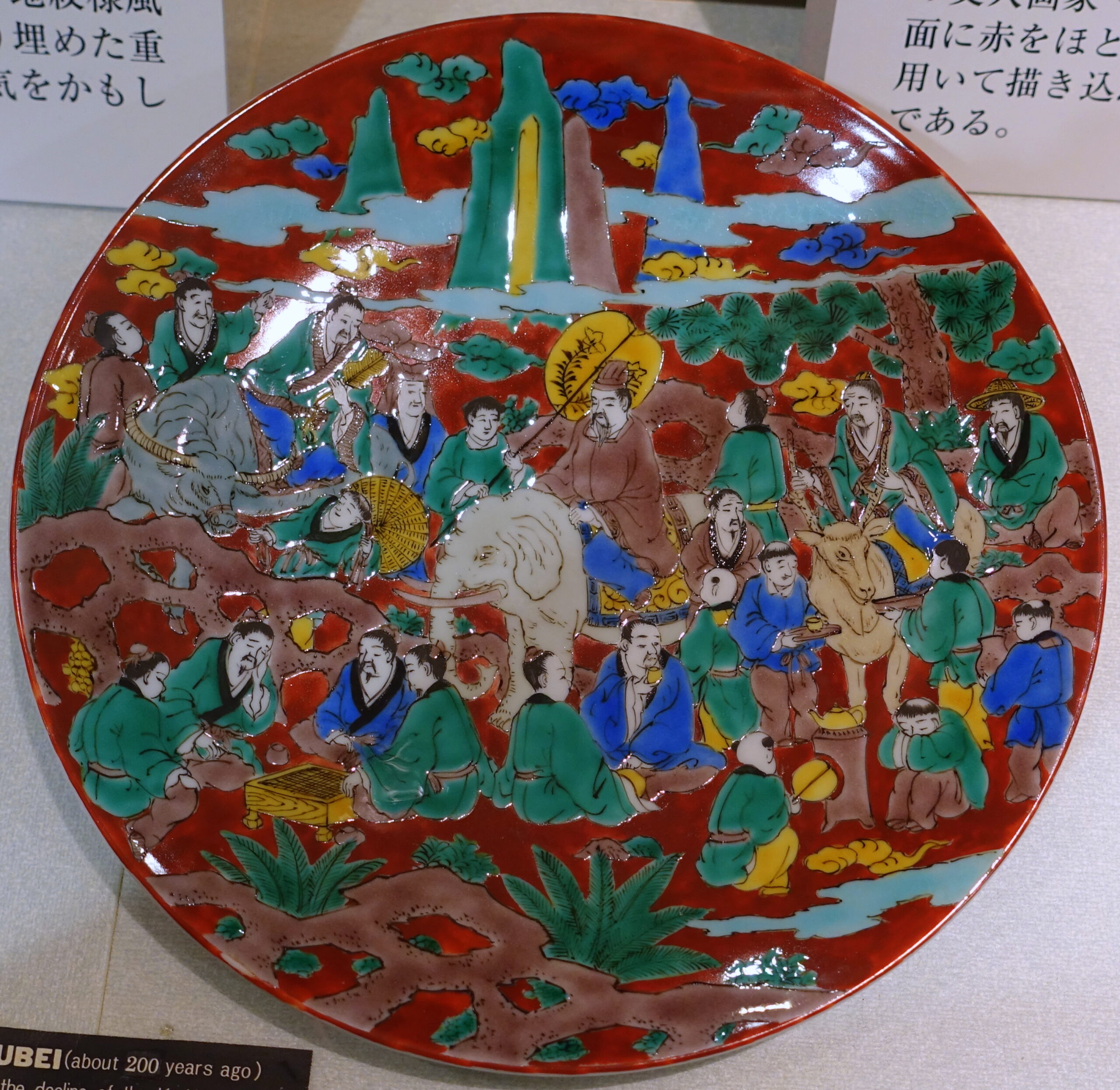
The Kaga Maeda domain made a sustained effort starting around 1800 to revive the tradition. The first successful new kiln opened in 1807 at Kasuga-yama (春日山) in Kanazawa, under the Kyoto-trained potter Aoki Mokubei (1767–1833). Mokubei brought a more refined, scholarly Kyoto-influenced approach — what historians now call Mokubei-style Kutani (木米風): bold red ground with painted Chinese scenes.
The revival expanded rapidly. Over the next 40 years, multiple kilns opened across the region, each developing a distinct stylistic school. These schools still organize the modern Kutani vocabulary, and most working Kutani today can be read as a descendant of one of them.
By 1850 there were dozens of Kutani kilns across the Kaga region, organized into a regional industry rather than a single workshop. Output volume was perhaps a hundred times what Ko-Kutani had ever produced.
The Meiji-era export boom — and the Vienna 1873 gold medal
When Japan opened to foreign trade in the 1850s and 60s, Kutani became one of the first Japanese ceramic exports to enter the European market, alongside Imari/Arita and Satsuma wares. The dense painted surface and heavy gold of Shōzan-style Kutani aligned almost perfectly with Victorian European aesthetic preferences.
1873 was the breakthrough year. At the Vienna World’s Fair (1873 Weltausstellung), Kutani-yaki won a gold medal. International recognition multiplied export volume; by the 1880s, Kutani was being shipped through Yokohama in commercial quantities to London, Paris, San Francisco, and New York. Western 19th-century paintings of well-appointed dining rooms frequently include Kutani pieces in the background — visible in some Whistler and Degas works.
The export market created a peculiarity. Many Kutani pieces produced 1880–1920 were never meant for the domestic Japanese market. They were sized for European dining (12-inch plates, soup tureens, tea sets), decorated in styles emphasizing what Europeans wanted to see in “Japanese” porcelain — gold, dense pattern, exotic scenes — and exported in volumes that dwarfed contemporary domestic sales.
When World War I and the 1920s economic disruptions cut off European trade, the export-oriented Kutani industry contracted sharply. Many smaller kilns closed; the survivors reoriented toward the domestic Japanese market. That reorientation is the lineage the current generation of working kilns descends from.
The 20th century and the named-kiln tier today
Kutani-yaki was designated a METI Traditional Craft Product (国指定伝統的工芸品) in 1975 — the same wave of designations that covered Echizen lacquerware (1975), Echizen washi (1976), and Echizen Uchihamono (1979). The designation covers porcelain produced in Ishikawa Prefecture using traditional overglaze-enamel techniques and the Goku-sai palette.
In 2026, the active Kutani workshops number roughly 120–150 kilns across Nomi, Komatsu, Kaga, and Kanazawa. The industry sits in three tiers. At the top, three to five potters at any given time who hold ningen-kokuhō designation — pieces ¥500,000 to ¥3,000,000+. In the middle, named-kiln workshops with 50 to 150 years of continuous operation, each with a house style and named potters; pieces ¥3,000 to ¥50,000. And a newer tier of designer-collaboration makers, ¥2,000 to ¥20,000.
Seikou-gama sits firmly in the named-kiln tier — the SK-286 soba-choko is at the entry of that kiln’s price range.
Seikou-gama — the kiln that made this cup
Seikou-gama (青郊窯) was founded in 1903 (Meiji 36) in Nomi village, Ishikawa. The kiln’s founder was Sō Seikō (蘇 青光) — the name itself (“green color”) signals the kiln’s specialization in colored overglaze. The workshop is now in its third generation; the current head, also using the Seikō name, took over in the late 1990s.
The house style emphasizes the Yoshida-ya tradition — deep colors, dense floral painting, no red — while also producing pieces in the Shōzan gold-brocade style for the gift market. The kiln operates 6–8 wheels and uses both hand-thrown and slip-cast bodies. The painting is entirely hand-done.
The soba-choko form Seikou produces is the workshop’s most widely-distributed shape, sold through retailers across Japan and exported to specialty Japanese-craft stores in the US and Europe.
The soba-choko form — a multi-use Japanese cup
The soba-choko (蕎麦猪口) is a small cylindrical cup, typically 8 cm × 6.5 cm. Its original use was as the dipping cup for cold soba noodles — pour in dashi-based tsuyu sauce, dip each bite. The 280 ml capacity is precisely sized for this; smaller and the noodles drag through, larger and the sauce-to-noodle ratio is wrong.
In modern Japanese kitchens, the soba-choko has become the universal small-cup form. Japanese tea. Sake (warm or cold). Small dessert servings. Salt or spice presentation. Soft-serve ice cream in a kissaten. Yogurt with fruit. Any time a 200–300 ml liquid or semi-solid wants a Japanese-feeling vessel. High-end Tokyo restaurants will set out a single soba-choko per diner at the start of the meal, then refill it across courses.
For an international buyer, the soba-choko is the most useful single Japanese ceramic to start a collection with — significantly more versatile than a yunomi (taller, narrower, primarily for tea) or a chawan (broader, for matcha or rice).
Visual heritage anchors in Kaga
Kutani Yakimono no Sato (九谷焼窯跡展示館) — the kiln-site museum at the original Kutani village, daily 9:00–17:00. The Ishikawa Prefectural Museum of Art in Kanazawa holds the major institutional collection of Ko-Kutani and Saiko-Kutani. Kenroku-en (兼六園), Kanazawa’s classical garden, sits 70 km from the kilns; built by successive generations of the Maeda clan, it pairs naturally with a Kutani trip. The Higashi Chaya District has historic teahouses displaying Kutani in working use. The Kanazawa 21st Century Museum of Art shows rotating contemporary Kutani.
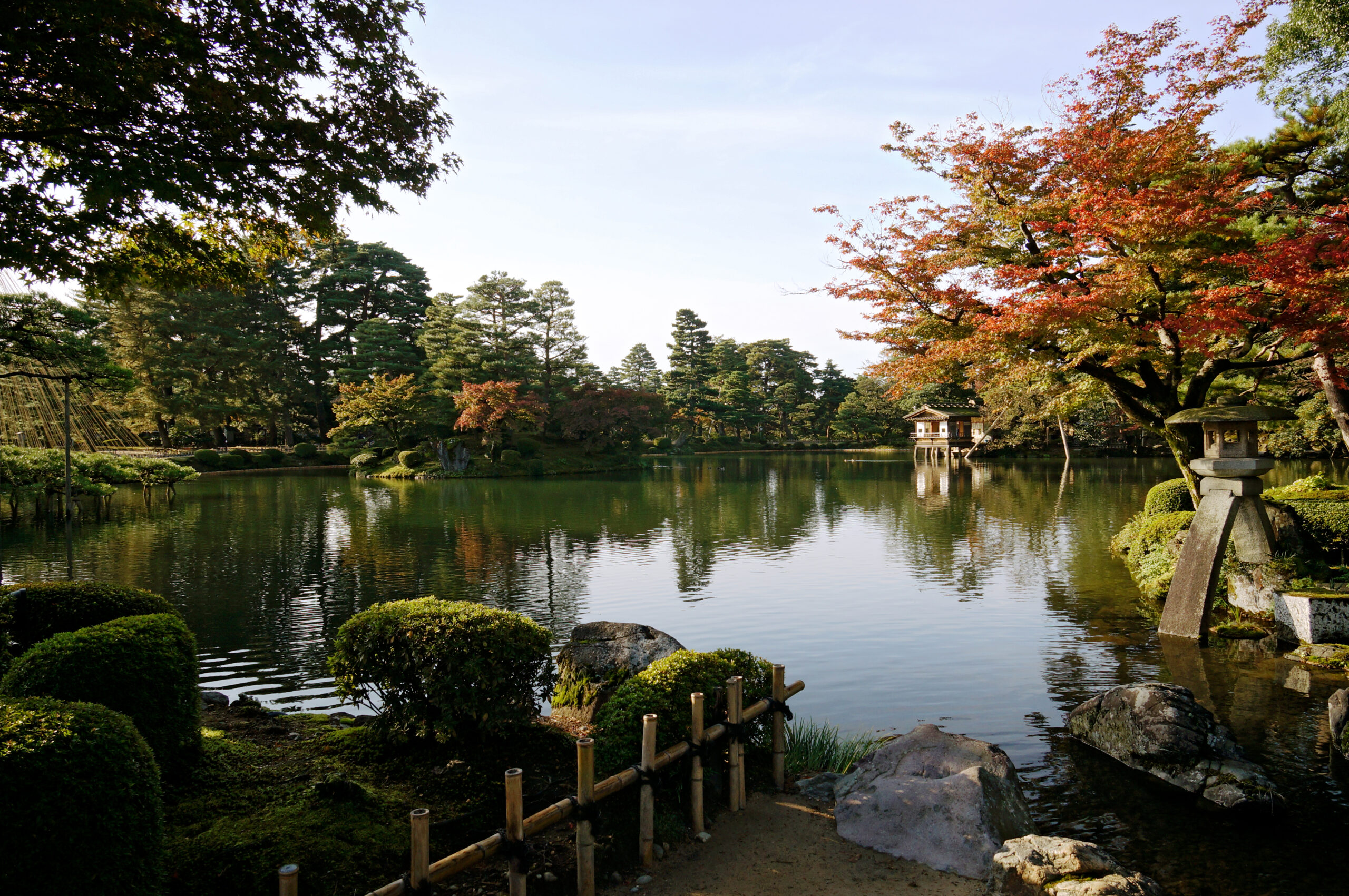
Ishikawa also produces approximately 98% of all gold leaf in Japan — the Kanazawa Kinpaku (金沢箔) industry, anchored in the city since the 1590s. Gold leaf has historically been a Kutani companion: kinrande Kutani is gold-leaf applied over fired porcelain. The typical visitor itinerary is Kanazawa Kinpaku → Kutani-yaki → Yamanaka lacquerware → Kaga Yūzen silk dye — Ishikawa is unusual in having four METI-designated crafts within a 50 km radius.
📦 Shipping and where to buy from outside Japan
The 110 g cup ships well; the bigger variables are packaging, customs declared value, and a small but real international transit breakage rate on porcelain. Per the Amazon JP listing as of May 14, 2026, the SK-286 is currently in the Amazon JP Global Store catalog — that means direct international shipping to the US, EU, AU, CA and most major destinations without a proxy. Estimated international shipping cost: $8–$20 USD for this weight class. Customs are not a meaningful concern at a ¥2,420 declared value — well below de minimis in every major jurisdiction.
Three paths in order of consumer friction:
- Amazon JP Global Store (sourced): direct from the original listing. Seller Kitazan-do packs in bubble wrap and double-boxes; based on category-level data, roughly one breakage report per 50 international ceramic orders is typical.
- Amazon.com (US): the SK-286 itself is not individually listed on .com, but Amazon US carries a wide range of Japanese ceramics — Hasami-yaki, Mino-yaki, and some larger-producer Kutani — for direct US Prime shipping and USD pricing.
- Proxy services (Buyee, Tenso): only useful if a particular variant is region-locked on Amazon JP Global Store or if you want to combine the cup with other items from Rakuten or specialty retailers that don’t ship internationally. For this specific SK-286, the proxy markup (typically 10–20% plus consolidation fees) makes it less attractive than the direct Global Store path.
Specialty Japanese-craft retailers in the US/EU stock rotating Kutani inventory at roughly 1.5–2× Amazon JP prices: Mutual Adoration (NY), Native & Co (London), Sou·Sou (San Francisco), Tortoise General Store (LA). Direct from Seikou-gama is possible by appointment in Nomi (10:00–16:00 weekdays); no English-language web shop as of May 2026.
Price snapshot across stores
| Store | Item / Variant | Price | Notes |
|---|---|---|---|
| 🇺🇸 Amazon.com (US) | Browse Japanese soba-choko cups and named-kiln Kutani | varies (USD) | Best if you’re shopping from the US — Prime shipping, USD pricing, no international customs. Amazon US carries Hasami-yaki, Mino-yaki, and some larger-producer Kutani — useful for cross-comparison. Seikou-gama’s exact SK-286 is sourced from Japan (next row). |
| 🇯🇵 Amazon JP Global Store | Seikou-gama SK-286 Soba Choko (sourced listing) | ¥2,420 (≈ $16 USD) | Ships internationally from Japan; seller Kitazan-do double-boxes ceramics. ~$8–$20 USD shipping. 24 loyalty points back. The authoritative source for this specific piece. |
| Maker direct (Seikou-gama) | Workshop visit in Nomi-shi, by appointment | Unconfirmed — check on-site | Workshop tours weekdays 10:00–16:00. Direct purchase available on-site; no English-language web shop as of 2026-05. |
| Proxy services (Buyee / Tenso) | Rakuten / Yahoo! listings of Seikou-gama pieces | ¥2,420 + 10–20% proxy fee | Only useful for variants region-locked on Amazon JP Global Store, or to consolidate with other Japan-only retailers. For SK-286 itself, the Global Store path is cheaper. |
Prices and stock fluctuate. Verify at the retailer before purchasing. USD figures are approximate at ¥150/USD as of mid-2026 — JPY is the authoritative price for the specific listed item.
What it does well
Seikou-gama is a 1903-founded, third-generation Kutani kiln — not a tourist-grade decal. At ¥2,420 the SK-286 is the lowest-stakes way to own a real named-kiln piece.
The 280 ml shape works as a tea cup, sake cup, dessert bowl, ice-cream cup, salt cellar, and the original cold-soba dipping vessel. More versatile than a yunomi or chawan.
The cherry-blossom and four-seasons floral pattern is the most recognizable Kutani imagery to non-Japanese eyes — kacho (flowers-and-birds) is the core Kutani subject since the 18th century.
Per the maker’s published process, the Goku-sai overglaze painting is hand-done in the Seikou-gama workshop. Slight variation between pieces is the expected signature, not a defect.
Weaknesses and things to verify before buying
- Single cup, no gift presentation. The SK-286 ships without a paulownia gift box or wrapping. If the purchase is for a wedding, anniversary, or formal occasion, the Dentō-honpo pair sets at ¥6,380 or ¥14,190 are a better fit.
- Dishwasher accelerates overglaze wear. Goku-sai pigments are fired onto the glaze surface; daily dishwashing dulls them visibly over 5–10 years. Hand-washing maintains the painted surface indefinitely.
- ~2% international transit breakage rate. Porcelain is fragile. The seller (Kitazan-do) double-boxes, but ceramic shipments from Japan to international destinations carry a small but real risk of breakage. Verify the seller’s replacement policy before purchasing.
- Stacks, but the painted surface needs protection. The cup is shaped to stack, but stacking without a cloth or paper interleaf can scratch the overglaze. Plan storage accordingly.
- Pricing snapshot only. Only the Amazon JP listing as of May 14, 2026 is available — live pricing and stock may have shifted since the writing date. Verify the current price at the affiliate link before purchasing.
- Not a Living National Treasure piece. Seikou-gama is a named-kiln tier producer, not a ningen-kokuhō-designated artist. If the buyer’s expectation is a museum-grade work, the price tier needs to be ¥100,000+ and the maker needs to be in the top tier.
Conclusion — which buyer type are you?
Skip the SK-286. Step up to the Dentō-honpo Moon-viewing Rabbit pair (¥14,190) or the Iwataya Tsubaki-zukushi coffee pair (¥11,000) — both include gift presentation suitable for weddings, anniversaries, or retirements.
The SK-286 is the right pick. Named-kiln, recognizable motif, multi-purpose form, ships internationally, lowest-stakes price point. Buy one to start, add a second variant later if it earns daily use.
The Nakamaru Yu-sai Red Mug at ¥1,846 is below the named-kiln entry price and uses a Western mug shape with a handle. Less prestige, more daily resilience.
If you run everything through a dishwasher daily, need a coffee mug with a handle, or want a museum-grade display piece, this is the wrong category. A Western porcelain mug or a higher-tier ningen-kokuhō piece is a better fit.
Other ways to approach this purchase
The annual Kutani-yaki Festival in Nomi-shi (early May) and the Kanazawa Kogei-ten craft fair (autumn) offer direct-from-maker buying without the international shipping cost. Travel-aligned buyers may prefer this path.
Yahoo Japan Auctions (via Buyee) carries older Seikou-gama and other named-kiln pieces, sometimes at lower prices than new retail. Verify provenance — Ko-Kutani fakes are not unknown.
Native & Co (London), Mutual Adoration (NY), Tortoise General Store (LA), Sou·Sou (San Francisco) all carry rotating Kutani inventory. Prices are 1.5–2× Amazon JP, but no transit risk and no customs to manage.
If the household dishwashes everything and the cup will be in the rotation every day, Kutani is a poor fit. A modern Hasami-yaki or Mino-yaki cup costs less and is engineered for the modern Japanese dishwasher.
🏆 Editor’s Pick
¥2,420 (≈ $16 USD) · 280 ml · 110 g · Nomi, Ishikawa · Seller Kitazan-do.
Recommended over the higher-priced pair sets and the Snoopy collaboration because:
- Seikou-gama is a 1903-founded named Kutani kiln, third generation — genuine named-kiln quality, not a tourist-grade decal.
- The soba-choko form is the most multi-purpose Japanese ceramic — tea, sake, dessert, ice cream, soba dip.
- At ¥2,420 it is the lowest-stakes way to own a real Kaga-region named-kiln piece.
- The cherry-blossom and four-seasons motif is the most recognizable Kutani imagery to international eyes.
❓ Frequently Asked Questions
Does this cup ship internationally from Japan?
Yes. The SK-286 is available through Amazon JP Global Store, which ships to the US, EU, AU, CA and most major destinations. Estimated international shipping cost is $8–$20 USD for a single 110 g porcelain piece. Customs are not a concern at the ¥2,420 declared value.
Is the cup dishwasher-safe?
Technically yes — a modern dishwasher will not crack the porcelain. However, the Goku-sai overglaze enamel dulls visibly over 5–10 years of daily machine washing. Hand-washing is recommended to preserve the painted surface. The cup is also microwave-safe.
What is a soba-choko, and can I use it for things other than soba?
A soba-choko (蕎麦猪口) is a small cylindrical Japanese cup, originally the dipping vessel for cold soba noodles. In modern Japanese kitchens it is the universal small-cup form — used for Japanese tea, sake, dessert, ice cream, yogurt, salt or spice presentation. The 280 ml capacity works for any of these.
Who is Seikou-gama, and how do I know this is real Kutani?
Seikou-gama (青郊窯) was founded in 1903 in Nomi-shi, Ishikawa Prefecture — in the heart of the Kaga region where Kutani has been made since 1655. It is one of the named Kutani kilns and is now in its third generation under the Sō Seikō name. The piece is produced and hand-painted in the workshop. Kutani-yaki has held METI Traditional Craft Product designation since 1975.
Does the cup come gift-wrapped?
No. The SK-286 is a single piece sold without a paulownia gift box. If you need gift presentation, consider the Dentō-honpo Husband-and-Wife Yunomi Pair (¥6,380) or the Moon-viewing Rabbit Pair with gold leaf (¥14,190), both of which include gift wrap.
How do Goku-sai and Ko-Kutani relate?
Goku-sai (五彩, “five colors”) refers to the Kutani overglaze palette: red, green, yellow, deep blue, and purple. Ko-Kutani (古九谷, “old Kutani”) refers to pieces produced in the original 1655–1700 founding window, before the mysterious closure. Modern Goku-sai painting descends from the revival kilns that re-established the tradition from 1807 onward — Yoshida-ya, Iida-ya, Shōzan, Eiraku, and the named kilns that followed, including Seikou-gama.
What if the cup breaks in transit?
Based on category-level data, roughly one breakage report per 50 international ceramic orders is typical for porcelain shipped from Japan. The seller (Kitazan-do) packs in bubble wrap and double-boxes to reduce this risk. If a piece arrives damaged, contact the seller through Amazon JP’s standard A-to-z guarantee process — refunds or replacements are typically handled within 7–14 days.
jpmono.com is curated by a Japan-based editorial team (working out of Toyama in the Hokuriku region and Nara in Kansai) and is independent. We don’t take payment from the makers we feature; income comes from affiliate links. Read more about our editorial standards.
🤖 This article was researched and drafted with AI assistance, then edited by the jpmono editorial team in Toyama and Nara. Specs, pricing, and availability are drawn from the Amazon JP listing as of 2026-05-14; historical and craft-context claims follow the sources cited in our research notes. Please verify current pricing at the retailer link before purchasing.
Affiliate disclosure: jpmono.com may earn a commission on qualifying purchases made through links on this page, at no additional cost to you.