![Tokoname-yaki Kyusu Teapot — Kitsusako ‘Rasen’ Spiral 330ml with Latest Ceramic Strainer (¥4,180 / ≈$28 USD) [2026 Buyer’s Guide]](https://jpmono.com/wp-content/uploads/2026/06/kitsusako-tokoname-rasen-kyusu-where-to-buy-2026-featured-1400x1050.jpg)
Tokoname-yaki (常滑焼) is the 1,000-year-old pottery of Tokoname, in central Aichi Prefecture — one of the Six Old Kilns (Nihon Rokkoyō, 日本六古窯), designated a METI Traditional Craft Product in 1976, and Japan’s most internationally recognized teapot-producing region. The iron-rich clay of the Chita Peninsula fires to deep red-brown shudei (朱泥) or dark kokudei (黒泥); the resulting kyusu (急須, side-handled Japanese teapot) is the canonical vessel for brewing sencha green tea.
This ‘Rasen’ (螺旋, “spiral”) kyusu from Kitsusako is a 330 ml dark-grey kokudei piece with an integrated ceramic strainer fine enough for the most delicate fukamushi-cha (deep-steamed sencha). At ¥4,180 (≈ $28 USD as of May 2026) it is the practical entry point to a real Tokoname kyusu — well-priced for an international tea enthusiast and easier on a Western counter than the brighter shudei red.
This guide walks through the 1,000-year arc from medieval ash-glazed jars to the 19th-century shudei revolution, locates the workshop on the map, and lays out the buying paths from outside Japan. Written from a Japan-based editor’s desk in Toyama and Nara — not from any maker payroll.
🔄 Last updated
⏱️ ~14 min read
🏷️ Tokoname-yaki · Aichi · Six Old Kilns

- Who this is for — and who should skip it
- Product overview (from published specs)
- Glossary — Japanese terms used in this guide
- 📍 Where this comes from — Tokoname, place and craft
- Price snapshot across stores
- What it does well
- Weaknesses and things to verify before buying
- Conclusion — which buyer type are you?
- Other ways to approach this purchase
- 🏆 Editor’s Pick
- ❓ Frequently Asked Questions
- 📌 Related Japanese Crafts
Who this is for — and who should skip it
- Brew Japanese sencha or fukamushi-cha daily for one or two people
- Want a real Tokoname kyusu from a Tokoname specialist, not a generic factory listing
- Prefer the muted kokudei dark grey over the brighter shudei red
- Like the contemporary ‘rasen’ spiral surface paired with a traditional form
- Want to spend under $40 USD on your first Japanese teapot
- Serve tea for four or more people in one brew — 330 ml is too small
- Brew Western-style tea bags — the fine strainer is wasted
- Want a matcha vessel — that requires a chawan and chasen, not a kyusu
- Want a hand-thrown piece by a named potter — start at ¥8,000+ instead
- Need dishwasher-safe ceramics — this is hand-wash only
Product overview (from published specs)
Sources: Amazon US search (primary, moonill-20 tag) for browsing comparable Tokoname kyusu in USD with Prime; Amazon JP Global Store (secondary, moonill-22 tag) for the specific Kitsusako ‘Rasen’ listing sourced from Japan; Kitsusako’s own retailer materials for design notes.

Tokoname-yaki Kyusu Teapot
きつさこ 常滑焼 らせん急須 330ml【 最新フィルター茶こし付 】/ダークグレー 黒 味がまろやかになる急須 深蒸し可 日本製
在庫あり。 · Sold by デイリーセントラルセンター【きつさこ公式SHOP】 · ASIN B08ZRYYLLG
Price and availability as of 2026-08-31 02:30 JST. The Amazon listing at the time of purchase is authoritative. jpmono.com earns a commission on qualifying purchases at no extra cost to you.
| Spec | Value (per Amazon JP listing, May 2026) |
|---|---|
| ASIN | B08ZRYYLLG |
| Brand / retailer | Kitsusako (きつさこ) — Tokoname specialist retailer |
| Maker | Tokoname potter cooperatives, Aichi Prefecture |
| Form | Yokode-kyūsu (横手急須) — side-handle, right-hand pour |
| Capacity | 330 ml maximum (≈ 3–4 sencha cups) |
| Dimensions | ⌀ 9 × H 8.5 × W 14 cm (including handle) |
| Weight | ≈ 240 g |
| Material | Kokudei (黒泥) dark-grey iron-rich Tokoname clay, reduction-fired |
| Strainer | Integrated fine ceramic mesh (“seramesh”-style), fukamushi-cha compatible |
| Made in | Tokoname, Aichi Prefecture, Japan |
| Price (sourced listing) | ¥4,180 (≈ $28 USD as of May 2026; ¥150/USD baseline) |
| International shipping | Amazon JP Global Store to US/EU/AU/CA; $10–25 USD shipping; ≈ 2–3% ceramic-transit breakage |
Glossary — Japanese terms used in this guide
📖 Open glossary (10 terms)
- Tokoname-yaki (常滑焼)
- Pottery made in Tokoname, Aichi. One of Japan’s Six Old Kilns; METI-designated Traditional Craft Product (1976).
- Kyusu (急須)
- Japanese teapot, typically side-handled, used for steeping leaf-tea — most commonly sencha.
- Yokode-kyūsu (横手急須)
- “Side-handle teapot.” The canonical Japanese kyusu form; handle is perpendicular to the spout, allowing single-handed pour with shaking.
- Shudei (朱泥)
- “Vermilion clay.” Tokoname’s signature red-brown unglazed body, oxidation-fired so iron forms ferric oxide.
- Kokudei (黒泥)
- “Black clay.” The dark-grey reduction-fired counterpart to shudei; iron forms ferrous oxide. The color of this article’s kyusu.
- Sencha (煎茶)
- Steamed green tea — the everyday Japanese leaf tea, brewed at 70–80 °C in a kyusu.
- Fukamushi-cha (深蒸し茶)
- “Deep-steamed sencha.” Steamed 2–3× longer than standard sencha, producing finer leaf particles and a rounder, sweeter cup. Requires a fine strainer.
- Nihon Rokkoyō (日本六古窯)
- “Six Old Kilns of Japan” — the six medieval pottery regions (Tokoname, Seto, Shigaraki, Echizen, Tamba, Bizen) whose kilns have operated continuously since at least the Heian–Kamakura period.
- Rasen (螺旋)
- “Spiral.” The exterior surface motif on this Kitsusako kyusu — a contemporary Tokoname design language, not a 19th-century pattern.
- Chita Peninsula (知多半島)
- The peninsula on the Pacific (Ise Bay) coast of Aichi where Tokoname sits. Iron-rich riverine clay sediments are the geological foundation of the craft.
📍 Where this comes from — Tokoname, place and craft

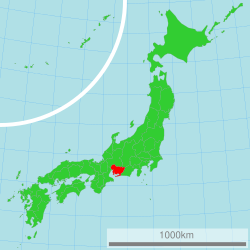
The region — Chita Peninsula clay and Pacific trade
Tokoname (常滑) is a city of roughly 60,000 people on the Chita Peninsula (知多半島), the long thumb of land that extends south from Nagoya into the Pacific (Ise Bay) coast of central Aichi. The city center sits on the peninsula’s western edge — the Pacific to the west, the bay to the east.

For international-reader geography: Tokoname is 15–20 km south of Centrair Nagoya International Airport (NGO), the main gateway for central Japan and a frequent connection point for foreign visitors heading on to Kyoto. From Centrair to Tokoname Station: 25 minutes on the Meitetsu line, ¥360. From Nagoya Station: 40 minutes on the Meitetsu Airport line. The Tokoname Pottery Walk (やきもの散歩道) — a preserved district of historic kilns, shop houses, and active workshops — is 15 minutes on foot from the station.
Geographically, the Chita Peninsula is rich in iron-bearing clay. River sediments laid down across the peninsula carry an unusually high proportion of iron oxide, which on firing produces the deep red-brown shudei tone Tokoname is famous for. The same iron content, fired in reduction (oxygen-starved kiln atmosphere), turns the body to kokudei dark grey — the color of the kyusu in this article.
Water from the surrounding hills, pine forests for charcoal, Pacific shipping access for finished ware, and proximity to the Kyoto–Edo coastal trade route all converged here. By the medieval period Tokoname was producing perhaps 20% of all Japanese ceramic ware.
A thousand-year anchor — the Six Old Kilns
Tokoname’s pottery tradition has unusually deep roots. The first documented Tokoname kilns date to the early 12th century — late Heian period, in the tail end of the Sue-ware tradition. The earliest pieces were utilitarian: storage jars, water jugs, ash-glazed bowls, and large transport vessels.
What sets Tokoname apart among Japan’s old kilns is sheer scale. Archaeological surveys have documented over 3,000 medieval kiln sites in and around Tokoname — the densest concentration of pre-modern Japanese kilns anywhere. Tokoname jars from this period have been recovered from coastal archaeological sites stretching from Hokkaidō to Kyushu, confirming an extensive maritime trade network up and down the Pacific coast.
Tokoname is one of the Six Old Kilns (Nihon Rokkoyō, 日本六古窯) — the medieval pottery centers that anchor Japanese ceramic history. Of the six (Tokoname, Seto, Shigaraki, Echizen, Tamba, Bizen), Tokoname is the largest by historical volume and the most commercial in orientation. The other five tended toward tea-ceremony-oriented refined ware; Tokoname produced everyday vessels for everyday people, in extraordinary quantity.
“The other five Six Old Kilns made tea bowls for the tea master. Tokoname made the jars the tea was carried in.”
- c. 1100 — First documented Tokoname kilns; late Sue-ware tradition; ash-glazed jars and storage vessels.
- 12th–13th c. — Over 3,000 medieval kiln sites operate; jars traded by ship from Hokkaidō to Kyushu.
- Edo period — Tokoname remains a large-format utilitarian center: oil jars, soy-sauce barrels, sake vessels.
- 1860s–1870s — Meiji opening; Chinese tea-pouring forms enter Japan; Sugie Jumon (杉江寿門) adapts kyusu technique to Tokoname clay.
- 1880s — Tokoname shudei kyusu emerges as a distinctly Japanese refinement of the Chinese form.
- 1900–1930 — Boom era; international exports through Yokohama and Kobe reach the UK, US, and continental Europe.
- 1976 — Tokoname-yaki designated a METI Traditional Craft Product (国指定伝統的工芸品).
- 2003 — Murata Ryuichi (村田龍一) designated Living National Treasure for Tokoname-yaki.
- 2026 — Roughly 300–400 active kilns; Tokoname produces an estimated 70% of all Japanese kyusu.
The kyusu pivot — late 19th century
Until the late Edo period, Tokoname did not produce kyusu. Side-handled teapots were imported from China or made in small quantities by Kyō-yaki and other refined-pottery centers. Tokoname’s specialty remained large-format utilitarian ware.
The transition happened in the 1860s–1870s, when three changes converged during the Meiji opening of Japan. First, Chinese tea-pouring (kyū-shu) practice became fashionable among the Japanese literati class, creating demand for the small-format teapot. Second, Tokoname potters realized the local iron-rich clay was exceptionally well suited for the form, producing a thinner-walled, more durable teapot than the imported Chinese ware it began to replace. Third, sencha green tea — which requires the kyusu form for proper brewing — became widely consumed in middle-class households.
The key figure is Sugie Jumon (杉江寿門, 1828–1897), a Tokoname potter who studied Chinese teapot-making technique and adapted it to the local clay. By the 1880s, Sugie’s workshop and his students had developed the Tokoname shudei kyusu — a distinctly Japanese refinement of the imported form. The Meiji–Taishō period was the boom era; exports through Yokohama and Kobe carried Tokoname kyusu to British, American, and European tea-drinkers.
By the early 20th century, Tokoname accounted for roughly 70% of all Japanese kyusu production, a dominance that has continued essentially uninterrupted to 2026.
Why the clay matters — iron, color, and the tea-mellowing effect
The Chita Peninsula’s geology is the foundation. Sediments deposited by ancient rivers into Ise Bay contain 5–10% iron oxide by weight — much higher than typical Japanese pottery clay. That iron content has two effects.
The second effect is the more interesting Tokoname property: iron in the unglazed clay subtly mellows the tea brewed inside it. As sencha steeps in a Tokoname kyusu, trace iron leaches into the brew and binds with the catechins — the bitter compounds in green tea — softening the astringency. Side-by-side blind tastings documented by Japanese tea associations consistently show the same sencha brewed in a Tokoname kyusu reads as less bitter, with the sweet umami notes more prominent, than the same leaf brewed in porcelain.
This is not folklore. It is a documented chemical interaction between iron-rich unglazed ceramic and tea catechins, and it is the reason serious sencha drinkers reach specifically for Tokoname rather than for any other unglazed clay.
The yokode-kyūsu form — what to learn from the side handle
The yokode-kyūsu (横手急須, “side-handle teapot”) is the canonical Tokoname kyusu: a round body with the handle set perpendicular to the spout, gripped from the side rather than from above. It is the Japanese kyusu form, distinct from both the Chinese and the Western overhead-handle teapot.
The side handle has two functional advantages. A thumb-and-fingers grip allows the brewer to pour while gently shaking the kyusu, ensuring full extraction of the leaves. And the short lever arm makes precise drip-by-drip pouring possible — necessary for the careful distribution that high-grade sencha service requires.
For an international tea brewer learning the Japanese sencha method, the yokode-kyūsu is the form to learn. Overhead-handle teapots — Western or Chinese — cannot replicate the pour precision the technique calls for. This kyusu uses the standard right-hand grip: handle on the right when the spout points away from you. (Tokoname workshops produce left-hand versions on custom order.)
Kitsusako — the retailer behind this kyusu
Kitsusako (きつさこ) is a Tokoname-specialty retailer that contracts production directly with Tokoname potter cooperatives, designing kyusu to specifications optimized for daily tea use. The ‘rasen’ (螺旋, “spiral”) exterior is a Kitsusako-specific surface texture — a contemporary look on a traditional body, material, and form.
The “latest fine ceramic strainer” Kitsusako advertises is an integrated mesh insert finer than the standard Tokoname strainer — designed for fukamushi-cha (深蒸し茶, “deep-steamed sencha”). Fukamushi leaves are steamed two to three times longer than standard sencha during processing, leaving much finer particles in the cup; ordinary strainers let too many of those particles through. The Kitsusako mesh addresses this, producing a clean, cloud-free pour from a fukamushi brew.
Price snapshot across stores
Listings change frequently; always verify at the retailer before buying. JPY is the authoritative price; USD figures are approximate at a ¥150/USD baseline.
| Store | Item / variant | Price (JPY / USD est.) | Notes |
|---|---|---|---|
| 🇺🇸 Amazon.com (US) | Browse Japanese Tokoname kyusu teapots | varies (USD) | Best if you are shopping from the US — Prime shipping, USD pricing, no international customs. Amazon US carries Tokoname kyusu from several Tokoname makers (Yamakin, Gyokko, and others) — useful for comparing form, size, and color. Kitsusako’s exact ‘Rasen’ is sourced from Japan (next row). |
| 🇯🇵 Amazon JP Global Store | Kitsusako ‘Rasen’ 330 ml kokudei (B08ZRYYLLG) | ¥4,180 / ≈ $28 USD | Ships internationally from Japan. The sourced listing for this guide. ≈ 240 g; estimated shipping $10–25 USD. Ceramic transit breakage ≈ 2–3%. |
| Maker direct (Kitsusako) | Same ‘Rasen’ kyusu via Kitsusako’s own e-commerce | ≈ ¥4,180 / ≈ $28 USD | Domestic Japan shipping only; international buyers will need a forwarder. Useful mainly if you are already in Japan. |
| Proxy services (Buyee / Tenso) | Forwarded purchase from Japanese e-commerce | ¥4,180 + ¥1,500–3,000 fees + shipping | Useful if the item is only on Japanese marketplaces and you want it anyway. Not necessary for this kyusu — Amazon JP Global Store covers most major destinations directly. |
What it does well
Weaknesses and things to verify before buying
- Capacity caps at two drinkers. 330 ml is roughly three to four small sencha cups. For four or more people, step up to a 410–500 ml kyusu (the Kigaku 410 ml is the next size up).
- Hand-wash only. No dishwasher, no detergent, no microwave. The unglazed iron-rich clay absorbs flavors over time — dish soap residues will affect tea taste.
- Thermal shock risk. Do not pour cold water into a hot kyusu (or vice versa). Always pre-warm with hot water before brewing high-grade tea. The clay can crack from rapid temperature change.
- Stains and darkens with use. Iron-rich Tokoname clay develops a patina over months and years of daily tea. This is considered desirable in serious tea practice but can surprise buyers expecting the kyusu to look pristine indefinitely.
- Right-hand-grip standard. The handle is on the right when the spout faces away. Left-handed pour versions exist but require a custom order from the maker, not the Amazon JP listing.
- Ceramic transit breakage ≈ 2–3%. International shipping ceramics is never zero-risk. Amazon JP Global Store packs decently; verify the item on arrival, photograph any damage immediately, and use the return process within the eligibility window.
- Listings shift. Pricing, color availability (kokudei vs. shudei vs. matte black), and stock change frequently; always verify the current state of the listing at the link before committing.
Conclusion — which buyer type are you?
Other ways to approach this purchase
🏆 Editor’s Pick
Kitsusako ‘Rasen’ Tokoname Kyusu — 330 ml, Kokudei Dark Grey
- Specialist Tokoname retailer (Kitsusako) — not a generic factory listing; design developed with Tokoname potter cooperatives.
- 330 ml is the international sweet spot — too small for a Western teapot, exactly right for a 3–4 cup Japanese sencha session for one or two.
- Kokudei dark grey is more versatile on a Western counter than the brighter shudei red; the ‘rasen’ spiral exterior gives the form a contemporary feel without losing the traditional material.
- Latest fine ceramic strainer makes this one of the few entry-tier kyusu that handles fukamushi-cha cleanly.
- ¥4,180 (≈ $28 USD) — the lowest-stakes way to own a real Tokoname kyusu from a dedicated retailer.
Prices and availability are based on listings at the time of writing. Verify at the retailer before purchasing.
❓ Frequently Asked Questions
Does the Kitsusako ‘Rasen’ kyusu ship internationally?
Yes, via Amazon JP Global Store to the US, EU, UK, Australia, Canada, and most major destinations. Estimated shipping is $10–25 USD for a ≈ 240 g ceramic item. Ceramic transit breakage runs at roughly 2–3% historically; photograph any damage on arrival and use the return process within the eligibility window.
Is 330 ml enough for two people?
Yes — that is exactly its design point. 330 ml brews three to four small sencha cups, which is the standard Japanese single-session size for one or two drinkers. For three or more, step up to a 410–500 ml kyusu such as the Kigaku ‘Shichijūshichi’ covered in the variant section.
Can I put this kyusu in the dishwasher or microwave?
No to both. The unglazed iron-rich clay is hand-wash only, ideally with hot water and no detergent — detergent residues affect tea flavor over time. Air-dry upside down with the lid off. Microwaving an unglazed kyusu risks cracking from uneven heating; do not do it.
What is the difference between shudei and kokudei?
Same clay, different kiln atmosphere. Shudei (朱泥) is oxidation-fired and finishes red-brown as iron forms ferric oxide. Kokudei (黒泥) is reduction-fired (oxygen-starved) and finishes dark grey as iron forms ferrous oxide. Functionally they behave the same way for brewing; the choice is aesthetic.
Does the iron in Tokoname clay really change the taste of tea?
Yes — and this is a documented chemical interaction, not folklore. Trace iron from the unglazed clay binds with green-tea catechins (the bitter compounds), softening astringency and bringing the sweet umami notes forward. Side-by-side blind tastings by Japanese tea associations consistently show the effect. It is the reason serious sencha drinkers reach for Tokoname rather than porcelain.
Will the kyusu stain or change color over time?
Yes. Iron-rich unglazed clay develops a patina from regular tea use over months and years. This is considered desirable in serious tea practice — an old kyusu visibly carries its history. If you want a permanently pristine appearance, an unglazed Tokoname kyusu is the wrong category.
Is this kyusu suitable for matcha?
No. Matcha is whisked, not steeped, and requires a wide bowl (chawan, 茶碗) and a bamboo whisk (chasen, 茶筅). A kyusu is for leaf tea — sencha, fukamushi-cha, gyokuro, hojicha, bancha. For matcha, look at a different category entirely.
jpmono.com is curated by a Japan-based editorial team working out of Toyama (Hokuriku) and Nara (Kansai), and is independent. We don’t take payment from the makers we feature; income comes from affiliate links.
This article was drafted with AI assistance and edited by the jpmono editorial team. Facts, specs, and prices are sourced from the linked Amazon listings and from Tokoname-yaki industry references as of May 2026.
Affiliate disclosure: jpmono.com may earn a commission on qualifying purchases made through links on this page, at no additional cost to you.