![Takachiho Kagura Mask — Oni (Demon) Face from the Birthplace of Japanese Mythology (¥12,000 / ≈$80 USD) [2026 Buyer’s Guide]](https://jpmono.com/wp-content/uploads/2026/05/japan-map-regions-and-prefectures-800x1050.png)
Takachiho (高千穂), tucked into the northern mountains of Miyazaki Prefecture in Kyushu, is the place the Kojiki (712 CE) and Nihon Shoki (720 CE) name as the geographic stage for the founding events of Shintō — the cave where the sun goddess Amaterasu hid herself, the riverbed where Ame-no-Uzume danced to draw her out, and the peak where Ninigi-no-Mikoto descended from the heavens. The town’s night-long sacred dance, the Takachiho Yokagura (高千穂夜神楽), has been performed at Takachiho Shrine and at neighborhood shrines through the surrounding valleys since at least the 12th century. Japan’s Agency for Cultural Affairs designated it a National Important Intangible Folk Cultural Property in 1978 — formal recognition that it is a continuous living tradition, not a museum reconstruction.
The masks worn during those dances—the red-faced oni-men, the pale ko-omote, the long-nosed tengu, and the wrinkled okina—are the iconography of that living myth. Takachiho masks may be made for display as hand-painted resin or carved wood, with forms echoing the masks used in kagura. Resin display masks are suited to wall or shelf presentation, while wooden masks require greater care in dry climates and during humidity changes.
This guide walks through three things an international buyer needs in roughly equal measure: the 1,300-year mythological arc that makes a Takachiho mask meaningful rather than generic; the practical comparison of resin versus wood-carved options at the relevant price tiers; and the shipping reality of getting a 200 g resin object from a small Miyazaki distributor to a wall in the US, EU, or Australia.
🔄 Updated
⏱️ ~14 min read
🗾 Miyazaki · Kyushu
- Who this is for — and who should skip it
- Product overview (from published specs)
- 📍 Where this comes from — place, era, and the craft tradition
- 📦 Shipping & where to buy from outside Japan
- Where to buy
- What it does well
- Weaknesses and things to verify before buying
- Conclusion — which buyer type are you?
- Other ways to approach this purchase
- ❓ Frequently Asked Questions
- 📌 Related Japanese Crafts
Who this is for — and who should skip it
- Want a wall or tokonoma piece tied to a specific Japanese place, not generic “Asian decor”
- Already know what Shintō, the Kojiki, or kagura is — or want a meaningful entry point
- Prefer resin for international shipping safety over wood that may crack in dry indoor climates
- Are setting a budget in the gift-or-souvenir range
- Want both the dramatic (oni) and contemplative (ko-omote) faces of kagura iconography
- Want a working performance mask — kagura troupes carve from hinoki cypress, not resin
- Are looking for a museum-grade workshop piece in carved wood
- Plan to display outdoors — sunlight and weather will degrade the paint over years
- Want to wear the mask — these are decorative; the inside is not finished for face contact
- Need same-week shipping in the US/EU — Amazon JP Global Store typically runs 7–14 days
Product overview (from published specs)
| Field | Spec |
|---|---|
| Item | Takachiho Kagura Mask — Oni-men + Ko-omote pair |
| Material | Resin (FRP cast composite), hand-painted |
| Dimensions | ~13.5 cm tall × 9 cm wide per mask |
| Weight | ~200 g (both masks) |
| Made in | Takachiho, Nishi-Usuki-gun, Miyazaki Prefecture, Japan |
| Maker | Takachiho local kagura-mask craftspeople (no single registered brand) |
| Price | — |
| Packaging | Standard cardboard box, flat-pack |
| International shipping | Amazon JP Global Store to most major destinations; est. $8–$20 USD |
📖 Glossary — terms used in this article
- Kagura (神楽)
- Sacred Shintō dance, performed at shrines as a religious ritual. The court version is mikagura (御神楽); the rural-shrine version is sato-kagura (里神楽). Takachiho’s tradition is a sato-kagura performed at night.
- Yokagura (夜神楽)
- “Night-kagura.” The all-night, 33-dance cycle performed at Takachiho’s neighborhood shrines from mid-November through mid-February.
- Oni-men (鬼面)
- “Demon mask.” Red or dark-brown face with prominent fangs, bulging eyes, and gold-leaf eyebrows. Used in dances depicting demons defeated by Shintō gods.
- Ko-omote (小面)
- “Small face.” A pale young-female mask with downcast eyes, red lips, and painted brows — the contemplative counterpart to the oni’s drama. Shared with the Noh theater tradition.
- Ama-no-Iwato (天岩戸)
- “The heavenly rock-door.” The cave into which the sun goddess Amaterasu retreated, plunging the world into darkness in the Kojiki narrative. A shrine of the same name in Takachiho marks the traditional site.
- Tokonoma (床の間)
- A recessed display alcove in a traditional Japanese room, used for hanging scrolls and seasonal objects. A common indoor display context for kagura masks.
- Kamidana (神棚)
- A small household Shintō altar, typically wall-mounted. Some families place protective masks near (not on) the kamidana.
- FRP (Fiber-Reinforced Plastic)
- The resin composite used to cast modern decorative kagura masks. Light, dimensionally stable across humidity changes, and effectively unbreakable in transit.
📍 Where this comes from — place, era, and the craft tradition

The region — a mountain town at the heart of Kyushu
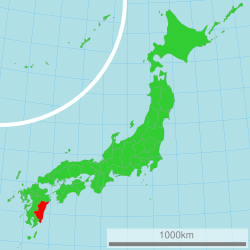
Takachiho (高千穂) is a town of approximately 11,000 people in Nishi-Usuki-gun, in the far north of Miyazaki Prefecture (宮崎県). It sits at the boundary of Miyazaki, Kumamoto, and Ōita — the three prefectures whose interior mountain ranges define central Kyushu’s spine. The Gokase River cuts through the town, carving the Takachiho Gorge with its vertical basalt walls; the volcanic geology that produced those walls is the same geology that produced Mount Aso 50 km to the northwest, one of the world’s largest active calderas.
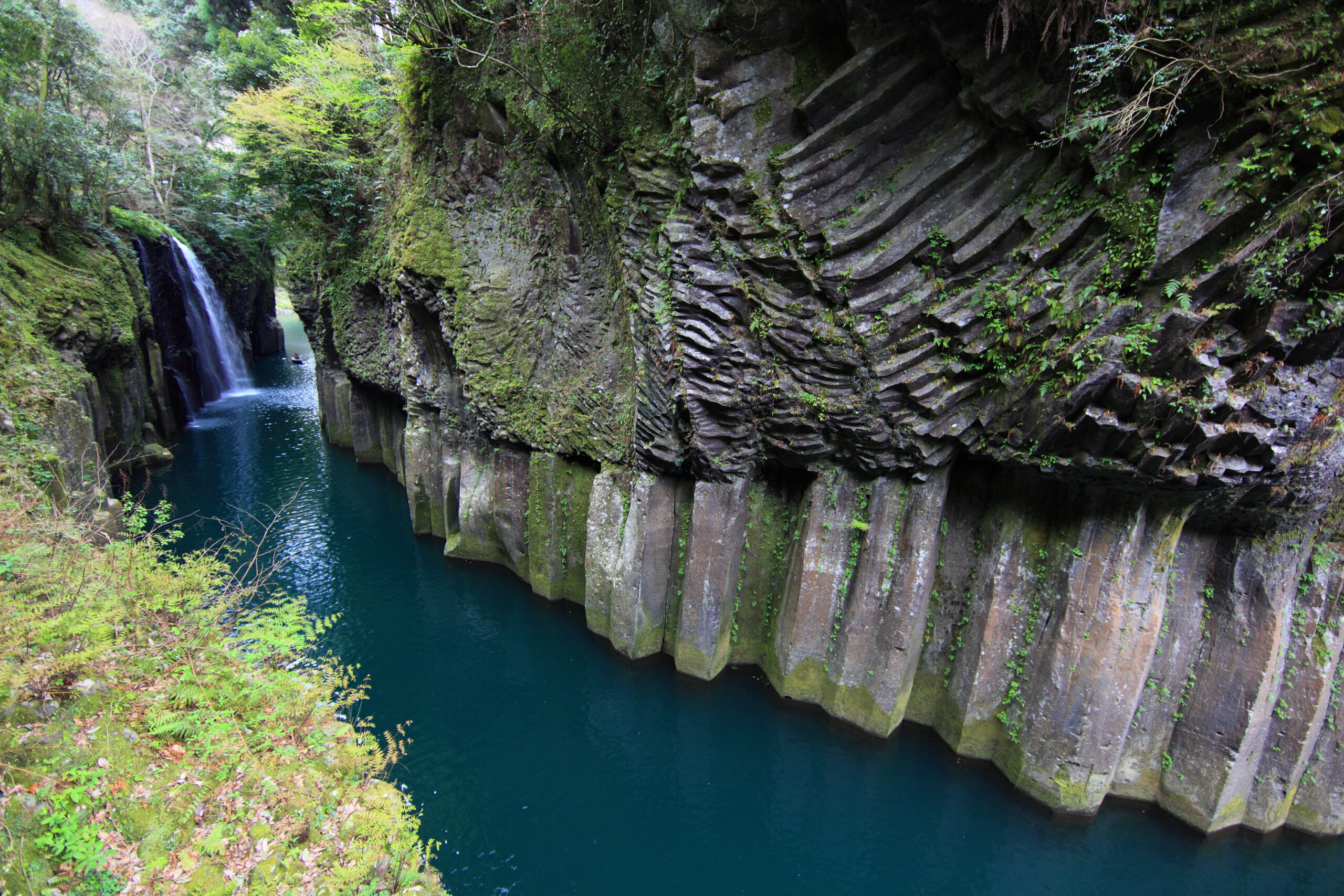
Practically, for an international visitor: Takachiho is roughly 2.5–3 hours by car or bus from Kumamoto Airport, which is the closest international gateway. From Fukuoka it is about 3.5 hours by car; from Miyazaki city, about 2 hours. There is no rail service to Takachiho — the JR Takachiho Line was closed in 2008 after typhoon damage, and the right-of-way was never reopened. Most international visitors arrive by rental car or by tour bus.
The town’s modern economy rests on three pillars: agriculture (rice terraces on the steep mountain slopes, Miyazaki beef from the surrounding pastures), tourism centered on the gorge and the kagura performances, and small-scale craft. The kagura masks and the kagura performance are themselves a major cultural-tourism draw. Mountain weather defines the year here: winter is cold and dry with frequent morning mist (kiri-tachi 霧立), summer is short and warm, and the autumn sea-of-clouds (unkai 雲海) view from Kunimi-ga-oka is one of Kyushu’s signature photographs.
The mythic anchor — Amaterasu, Ame-no-Uzume, and Ninigi-no-Mikoto
Takachiho’s place in Japanese culture is exceptional. It is the documented setting for two of the most important episodes in the Kojiki (古事記, 712 CE) and the Nihon Shoki (日本書紀, 720 CE) — the two oldest surviving Japanese chronicles, compiled at the Nara imperial court at the order of Empress Genmei and her successors.
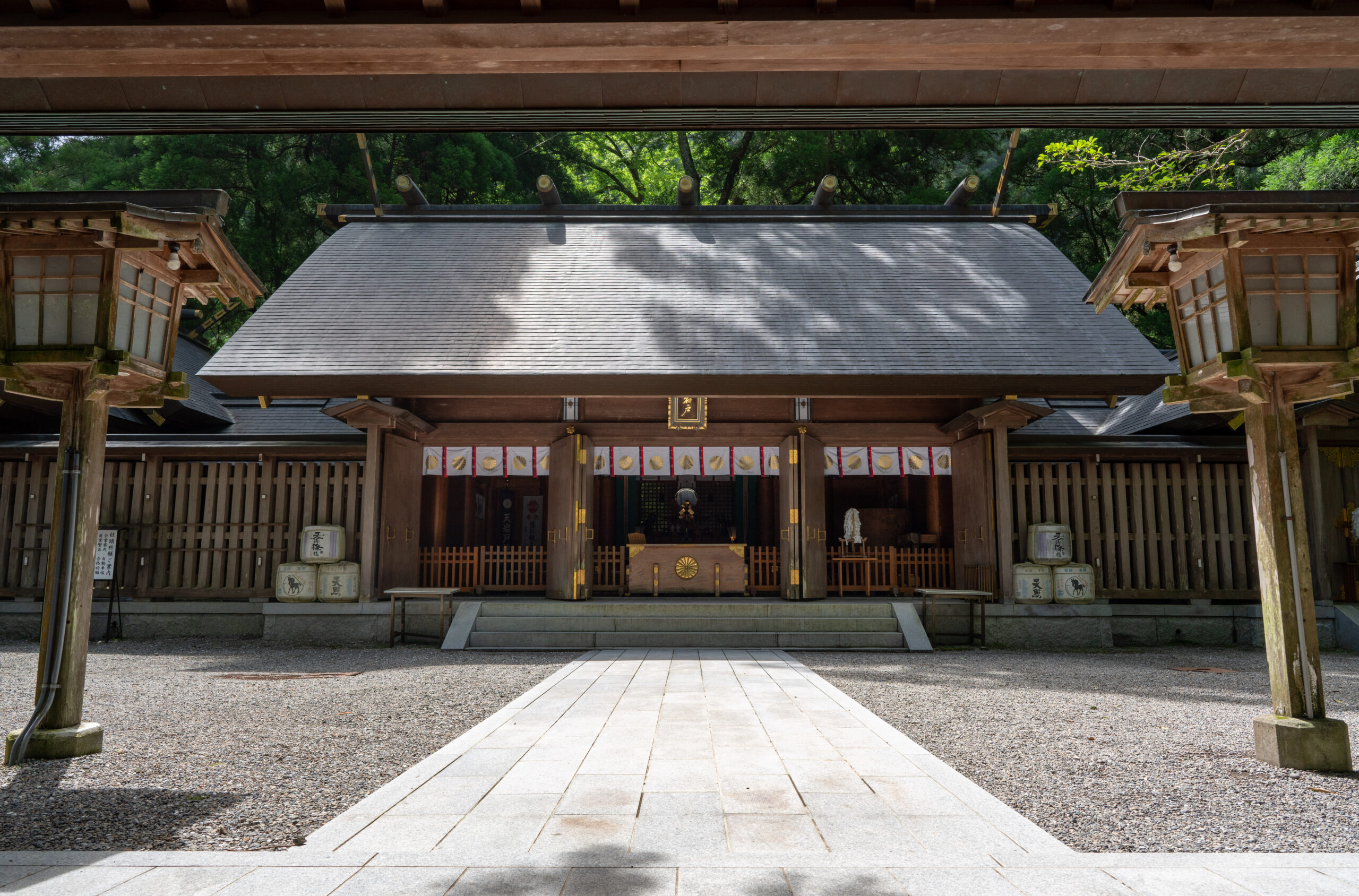
The first episode is the Ama-no-Iwato (天岩戸隠れ). The sun goddess Amaterasu (天照大神), after a violent conflict with her brother Susano-o, retreated into a cave called Ama-no-Iwato (“the heavenly rock-door”) and sealed it shut. The world plunged into darkness. The other deities of the heavenly plain gathered in council on the riverbed of Ama-no-Yasugawara (“the heavenly meeting-river”) to devise a way to draw her out. The goddess Ame-no-Uzume (天宇受売命) climbed onto an overturned tub and performed a dance so wild and uninhibited that the assembled gods burst out laughing. Amaterasu, curious about the noise, cracked the door of the cave to peer out. The strongman god Tajikarao seized the door and flung it away, and the goddess was reluctantly drawn back into the world. Sunlight returned. The Ama-no-Iwato Shrine (天岩戸神社) in Takachiho — about 8 km from the town center — marks the traditional location of the cave; the riverside cave-shrine of Ama-no-Yasugawara, where visitors today stack small stones to make wishes, is a ten-minute walk further on.
The second episode is the Tenson Kōrin (天孫降臨), the descent of the heavenly grandchild. Ninigi-no-Mikoto (邇邇芸命), grandson of Amaterasu, descended from the heavenly plain Takamagahara (高天原) to the mountain peak of Takachiho-mine (高千穂峯). From Ninigi descends Jimmu, the legendary first emperor of Japan, and from Jimmu the unbroken imperial line that the modern monarchy still traces to itself. The peak the Kojiki names is generally identified either with Takachiho-mine on the Miyazaki–Kagoshima border or with the Takachiho region of northern Miyazaki described in this article. Both traditions are old; both shrines mark the site.
“For Japanese culture, Takachiho is the place where the foundational mythology happened in the textual record — the closest equivalent to a Western foundational sacred site like Bethlehem or Mecca. The masks worn in the kagura dances are the iconography of that living myth.”
A 1,300-year timeline
-
712 CE — The Kojiki is compiled at the Nara court. The Ama-no-Iwato and Tenson Kōrin episodes are explicitly set at Takachiho. -
720 CE — The Nihon Shoki follows, restating the descent of Ninigi-no-Mikoto at Takachiho-mine. -
10th–12th c. — Heian-period kagura is formalized: court mikagura at the imperial palace, parallel sato-kagura at provincial shrines including Takachiho. -
12th c. onward — Takachiho Shrine Yokagura, the 33-dance night cycle, becomes the documented form of the local tradition. -
Edo period (1603–1868) — Mask types stabilize into the canonical set: oni-men, ko-omote, okina, tengu, sanbaso. Hereditary roles develop in each neighborhood shrine’s troupe. -
1978 — Japan’s Agency for Cultural Affairs designates the Takachiho Yokagura a National Important Intangible Folk Cultural Property. -
2008 — The JR Takachiho Line is closed after typhoon damage; the town becomes road-access only, reinforcing its remote character. -
Today — Roughly twenty neighborhood shrines still perform the full all-night yokagura cycle each winter. A nightly one-hour demonstration at Takachiho Shrine runs year-round at 20:00 (¥1,000).
The Yokagura today — a 33-dance cycle, performed dusk to dawn
Yokagura (夜神楽, “night-kagura”) is the cycle of 33 dances performed by masked performers between mid-November and mid-February at Takachiho Shrine and at the neighborhood shrines scattered through the surrounding valleys. The full cycle takes roughly seven hours, from sunset to dawn, performed continuously on the wooden floor of the kagura-den (神楽殿) — the shrine’s dance hall. The 33 dances together span the cosmological narrative: the descent of the gods, the Ama-no-Iwato episode (with Uzume’s dance and Tajikarao’s rock-throwing as set pieces), the establishment of human society on the islands, and the agricultural-fertility blessings that close the cycle.
Two features distinguish Takachiho’s kagura from Noh theater, with which Western readers may be more familiar. First, the performers are not professional actors — they are farmers, school teachers, and shopkeepers from the Takachiho community. Each neighborhood shrine has its own kagura troupe with hereditary roles, often passed father-to-son or uncle-to-nephew through generations. Second, the dances are explicit Shintō ritual, not theatrical performance. The masks themselves are treated as sacred objects when in use, stored carefully in the shrine between performances and rotated according to ritual calendar.
For an international visitor, two access points: the Takachiho Shrine evening demonstration (神楽の里) presents a one-hour abridged set every night at 20:00 year-round at the Takachiho Shrine kagura-den, with English subtitles displayed on a screen at the side. Admission is ¥1,000. The full all-night yokagura at neighborhood shrines runs on specific dates between November and February; advance arrangement through the Takachiho Tourist Association is required, and the experience is closer to overnight pilgrimage than to a theater visit — local audiences bring blankets, share food, and rotate in and out across the night.
The masks — five canonical types
A full kagura troupe maintains a collection of 30–50 masks. Some are working masks in current rotation; others are heirlooms, occasionally a century or more old, held in storage and only used on specific dates. The carving masters — fewer than 10 active in Takachiho today — work in hinoki cypress, painted with traditional mineral pigments and finished with gold leaf at the brows and lips of the oni and tengu types. A working wooden mask takes weeks to carve and finish.
The resin replicas, including the piece this article covers, are produced for the decorative-souvenir market by Takachiho-affiliated craftspeople using molds taken from the classical mask shapes. They are not used in actual performance. They are intended for home display: in a tokonoma alcove, on a wall in a study or library, near (not on) a kamidana, or in a meditation or yoga space. The choice of oni + ko-omote in a single set is canonical — the two faces represent the yang (dramatic, externalized) and yin (contemplative, internalized) polarities of kagura iconography.
What the mask carries for an international buyer
A Takachiho kagura mask is not generic Japanese decoration. It is the iconography of a specific living religious practice rooted in a specific place — comparable, in cultural register, to displaying a Greek Orthodox icon or a hand-painted reproduction of an Ethiopian processional cross. Japanese visitors to a home that displays a kagura mask will recognize its origin immediately; the object reads as placed, not decorative.
Common display contexts that international owners report: in a home library or study, where the oni faces outward as a kind of guardian; in a dining-room tokonoma alcove paired with a hanging scroll; in a personal meditation or yoga space; or in a Japanese-themed restaurant, ryokan-style guest room, or tea-ceremony room. The piece works on a wall, on a shelf with a small stand, or even propped behind books — the resin handles all of these without warping.
📦 Shipping & where to buy from outside Japan
The Takachiho cooperative’s masks are individually finished, and makers and distributors may offer different purchase routes. When choosing a mask, consider whether it is resin or wood, how it is finished, and whether it is intended for display or performance use.
- Amazon JP Global Store — compare makers and materials before buying; confirm the origin and construction.
- Amazon US — searching for Japanese kagura masks surfaces several products; verify the maker and origin because quality varies.
- Direct from Takachiho — the Takachiho Tourist Information Center near Takachiho Shrine sells masks year-round at retail and can arrange international shipping for travelers who buy in person but don’t want to carry the masks home in a suitcase.
- Proxy services (Buyee / Tenso) — useful for Rakuten or Yahoo! Japan stores that do not ship abroad directly; service fees apply.
- Specialty importers in the US/EU — Japan Society shops, the Mingei International Museum gift shop, and similar destinations sometimes carry kagura masks. Stock is irregular and prices generally higher than Amazon JP.
Customs note: decorative masks are unrestricted personal import in the US, EU, UK, Canada, and Australia. There are no CITES or restricted-material concerns with resin. Some buyers prefer to declare the religious-symbolic nature on customs forms if asked; it is not required.
Where to buy
| Store | Item / Variant | Price | Notes |
|---|---|---|---|
| 🇺🇸 Amazon.com (US) | Browse Japanese kagura & demon masks | varies (USD) | Best if you’re shopping from the US — Prime shipping, USD pricing, no international customs. Amazon US carries kagura and Japanese demon masks from several sellers, useful for comparing styles and size tiers. Verify maker and origin before buying. |
| 🇯🇵 Amazon JP Global Store | Oni-men + Ko-omote pair, 13.5 cm, resin | Varies — see search results | International availability depends on the seller. |
| Maker direct (Takachiho) | Walk-in: Takachiho Tourist Information Center | — | Retail at the Takachiho Shrine area. International shipping can be arranged by the shop; ask at the counter. No online cart. |
| Proxy services (Buyee / Tenso) | Rakuten / Yahoo! Japan stores | — | Useful when Amazon JP is out of stock; adds about $10–$20 USD over Amazon JP Global Store. |
Prices and availability as of May 16, 2026; verify at the retailer before purchase. USD figures are approximate (¥150/USD baseline).
What it does well
Weaknesses and things to verify before buying
- It is a replica, not a performance mask. Resin replicas are not used by working kagura troupes, which carve from hinoki cypress. If your interest is in owning the same material a performer uses, choose a wood-carved workshop piece rather than resin.
- The painted finish degrades in sunlight over years. The hand-painted palette uses pigments that fade with direct UV exposure. Display indoors and avoid spots that catch direct afternoon sun.
- The masks are not designed for face-wearing. The inside is unfinished, the eye and breathing apertures are decorative rather than functional, and the back of an oni-men is the wrong shape to seat against a real face. Treat as wall or shelf objects.
- Amazon US products are not all Takachiho-made. Several sellers offer kagura-mask styling; verify the maker and country of origin before buying.
- The brand on Amazon JP is the Takachiho local distributor, not a single named workshop. If you want a specific master carver’s named piece, that path runs through the Takachiho Tourist Information Center or through Miyazaki regional craft galleries — not Amazon.
- Shipping window is 7–14 days through Global Store. Not a same-week-gift option. Plan ahead for birthdays or anniversaries.
- The cardboard packaging is standard, not gift-grade. If you’re sending this as a present, factor in a separate gift box or a furoshiki cloth wrap on arrival.
Conclusion — which buyer type are you?
Other ways to approach this purchase
❓ Frequently Asked Questions
Is this a real kagura performance mask?
No — it is a hand-painted resin replica, produced for the decorative-souvenir market by Takachiho-affiliated craftspeople. Working performance masks used by kagura troupes are carved from hinoki cypress and are not generally sold to the public. The resin replica uses molds taken from the classical mask shapes and is painted in the canonical palette.
Can it be shipped to the US, EU, or Australia?
Yes, via Amazon JP Global Store. The pair weighs about 200 g and ships in a flat-pack cardboard box; estimated international shipping is $8–$20 USD, with typical transit of 7–14 days. Resin handles international shipping with effectively no transit damage. There are no CITES or restricted-material concerns.
Is it appropriate to display a Shintō-related mask in a non-Japanese home?
Yes. The resin decorative replicas are explicitly produced for the souvenir and home-display market and are not consecrated ritual objects. Japanese visitors to your home will recognize the iconography as Takachiho kagura and read the display as respectful interest in the tradition. The masks are commonly displayed in homes, restaurants, and tea-ceremony rooms outside Japan.
How do I clean and care for the masks?
Dust with a soft brush — a clean dry watercolor brush works well — and avoid wet cleaning, which can lift the hand-painted pigments. Keep the masks out of direct sunlight, since UV exposure fades the paint over the course of years. For wall mounting, use small museum-grade hanging hooks or 3M-style adhesive picture hangers; at 200 g for the pair, the load is well within adhesive-hanger range.
How does it compare with a wood-carved version?
A wood-carved mask in hinoki cypress is closer to the material used by working kagura troupes than resin. It is more sensitive to dry indoor climates and humidity-shocked transit, so it needs careful acclimatization and display conditions. Resin is generally the easier entry for display; wood suits buyers seeking a workshop-grade object.
Can I watch a real kagura performance if I visit Takachiho?
Yes — two access points. The Takachiho Shrine kagura-den hosts a one-hour abridged demonstration every night at 20:00, year-round, with English subtitles displayed on a side screen; admission is ¥1,000. The full all-night yokagura at neighborhood shrines runs on specific dates between mid-November and mid-February, with advance arrangement required through the Takachiho Tourist Association.
What’s the cultural significance of pairing oni with ko-omote?
The two faces stand for the yang and yin polarities of kagura iconography: the dramatic externalized oni (demon, often defeated by a Shintō god in the dance) paired with the contemplative internalized ko-omote (a quiet young-female face shared with Noh theater). Buyers often display them side by side, with the oni on the left and the ko-omote on the right, mirroring the convention of how they would face an audience in a kagura-den.
jpmono.com is curated by a Japan-based editorial team (working out of Toyama in the Hokuriku region and Nara in Kansai) and is independent. We do not take payment from the makers we feature; income comes from affiliate links. Read more about our editorial standards.
🤖 Editorial note—this article was drafted with AI-assisted research and reviewed by a jpmono editor. Factual claims about Takachiho, the Kojiki and Nihon Shoki narratives, and the kagura tradition draw on cultural and craft references. Prices and availability vary by maker and time.
Affiliate disclosure: jpmono.com may earn a commission on qualifying purchases made through links on this page, at no additional cost to you.