![Iwatsuki Gogatsu-Ningyō Compact Kabuto Helmet — 380-Year Saitama Doll Tradition (¥29,800 / ≈$199 USD) [2026 Buyer’s Guide]](https://jpmono.com/wp-content/uploads/2026/05/watmosphere-iwatsuki-gogatsu-ningyo-kabuto-where-to-buy-2026-featured-1.jpg)
Iwatsuki ningyō (岩槻人形) is the doll tradition of Iwatsuki, a former Edo-period post-station town that now sits inside Saitama City, about 30 km north of central Tokyo. Per the Iwatsuki Doll Co-op’s published figures and METI’s craft register, the district produces roughly half of all hina-ningyō (Girls’ Day) and gogatsu-ningyō (Boys’ Day) dolls made in Japan — the densest concentration of ceremonial doll workshops in the country. The craft was formally designated a METI Traditional Craft Product in 2007.
This article covers a specific 8-go compact kabuto helmet set listed under the Iwatsuki-Kinsei (岩槻謹製, “respectfully made in Iwatsuki”) quality mark and sold on Amazon Japan by the seller Watmosphere. The design references Date Masamune’s iconic crescent-moon-crest helmet, comes pre-mounted in a glass-front display case, and is sized to live on a console or chest of drawers rather than the 1.5 × 1.5 m floor footprint that a full-scale yoroi (armor) display would require.
What follows is a catalog-style read of the listing as of May 17, 2026 — who it fits, who should skip it, how Iwatsuki’s doll district came to dominate Boys’ Day production, and how to actually receive one outside Japan. Spec, price, and shipping facts come from the Amazon JP listing snapshot; live pricing may have shifted since this writing.
🔄 Updated:
⏱️ Read time: ~12 min
🗾 Made in: Iwatsuki, Saitama

- Who this is for — and who should skip it
- Product overview (from published specs)
- 📍 Where this comes from — Iwatsuki, the doll capital of Kantō
- Which variant should you choose?
- Price snapshot across stores
- What it does well
- Weaknesses and things to verify before buying
- Conclusion — which buyer type are you?
- Other ways to approach this purchase
- 🏆 Editor’s Pick
- ❓ Frequently Asked Questions
- 📌 Related Japanese Crafts
Who this is for — and who should skip it
- Have a son, grandson, or nephew turning 1–10 and want a culturally specific Boys’ Day gift
- Live in an apartment and cannot dedicate a tatami room to a full yoroi (armor) display
- Want a verifiable Iwatsuki-authorized maker rather than a generic mass-imported set
- Prefer one-piece “case-included” sets that store as a single unit between seasons
- Are comfortable with a ¥29,800 (≈ $199 USD) ceremonial-display budget
- Want a hands-on / play helmet for a child — this is display only
- Are shopping for a full-scale yoroi (armor) set; 8-go is the compact format, not the heirloom format
- Need same-week delivery — international Amazon JP Global Store transit is typically 1–3 weeks
- Cannot accommodate a ~30 cm-tall glass case on a stable, indirect-light surface
- Already own a family kabuto handed down from previous generations (tradition discourages doubling up)
Product overview (from published specs)
The table below summarizes the listing as of May 17, 2026. Only the Amazon JP listing snapshot is available; live pricing may have shifted, and Amazon US does not individually list this exact item.
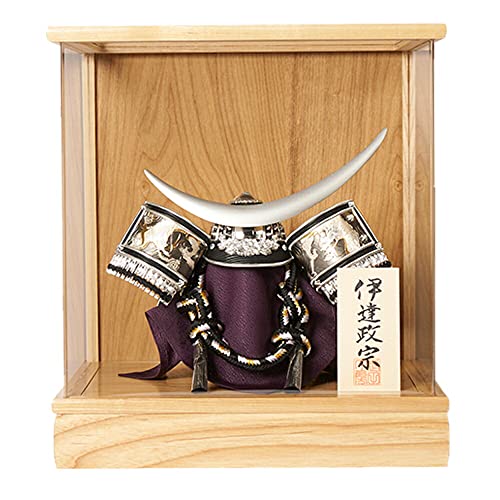
Iwatsuki Gogatsu-Ningyō Compact Kabuto Helmet
五月人形 コンパクト 日本製 岩槻謹製 兜 ケース入り 収納飾り 8号 御洒落 子供の日 伊達政宗
残り4点 ご注文はお早めに · Sold by Watmosphere · ASIN B0BQVB6XYC
Price and availability as of 2026-08-31 02:30 JST. The Amazon listing at the time of purchase is authoritative. jpmono.com earns a commission on qualifying purchases at no extra cost to you.
| Spec | Value | Source |
|---|---|---|
| Maker / mark | Iwatsuki-Kinsei (岩槻謹製), sold by Watmosphere | Amazon JP Global Store listing |
| Origin | Iwatsuki, Saitama City, Saitama Prefecture, Japan | Listing + METI craft register (2007) |
| Design reference | Date Masamune-style kabuto with crescent-moon (mikazuki) front crest | Listing feature list |
| Size class | 8-go (約30 cm tall) — compact apartment format | Listing dimensions |
| Materials | Metal kabuto + brocade lacing + lacquered wood base + glass-front display case | Listing material section |
| Weight | Approximately 2 kg (helmet + case) | Listing |
| Price | ¥29,800 (≈ $199 USD as of May 2026) | Amazon JP listing |
| ASIN | B0BQVB6XYC | Amazon JP |
| International shipping | Amazon JP Global Store ships to ~70 countries; estimate $40–$80 USD (bulky 2 kg parcel) | Amazon JP listing |
📖 Glossary — Japanese doll terms used in this guide
- Gogatsu-ningyō (五月人形)
- Literally “May dolls.” Ceremonial figures displayed for Tango-no-Sekku (端午の節句, Boys’ Day) on May 5. Typically a kabuto, a yoroi, or a warrior-figure doll.
- Hina-ningyō (雛人形)
- The Girls’ Day counterpart, displayed for Hinamatsuri on March 3. Iwatsuki makes roughly half of these too.
- Kabuto (兜)
- The samurai helmet — the top piece of a yoroi (full armor). On its own, mounted on a stand, it is the most common compact-format gogatsu-ningyō.
- Yoroi (鎧)
- The full samurai armor set — helmet, mask, cuirass, sleeves, skirt. Heirloom-format yoroi displays typically need ~1.5 × 1.5 m of floor space.
- Iwatsuki-Kinsei (岩槻謹製)
- “Respectfully made in Iwatsuki.” A quality designation that the doll was assembled by an Iwatsuki-authorized workshop, rather than imported and rebadged.
- 8-go (8号)
- A traditional Japanese sizing unit for ceremonial dolls. 8-go works out to roughly 30 cm tall — the standard “compact apartment” size class.
- Tango-no-Sekku (端午の節句)
- May 5, originally one of the five seasonal festivals; now Children’s Day, but specifically the day of celebration for boys and the display of gogatsu-ningyō.
- Date Masamune (伊達政宗, 1567–1636)
- Lord of the Sendai domain. His crescent-moon-crest kabuto is one of the three most recognized samurai helmet silhouettes in Japan; the others are Tokugawa Ieyasu’s and Sanada Yukimura’s.
📍 Where this comes from — Iwatsuki, the doll capital of Kantō

Iwatsuki sits in the southeastern corner of Saitama Prefecture, on the flat alluvial plain north of Tokyo. It is no longer a separate city — it merged into Saitama City in 2005 — but the doll district survives as a self-conscious ward (Iwatsuki-ku) with its own co-op, museum, and an annual doll-and-toy festival. The Moto-Arakawa river system runs nearby, and the area was historically rich in paulownia (kiri) wood: light, soft, and tight-grained, exactly the material doll torsos and armor stands have always wanted. That is the proximate reason the trade settled here; the more important reason is roads.
Iwatsuki was a post-station on the Nikkō Onari-kaidō, the ceremonial road the Tokugawa shōguns used to travel from Edo to Nikkō Tōshō-gū. Anyone supplying the Tokugawa court — and that included the doll-makers of Kyoto — wanted to be on that road, close enough to Edo (modern Tokyo) to take orders but far enough out that workshop rents were a fraction of central-Edo prices. In the 1640s, doll makers from Kyoto’s traditional doll district began relocating to Iwatsuki. Over the next century, what had been a Kyoto craft put down deep roots in Saitama.
- 1457 — Iwatsuki Castle built; the town becomes a regional administrative center.
- 1640s — Kyoto doll artisans begin relocating to Iwatsuki to be closer to the Edo market.
- 1700s — Iwatsuki overtakes other Kantō towns and becomes the dominant doll producer of the region.
- 1868 — Edo is renamed Tokyo; the doll trade carries over uninterrupted as a domestic luxury craft.
- 2005 — Iwatsuki City is merged into Saitama City, becoming Iwatsuki Ward.
- 2007 — METI designates Iwatsuki ningyō a Traditional Craft Product (伝統的工芸品).
- 2020 — The Iwatsuki Ningyō Museum (Saitama City Iwatsuki Doll Museum) opens, the first national-grade public doll museum.
- 2026 — Iwatsuki workshops continue to produce ~50% of Japan’s national hina-ningyō and gogatsu-ningyō supply.
The economic gravity of that 1640s migration is hard to overstate. The Iwatsuki Doll Co-op reports that the ward today produces approximately half of all hina-ningyō and gogatsu-ningyō made in Japan. That is not a regional specialty — it is the national supply. The other half is split between Kyoto, Tokyo (Edo-style), Hakata, and a handful of smaller centers. So when a Japanese family buys a Boys’ Day kabuto for a newborn son, the statistical likelihood is that it was assembled in Iwatsuki.
“Roughly half of every Japanese family’s Boys’ Day helmet and Girls’ Day princess set comes out of one ward of one city in Saitama — a craft concentration that has held for nearly three hundred years.”
The Iwatsuki-Kinsei mark on this listing is the co-op’s quality designation. It indicates the piece was assembled in an Iwatsuki-authorized workshop following the traditional joinery (no metal fasteners in the lacing), the traditional brocade-and-leather odoshi (lacing) technique, and the traditional finishing. It does not mean any single artisan made every part — modern doll-making is a multi-workshop chain (metal-smithing, brocade, lacquer, joinery, final assembly) — but it means each part came through that chain, not from offshore mass production.
The Date Masamune crescent-moon kabuto on this set is one of the three most-replicated samurai helmets in the Japanese market, alongside Tokugawa Ieyasu’s and Sanada Yukimura’s. The historical Date Masamune was the lord of the Sendai domain (modern Miyagi) who died in 1636, and his helmet is held to symbolize strength, intelligence, and longevity — qualities a family traditionally wishes for a son. The 8-go compact format here exists because postwar urban Japanese apartments simply cannot accommodate the traditional 1.5 × 1.5 m floor-format yoroi display. That is the practical answer to “why does a 380-year-old craft now come in a glass case smaller than a microwave.”
Which variant should you choose?
Only one variant is currently listed on Amazon JP for this exact set. If you want the same Iwatsuki-Kinsei certification at a different size, size up via the maker-direct route (see “Other ways to approach this purchase” below); 10-go (~37 cm) and 12-go (~45 cm) versions exist but are not on Amazon JP at this writing.
Iwatsuki-Kinsei Date Masamune Kabuto, 8-go with display case
The Date Masamune crescent-moon front crest, brocade lacing, lacquered wood base, glass-front display case. 8-go (~30 cm tall) compact format — fits a console or chest of drawers; does not need a tatami room. Single-piece “case-included” set, so off-season storage is one unit, not five.


Price snapshot across stores
Based on listings as of May 17, 2026. JPY is the authoritative price; USD figures are approximate at ¥150/USD and may shift with the exchange rate.
| Store | Item / Variant | Price | Notes |
|---|---|---|---|
| 🇺🇸 Amazon.com (US) | Browse Japanese kabuto & gogatsu-ningyō display sets | varies (USD) | Best if you are shopping from the US — Prime shipping, USD pricing, no international customs. Amazon US carries Japanese kabuto display sets from various makers — useful for comparing scale, mounting style, and price tiers. This exact Iwatsuki-Kinsei piece is sourced from Japan (next row). |
| 🇯🇵 Amazon JP Global Store | Iwatsuki-Kinsei Date Masamune 8-go, glass case included (B0BQVB6XYC) | ¥29,800 (≈ $199 USD) | Ships internationally from Japan. ~2 kg parcel, international shipping fee approximately $40–$80 USD depending on destination. Listing handles customs paperwork. |
| Maker direct (Iwatsuki Doll Co-op shops) | Various 8-go / 10-go / 12-go kabuto, Iwatsuki-Kinsei certified | ¥25,000 – ¥250,000 typical range | Walk-in shops in Iwatsuki Ward, Saitama City. Many do not ship overseas directly; useful if you are visiting Japan or know someone forwarding from a Japanese address. |
| Proxy services (Buyee / Tenso) | Same B0BQVB6XYC listing, forwarded | ¥29,800 + ~¥3,000 service fee + shipping | Only useful if Amazon JP Global Store will not ship to your country. Otherwise, the Global Store path is simpler. |
What it does well
Weaknesses and things to verify before buying
- Display only — not a toy. The brocade lacing, metal kuwagata (horn crest), and lacquered base will not survive a curious child. If the recipient is the boy the gift is for, plan for an adult to handle setup and storage.
- Sunlight will fade the brocade. Iwatsuki ningyō care guidance recommends keeping the case out of direct sunlight year-round; the brocade odoshi (lacing) and gold-leaf accents are pigment-sensitive. South-facing windowsill is the worst place to display.
- Off-season storage matters more than people expect. The recommended discipline is to take the helmet down soon after May 5 (some sources say within a week) and keep it boxed for the next ~11 months. Leaving it out year-round is the most common cause of brocade fade and metal tarnish.
- International shipping is bulky for a 2 kg parcel. The display case is glass-fronted and rigid; carriers price it by volume, not pure weight. Expect $40–$80 USD shipping to most destinations, and longer transit (1–3 weeks) than a typical Amazon order.
- “Iwatsuki-Kinsei” is not the same as “single-artisan handmade.” Modern Iwatsuki ningyō are produced through a multi-workshop chain — metalsmith, brocade weaver, lacquer-finisher, joiner, assembler. The mark certifies the chain is Iwatsuki-authorized; it does not mean one named individual made every part. If you specifically want a named-artisan piece, the maker-direct shops in Iwatsuki can quote you those (¥150,000+ typically).
- Live pricing may have shifted. The ¥29,800 figure is the listing snapshot as of May 17, 2026. Gogatsu-ningyō pricing rises seasonally in the weeks before May 5 and discounts after. The Amazon JP listing reflects current price; the snapshot here may not.
- One kabuto per son, traditionally. Japanese custom holds that each boy in a family receives his own gogatsu-ningyō; passing one down is generally not done. If you already own one for a son, this is a duplicate that custom does not really sanction.
Conclusion — which buyer type are you?
Other ways to approach this purchase
🏆 Editor’s Pick

Iwatsuki-Kinsei Date Masamune 8-Go Compact Kabuto
- Iwatsuki-Kinsei mark — assembled in the ward that supplies ~50% of Japan’s national gogatsu-ningyō output
- 8-go (~30 cm) compact format fits a console; full-tatami floor space not required
- Case-included single-unit storage — one box for the 11 off-season months
❓ Frequently Asked Questions
Does Amazon JP Global Store ship this kabuto outside Japan?
What does “Iwatsuki-Kinsei” mean and why does it matter?
Can children handle the helmet, or is it display-only?
Is the 8-go size large enough to feel ceremonial?
When is this typically displayed, and when is it put away?
Why Date Masamune specifically — what does the crescent moon mean?
Can I find this exact item on Amazon US?
jpmono.com is curated by a Japan-based editorial team (working out of Toyama in the Hokuriku region and Nara in Kansai) and is independent. We do not take payment from the makers we feature; income comes from affiliate links. Read more about our editorial standards on the About page.
Editorial note: this article was researched against the Amazon JP listing snapshot for ASIN B0BQVB6XYC (Iwatsuki-Kinsei Watmosphere kabuto), the Iwatsuki Doll Co-op’s published production figures, and METI’s traditional-craft register. Drafting and visual structuring were assisted by an AI writing tool under human editorial review; all factual claims are anchored to the cited listing and craft-register sources.
Affiliate disclosure: jpmono.com may earn a commission on qualifying purchases made through links on this page, at no additional cost to you.