![Ryūkyū Glass Aranami Cobalt Tumbler by Genka Genkichi — 450 ml Hand-Blown Okinawa Glass (¥5,288 / ≈$35 USD) [2026 Buyer’s Guide]](https://jpmono.com/wp-content/uploads/2026/05/genka-genkichi-aranami-cobalt-tumbler-where-to-buy-2026-featured.jpg)
Ryūkyū glass (琉球ガラス) is the hand-blown glass tradition of Okinawa — Japan’s southernmost prefecture, an archipelago that stretches roughly 1,000 km southwest from Kyushu toward Taiwan. Unlike most Japanese crafts whose roots run four hundred to a thousand years, modern Ryūkyū glass is only about eighty years old. Its origin is precise and unromantic: in the wreckage of the 1945 Battle of Okinawa, under American military occupation, a handful of Okinawan glassblowers began melting down discarded U.S. military beer and soda bottles and hand-blowing the recycled glass into household ware for the civilian population.
The recycled feedstock left signature traits — visible air bubbles (kihō, 気泡) from incomplete melting, free-form thickness, and saturated colors carried from the original Coca-Cola, beer, and liquor bottles. By the 1960s those traits had hardened into a deliberate aesthetic; in 1998 Okinawa Prefecture formally designated Ryūkyū glass a Traditional Craft. Genka Genkichi (源河源吉) is one of the most respected named craftspeople working in that tradition today, operating his own workshop near Naha.
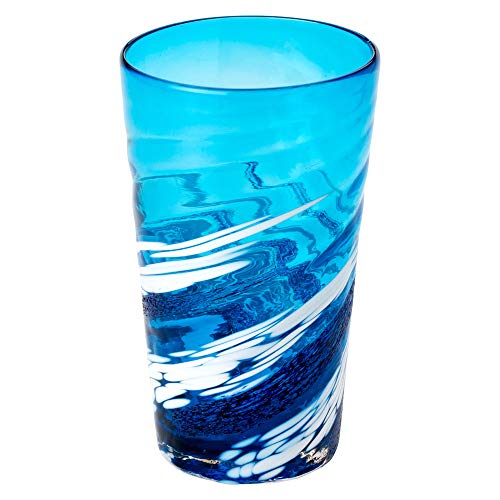
This guide covers Genka’s “Aranami” (荒波, “rough waves”) Series cobalt tumbler — a 450 ml hand-blown highball / beer glass in his signature deep cobalt blue — at ¥5,288 (≈ $35 USD as of May 2026). It sits at the practical entry point for a real named-craftsperson Ryūkyū piece, well below the ¥10,000–20,000 collector-grade range. We compare it to Genka’s own Aranami long beer glass and Chura-umi taru glass, to other Okinawan workshops (Okuhara Glass, Suikei-gama), and to mainland Japanese cut-glass traditions (Edo kiriko, Satsuma kiriko) so an international reader can place it accurately before buying.
🔄 Last updated:
⏱ Read time: ~13 min
🗾 Origin: Okinawa Prefecture, Japan
- Who this is for — and who should skip it
- Product overview (from published specs)
- 📍 Where this comes from — place, era, and the craft tradition
- 📦 Shipping & where to buy from outside Japan
- Price snapshot across stores
- What it does well
- Weaknesses and things to verify before buying
- Conclusion — which buyer type are you?
- Other ways to approach this purchase
- 🏆 Editor’s Pick
- ❓ Frequently Asked Questions
- 📌 Related Japanese Crafts
Who this is for — and who should skip it
- Want a daily-use tumbler at highball / beer / iced-tea capacity (450 ml is the Western-standard tall-drink size).
- Care that “Ryūkyū glass” actually came from Okinawa, not a Chinese-import re-brand.
- Prefer named-craftsperson work over anonymous OEM pieces, but do not need a ¥15,000+ collector grade.
- Like saturated cobalt blue and visible air bubbles as a design feature.
- Are looking for a one-piece gift with a clear story behind it.
- Want machine-precise, thin-walled crystal stemware for formal Western fine dining.
- Need a dishwasher-safe, stackable everyday glass for a busy household.
- Plan to use it for hot drinks — thick walls help, but thermal shock is still a real risk.
- Expect identical pairs — hand-blown pieces vary slightly in shape, thickness, and bubble pattern.
- Prefer the geometric precision of Edo kiriko or Satsuma kiriko cut glass.
Product overview (from published specs)
Per the Amazon JP listing as of May 16, 2026, and Genka Genkichi workshop attribution:
Ryūkyū Glass Aranami Cobalt Tumbler by Genka Genkichi
琉球ガラス 荒波シリーズ コバルトタンブラー 450ml 作者:源河源吉 沖縄県の工芸品 吹きガラス・コバルトブルー ハイボール・ビール用 日本製
現在在庫切れです。 · ASIN B01L3NEGZM
Price and availability as of 2026-08-31 02:30 JST. The Amazon listing at the time of purchase is authoritative. jpmono.com earns a commission on qualifying purchases at no extra cost to you.
| Item | Detail |
|---|---|
| Maker | Genka Genkichi (源河源吉), Okinawa |
| Series | Aranami (荒波, “rough waves”) — signature cobalt line |
| Material | Hand-blown soda-lime glass, cobalt-blue colored, with characteristic Okinawan air bubbles (kihō) |
| Dimensions | ⌀ 8 × H 13 cm (approximate) |
| Capacity | 450 ml |
| Weight | Approximately 320 g (heavy free-form Ryūkyū style) |
| Made in | Okinawa Prefecture, Japan — listing explicitly labeled “沖縄県の工芸品” (Okinawa Prefecture craft product) |
| Price | ¥5,288 (≈ $35 USD as of May 2026, ¥150/USD baseline) |
| ASIN | B01L3NEGZM |
| International shipping | Amazon JP Global Store, most major destinations, estimated $15–30 USD shipping |
Sources: Amazon US search (primary, moonill-20) for comparable Japanese hand-blown glassware; Amazon JP Global Store listing for B01L3NEGZM (secondary, moonill-22) as the sourced listing; Genka Genkichi workshop attribution and Okinawa Prefecture craft designation.
📖 Glossary — Japanese craft terms used in this guide
Ryūkyū glass (琉球ガラス) — hand-blown glass tradition native to Okinawa; modern form developed after 1945 from recycled U.S. military bottles. Okinawa Prefecture Traditional Craft (1998).
Kihō (気泡) — literally “air bubble.” The visible bubbles inside Ryūkyū glass are a deliberate feature, not a defect — a legacy of incomplete melting in the early recycled-glass era.
Aranami (荒波) — “rough waves.” The name of Genka Genkichi’s signature deep-cobalt line.
Chura-umi (美ら海) — “beautiful sea” in Okinawan dialect (Uchinaaguchi). Also the name of Okinawa’s most famous aquarium, and of Genka’s lighter-colored second line.
Fukigarasu (吹きガラス) — hand-blown glass; the technique used for all Ryūkyū glass pieces.
Ryūkyū Kingdom (琉球王国, 1429–1879) — independent monarchy that ruled the Okinawan archipelago with its own language, religion, and trade relationships before annexation as Okinawa Prefecture in 1879.
Shokunin (職人) — craftsperson / artisan. Used here to distinguish named-craftsperson work from anonymous factory-OEM Ryūkyū-style glass.
Mingei (民芸) — folk-craft aesthetic movement (1920s onward) that emphasized everyday utility and unsigned artisan work. Okuhara Glass Workshop is the most mingei-aligned Ryūkyū glass maker.
📍 Where this comes from — place, era, and the craft tradition

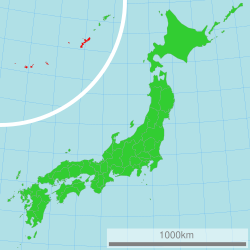
The region — Okinawa Prefecture, southwestern Japan
Okinawa Prefecture (沖縄県) is the southernmost of Japan’s 47 prefectures — an archipelago of more than 160 islands stretching about 1,000 km southwest from Kyushu toward Taiwan. The largest island, Okinawa Hontō (沖縄本島), sits roughly 1,200 km southwest of Tokyo, 800 km from Osaka, and 700 km from Taipei. The prefectural capital, Naha (那覇), occupies the southwestern coast of Okinawa Hontō.
For international-reader geography: Naha is about 2.5 hours by plane from Tokyo Haneda, or 2 hours from Osaka. Naha Airport (OKA) has direct connections to Seoul, Taipei, Shanghai, Hong Kong, and other Asian destinations. The major Ryūkyū glass workshop areas cluster in Naha city, in Itoman city on the southern coast (home of the Ryūkyū Glass Mura theme park), and in the Yomitan and Onna village area along the central west coast.
Okinawa is also culturally and historically distinct from main-island Japan. Until 1609 it was the independent Ryūkyū Kingdom (琉球王国), with its own monarchy, language (Okinawan / Uchinaaguchi), religion, and trade relationships with China, Korea, and Southeast Asia. The Satsuma invasion of 1609 placed Ryūkyū under Japanese suzerainty; the 1879 Meiji annexation formally created Okinawa Prefecture. After the Battle of Okinawa in 1945 it was under American military administration for twenty-seven years before reverting to Japan in 1972.
That post-war American period is the immediate context for everything we now call Ryūkyū glass.
The historical anchor — 1945 onward, the post-war recycling origin
Most Japanese craft traditions are old. Echizen washi paper has been made for roughly 1,500 years; Tokoname-yaki pottery for about 1,000; Arita-yaki porcelain for 410. Modern Ryūkyū glass is around eighty years old. Its origin is uncommonly precise.
Okinawa was devastated by the 1945 Battle of Okinawa — the only WWII land battle fought on Japanese soil, with civilian casualties estimated at more than 80,000. Postwar reconstruction was bleak. The Okinawan economy was destroyed, the population lived in poverty under American military administration, and basic household goods were scarce.
In that vacuum, a small number of Okinawan glassblowers — some with limited pre-war small-scale glass production experience, others learning the craft from scratch — began making household glassware from recycled American military beer and soda bottles. The U.S. military based hundreds of thousands of troops on Okinawa; the empty Coca-Cola, beer, and liquor bottles accumulated in massive volume. Okinawan glassblowers gathered the bottles, melted them down in small furnaces, and hand-blew the recycled glass into tumblers, plates, and bowls for the civilian population.
The recycled-glass technique left a signature.
Incomplete melting trapped dissolved gas — air bubbles (kihō) inside the finished piece. Mainland Japanese glassmakers treated bubbles as defects; Okinawan glassblowers, working with the equipment they had, embraced them. Color carried through from the source bottles — green from Coca-Cola, amber from beer, clear from miscellaneous sources — and workshops soon mixed them deliberately. Walls of 5–8 mm thickness were typical, three to four times the mainland norm, because the bottle stock varied and blown pieces inherited that inconsistency.
By the late 1950s those features had hardened into a deliberate aesthetic. Ryūkyū glass had become its own tradition, not an Okinawan branch of mainland Japanese glassmaking.
- 1429 — Ryūkyū Kingdom unified; Naha becomes the trade-capital of an independent Okinawan monarchy.
- 1609 — Satsuma-domain invasion places Ryūkyū under Japanese suzerainty while preserving the local monarchy.
- 1879 — Meiji-era annexation formally creates Okinawa Prefecture.
- Late Meiji (~1880s–1900s) — First small-scale Okinawan glass production; tableware and bottles for the regional market.
- 1945 — Battle of Okinawa; American military occupation begins. Glassblowers start recycling U.S. military beer and soda bottles for civilian household ware.
- 1952 — Okuhara Glass Workshop founded in Naha — the oldest continuously-operating Ryūkyū glass workshop.
- 1950s–60s — Air bubbles, free-form thickness, and saturated colors refined into a deliberate Ryūkyū aesthetic.
- 1972 — Okinawa reverts from American administration to Japanese jurisdiction; mainland Japan retail begins stocking Ryūkyū glass.
- 1990s — Chinese-import “Okinawa-style” glass floods the tourist market; named-craftsperson workshops (Genka, Okuhara, Suikei-gama) differentiate as the authentic tier.
- 1998 — Ryūkyū glass formally designated an Okinawa Prefecture Traditional Craft. National METI designation is still pending as of 2026.
- 2026 — Approximately 40 active Ryūkyū glass workshops in Okinawa; named-craftsperson tier (Genka, Okuhara, Suikei-gama) co-exists with tourist-retail and imported imitation tiers.
“Mainland Japanese glassmakers treated bubbles as defects. Okinawan glassblowers, working with what the war had left them, made the bubbles the point.”
The 1972 reversion and the modern industry
In 1972 Okinawa reverted from American administration to Japanese jurisdiction. Twenty-seven years of separation had let the local craft economy evolve in isolation; reunion opened both markets and competition. Tokyo and Osaka department stores began stocking Ryūkyū glass as a tropical Japanese craft. Cheaper Chinese-made “Okinawa-style” glass started appearing in tourist retail. The named-craftsperson workshops emerged in the 1990s in direct response — Genka, Okuhara, Suikei-gama and others marking their pieces by signed origin so buyers could tell authentic Okinawan production from imitation.
Ryūkyū glass was formally designated an Okinawa Prefecture Traditional Craft in 1998. National METI designation — which Echizen washi, Nambu tetsubin, and Arita-yaki already hold — remains pending as of 2026.
The current industry is roughly tiered as follows.
Genka Genkichi — the maker of this tumbler
Genka Genkichi (源河源吉) is a named living Okinawa glassblower who operates his own workshop. He has been producing Ryūkyū glass for several decades; his pieces are stocked through specialized Okinawa-craft retailers and, more recently, through Amazon JP under the workshop’s name.
The Aranami (荒波, “rough waves”) Series is his signature line. It is a single-color overlay — deep cobalt blue across the entire body, inspired by the deep-ocean color of Okinawa’s offshore waters — and runs across multiple forms: a tumbler, a long beer glass, a taru-shape (barrel-form) glass. Air bubbles concentrate near the base, where the wall thickness is greatest.
The Chura-umi (美ら海, “beautiful sea”) Series is his second major line, in lighter ocean blues, pinks, ambers, and greens. It is more decorative and less formal than the Aranami — more aquarium-shop than ocean.
For an international buyer, the practical upshot: a Genka piece is verified as authentic Okinawan craft (the Amazon JP listing carries the “沖縄県の工芸品” / Okinawa Prefecture craft product label), is associated with a documented workshop, and sits at an entry price point in the named-craftsperson tier.
Visiting Okinawa
If you ever travel to Okinawa and want to anchor the craft context in person, the relevant stops are tightly clustered.
- Ryūkyū Glass Mura (琉球ガラス村), Itoman — glassblowing demonstrations and direct sales from member workshops. Daily 9:00–17:30.
- Okuhara Glass Workshop, Naha — open to visitors; founded 1952. Walking distance to the Naha–Shuri historic area.
- Shuri Castle (首里城) — the historic Ryūkyū Kingdom palace. Restoration after the 2019 fire is ongoing.
- Tsuboya Pottery Street (壺屋やちむん通り) — the parallel Okinawan craft tradition of Tsuboya-yaki pottery, about 1 km from central Naha.
- Chura-umi Aquarium (美ら海水族館) — Okinawa’s most famous tourist site and the visual reference for Genka’s Chura-umi color palette.
📦 Shipping & where to buy from outside Japan
Glass is unrestricted personal import in all major jurisdictions — no CITES concerns, no agricultural or alcohol-style restrictions. The practical buying paths from outside Japan are:
- Amazon JP Global Store — the most reliable path. Ships this 320 g glass plus protective packaging (~500 g total shipped weight) to the US, EU, AU, CA, and most other major destinations. Estimated $15–30 USD shipping. The listing explicitly carries the “沖縄県の工芸品” label, which is the simplest way to confirm Okinawan origin before buying. Many other Amazon JP “Ryūkyū glass” listings are Chinese-import re-brands — always check for that Okinawa Prefecture craft label.
- Amazon US (amazon.com) — limited direct Okinawa-glass coverage. Searches for “Ryukyu glass” or “Okinawa glass” surface a mixed catalog where authenticity is harder to verify than via Amazon JP’s Prefecture-craft labeling.
- Maker direct — most named-craftsperson Okinawa workshops ship internationally via Japan Post EMS. Workshop addresses are not standardized for casual mail-order; the practical path is through Amazon JP rather than direct workshop email.
- Proxy services (Buyee / Tenso) — useful for the Okinawan-craft retailers that do not ship internationally directly. Adds a 5–10% service fee plus repackaging cost, but unlocks the broader catalog of Okinawan online glass retailers.
- Specialty Japanese-goods retailers in your region — a small number of brick-and-mortar shops in the US, EU, and UK (Native & Co in London, Tortoise General Store in LA, and similar) carry Ryūkyū glass. Selection is narrow but the markup is often justified by curatorial effort and after-sale support.
Customs note: glass is unrestricted in all major destinations. Standard import VAT or sales tax may apply once the total order value crosses your jurisdiction’s de minimis threshold ($800 in the US, €150 in the EU, £135 in the UK as of mid-2026).
Price snapshot across stores
| Store | Item / variant | Price | Notes |
|---|---|---|---|
| 🇺🇸 Amazon.com (US) | Browse Japanese hand-blown glass & Ryūkyū-style tumblers | varies (USD) | Best if you’re shopping from the US — Prime shipping, USD pricing, no international customs. Amazon US carries a mixed catalog of Japanese hand-blown glass (Hirota, Toyo Sasaki, Aderia, and a few Ryūkyū-style listings) — useful for comparing form factor and price tier. The specific Genka Genkichi piece in this guide is sourced from Amazon JP (next row). |
| 🇯🇵 Amazon JP Global Store | Aranami Cobalt Tumbler 450 ml (B01L3NEGZM) | ¥5,288 (≈ $35 USD) | Ships internationally from Japan. The sourced listing for this article; explicitly labeled “沖縄県の工芸品” (Okinawa Prefecture craft product). Add $15–30 USD international shipping. |
| Maker direct (Genka Glass Workshop) | Aranami / Chura-umi pieces | Unconfirmed — check workshop | No standardized public e-commerce storefront as of writing. International mail-order is generally easier through Amazon JP than direct. |
| Proxy services (Buyee / Tenso) | Routes to Okinawan retailer catalogs | ¥5,288 + 5–10% service fee + repack | Useful for Okinawan online retailers that do not ship internationally. Adds a service fee plus repackaging. |
Prices and stock fluctuate. JPY is the authoritative price; USD figures are approximate (¥150/USD as of May 2026). Verify current pricing at the retailer before purchasing.
What it does well
Weaknesses and things to verify before buying
- Hand-blown variability. No two pieces are identical in thickness, bubble pattern, or rim shape. If you need matched pairs or sets, expect visible variation between glasses; buy in person if uniformity matters.
- Thermal shock risk. Walls of 5–8 mm slow heat transfer but do not eliminate it. Pouring hot tea into a glass straight from the freezer, or vice versa, can crack the piece. Treat as a cold-drink glass first.
- Hand-wash only. Dishwashers chip the hand-formed rim over time, and the bubble pattern can trap detergent residue. Hand-wash with mild soap; air-dry.
- Do not stack. The free-form thickness and rim variation mean stacked Ryūkyū glasses can crack from uneven contact. Store on an open shelf, not nested.
- Not formal-Western stemware. The aesthetic is the opposite of thin, machine-precise crystal. For Riedel-style wine service or formal Champagne, this is not the glass.
- Authenticity check before buying. Many other Amazon JP “Ryūkyū glass” listings are Chinese-import re-brands. Verify the “沖縄県の工芸品” or named-workshop attribution in the listing description before committing.
- Shipping fragility. Glass at ~320 g shipped internationally requires double-boxed packing. Confirm the seller’s packing protocol; if anything is unclear, ask before ordering.
Conclusion — which buyer type are you?
Other ways to approach this purchase
🏆 Editor’s Pick
Among the various “Okinawa glass” listings on Amazon JP, this is the one to start with. Three reasons:
- Verified Okinawan craft. The listing explicitly carries the 沖縄県の工芸品 label — a meaningful filter against the Chinese-import imitations that dominate the budget tier.
- Named, living craftsperson. Genka Genkichi operates his own documented workshop; the Aranami line is his signature, not a generic catalog SKU.
- Practical capacity at the entry price. 450 ml is the universal Western tall-drink size, and ¥5,288 sits at the bottom of the named-craftsperson tier — well below the ¥10,000–20,000 collector range.
❓ Frequently Asked Questions
Is “Ryūkyū glass” the same as “Okinawa glass”?
Are the air bubbles a defect?
Can it go in the dishwasher or freezer?
How does it compare to Edo kiriko or Satsuma kiriko cut glass?
How can I tell authentic Okinawan glass from Chinese imitations?
Does Amazon JP Global Store actually ship glass internationally?
Why is national METI Traditional Craft designation still pending in 2026?
jpmono.com is curated by a Japan-based editorial team (working out of Toyama in the Hokuriku region and Nara in Kansai) and is independent. We don’t take payment from the makers we feature; income comes from affiliate links. We don’t physically test every product — we read maker specs, source listings, and prefecture-level craft documentation, and we mark uncertainty plainly when the data is thin. Read more about our editorial standards.
🤖 This article was prepared with AI-assisted drafting and reviewed by the jpmono editorial team. Facts are sourced from the linked Amazon JP listing snapshot, the Genka Genkichi workshop attribution, and Okinawa Prefecture craft documentation as of May 16, 2026. Live pricing and availability may have shifted since the writing date — check the retailer before purchasing.
Affiliate disclosure: jpmono.com may earn a commission on qualifying purchases made through links on this page, at no additional cost to you.