![Osaka Naniwa Pewter Tin Sake Cup: Where to Buy the Merchant City’s Craft [2026]](https://jpmono.com/wp-content/uploads/2026/05/osaka-naniwa-pewter-tin-sake-cup-where-to-buy-2026-featured.jpg)
A guinomi made of pure tin is a quiet object with a loud history. The piece covered here is an Osaka Naniwa Suzuki (大阪浪華錫器, “Osaka Naniwa tinware”) sake cup — hand-spun, lathe-shaved, and mirror-polished by tinsmiths working in the city that Edo-period Japan called “the nation’s kitchen.” It is not a mass-cast novelty. Osaka Naniwa Suzuki was designated a national traditional craft in 1983, and the soft, low-melting metal forces almost every step to be done by hand.
For an international reader, tin sake ware is the prestige material of the Japanese drinking table. Tin does not rust, it carries a high ion content, and it is traditionally believed to round off the sharp edge of sake and to keep water and beer crisp when the cup is chilled. Osaka concentrated this craft because, during the Edo period, the city was Japan’s commercial hub, and demand from temples, tea masters, and sake merchants pulled metalsmiths into one place.
This guide is written for buyers deciding whether an Osaka tin guinomi is worth it, how it compares to the better-known Toyama (Nousaku) and Kyoto (Kaikado) tin pieces, and how to actually buy one from outside Japan. One honest note up front: the data feed for this article returned the listing identifier (ASIN B0C9G3SLVD) and the keyword, but no live price, dimensions, or weight. Where a number is missing, this article says so rather than inventing one.
🔄 Updated
⏱️ ~10 min read
![Osaka Naniwa Pewter Tin Sake Cup: Where to Buy the Merchant City's Craft [2026]](https://m.media-amazon.com/images/I/31cYv9Wa9SL._SL500_.jpg)
- Who this is for — and who should skip it
- Product overview (from published specs)
- 📍 Where this comes from — place, era, and the craft tradition
- 📌 How does it compare?
- Price snapshot across stores
- 📦 Shipping & where to buy from outside Japan
- What it does well
- Weaknesses and things to verify before buying
- Conclusion — which buyer type are you?
- Other ways to approach this purchase
- 🏆 Editor’s Pick
- ❓ Frequently Asked Questions
Who this is for — and who should skip it
- Want a designated traditional craft (dentō kōgeihin) rather than a generic tin cup
- Drink sake and want to test the long-held claim that tin softens its edge
- Value hand-finishing and accept visible tool marks as part of the object
- Are buying a gift with a verifiable place-of-origin story (Osaka, the merchant capital)
- Already own Nousaku or Kaikado tin and want an Osaka piece to round out the set
- Want a dishwasher- and freezer-safe everyday cup you never have to think about
- Need exact capacity, weight, and dimensions confirmed before you commit (not in our data)
- Expect flawless machine-uniform surfaces — tin shows hand and tool marks
- Want the lowest possible price; tin sake ware is a splurge over glass or ceramic
- Cannot accept that pure tin is soft and dents and scratches with rough handling

Product overview (from published specs)
The table below combines the spec-provided listing identifier with the craft facts in our source notes. Capacity, weight, and exact dimensions were not returned in the data feed for this listing, so they are marked rather than guessed. Confirm them on the live listing before buying.
Osaka Naniwa Pewter Tin Sake Cup
大阪錫器(Osakasuzuki) 伝統工芸品 大阪錫器 富士山 ぐい呑(青)
残り1点(入荷予定あり) · Sold by Amazon.co.jp · ASIN B0C9G3SLVD
Price and availability as of 2026-08-31 02:30 JST. The Amazon listing at the time of purchase is authoritative. jpmono.com earns a commission on qualifying purchases at no extra cost to you.
| Attribute | Detail |
|---|---|
| Item | Pure tin guinomi / sake cup |
| Craft name | Osaka Naniwa Suzuki (大阪浪華錫器) |
| Material | High-purity tin, hand-spun and lathe-shaved |
| Finish | Mirror-polished, hand-finished (tool marks characteristic) |
| Origin | Osaka (Naniwa), Kansai region |
| Designation | National traditional craft (METI), designated 1983 |
| Capacity / size / weight | Unconfirmed — check listing (not returned in source data) |
| Amazon JP listing ID | ASIN B0C9G3SLVD |
Sources: Amazon US search (primary, moonill-20) + Amazon JP Global Store (secondary, moonill-22, sourced listing) + maker direct. Only the listing identifier and keyword were available from the data feed; live pricing and dimensions may have shifted or were not returned at the time of writing.
📖 Glossary — key terms
- Naniwa (浪華 / 難波) — an old name for the Osaka area, still used in craft names.
- Suzuki (錫器) — tinware; objects made from tin.
- Guinomi (ぐい呑み) — a small, handle-less cup for drinking sake, generally a touch larger and deeper than an ochoko.
- Tenka no daidokoro (天下の台所, “the nation’s kitchen”) — the Edo-period nickname for Osaka as Japan’s commercial and distribution hub.
- Dentō kōgeihin (伝統的工芸品) — a craft officially designated as traditional by Japan’s Ministry of Economy, Trade and Industry (METI).
- Shokunin (職人) — a skilled craftsperson or artisan.
- Metal spinning — forming a disc of metal over a rotating form on a lathe; with tin, the spinning, shaving, and polishing are done largely by hand.

📍 Where this comes from — place, era, and the craft tradition

Osaka faces Osaka Bay on the Seto Inland Sea side of the Kansai region, where a dense network of rivers and canals once funneled rice, sake, and goods from across western Japan into a single marketplace. That logistics position — not a mountain, not a single raw material — is why metalworking concentrated here. Where merchants and money gather, makers of fine vessels follow.
During the Edo period, Osaka was Japan’s commercial engine, the “tenka no daidokoro” — the nation’s kitchen. The court and the great temples of nearby Kyoto and Nara were centuries old by then; Kyoto had been the imperial capital since 794, and Nara before it from 710 to 794. Against that long Kansai backdrop, Osaka’s role was the marketplace, and the marketplace created concentrated, sophisticated demand: temples needed ritual vessels, tea masters needed caddies and water jars, and sake merchants needed cups and servers worthy of their product. Tinsmiths gathered to meet it.
- 710–794 — Nara serves as Japan’s imperial capital (the Nara period), anchoring Kansai’s deep craft history.
- 794 — Kyoto becomes the imperial capital, a role it holds until 1869.
- 1583 — Construction of Osaka Castle begins, cementing the city as a commercial center.
- Edo period (1603–1868) — Osaka becomes “the nation’s kitchen”; demand from temples, tea masters, and sake merchants concentrates tinsmiths in the city.
- 1868 — The Meiji Restoration ends the Edo period; Japan modernizes but Osaka’s metalworking trade continues.
- 1983 — Osaka Naniwa Suzuki is designated a national traditional craft by METI.
- 2026 — Osaka tinsmiths continue to spin, shave, and polish pure tin sake ware largely by hand.
What makes the craft labor-intensive is the metal itself. Pure tin has a low melting point and is unusually soft, which rules out the high-temperature, high-pressure shortcuts used for harder metals. The disc is spun over a form, shaved on a lathe, and polished — and because tin will not tolerate aggressive automation, those steps stay in human hands. The result is that each cup carries faint tool marks. They are not flaws; they are the signature of the process.
Tin’s appeal in the drinking world rests on a few practical properties. It does not rust. It is ion-rich, which is the basis of the traditional belief that it rounds off the sharp edge of sake. And it takes on cold quickly, so a tin cup chilled in the refrigerator keeps water, sake, or beer crisp. Those qualities made tin the prestige material for sake vessels and tea caddies long before it became a design-shop favorite.
“Osaka did not become a tin town because of a mine or a mountain. It became one because it was the marketplace — and the marketplace wanted vessels worthy of its sake.”
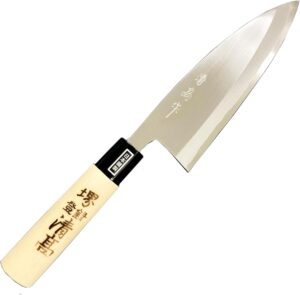
For an Osaka piece specifically, the through-line is commerce and refinement rather than rural folk-craft. This is the second Osaka object covered on this site, alongside the Sakai deba knife, and it fills the prefecture’s open metal cell with the material the merchant city is most associated with.
📌 How does it compare?
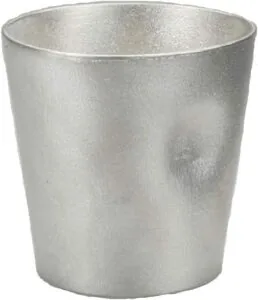
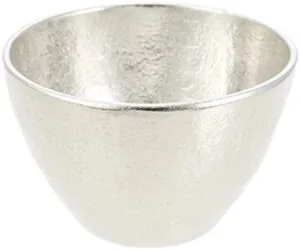
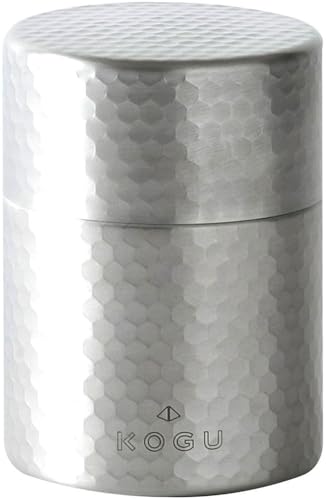
Related pieces and the wider Japanese metal-craft world on jpmono.com:
Price snapshot across stores
The data feed did not return a live price for this listing, so the JPY/USD figures below are marked as unconfirmed rather than estimated. Tin sake ware generally sits well above glass or ceramic. Prices and stock fluctuate — confirm at the retailer before buying.
| Store | Item / Variant | Price | Notes |
|---|---|---|---|
| 🇺🇸 Amazon.com (US) | Browse Japanese tin sake cups & guinomi | varies (USD) | Best if you are shopping from the US — Prime shipping, USD pricing, no international customs. Amazon US carries Japanese tin and pewter sake ware from various makers, useful for comparing form and price tiers. The specific Osaka Naniwa Suzuki piece is sourced from Japan (next row). |
| 🇯🇵 Amazon JP Global Store | Osaka Naniwa Suzuki pure tin guinomi (ASIN B0C9G3SLVD) | Not returned at time of writing — check listing | The sourced listing for the exact item. Ships internationally from Japan to most major destinations via Amazon JP Global Store. |
| Maker direct | Osaka tinware workshops | varies | Some Osaka tin makers sell direct; English support and international shipping vary by workshop. |
| Proxy services (Buyee / Tenso) | Japan-domestic-only listings | item price + forwarding fee | Use only if a listing ships within Japan only. Adds a forwarding and handling fee on top of the item price. |
JPY (¥) is the authoritative price for the specific listed item; any USD figure is an approximate estimate at roughly ¥150/USD. No live price was returned for this listing at the time of writing.
📦 Shipping & where to buy from outside Japan
The specific cup is sourced from the Amazon JP Global Store listing, which ships internationally from Japan to most major destinations. For US and EU buyers, international shipping on a small, light tin cup typically falls in the $15–$40 range, though the exact figure depends on the destination and the seller — confirm it at checkout. Buyers in other regions may see higher rates.
What it does well
Weaknesses and things to verify before buying
- Soft metal. Pure tin dents and scratches with rough handling and has a low melting point — keep it away from direct heat, stovetops, ovens, and dishwasher heat cycles.
- No verified dimensions in our data. Capacity, weight, and size were not returned in the source feed; confirm them on the listing if they matter to you.
- No price returned at time of writing. You will not know the budget until you open the live listing.
- Patina and dulling. Tin can lose its shine over time and benefits from occasional gentle polishing; it is not a set-and-forget surface.
- Tool marks are intentional. Buyers expecting flawless, machine-uniform surfaces may read the hand-finish as imperfection.
- International shipping and customs. Confirm the Global Store ships to your country and check whether your import threshold triggers duty or tax.
Conclusion — which buyer type are you?
Other ways to approach this purchase
🏆 Editor’s Pick
❓ Frequently Asked Questions
Does the Osaka Naniwa Suzuki tin cup ship internationally?
Why is pure tin used for sake cups?
Can I put it in the dishwasher or freezer?
How is this different from Nousaku tin cups?
What does it cost?
Is it really a designated traditional craft?
Why isn’t the surface perfectly uniform?
jpmono.com is curated by a Japan-based editorial team (working out of Toyama in the Hokuriku region and Nara in Kansai) and is independent. We do not take payment from the makers we feature; income comes from affiliate links. We do not physically test every product — we read maker specs and source listings.
This article was prepared with AI assistance and reviewed against the available source data. Where the data feed did not return a value (live price, dimensions, weight), the article states that plainly rather than estimating.
Affiliate disclosure: jpmono.com may earn a commission on qualifying purchases made through links on this page, at no additional cost to you.