![Edo Komon Silk Gamaguchi Coin Purse: Tokyo Stencil-Dyed Craft [2026]](https://jpmono.com/wp-content/uploads/2026/05/japan-map-regions-and-prefectures-800x1050.png)
Edo Komon (江戸小紋, “Edo fine pattern”) is a stencil-dyeing tradition that the city of Edo — present-day Tokyo — refined over the long peace of the Tokugawa centuries. From across a room it reads as a calm, single color. Up close it dissolves into tens of thousands of minuscule dots, printed through a hand-cut paper stencil and locked in with rice paste before the silk takes its dye. The gamaguchi (がま口, “clasp-mouth”) coin purse covered here, attributed to Tomita Some Kogei in Shinjuku, carries the classic same (鮫, “shark-skin”) komon onto an everyday object you can actually carry.
What makes Edo Komon interesting to an international reader is not just the technique but the social logic behind it. The pattern was born of restraint: under shogunal sumptuary laws that banned open displays of wealth, samurai and townspeople alike poured their taste into patterns so fine they passed as plain cloth — an aesthetic the Japanese call iki. The shark-skin motif belonged originally to the Kishū Tokugawa house; today it is one of three classic Edo Komon grounds, alongside gyōgi and kaku-tōshi.
This guide is written from a Japan-based editorial desk for readers shopping from outside Japan. We cover what an Edo Komon silk gamaguchi is, where and how it is made, who it suits, who should pass, and the practical options for buying a small piece of Tokyo stencil-dyed craft through maker-direct or specialist channels. We do not physically test the items; we consult maker information and craft references.
🔄 Updated:
⏱️ Read time: ~11 min
- Who this is for — and who should skip it
- Product overview (from published specs)
- Where this comes from — place, era, and the craft tradition
- Where to buy
- What it does well
- Weaknesses and things to verify before buying
- Conclusion — which buyer type are you?
- Other ways to approach this purchase
- ❓ Frequently Asked Questions
Who this is for — and who should skip it
- Want a small, genuinely useful object that carries a documented Tokyo craft tradition rather than a souvenir trinket.
- Appreciate understated pattern — the iki idea that subtlety is more refined than display.
- Are buying a gift that travels light and reads as thoughtful without being expensive jewelry.
- Like the practical clasp (gamaguchi) format for coins, earbuds, a ring, or small charging cables.
- Are building a collection of Japanese stencil-dyed textiles and want a wearable, everyday entry point.
- Need a large wallet with card slots and a billfold — a gamaguchi is small by design.
- Want a bold, high-contrast print; Edo Komon is deliberately quiet at arm’s length.
- Expect machine-washable durability — dyed silk needs gentle, careful handling.
- Require confirmed purchase details before buying; the available information is limited.
- Prefer vegan materials — this is silk.
Product overview (from published specs)
| Attribute | Detail | Source |
|---|---|---|
| Item type | Gamaguchi (clasp-mouth) coin purse | Product details |
| Craft | Edo Komon — Tokyo Some-komon stencil dyeing (METI-recognized Traditional Craft) | Craft record |
| Pattern | Same (shark-skin) komon — one of the three classic grounds | Spec hint |
| Material | Silk (dyed); metal clasp frame | Craft / product details |
| Attributed maker | Tomita Some Kogei, Shinjuku, Tokyo (surviving workshop) | Spec hint |
| Confirmed price | Unconfirmed | — |
| Dimensions / weight | Unconfirmed manufacturer | — |
Exact prices, dimensions, silk composition, and availability vary by workshop and design. Confirm the current craft attribution and specifications with the maker or specialist seller before purchase.
📖 Glossary — key terms
- Edo Komon (江戸小紋) — Tokyo’s fine-pattern stencil dyeing; “komon” means a small, all-over repeating motif.
- Gamaguchi (がま口) — a “toad’s-mouth” coin purse with a hinged metal clasp that snaps open and shut.
- Same (鮫) — the “shark-skin” ground, a fan of tiny dots; one of the three classic Edo Komon patterns.
- Iki (粋) — an Edo-period aesthetic of understated, restrained chic; flashiness is the opposite of iki.
- Kamishimo (裃) — the samurai’s formal two-piece ceremonial wear that carried each domain’s signature komon.
- Ise katagami (伊勢型紙) — the hand-punched paper stencils, made in Suzuka (Mie), used to print the resist.
- Jō-komon (定小紋) — a domain’s “fixed” or registered komon motif, reserved for its retainers.
- METI — Japan’s Ministry of Economy, Trade and Industry, which designates official Traditional Crafts (dentōteki kōgeihin).
Where this comes from — place, era, and the craft tradition

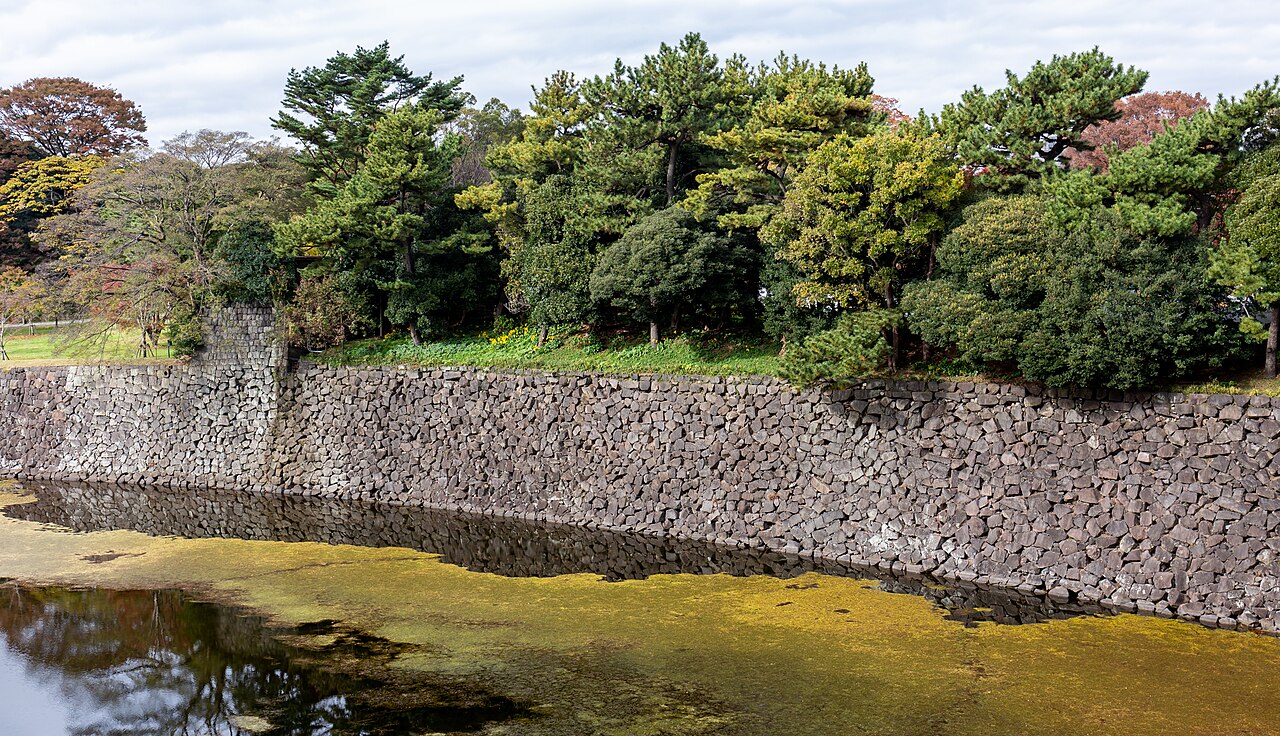
Tokyo sits on the Kantō plain, on the Pacific coast of central Honshū. Under the name Edo it became the seat of the Tokugawa shogunate in 1603, and over the following two and a half centuries it grew into one of the largest cities in the world. That concentration of samurai households, each tied to a provincial domain but resident in Edo, is what seeded the craft. Domains were obliged to maintain formal dress, and formal dress meant kamishimo cut from cloth bearing the house’s registered komon.
The dyeing itself settled in the city’s western wards. Shinjuku and Nerima had what the craft needed: space for stretching long bolts of silk, and rivers — the Kanda and the Myōshōji — whose clean, steady water was essential for washing the rice-paste resist out of the cloth after dyeing. Where the water went, the dyers followed, and pockets of that industry survive there today.
- 1603 — Tokugawa Ieyasu establishes the shogunate at Edo; the samurai administration concentrates in the city.
- 1600s–1700s — Domains standardize their jō-komon motifs on kamishimo; the same shark-skin ground is tied to the Kishū Tokugawa house.
- 1683 — Tokugawa sumptuary edicts tighten; restraint pushes the pattern ever finer, the heart of the iki aesthetic.
- 1868 — The Meiji Restoration dissolves the samurai class; komon shifts from formal kamishimo to civilian kimono and small goods.
- 1976 — Tokyo Some-komon is recognized by METI as a National Traditional Craft.
- Today — Surviving Shinjuku workshops such as Tomita Some Kogei still cut, resist, and dye Edo Komon by hand.
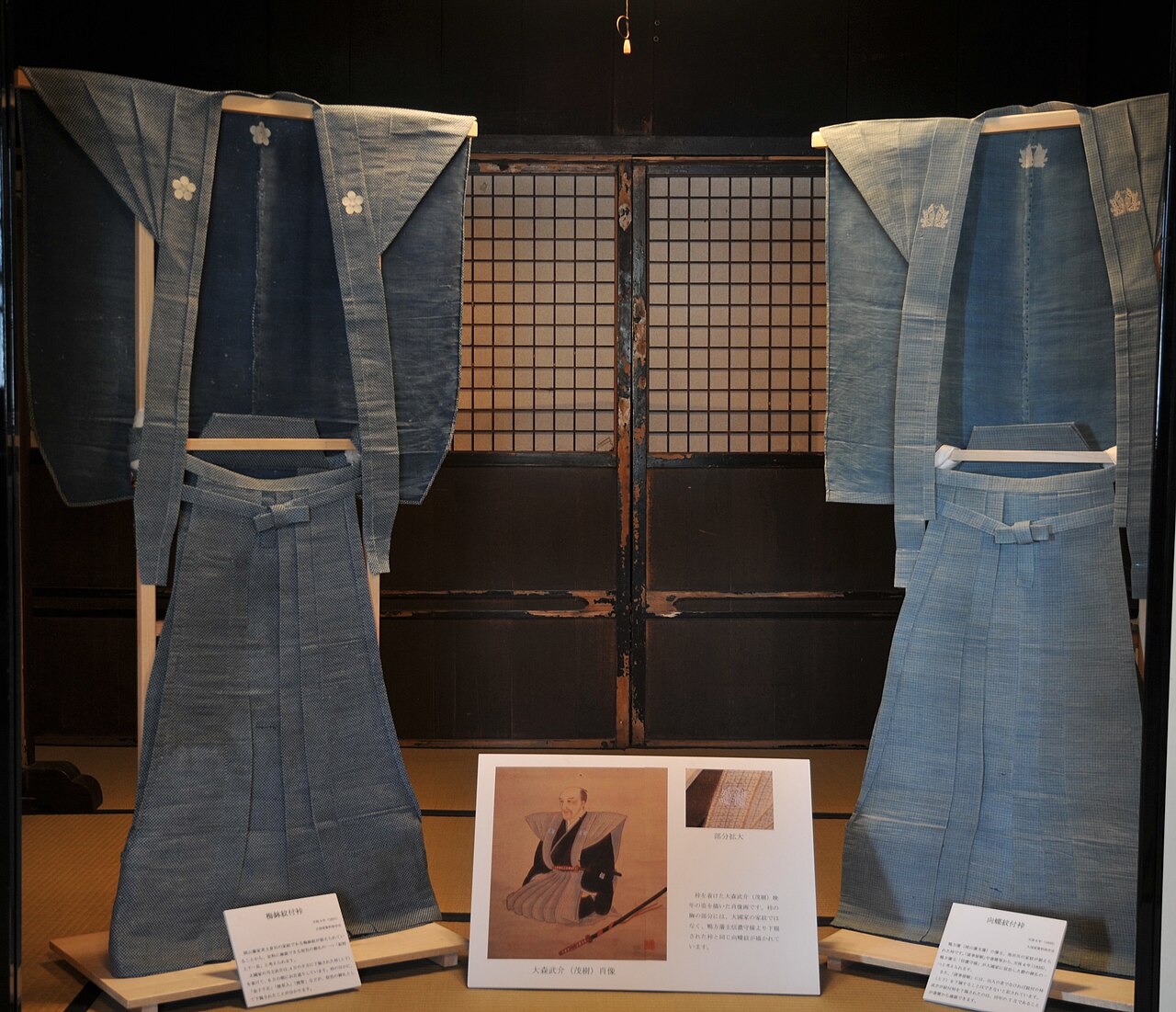
The aesthetic logic is worth dwelling on, because it is the opposite of how Western luxury usually signals value. Tokugawa sumptuary law (kenyaku-rei) repeatedly banned ostentation — bright dyes, gold, conspicuous embroidery. The response was not to comply dully but to compete in subtlety. Patterns shrank until, from a few steps away, a richly worked bolt of silk read as a plain, sober color. Only on close inspection did the work reveal itself: tens of thousands of dots, each printed through a stencil, each requiring a steady hand to register perfectly across the length of the cloth.
“Edo Komon is wealth that refuses to announce itself — a fabric engineered to look plain from across the room and reveal its labor only to whoever leans in.”
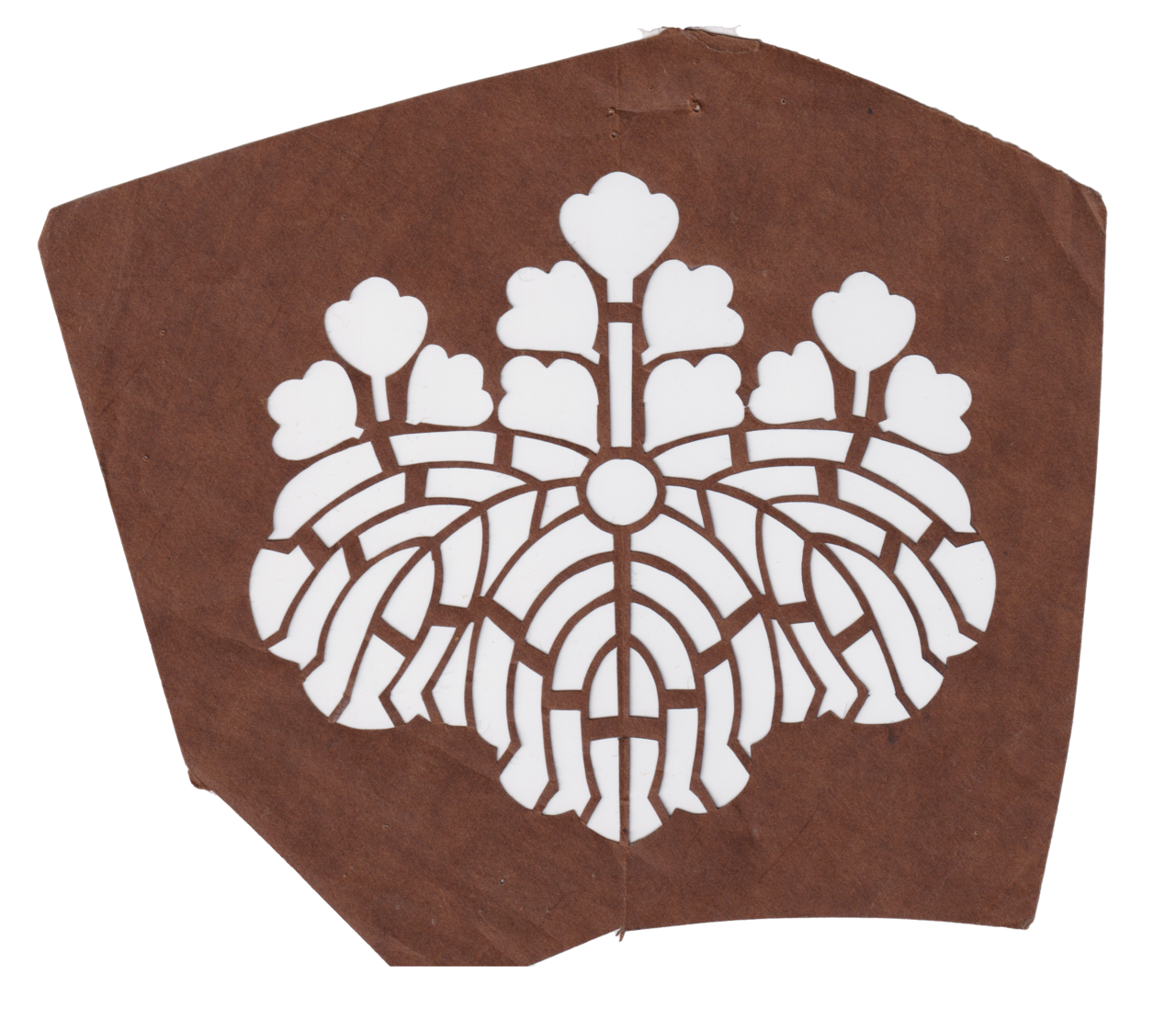
The technique depends on a second region entirely. The stencils — Ise katagami — are made in Suzuka, in Mie Prefecture, where artisans punch a single sheet of laminated mulberry paper with the full repeat of a pattern. A fine same stencil can hold tens of thousands of tiny holes. In the Tokyo workshop, the dyer lays this stencil on stretched silk and squeegees rice paste through it; where the paste sits, dye cannot reach. The cloth is then dyed, steamed to fix the color, and washed — historically in the Kanda or Myōshōji — to remove the resist and reveal the pattern in negative.
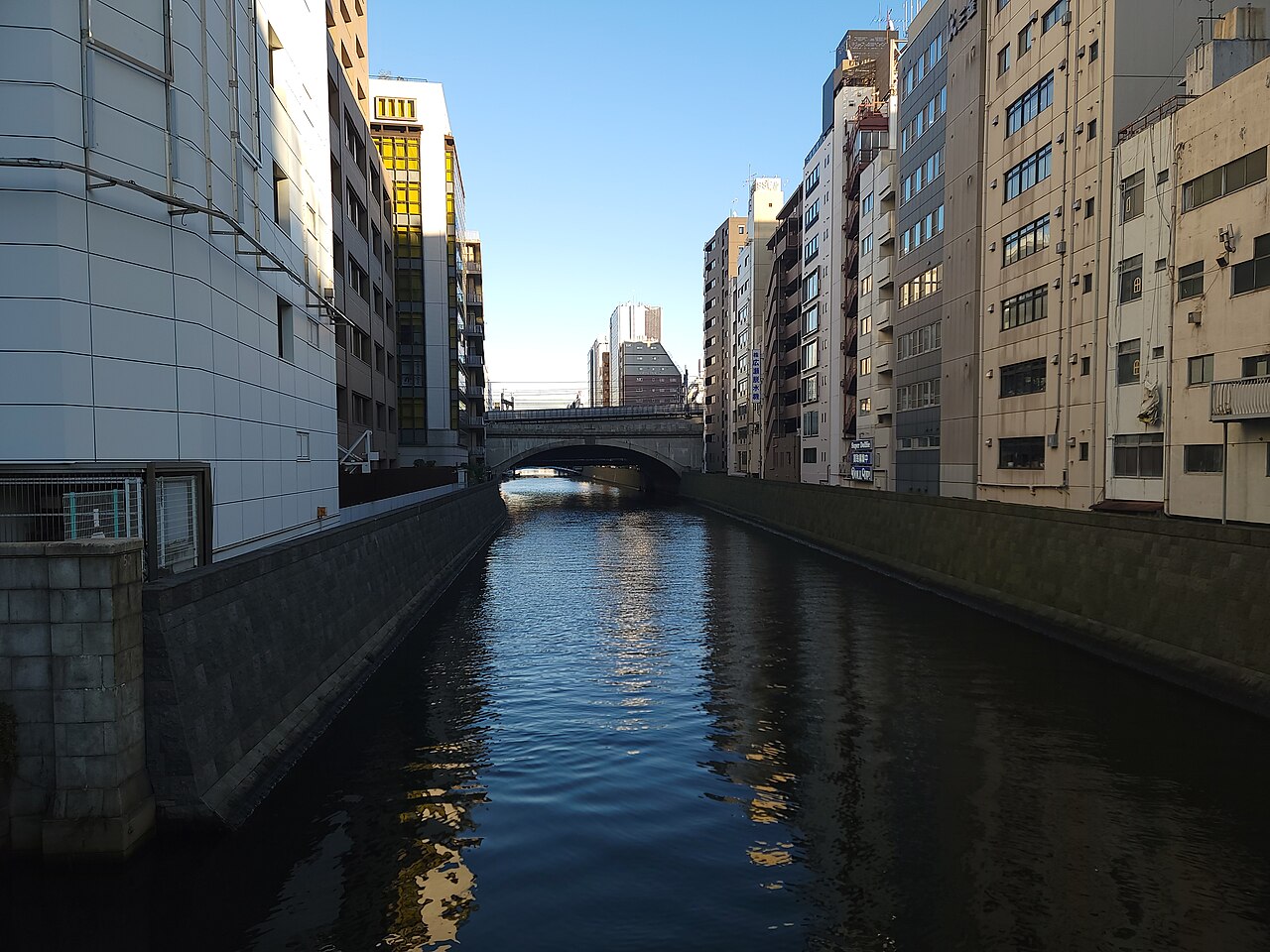
What “still made here” means in practice is modest but real. Edo Komon is no longer a mass industry; the surviving Tokyo workshops are small, family-scale operations, and Tomita Some Kogei in Shinjuku is one of the names that continues the work. A coin purse is, in that light, an accessible way to own the craft: it uses a small panel of properly dyed silk, fitted to a metal clasp, at a fraction of the cost and commitment of a full kimono bolt.
Where to buy
Prices for Edo Komon silk accessories vary with fabric, stencil pattern, clasp, and maker. Any USD conversion is approximate and changes with the exchange rate; compare the yen price with shipping and customs.
| Store | Item / variant | Price (JPY + USD est.) | Notes |
|---|---|---|---|
| 🇺🇸 Amazon US (search) | Browse Japanese dyed-silk purses & pouches | varies (USD) | Best if you are shopping from the US — Prime shipping, USD pricing, no international customs. Amazon US carries Japanese silk pouches, gamaguchi, and stencil-dyed goods from various makers; this article’s exact Edo Komon piece is sourced from Japan (next row). |
| 🇯🇵 Amazon JP Global Store | Edo Komon silk gamaguchi, same pattern | — | Amazon JP Global Store; international shipping may be available. |
| Maker direct | Tomita Some Kogei (Shinjuku) | Varies — Unconfirmed | A surviving workshop; direct retail availability and international shipping are not confirmed here — check the maker’s own channels. |
| Proxy services (Buyee / Tenso) | Forwarding from JP shops not shipping abroad | Item price + service fee + forwarding | Useful if a domestic-only Japanese shop lists a variant you want; adds a handling fee and a second shipping leg. |
Prices in USD are approximate and depend on the current exchange rate (≈ ¥150/USD baseline as of mid-2026). Prices and stock fluctuate; the affiliate links carry current data.
What it does well
Weaknesses and things to verify before buying
- Purchase details were not confirmed. Verify them before checkout.
- Silk requires gentle care. Dyed silk is not machine-washable; expect spot-cleaning only, and keep it out of prolonged direct sun to avoid fading.
- Small by design. A gamaguchi holds coins and small items — it is not a substitute for a card-and-bill wallet. Consider the capacity before buying.
- Maker attribution vs. unit confirmation. The Tomita Some Kogei attribution and same pattern come from the product description; confirm the exact pattern, color, and maker in the product photos, as product pages can change.
- International shipping and customs. If you buy through Amazon JP Global Store, factor international shipping and possible customs duties above your country’s threshold; lead times are longer than domestic Prime.
- Pattern is subtle on purpose. If you want a bold, photographic print, Edo Komon will read as understated to the point of plain at a distance — that is the intent, not a flaw, but it is not for every taste.
Conclusion — which buyer type are you?
Other ways to approach this purchase
❓ Frequently Asked Questions
What is Edo Komon, exactly?
Edo Komon is a Tokyo stencil-dyeing tradition (officially Tokyo Some-komon) in which a hand-cut paper stencil prints a rice-paste resist onto silk before dyeing. The result is an all-over pattern of tiny dots so fine it reads as a single color from a distance. It is recognized by Japan’s METI as a National Traditional Craft.
What does the “same” (shark-skin) pattern mean?
The same ground is a fan-shaped field of minute dots resembling shark skin. It is one of the three classic Edo Komon patterns, alongside gyōgi and kaku-tōshi, and was historically associated with the Kishū Tokugawa house.
Does it ship internationally?
Japanese dyed-silk goods are often sourced through Amazon JP Global Store, which ships to most major destinations internationally. Expect international shipping fees and possible customs duties above your country’s threshold. Shoppers in the US may also find comparable Japanese dyed-silk goods directly on Amazon US.
How do I care for dyed silk?
Treat it gently: spot-clean rather than machine-wash, keep it away from prolonged direct sunlight to prevent fading, and store it flat or loosely so the clasp frame keeps its shape. Silk is delicate compared with cotton or synthetic pouches.
Is it a good gift?
Yes — it is light to post, intuitive to use, and carries a documented Tokyo craft story without being expensive jewelry. The classic same ground reads as unisex and understated, which suits a wide range of recipients.
Why is no exact price shown?
Availability and prices for Edo Komon accessories change with the maker and pattern. Rather than rely on an old figure, compare current offers from a workshop or specialist craft seller and include delivery costs.
How is Edo Komon different from yuzen or other dyeing?
Yūzen (as in Kyoto’s Kyo Yuzen) is a free-hand, painterly resist-dyeing that produces large pictorial designs. Edo Komon is the opposite instinct: a single repeating micro-pattern printed through a stencil, prized for restraint rather than display. See our Kyo Yuzen furoshiki guide for the contrast.
jpmono.com is curated by a Japan-based editorial team (working out of Toyama in the Hokuriku region and Nara in Kansai) and is independent. We do not take payment from the makers we feature; income comes from affiliate links. Read more about our editorial standards.
Note: This article was prepared with AI assistance and reviewed against public craft references and Edo Komon records. Specifications, pricing, and availability vary by maker and should be confirmed with the seller.
Affiliate disclosure: jpmono.com may earn a commission on qualifying purchases made through links on this page, at no additional cost to you.