![Osaka Naniwa Suzuki Tin Tea Caddy: Where to Buy the Airtight Chazutsu [2026]](https://jpmono.com/wp-content/uploads/2026/05/japan-map-regions-and-prefectures-800x1050.png)
- What it is: A hand-finished pure-tin tea caddy (chazutsu) with a near-airtight double lid, made in the Osaka Naniwa Suzuki tin-ware tradition.
- Made in: Osaka, Osaka Prefecture (Kansai) — Osaka Naniwa Suzuki was designated a national traditional craft in 1983.
- Price band: Mid-to-upper range for a hand-turned pure-tin caddy — never a bargain-bin figure.
- Best for: loose-leaf drinkers who want a heavy, cool-to-the-touch caddy that seals well and lasts decades.
- Skip if: you want something light, dishwasher-safe, or inexpensive for travel.
- Shipping: ships internationally from Amazon Japan — jump to our pick ↓
Pure tin is soft enough to bend in the hand — soft enough that a caddy made from it has to be turned on a lathe and finished by hand rather than stamped out. That softness is the whole point. When two pieces of the same metal are turned to sit inside one another, the inner lid drops into the body and settles with a slow, cushioned resistance, pushing the air out as it goes. That is the sound and feel of an Osaka Naniwa Suzuki (大阪浪華錫器, “Osaka Naniwa tin ware”) chazutsu — a tea caddy whose seal comes not from a gasket but from the metal itself.
Osaka Naniwa Suzuki is Osaka’s traditional tin ware, designated a national traditional craft in 1983. Tin working first reached the Kansai region through temple ritual vessels — offering wares for sacred water and sake, prized because tin does not rust and does not impart an odor to what it holds. Those same properties are exactly what a tea drinker wants from a caddy: a neutral, sealed, cool interior that keeps loose leaf from staling. Over the Edo period the craft consolidated in merchant Osaka, the city known as the “nation’s kitchen,” where trade and tea culture kept refined metal tableware in steady demand.
This guide is written for international readers deciding whether a pure-tin caddy is worth the weight, the price, and the hand-wash-only care — and, if it is, where to actually buy one from outside Japan. We cover what the material does well, where it falls short, how it compares to wood, cherry-bark, and lacquer caddies, and the two Amazon paths (US search and Amazon Japan Global Store) that make the most sense for a buyer abroad.
🗓️ Published: July 5, 2026 · ♻️ Last updated: July 5, 2026 · ⏱️ Read time: ~9 min
ℹ️ Tin caddies combine a metal inner vessel with a wooden sleeve; dimensions, weight, and capacity vary by maker.
- Who this is for — and who should skip it
- Product overview (from published specs)
- 📍 Where this comes from — place, era, and the craft tradition
- 📦 Shipping & where to buy from outside Japan
- Where to buy
- What it does well
- Weaknesses and things to verify before buying
- Conclusion — which buyer type are you?
- Other ways to approach this purchase
- ❓ Frequently Asked Questions
Who this is for — and who should skip it
- drink loose-leaf tea and want a caddy that genuinely seals against air and humidity
- like the heft and cool sheen of solid metal, and want an object that ages well
- value hand-finished traditional craft over mass-produced tins
- are furnishing a tea corner and want a piece with a documented Osaka lineage
- plan to keep and use it for decades rather than seasons
- want something light and pocketable for travel
- expect dishwasher or microwave convenience
- are shopping on a tight budget for a first tea tin
- dislike the responsibility of hand-washing and wiping dry
- need a large-volume canister — tin caddies are usually modest in capacity
Product overview (from published specs)
Across the tradition, Osaka Naniwa Suzuki tin caddies are made by pressing and soldering tin sheet into a tight-fitting inner vessel, then seating that vessel in a hand-turned wooden sleeve so the two materials form an airtight seal. The tin does not react with tea leaves; the wood breathes just enough to help keep moisture stable.
| Attribute | Detail | Source |
|---|---|---|
| Material | Pure tin (soft, heavy, rust-free, odorless) | Naniwa Suzuki tradition |
| Type | Tea caddy (chazutsu) with fitted double lid | Product details |
| Construction | Lathe-turned and hand-finished; brushed tin surface | Naniwa Suzuki tradition |
| Origin | Osaka, Osaka Prefecture (Kansai) | Spec |
| Designation | National traditional craft (1983) | Data notes |
| Capacity / dimensions | — | — |
| Weight | — | — |
| Price | — | — |
📖 Glossary — key terms
- chazutsu (茶筒) — a tea caddy; a cylindrical container for storing loose-leaf tea, usually with a fitted inner and outer lid.
- suzuki (錫器) — tin ware; objects made from tin. Osaka’s tradition is Naniwa Suzuki.
- Naniwa (浪華 / 難波) — an old name for the Osaka area; also written 難波 for the ancient capital.
- Naniwa-kyo (難波京) — the ancient capital established at Naniwa under Emperor Kotoku (645).
- tenka no daidokoro (天下の台所) — “the nation’s kitchen,” the Edo-period nickname for Osaka as Japan’s trading and provisioning hub.
📍 Where this comes from — place, era, and the craft tradition

Osaka sits on the eastern shore of Osaka Bay in the Kansai region of western Japan, at the mouth of a river network that funneled goods in from across the country. That geography is the reason the city became a commercial hub rather than an administrative one: rice, textiles, metals, and tea moved through Osaka’s warehouses and markets, and the artisans who served that trade — knife-smiths in nearby Sakai, tin-turners in the city itself — grew up alongside it.
Naniwa is the old name for this stretch of coast, and it carries real historical weight. In 645, under Emperor Kotoku, the imperial capital was established here as Naniwa-kyo (難波京). Long before Osaka was “Osaka,” this was already a place where the court, temples, and shrines concentrated ritual and craft.
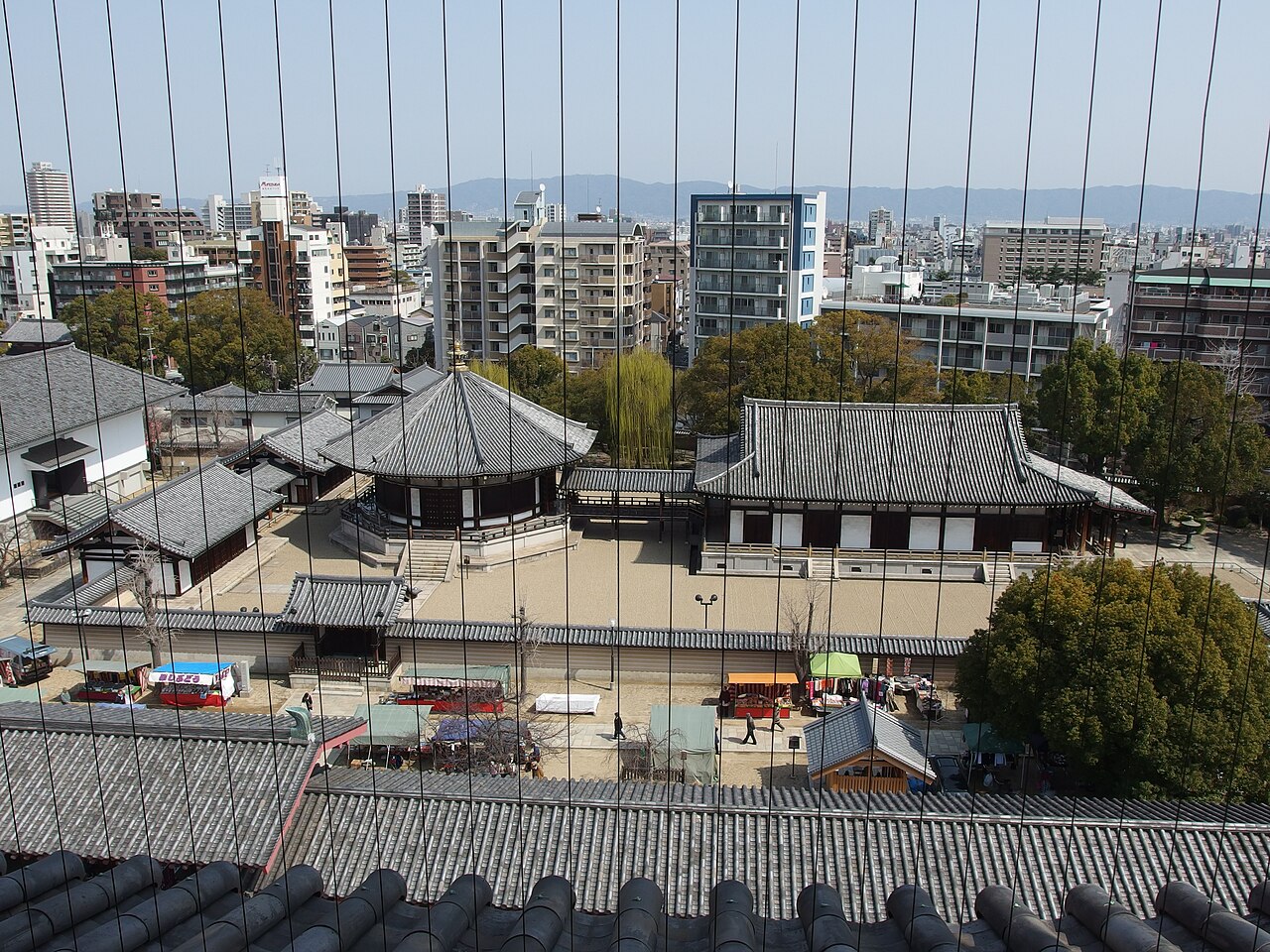
Tin came into Kansai through the temples and shrines. Ritual vessels — offering wares for sacred water and sake — were made in tin because the metal does not rust and does not impart an odor to what it holds, qualities that mattered when the contents were meant to be pure. Shitenno-ji, founded in 593 by Prince Shotoku, is one of the anchors of this early Buddhist-ritual world, and it is in that context of sacred vessels that tin working established itself in the region.
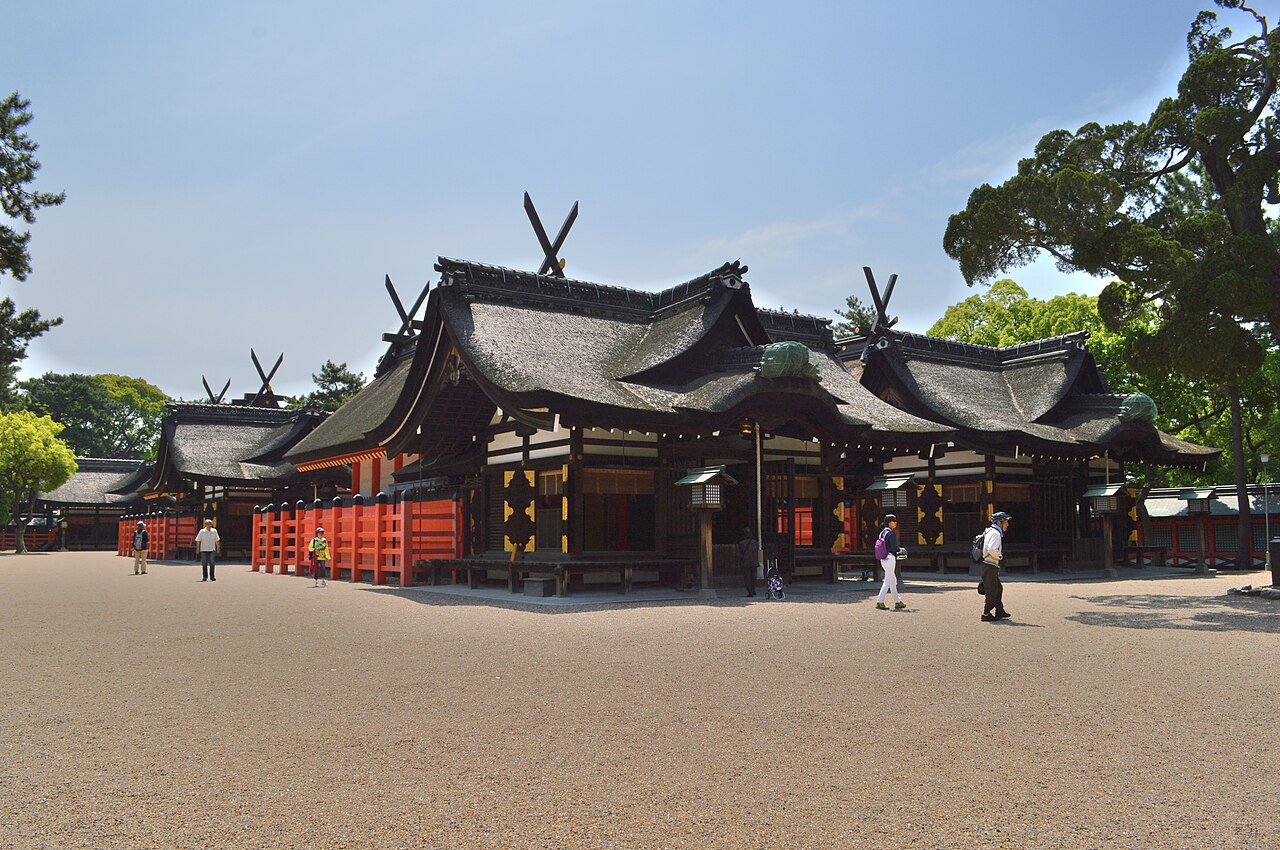
Those two material facts — rust-free and odorless — are traditionally the reasons tin was chosen for shrine offerings at ancient sites like Sumiyoshi Taisha, and they carry straight over into tableware. A metal that will not taint water or sake is a metal that will not taint tea leaves either. The step from ritual vessel to tea caddy is a short one.
- 593 — Shitenno-ji founded by Prince Shotoku; temple ritual vessels bring tin working into Kansai.
- 645 — Naniwa-kyo established as the imperial capital under Emperor Kotoku.
- 1603 — Edo period begins; Osaka grows into “the nation’s kitchen” (tenka no daidokoro), and tin tableware serves its tea and dining trade.
- 1868 — The Edo period ends; the merchant workshops carry the tin craft into the modern era.
- 1983 — Osaka Naniwa Suzuki designated a national traditional craft.

Through the Edo period (1603–1868), Osaka earned its nickname as the “nation’s kitchen.” Goods from every province passed through its markets, and a merchant culture with money and leisure sustained a demand for refined tableware — including the tea utensils that a settled urban tea culture required. Tin ware consolidated from a scattered temple craft into a genuine city industry in exactly this environment.

What still being made here means, in practical terms, is that pure tin is worked essentially the way it has to be worked. The metal is very soft and quite heavy, so it cannot be pressed the way steel is; each piece is turned on a lathe and finished by hand. The same softness lets a maker turn an inner and outer lid to sit flush against the body, which is what produces the caddy’s near-airtight double seal — and, in the sake cups that are the tradition’s other signature product, the same tin conducts cold so well that a chilled cup keeps a drink cold in the hand.
“A metal chosen because it would not taint sacred water or sake is the same metal that will not taint your tea — the shrine offering and the tea caddy are cousins.”
📦 Shipping & where to buy from outside Japan
For international orders, postage and import charges for a solid tin caddy vary by destination, carrier, weight, and service speed. Check the customs rules and delivered cost for your country before ordering.
Buyers outside Japan can compare international retailers with maker-direct or specialty-shop channels. A proxy service can forward a domestic order where necessary, with an additional service fee and international shipping leg.
Where to buy
USD amounts are approximate and depend on the current exchange rate; use the rate at the time of comparison.
| Store | Item / Variant | Price (JPY + USD est.) | Notes |
|---|---|---|---|
| 🇺🇸 Amazon.com (US) | Browse Japanese tea caddies & tin ware | varies (USD) | Best if you’re shopping from the US — Prime shipping, USD pricing, no international customs. Amazon US carries Japanese tea caddies and tin tableware from various makers; this exact Osaka piece ships from Japan (next row). |
| 🇯🇵 Amazon JP Global Store | Osaka Naniwa Suzuki pure-tin chazutsu (this item) | Current store information | Ships internationally from Japan to 65+ countries — including Canada, the UK and Australia — with import fees estimated at checkout. |
| Maker direct | Osaka Naniwa Suzuki workshops / specialty shops | Varies — often domestic-only | Widest selection, but many pages ship within Japan only; pair with a proxy service for delivery abroad. |
| Proxy services (Buyee / Tenso) | Forwarding from Japan | Item price + forwarding fee | Useful when a maker-direct or specialty item isn’t on the Global Store; adds a service fee and a second shipping leg. |
What it does well
- 🍽️ Dishwasher: no — hand-wash only; tin is soft and low-melting, so keep it away from dishwasher heat and detergents.
- ♨️ Microwave: no — it is solid metal.
- 🧴 Daily care: wipe dry after washing and avoid abrasive scourers; the soft surface scratches, and the cool matte sheen is the point.
Weaknesses and things to verify before buying
- It is heavy. Tin is dense, so the caddy feels weighty for its size — a virtue on the shelf, a drawback if you wanted something to travel with.
- Soft metal marks and dents. The same softness that makes the seal also means the surface scratches and the body can dent if dropped or knocked hard.
- Hand-wash only. No dishwasher, no microwave; you are signing up for wipe-and-dry care.
- Modest capacity. Tin caddies are typically sized for a working supply of leaf, not bulk storage.
- Specifications vary. Tin is dense, and caddies are typically sized for a working supply of leaf rather than bulk storage.
- Not a bargain buy. Hand-turned pure tin sits above the price of a stamped tin or a simple ceramic jar; the value is in the craft and the seal, not in being cheap.
Conclusion — which buyer type are you?
Other ways to approach this purchase
❓ Frequently Asked Questions
Does Amazon Japan ship this tin tea caddy internationally?
Japanese tin and metalwork are sold through domestic and international retailers, but shipping coverage and import handling vary. Check the destination requirements before ordering.
Is pure tin safe and suitable for storing tea?
Tin is traditionally valued precisely because it does not rust and does not impart an odor — the reason it was used for shrine offering vessels holding sacred water and sake. Those same properties make it well suited to keeping loose-leaf tea neutral and fresh.
How airtight is the double lid really?
Because tin is soft, the maker can turn an inner and outer lid to sit flush against the body. The lid settles slowly, pushing air out as it seats — a near-airtight metal-on-metal seal without any rubber gasket. It is very good against air and humidity, though no lidded caddy is a hermetic vacuum.
Can I put a tin chazutsu in the dishwasher or microwave?
No to both. It is solid metal, so never microwave it, and tin is soft and low-melting, so hand-wash it and wipe it dry rather than running it through a dishwasher. Avoid abrasive scourers, which scratch the soft surface.
How is it different from a wooden or cherry-bark tea caddy?
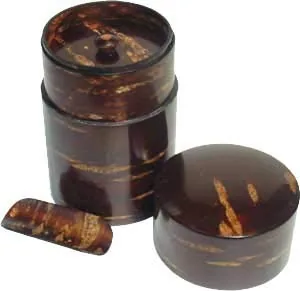
Wood and cherry-bark (kabazaiku) caddies are lighter and warmer to the touch and often cost less. A tin caddy trades that for heft, a cool metal sheen, and a metal-on-metal seal that many drinkers find tighter. See the comparison box above for our guides to both.
Why is tin ware relatively heavy and expensive?
Pure tin is dense, so a caddy feels weighty for its size, and it is too soft to stamp, so each piece is lathe-turned and finished by hand. That labor — and the material — is why a hand-turned tin caddy sits above a stamped tin or a plain ceramic jar in price.
jpmono.com is curated by a Japan-based editorial team (working out of Toyama in the Hokuriku region and Nara in Kansai) and is independent. We don’t take payment from the makers we feature; income comes from affiliate links. Read more about our editorial standards.
🤖 This article was drafted with AI assistance and reviewed against the craft tradition by the jpmono editorial team. Specifications and prices can vary by maker and time of purchase.
Affiliate disclosure: jpmono.com may earn a commission on qualifying purchases made through links on this page, at no additional cost to you.