![Kurume Kasuri Indigo Cotton Noren: Fukuoka’s Ikat Doorway Curtain, Reviewed [2026]](https://jpmono.com/wp-content/uploads/2026/07/kurume-kasuri-indigo-cotton-noren-where-to-buy-2026-featured.jpg)
- What it is: A doorway curtain (noren) woven from cotton threads that were tied and indigo-dyed before they ever reached the loom.
- Made in: Kurume, Fukuoka Prefecture, Kyushu — designated an Important Intangible Cultural Property in 1957.
- Price band: Mid-range for hand-woven Japanese textiles; live pricing was not in our snapshot, so check the listing.
- Best for: Buyers who want one textile that carries a documented craft lineage rather than a printed approximation of one.
- Skip if: You want a crisp, machine-exact geometric pattern — kasuri’s blurred edges are the entire point and cannot be made sharp.
- Shipping: ships internationally from Amazon Japan — jump to our pick ↓
Around 1800, a twelve-year-old girl in the castle town of Kurume noticed that her worn indigo work clothes had gone patchy — small white flecks where the dye had given out along the threads. Inoue Den decided the accident was worth reproducing on purpose, and worked backward from the faded cloth until she could bind the threads before dyeing them, so the white would appear exactly where she wanted it. That reverse-engineered accident became Kurume Kasuri (久留米絣, “Kurume ikat”).
What makes kasuri unusual among Japanese textiles is that the pattern is decided before weaving begins, not after. Sections of yarn are bound tight so indigo cannot penetrate, dipped repeatedly in an aizome vat, unbound, and then aligned on the loom so that the resisted white segments meet in the shape the weaver planned. The alignment is never perfect, and it is not supposed to be — that soft feathered edge along every motif is the signature of the technique, and it is the one thing a printed imitation cannot fake.
This guide is written for readers outside Japan who are weighing a real Kurume Kasuri noren against the far cheaper printed cotton curtains that dominate search results. We cover what the tradition actually is, how to tell woven kasuri from printed kasuri-look fabric, what the international purchase paths are from the US, Canada, the UK, and Australia, and who should honestly pass on this.
🔄 Updated: July 20, 2026
⏱️ Read time: about 11 minutes

ℹ️ Live pricing and several dimensional specs were not in our data snapshot — the linked listing is authoritative, and unconfirmed attributes are marked as such below.
- Who this is for — and who should skip it
- Product overview (from published specs)
- 📍 Where this comes from — place, era, and the craft tradition
- 📌 How does it compare?
- 📦 Shipping & where to buy from outside Japan
- Price snapshot across stores
- What it does well
- Weaknesses and things to verify before buying
- Conclusion — which buyer type are you?
- Other ways to approach this purchase
- 🏆 Editor’s Pick
- ❓ Frequently Asked Questions
Who this is for — and who should skip it
- Want a textile whose pattern is structural — woven in — rather than printed on the surface.
- Appreciate indigo that shifts tone over years of light exposure and washing.
- Are furnishing a doorway, kitchen pass-through, closet opening, or shelf front and want something that softens the gap without closing it.
- Are buying a gift with a verifiable designation behind it (Important Intangible Cultural Property, 1957).
- Accept small irregularities between panels as evidence of hand process, not defect.
- Need a precisely repeating, machine-registered pattern — kasuri edges are deliberately blurred.
- Want colorfastness from day one; natural indigo characteristically releases some dye in early washes.
- Are shopping purely on price — printed kasuri-look noren cost a fraction of woven ones.
- Need an exact made-to-measure width for a specific door frame; noren are sold in standard sizes.
- Expect blackout or privacy coverage — a noren is a visual divider, not a curtain that blocks a view.
Product overview (from published specs)
Kurume Kasuri Indigo Cotton Noren
久留米絣のれん
通常6~7日以内に発送します。 · Sold by JIMMY Online Shop · ASIN B0FJ668BG2
Price and availability as of 2026-09-01 05:22 JST. The Amazon listing at the time of purchase is authoritative. jpmono.com earns a commission on qualifying purchases at no extra cost to you.
| Attribute | Value | Source |
|---|---|---|
| Craft tradition | Kurume Kasuri (久留米絣) — pre-dyed thread ikat | Maker direct / designation record |
| Origin | Kurume, Fukuoka Prefecture, Kyushu | Maker direct |
| Material | Cotton, indigo-dyed (aizome) before weaving | Amazon JP Global Store listing |
| Nominal size | Approx. 85 × 150 cm (33 × 59 in) — verify on the live listing | Amazon JP Global Store listing |
| Pattern family | Traditional geometric kasuri motifs (arare hail-dot, kagasuri cross-fleck) | Amazon JP Global Store listing |
| Weight | Unconfirmed — check manufacturer site | — |
| Price | Not captured in our snapshot — see live listing | — |
| Designation | Important Intangible Cultural Property (1957) | Designation record |
📖 Glossary — the terms used in this article
- kasuri (絣) — the Japanese term for ikat: cloth whose pattern comes from threads dyed before weaving. The English word “ikat” is Indonesian in origin and describes the same principle.
- noren (暖簾) — a split fabric panel hung in a doorway. In Japan it marks a threshold and signals that a shop is open, rather than sealing the opening.
- aizome (藍染) — indigo dyeing. Depth of color comes from repeated dipping and oxidation, not from a single strong bath.
- arare (霰) — “hail,” a small scattered dot motif.
- kagasuri (蚊絣) — “mosquito kasuri,” a very fine cross-fleck pattern named for its density.
- koku (石) — the Edo-period unit measuring a domain’s rice yield, and therefore its rank. The Kurume Domain was assessed at 210,000 koku.
📍 Where this comes from — place, era, and the craft tradition

Kurume sits on the Chikugo River plain in southern Fukuoka Prefecture, on the island of Kyushu — the southwestern of Japan’s four main islands, closer to the Korean Peninsula than to Tokyo. The plain is flat, warm, and well watered, and it is the reason a thread-dyeing industry could take hold here at all. Cotton grew in the surrounding fields, and the local water was soft enough that a length of yarn could be dipped in an indigo vat over and over without the fibers stiffening or the color going muddy.
That matters more than it sounds. Kasuri is not a technique you can shortcut with a stronger dye bath.

Kurume was a castle town of the Kurume Domain, held by the Arima clan and assessed at 210,000 koku — a substantial holding by Edo-period standards. Castle towns concentrated people, money, and craft labor in one place, and a domain of that size had both the authority and the incentive to decide what its population should produce. When Inoue Den’s binding technique proved reproducible, the domain did not leave it to chance: the method was protected and taught as a domain industry, which is how a single girl’s experiment became a regional economy within a generation.
- c. 1800 — Inoue Den, aged twelve, works backward from a faded indigo garment and reproduces its white flecks by binding threads before dyeing.
- Early 1800s — The Kurume Domain (Arima clan, 210,000 koku) protects the technique and teaches it as a domain industry.
- 1868 onward — Through the Meiji period, Kurume Kasuri becomes the everyday working cloth of western Japan.
- Late 19th–20th c. — Counted with Iyo-gasuri (Ehime) and Bingo-gasuri (Hiroshima) as one of Japan’s three great kasuri traditions.
- 1957 — Kurume Kasuri is designated an Important Intangible Cultural Property.
- 2026 — Still woven in the Chikugo area, now largely for interior textiles such as noren rather than work clothing.
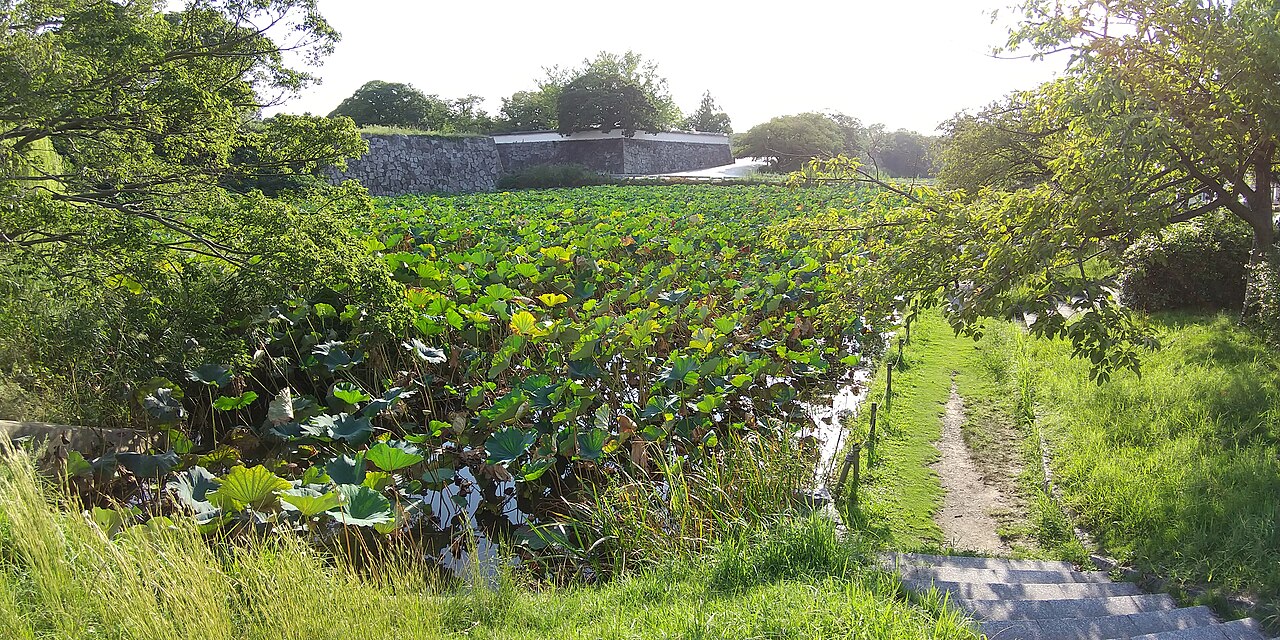
Fukuoka Prefecture as it exists today merges several former domains, including the Kuroda holding centered on Fukuoka Castle to the north. Proximity to a larger neighbor and to Kyushu’s trading ports shaped how Chikugo cloth left the region — textiles that began as local work wear moved outward along established commercial routes, which is a large part of why “Kurume” became a name recognized far beyond Kurume.
The 1957 designation as an Important Intangible Cultural Property is the formal recognition that the technique — not any single object — is what must survive. That framing is worth holding onto when you look at the price of a woven noren, because what you are paying for is the binding, the repeated dipping, and the alignment on the loom, all of which are labor that no machine has replaced.
“The blurred edge is not a decorative effect applied to the cloth. It is the residue of thread-binding — which is why no two lengths of Kurume Kasuri align identically.”
📌 How does it compare?
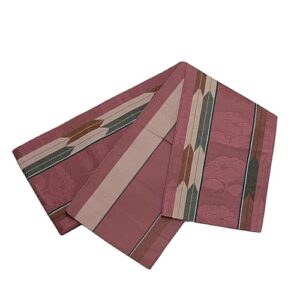 Hakata-ori Kenjo Silk Obi
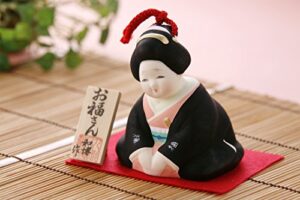 Hakata Ningyo Clay Figurine
Hakata Hasami Scissors
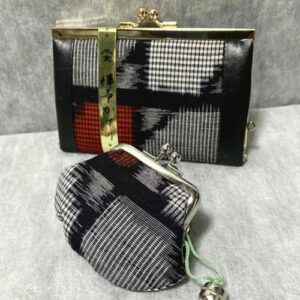 Iyo-Gasuri Coin Purse
Yumihama-gasuri Table Runner
Awa Aizome Indigo Tenugui
 Onta-yaki Mug (Oita)
 Karatsu E-Garatsu Guinomi
If you want the same indigo-and-cotton logic in a smaller, cheaper object, the Iyo-gasuri coin purse and the Yumihama-gasuri table runner are the closest comparisons — both are kasuri, both from other regions. For Fukuoka craft specifically, Hakata-ori is the silk counterpart to Kurume’s cotton.
📦 Shipping & where to buy from outside Japan
Textiles are among the least restricted categories for international shipment: there is no battery, no aerosol, no liquid, and no food-import paperwork. Amazon Japan’s Global Store path ships to 65+ countries including Canada, the UK, and Australia, with import fees estimated and generally collected at checkout so there is no surprise bill at the door.
Based on comparable lightweight textile orders, shipping typically lands in the $15–$40 range to the US, Canada, the EU, the UK, and Australia. A noren is light and folds flat, so it usually sits at the lower end of that band. Customs duty thresholds vary by country — the UK and EU apply VAT from a low value, while the US de minimis threshold is considerably higher — and Amazon’s checkout estimate is the figure to trust over any general rule of thumb.
If the specific listing is unavailable to your country, proxy services such as Buyee or Tenso can forward a domestic Japanese purchase, at the cost of an extra handling fee and a second shipping leg.
Price snapshot across stores
| Store | Item / Variant | Price | Notes |
|---|---|---|---|
| 🇺🇸 Amazon.com (US) | Browse Japanese indigo noren curtains | varies (USD) | Best if you are shopping from the US — Prime shipping, USD pricing, no international customs. Amazon US carries Japanese noren and indigo cotton textiles from several makers, useful for comparing sizes and price tiers. The Kurume-woven piece itself ships from Japan (next row). |
| 🇯🇵 Amazon JP Global Store | Kurume Kasuri indigo cotton noren, approx. 85 × 150 cm | See live listing (not in snapshot) | Ships internationally from Japan to 65+ countries — including Canada, the UK, and Australia — with import fees estimated at checkout. |
| Maker direct | Full pattern range, occasionally bolt cloth | Unconfirmed — check manufacturer site | Chikugo-area weaving houses often list more patterns than reach any marketplace. Most sell domestically only, which is where a proxy service becomes relevant. |
| Proxy services (Buyee / Tenso) | Any domestic Japanese listing | Item price + handling + forwarding | Use when a pattern is only sold within Japan. Expect an extra fee and a longer timeline than the Global Store path. |
Prices and stock fluctuate; the linked listing is authoritative at the time you read this. Where USD figures appear on this site alongside JPY, they are approximate estimates at a ¥150/USD baseline as of mid-2026, and the JPY price is the authoritative one.
What it does well
General guidance for indigo-dyed cotton — the listing’s own care label takes precedence.
- 🧺 Washing: hand-wash separately in cool water for the first several washes; natural indigo characteristically releases dye early on.
- ☀️ Sunlight: prolonged direct sun lightens indigo. In a bright doorway, expect gradual fading — many owners treat this as desirable.
- 🧴 Daily care: shake out and air rather than washing frequently; cotton kasuri softens with use and does not need aggressive cleaning.
- 🔧 Repairs: woven cotton takes a hand-stitched patch well, and sashiko-style mending is a traditional response to wear rather than a compromise.
Weaknesses and things to verify before buying
- Pattern alignment will not be perfect. The feathered, slightly drifting motif edge is inherent to thread-resist weaving. If you want machine-crisp geometry, this technique is structurally the wrong choice.
- Early color transfer is normal. Indigo-dyed cotton commonly releases dye in the first washes and can mark light-colored walls or clothing while new. Wash separately and confirm the listing’s care instructions.
- Live price and full specs were not in our snapshot. Dimensions are given as approximate and weight is unconfirmed — verify both against the listing before ordering for a specific doorway.
- “Kasuri-style” is not kasuri. A large share of noren sold internationally are printed imitations at a fraction of the price. Check that the listing states woven, pre-dyed thread, and check whether the reverse face carries the pattern.
- It does not provide privacy. A noren is split down the middle and hangs short. It marks a threshold and softens sightlines; it does not screen a room or block light.
- Standard sizing only. At roughly 85 cm wide, it will not span a wide doorway, and non-standard frames may need two panels or a different solution.
- Availability is intermittent. Output is limited by how many weavers still work the technique, so specific patterns appear and disappear rather than restocking predictably.
Conclusion — which buyer type are you?
Other ways to approach this purchase
🏆 Editor’s Pick
❓ Frequently Asked Questions
What is the difference between kasuri and ikat?
They describe the same principle. “Ikat” is the Indonesian-derived term used in English for cloth whose pattern comes from threads dyed before weaving; “kasuri” is the Japanese term. Kurume Kasuri is a specific regional tradition within that broader family.
How can I tell a woven Kurume Kasuri noren from a printed imitation?
Check the reverse face. Woven kasuri carries the pattern on both sides because the color is in the thread itself, while a printed panel is pale on the back. Woven motifs also vary slightly from one repeat to the next; printed ones repeat identically.
Does Amazon Japan ship a noren to Canada, the UK, or Australia?
Yes. Textiles carry no shipping restrictions of the kind that affect batteries or liquids, and the Global Store path covers 65+ countries including Canada, the UK, and Australia, with import fees estimated at checkout.
Will the indigo fade?
Gradually, yes — particularly in a sunlit doorway. Indigo lightens unevenly over years rather than washing out flat, and within the tradition that change is considered part of the cloth’s life rather than a fault.
How do I hang a noren?
Thread a tension rod or a slim wooden dowel through the loops sewn along the top edge. No brackets or drilling are required, which is why a noren moves easily between doorways.
Why is Kurume Kasuri called one of the three great kasuri traditions?
It is grouped with Iyo-gasuri from Ehime and Bingo-gasuri from Hiroshima. All three became major producers of everyday cotton cloth in western Japan, and Kurume Kasuri was designated an Important Intangible Cultural Property in 1957.
Is a noren suitable as a gift?
It works well for recipients who have a doorway to use it in and an interest in how things are made. It is less suited to someone expecting a functional window covering, since a noren neither closes nor darkens an opening.
jpmono.com is curated by a Japan-based editorial team working out of Toyama in the Hokuriku region and Nara in Kansai, and is independent. We do not take payment from the makers we feature; income comes from affiliate links. We do not physically test every product — we read makers’ specifications and source listings.
This article was drafted with AI assistance and reviewed by a human editor before publication. Product data reflects the source listing snapshot at the time of writing.
Affiliate disclosure: jpmono.com may earn a commission on qualifying purchases made through links on this page, at no additional cost to you.