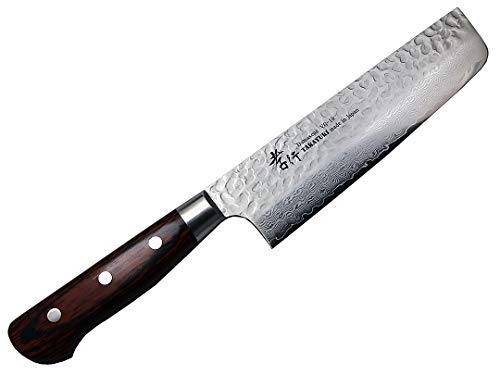
- What it is: a 160 mm nakiri (菜切, vegetable knife) from the Sakai Takayuki line, in VG-10 steel with 33-layer Damascus cladding and a hammered finish.
- Made in: Sakai, Osaka Prefecture — the blade-making city the brand is named for (the listing does not name the individual workshop).
- Price band: mid-range for a Damascus-clad Japanese knife — ¥19,800 at the listed seller (as of 2026-10-20; verify on the listing).
- Best for: cooks who prep vegetables daily and want a flat, tall blade that stays in contact with the board.
- Skip if: you want one knife for everything, or you will not hand-wash and dry a layered blade.
- Shipping: ships internationally from Amazon Japan — jump to our pick ↓
A nakiri arrives at the board flat. The whole edge lands at once, the cut closes behind the blade, and nothing rocks. That straight-down motion is the entire argument for the shape, and it is why a vegetable knife looks so plain standing next to a chef’s knife.
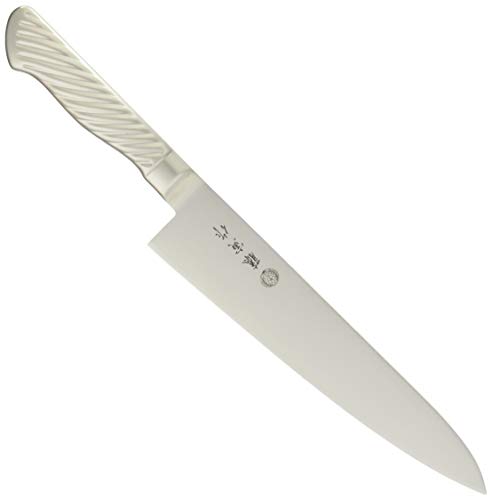
The blade in this guide is the Sakai Takayuki nakiri listed on Amazon Japan as 堺孝行 V金10号ダマスカス33層鎚目 菜切160 — a 160 mm vegetable knife in VG-10 steel with 33-layer Damascus cladding and a hammered finish. It was listed at ¥19,800, new, with three units remaining at the time of writing.
The brand carries the name of Sakai, the port city south of Osaka where Japanese blade-making has been organized as a trade rather than a single factory for centuries. This article works through what the listing states, what it leaves unstated, how the flat nakiri profile differs from a santoku or a gyuto, and which routes actually get the knife out of Japan.
Last updated October 20, 2026
Read time: about 13 minutes

- Who this is for — and who should skip it
- Product overview (from published specs)
- 📍 Where this comes from — Sakai, Osaka Bay
- 📌 How does it compare?
- Price snapshot across stores
- What it does well
- Weaknesses and things to verify before buying
- 📦 Shipping & where to buy from outside Japan
- Conclusion — which buyer type are you?
- Other ways to approach this purchase
- 🏆 Editor’s Pick
- ❓ Frequently Asked Questions
Who this is for — and who should skip it
- You cut cabbage, daikon, onions, carrots and leeks in volume and want the edge to stay on the board.
- You already own a chef’s knife for protein and want a second blade reserved for vegetables.
- You prefer stainless maintenance over the rust watch that comes with a carbon-steel blade.
- You have a board at least 40 cm wide; a tall 160 mm blade needs the room to land flat.
- You will hand-wash and dry a knife after each use, every time.
- You want one knife to cover every job; a santoku or gyuto covers more ground for the same money.
- You break down chickens, fillet fish or trim silverskin — the nakiri has no tip for any of it.
- You want a thin, flexible blade for delicate work; this is a tall, rigid pattern.
- You expect a knife to go in the dishwasher.
- You are shopping on price alone; ¥19,800 buys a versatile knife from several other makers.
Product overview (from published specs)
ℹ️ Only the Amazon JP listing was available to check at the time of writing, so a number of attributes below are marked as unstated rather than guessed. The linked listing is authoritative.
Sakai Takayuki Nakiri Knife
堺孝行 V金10号ダマスカス33層鎚目 菜切160
残り3点 ご注文はお早めに · Sold by e刃物comアマゾン店 · ASIN B08R8DW7D8
Price and availability as of 2026-10-20 13:43 JST. The Amazon listing at the time of purchase is authoritative. jpmono.com earns a commission on qualifying purchases at no extra cost to you.
| Attribute | What the listing states |
|---|---|
| Item | Nakiri (菜切) vegetable knife, 160 mm |
| Brand | Sakai Takayuki (堺孝行) |
| Steel | V金10号 (VG-10) stainless, with 33-layer Damascus cladding |
| Finish | 鎚目 (tsuchime) hammered texture |
| Blade length | 160 mm (from the listing’s 菜切160) |
| Edge geometry | Not stated — verify on the product page |
| Handle | Not stated; material and balance point unconfirmed |
| Weight | Not stated |
| Origin of the craft | Sakai, Osaka Prefecture (Sakai uchihamono, a METI-designated Traditional Craft) |
| Condition | New |
| Seller | e刃物comアマゾン店 (Amazon Japan marketplace) |
| Price | ¥19,800 (≈ $132 USD at a ¥150/USD baseline, as of 2026-10-20) |
| Stock | 残り3点 — three units left at the time of writing |
🔍 Glossary — the terms on the listing, in plain English
- Nakiri (菜切)
- A rectangular vegetable knife with a flat edge and a tall blade. It cuts straight down rather than rocking, and the height lets you scoop what you have cut.
- Uchihamono (打刃物)
- “Hammered blade” — cutlery shaped and heat-treated by forging rather than stamped from sheet steel. In Sakai the work is split among forging, sharpening and handle-making shops.
- V金10号 (VG-10)
- A stainless steel grade used widely for Japanese kitchen knives. It is the steel named in this listing’s title.
- Damascus, 33 layers
- Layered steel cladding that shows a patterned band along the blade face. The listing states 33 layers; the pattern is cosmetic as well as structural, and the layer lines are what you see above the edge.
- Tsuchime (鎚目)
- A hammered surface left visible on the blade. It breaks up food contact and gives the knife its dimpled texture.
- Sakai (堺)
- The port city on Osaka Bay whose blade workshops give the brand its name, and the place the craft tradition described in this article belongs to.
📍 Where this comes from — Sakai, Osaka Bay
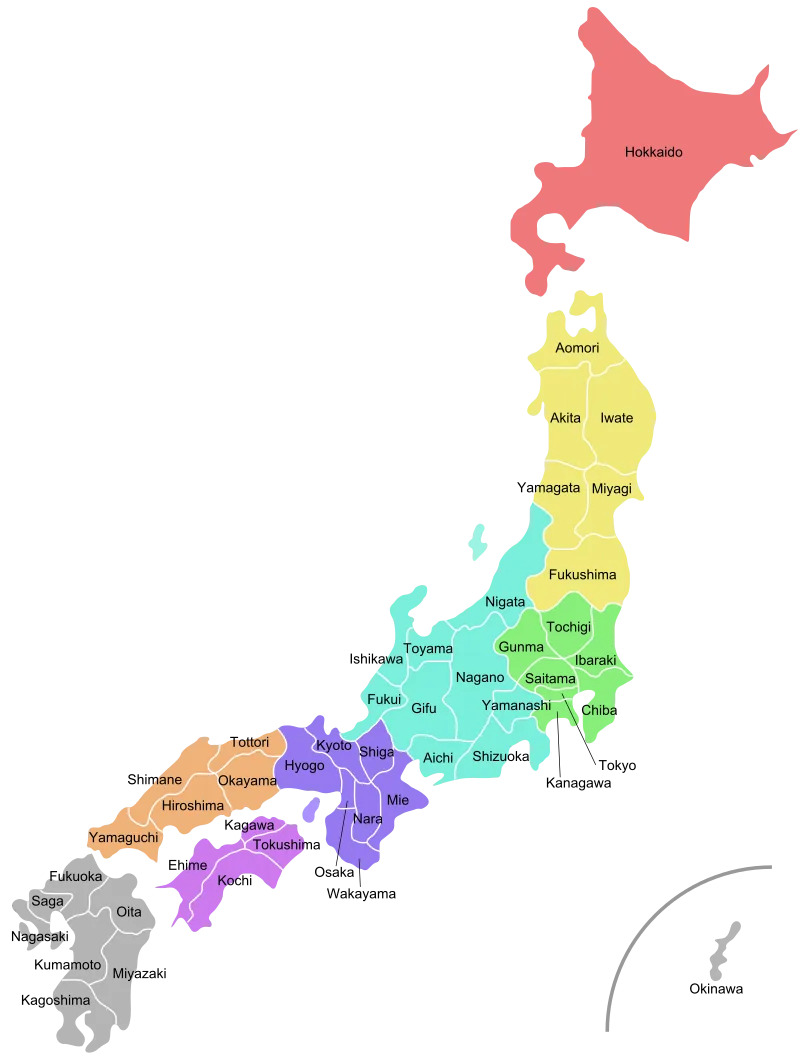
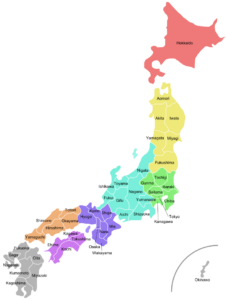
Sakai sits on the southern shore of Osaka Bay, in Osaka Prefecture, immediately south of the city of Osaka. The bay opens west into the Seto Inland Sea, and the land behind the port runs flat toward Kyoto and Nara — one of the oldest settled and most intensively farmed corners of the country. Summers are hot and humid, winters are mild, and goods moving through this port never had to cross a mountain range to reach a market.

What shaped the city’s metalwork was its politics as much as its geography. Sakai grew as a merchant port town, not a castle town, and its blacksmiths worked through independent guilds rather than under a single domain’s workshop. That structure — many small shops, each with one specialty — is why the city still makes blades in fragments instead of in one factory.
The commonly told account traces Sakai cutlery to tobacco-cutting knives in the 16th century, when the port’s trade brought in a leaf that needed a thin, hard blade to shred it. The trade stuck, and the grinding and forging skills that tobacco work demanded carried over into kitchen knives.

In the Edo period, Sakai makers held an exclusive, shogunate-authorized seal for quality. A seal of that kind is not a marketing emblem; it is a gate. It meant a blade could be sold as Sakai work only if it passed through the guild system that held the mark, which pushed quality control into the town’s institutions rather than leaving it to individual reputations.
-
15th–16th century — Sakai develops as a merchant port on the southern shore of Osaka Bay, organized around trade and independent guilds rather than a castle-town workshop system. -
16th century — The commonly told account dates Sakai cutlery to tobacco-cutting knives, the trade that established the town’s fine-edge grinding. -
Edo period (1603–1868) — Sakai makers hold an exclusive shogunate-authorized seal for blade quality. -
20th century — Production is documented as divided labor, with forging, sharpening and handle-making handled by separate specialist shops. -
Post-war decades — Sakai uchihamono is designated a Traditional Craft by METI, the ministry that maintains the national list of craft designations. -
2026 — The 160 mm VG-10 Damascus nakiri covered here is listed at ¥19,800 on Amazon Japan, new, with three units in stock.

Production survives as divided labor. Forging, sharpening and handle-making are separate trades, often in separate workshops, and a single finished knife may pass through three of them before it is boxed. The arrangement explains both the cost of a Sakai blade and its consistency: each step is done by someone who does only that step.
“Sakai’s blade industry grew around a port, not a castle — and it still runs as a chain of separate specialists rather than a single workshop.”
The listing does not name the individual workshop behind this blade. That is normal for the trade: the brand assembles the chain, and the chain is the reason a Sakai knife carries a city’s name rather than a single smith’s signature.
📌 How does it compare?
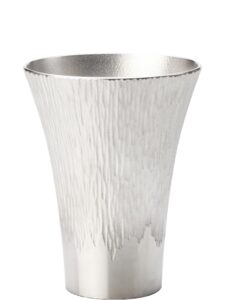
Other Japanese blades and kitchen objects covered on this site. Each card opens the full guide.
Price snapshot across stores
Prices below are for the specific 160 mm nakiri unless a row says otherwise. The yen figure is authoritative; the dollar figure is an estimate at a ¥150/USD baseline and moves with the exchange rate.
| Store | Item / variant | Price | Notes |
|---|---|---|---|
| 🇺🇸 Amazon.com (US) | Browse Japanese nakiri and vegetable knives | varies (USD) | Best if you are shopping from the US: Prime shipping, USD pricing, no import fees. Amazon.com carries nakiri and vegetable knives from Shun, Tojiro, Yoshihiro and other makers, which is useful for comparing geometry and steel at each price tier. This Sakai Takayuki piece is sourced from Japan (next row). |
| 🇯🇵 Amazon JP Global Store | Sakai Takayuki V金10号 33-layer Damascus nakiri, 160 mm, new | ¥19,800 (≈ $132 USD as of 2026-10-20; verify on the listing) | Ships internationally from Japan to 65+ countries — including Canada, the UK and Australia — with import fees estimated at checkout. Three units left at the time of writing. |
| Maker direct | Sakai Takayuki lines through specialist knife retailers | Unconfirmed — check retailer | No maker-direct international storefront was confirmed for this specific listing. Sakai production runs through knife shops and export agents, so a local specialist retailer is the usual alternative route. |
| Proxy services (Buyee / Tenso) | Same Japanese listing, forwarded | Item price + proxy fee + international shipping | Useful if a seller will not ship to your country directly. Adds a handling fee and a second shipping leg, and the parcel is repacked outside the seller’s control. |
Prices in USD are approximate and depend on the current exchange rate. Stock and price were as of October 20, 2026, and are not guarantees.
What it does well
There is a second, less obvious strength in the construction. The 33-layer cladding named in the listing is not only a pattern; a layered jacket around a hard stainless core is a way of putting a tough, thin edge in a blade that will not shatter on a board. The trade-off is that the layered face shows every fingerprint and every dried drop of vegetable water, which is why the care card below matters.
- 🍽️ Dishwasher: not advised for a Damascus-clad blade with a hammered face — hand-wash and dry.
- 🧴 Daily care: wipe dry immediately after use; the dimples of the hammered finish hold water against the steel.
- 🔪 Edge care: sharpening is a separate trade in Sakai, so plan on a whetstone or a local sharpener rather than a pull-through gadget.
- 🧊 Storage: keep it off a magnetic strip if the blade face matters to you, and out of a drawer where the edge can meet other metal.
Weaknesses and things to verify before buying
- The edge geometry is not stated. Whether this nakiri is ground on both sides or one is the single most important unstated fact for a buyer, and it cannot be settled from the listing text.
- The handle is not described. Material, shape and weight are unstated, so the balance point of the finished knife is unknown until you read the product page photographs closely.
- It is a single-task blade. No tip means no trimming, no filleting, no piercing. If you cook protein as often as vegetables, a santoku covers both at a similar price.
- The hammered face is a trade-off. It looks distinctive and it also gives wet slices more surface to cling to than a polished blade, and more places for water to sit.
- ¥19,800 is a lot for one job. The money buys layered steel and a Sakai name, not versatility. A stamped stainless nakiri does the same cutting for a fraction of the price, with a fraction of the finish.
- Stock is thin. Three units at the time of writing, from a marketplace knife seller. When a listing runs out, the same model may reappear at a different price from a different seller.
- Returns and import fees sit outside the listing. Cross-border orders can attract duty, and the return path runs through the seller, not through a local store.
📦 Shipping & where to buy from outside Japan
Amazon JP Global Store ships this listing internationally, and the checkout estimates import fees for most destinations before you pay. Shipping to the US, the EU, Canada, the UK and Australia typically runs $15–$40 for a parcel of this size, and delivery time depends on the carrier and the destination.
Duty thresholds differ by country. Orders above the local limit can attract customs charges on top of the fees estimated at checkout, and a kitchen knife is occasionally flagged for restricted-goods review depending on the destination. If a seller will not ship to your address, a proxy service such as Buyee or Tenso will forward the parcel from a Japanese address for a fee.
Conclusion — which buyer type are you?
Other ways to approach this purchase
🏆 Editor’s Pick
- The listing pairs a stainless VG-10 blade with 33-layer Damascus cladding and a hammered face — the finish most buyers are actually paying for at this price.
- 160 mm is the practical middle size for a home kitchen: enough blade for a cabbage, short enough to control on a small board.
- The seller is a specialist knife shop on Amazon Japan, and the listing ships through the Global Store rather than requiring a proxy.
“A nakiri is not the knife that does more. It is the knife that does one thing without wobbling.”
❓ Frequently Asked Questions
Is this nakiri double-bevel or single-bevel?
The listing does not state the edge geometry. Nakiri are commonly ground on both sides, but that is not confirmed for this item, so check the product page before ordering if you specifically want a single-bevel blade.
What does the 160 in the listing title mean?
It is the blade length in millimeters — 160 mm, about 6.3 inches. That is a mid-size nakiri, matched to a home cutting board rather than a professional prep station.
What is V金10号 (VG-10)?
A stainless steel grade widely used for Japanese kitchen knives. In this listing it is paired with a 33-layer Damascus cladding, which forms the patterned band above the edge.
Will Amazon Japan ship this to Canada, the UK or Australia?
Amazon JP Global Store ships to more than 65 countries, including Canada, the UK and Australia. Import fees are usually estimated at checkout, and local duty thresholds still apply on arrival.
How much is ¥19,800 in US dollars?
About $132 at a ¥150/USD baseline, as of October 20, 2026. The yen price is the authoritative one; the dollar figure moves with the exchange rate.
Can I use it for meat or fish?
A nakiri has a tall, flat blade with no tip, so it is built for vegetables. It will cut boneless protein, but it is not the tool for trimming, filleting or working around bones.
How should I care for a Damascus-clad blade?
Hand-wash and dry it immediately after use, and store it where the edge is protected. The hammered finish holds water in its hollows, so drying matters more than it does on a smooth blade.
jpmono.com is curated by a Japan-based editorial team, with desks in Toyama in the Hokuriku region and Nara in Kansai, and is independent. We do not take payment from the makers we feature; income comes from affiliate links. Read more about our editorial standards.
AI-assistance note: this article was drafted with editorial software that helps compile listing data and check structure. Product descriptions, prices and historical statements were reviewed and are limited to what the cited listing and published craft records state; unstated attributes are marked as unconfirmed.
Affiliate disclosure: jpmono.com may earn a commission on qualifying purchases made through links on this page, at no additional cost to you.