![Tsuchiya Kaki Yokan (つちや 柿羊羹, split-bamboo tube stick) — Ogaki, Gifu’s 1755 confectioner sets Mino dried-persimmon puree in a green bamboo case [2026 Guide for International Readers]](https://jpmono.com/wp-content/uploads/2026/07/tsuchiya-kaki-yokan-persimmon-where-to-buy-2026-featured.jpg)
- What it is: a firm amber jelly of Mino dried-persimmon puree, sugar and agar, set inside a length of split green bamboo you peel back and slice.
- Made in: Ogaki, Gifu (Chūbu) — by Okashi Tsuchiya (御菓子つちや), a confectioner founded in 1755.
- Price band: gift-grade regional wagashi — a specialty sweet rather than an everyday snack (check the live listing for the current figure).
- Best for: readers who like deep, honeyed dried-fruit flavor and want a travel-friendly, plant-based Japanese sweet to gift or try.
- Skip if: you expect fresh, tart fruit or a soft mousse texture — this is a dense, very sweet set jelly.
- Shipping: shelf-stable; ships internationally from Amazon Japan — jump to our pick ↓
Cut open a length of green bamboo the size of a small rolling pin and inside, where you would expect nothing, sits a solid amber stick of persimmon. That is the whole trick of kaki-yokan (柿羊羹, “persimmon yokan”): the confectioner Okashi Tsuchiya, working in the castle town of Ogaki in southwestern Gifu since 1755, pours a firm jelly of Mino dried-persimmon puree, sugar and agar straight into split green bamboo, and lets the wood become both mold and package.
You do not unwrap it so much as unpack it — the bamboo peels back along its split, and you slice the stick directly from the case. The wood lends a faint fresh-grass scent to a flavor that is otherwise deep, honeyed and unmistakably dried-persimmon. The fruit behind it, the Hachiya (蜂屋柿) persimmon dried in the Mino hills, was a prized autumn crop of the region long before it was a sweet; Tsuchiya’s version turns that short-lived fruit into something that keeps for months.
This guide is written from a Japan-based editor’s desk for international readers deciding whether to order a regional wagashi they cannot taste first. It explains what kaki-yokan actually is, why the bamboo tube matters more than it looks, how the Ogaki persimmon tradition sits in Japanese food history, and — practically — how to buy the specific Tsuchiya bamboo-tube bar through Amazon Japan’s Global Store, wherever you live.
🔄 Updated:
⏱️ Read time: ~9 min

ℹ️ Live pricing and some listing specifics weren’t in our snapshot — the linked Amazon Japan listing is authoritative; unconfirmed attributes are marked below and no price is stated here.
- Who this is for — and who should skip it
- Product overview (from published specs)
- Where this comes from — Ogaki, the water city of Gifu
- Price snapshot across stores
- What it does well
- Weaknesses and things to verify before buying
- Conclusion — which buyer type are you?
- Other ways to approach this purchase
- 🏆 Editor’s Pick
- 📦 Shipping & where to buy from outside Japan
- ❓ Frequently Asked Questions
Who this is for — and who should skip it
- Enjoy deep, honeyed dried-fruit flavor over fresh-fruit tartness.
- Want a plant-based sweet — no dairy, egg, meat or gelatin.
- Need a travel-friendly gift that does not melt or spoil quickly.
- Like the ritual of peeling the bamboo and slicing the stick yourself.
- Are curious about regional (meibutsu) wagashi beyond the famous Tokyo names.
- Expect a soft, mousse-like or custardy texture — this is a firm set jelly.
- Dislike very sweet confections; yokan is concentrated sugar and fruit.
- Want a low-sugar or “healthy snack” (we make no health claims here).
- Need it to keep for weeks after opening — refrigerate and eat within days.
- Live somewhere Amazon’s food-import eligibility does not reach (verify at checkout).
Product overview (from published specs)
Tsuchiya Kaki Yokan (つちや 柿羊羹, split-bamboo tube stick)
つちや 柿羊羹 190g × 2個セット 老舗和菓子店 岐阜名産 干し柿ようかん 高級贈答用 ギフト 手土産 岐阜 お土産 和菓子
通常3~4日以内に発送します。 · Sold by mfkセレクトストア · ASIN B0G4WYH7CN
Price and availability as of 2026-08-31 02:30 JST. The Amazon listing at the time of purchase is authoritative. jpmono.com earns a commission on qualifying purchases at no extra cost to you.
| Maker | Okashi Tsuchiya (御菓子つちや; historically written 槌屋) |
|---|---|
| Founded | 1755 (Hōreki 5) |
| Origin | Ogaki, Gifu Prefecture (Chūbu region) |
| Product | Kaki-yokan (柿羊羹) — persimmon yokan, a signature meibutsu (regional specialty) |
| Key ingredients | Dried-persimmon (干し柿) puree, sugar, agar (寒天) — essentially these only |
| Persimmon base | Tied to Mino’s Hachiya (蜂屋柿) dried-persimmon tradition |
| Format / packaging | Set inside a length of split green bamboo; peel back the case and slice the stick |
| Dietary | Plant-based; no dairy, egg, meat or gelatin; does not melt at room temperature |
| Shelf life | Agar-set neri-yokan; shelf-stable several months unopened. Refrigerate and eat within days after opening (see best-by date on the pack) |
| Listing (ASIN) | B0G4WYH7CN — Amazon Japan Global Store (bamboo-case, mid size) |
Sources: Amazon US search (primary, moonill-20), Amazon Japan Global Store listing (secondary, moonill-22, sourced listing), and maker/product data notes. Price was not present in the fetched snapshot and is not stated here.
📖 Glossary — key terms
- Yokan (羊羹) — a firm, sliceable Japanese jelly-sweet, usually set with agar.
- Neri-yokan (練り羊羹) — the dense, “kneaded” style of yokan (as opposed to the softer mizu-yokan); firm enough to slice cleanly.
- Kanten (寒天) — agar, a plant-derived (seaweed) gelling agent. It sets firm and, unlike gelatin, holds shape at room temperature.
- Kaki (柿) — persimmon. Hoshigaki (干し柿) — dried persimmon.
- Hachiya-gaki (蜂屋柿) — an astringent persimmon variety long dried in the Mino region of Gifu.
- Wagashi (和菓子) — traditional Japanese confectionery.
- Meibutsu (名物) — a regional specialty a place is known for.
- Mino (美濃) — the historical name for southern Gifu.
Other Japanese sweets, teas and tableware we’ve covered — natural companions to a stick of kaki-yokan.
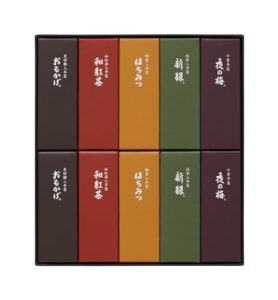

Toraya Small Yokan (Ko-gata Yōkan, 10-Bar Assorted Box) — Japan’s classic yokan
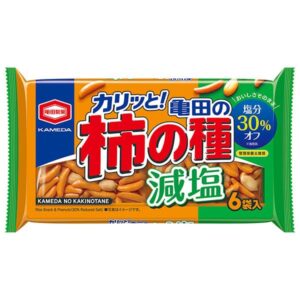

Kameda Kaki no Tane (亀田の柿の種, 6-bag box) — Niigata’s rice-cracker classic
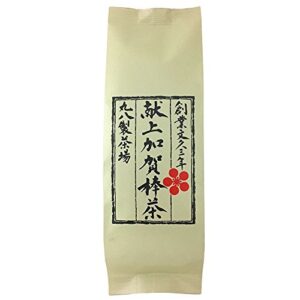

Maruhachi Seichajo Kenjo Kaga Bocha (献上加賀棒茶, sealed bag/tin)
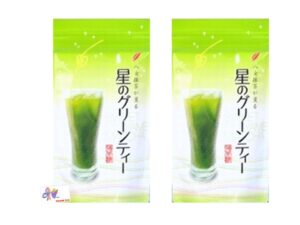

Hoshino Seichaen Yame Matcha (星野製茶園 八女抹茶, sealed 30–40g tin)
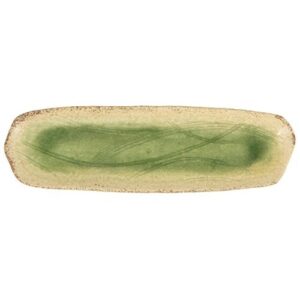

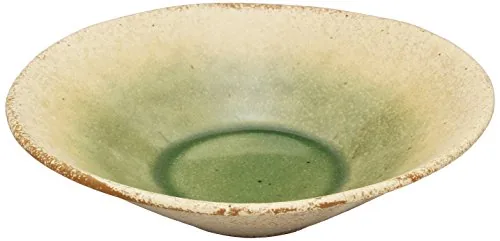
Mino-yaki Oribe Square Plate: Momoyama Green-Glaze Tea Ware
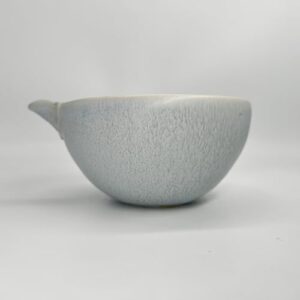

Mino-yaki Shino Ware Matcha Chawan: Where to Buy a Tea Bowl
Two of these — the Mino-yaki Oribe plate and Shino chawan — come from the same Gifu region as this persimmon yokan, and both make a natural serving pairing.
Where this comes from — Ogaki, the water city of Gifu

Ogaki sits in southwestern Gifu Prefecture, on the flat Nōbi plain in the historical province of Mino (美濃) — inland Chūbu, roughly midway between Nagoya to the east and the mountain pass of Sekigahara to the west. It is known within Japan as a mizu no miyako (“city of water”): artesian springs surface throughout the town, and that abundant, soft groundwater is the quiet reason a confectionery trade could take root and keep working here for centuries.
The town’s fortunes were shaped by its position on the road. Ogaki grew as a castle town on the main routes threading the plain, close to the ground where the decisive Battle of Sekigahara was fought in 1600. It also marks a literary endpoint: in 1689 the poet Matsuo Bashō concluded his famous travel account Oku no Hosomichi (“The Narrow Road to the Deep North”) in Ogaki. This is a place people passed through, rested in, and carried keepsakes home from — exactly the conditions under which a durable, giftable local sweet becomes a regional name.
The persimmon behind the yokan is older than the shop. In the Mino hills, astringent Hachiya persimmons were dried into hoshigaki to carry the autumn harvest through the year, and that dried fruit — intensely sweet, leathery, honeyed — was a prized regional product well before Okashi Tsuchiya opened its doors in 1755. What Tsuchiya did was take that concentrated dried-persimmon flavor, purée it with sugar and agar, and set it firm. The bamboo case is the finishing idea: split green bamboo as both mold and wrapper, lending its faint grassy aroma to the fruit.
- 1600 — The Battle of Sekigahara is fought just west of Ogaki, on the Mino plain the town commands.
- 1689 — Matsuo Bashō ends his Oku no Hosomichi journey in Ogaki.
- Edo period — Mino’s Hachiya persimmons are dried into hoshigaki, a prized regional autumn product.
- 1755 (Hōreki 5) — Okashi Tsuchiya is founded in Ogaki; the family name is also written 槌屋.
- Later Edo–modern era — Kaki-yokan set in split green bamboo becomes Ogaki’s signature meibutsu.
- 2026 — Tsuchiya still makes the bamboo-tube kaki-yokan; it reaches international buyers via Amazon Japan’s Global Store.
“The bamboo is not decoration. It is the mold, the wrapper, and the last note of the scent — the persimmon keeps its season inside a cut of green wood.”
Continuity is the point here, not novelty. A house that has sold sweets in one town since 1755 has outlasted the Edo period, the Meiji Restoration, and every reinvention of Japanese retail since — and it is still building the same object around the same fruit. That is what “made here” means for a regional wagashi: not a marketing story, but an unbroken habit of turning the local harvest into something that travels.
Price snapshot across stores
JPY (¥) is the authoritative price for the specific listed item; any USD figure would be an approximate estimate at roughly ¥150/USD. No live price was present in our snapshot, so figures below read “varies / check listing” rather than an invented number.
| Store | Item / Variant | Price (JPY + USD est.) | Notes |
|---|---|---|---|
| 🇺🇸 Amazon.com (US) | Browse Japanese yokan & wagashi | varies (USD) | Best if you’re shopping from the US — Prime shipping, USD pricing, no international customs. Amazon US carries Japanese yokan and dried-fruit sweets from various makers; Tsuchiya’s exact bamboo-tube kaki-yokan is sourced from Japan (next row). |
| 🇯🇵 Amazon JP Global Store | Tsuchiya kaki-yokan, bamboo case (mid size) — ASIN B0G4WYH7CN | check listing (¥) — no price in snapshot | Ships internationally from Japan to 65+ countries — including Canada, the UK and Australia — with import fees estimated at checkout. This is the sourced listing for the exact item. |
| Maker direct | Bamboo-tube and wood-box formats | Unconfirmed — check maker | Okashi Tsuchiya sells domestically; direct overseas shipping of food is not confirmed in our data. |
| Proxy services (Buyee / Tenso) | Forwarding from JP retailers | Item price + forwarding fee | A fallback if the Global Store listing is out of stock; note that some services restrict perishable/food forwarding — confirm before ordering. |
What it does well
- 🌡️ Storage: shelf-stable at room temperature for several months unopened (check the best-by date on the pack).
- ❄️ After opening: refrigerate and consume within a few days.
- 🔪 To serve: peel the split bamboo back and slice the amber stick directly from the case.
- 🌱 Dietary: plant-based — no dairy, egg, meat or gelatin; does not melt at room temperature.
Weaknesses and things to verify before buying
- It is very sweet and firm. Yokan is concentrated sugar and fruit set into a dense jelly; if you expect fresh-fruit tartness or a soft, mousse-like texture, this will not match your expectation.
- Short window after opening. Unopened it keeps for months, but once cut you should refrigerate it and eat it within a few days — plan for a gift or a short indulgence, not a pantry staple.
- No price in our snapshot. Live pricing was not in the fetched data; verify the current figure on the Amazon Japan listing before ordering, and do not rely on any estimate.
- Format and stock vary. Beyond the bamboo-case mid size, a wood-box larger format exists but its stock can be unstable; confirm which size and pack you are actually buying on the listing.
- Food-import eligibility is destination-specific. This is a room-temperature food with a best-by date, intended in small personal quantities; check AmazonGlobal International Shipping eligibility for your country and note that customs/eligibility are confirmed at checkout.
- Texture may be unfamiliar. The clean, firm agar set is normal for neri-yokan but can surprise first-time buyers used to Western jellies or fruit pastes.
Conclusion — which buyer type are you?
Other ways to approach this purchase
🏆 Editor’s Pick
📦 Shipping & where to buy from outside Japan
Tsuchiya’s kaki-yokan is a shelf-stable, room-temperature food with a best-by date, which makes it one of the more sendable wagashi. The specific bamboo-case item is sourced from the Amazon Japan Global Store, which ships internationally to 65+ countries — including Canada, the UK and Australia. Because it is a food item, the key step is to confirm AmazonGlobal International Shipping eligibility for your destination at checkout, where import fees are also estimated and collected for most countries.
Order in small personal quantities, expect a shipping-cost range broadly similar to other Japan-to-overseas grocery items (commonly around $15–$40 depending on weight and destination), and treat the best-by date as your planning window. If the Global Store listing is unavailable where you are, a forwarding service (Buyee / Tenso) is a fallback — but check first that they accept food/perishable forwarding.
❓ Frequently Asked Questions
What does Tsuchiya kaki-yokan taste like?
Deep, honeyed and concentrated — it is built on Mino dried Hachiya persimmon, so the flavor is closer to a fine dried fruit than to fresh persimmon. The texture is a firm, clean-slicing agar jelly, and the bamboo case adds a faint fresh-grass aroma.
Why is it packaged in bamboo?
The split green bamboo is both the mold the yokan is set in and its wrapper. You peel the case back and slice the stick directly from it, and the wood lends a light fresh scent — so the bamboo is functional, not just decorative.
Is it vegan or gelatin-free?
It is essentially dried-persimmon puree, sugar and agar (a seaweed-derived gelling agent), with no dairy, egg, meat or gelatin. Always confirm the ingredient list on the current listing, as recipes and allergen labeling can change.
How long does it keep, and how do I store it?
Unopened, agar-set neri-yokan is shelf-stable at room temperature for several months — check the best-by date on the pack. Once opened, refrigerate it and eat within a few days. It does not melt at room temperature, which is part of what makes it travel-friendly.
Can it be shipped to my country?
It ships internationally from the Amazon Japan Global Store to many destinations, including Canada, the UK and Australia. As a food item, eligibility is destination-specific — confirm AmazonGlobal International Shipping for your country at checkout, where import fees are also estimated. Order in small personal quantities.
How much does it cost?
A live price was not available in our data snapshot, so we do not quote a figure — the JPY price on the linked Amazon Japan listing is authoritative. It is a specialty regional sweet rather than an everyday snack, so expect gift-grade pricing; verify the current amount before ordering.
What should I serve it with?
Its concentrated sweetness pairs naturally with unsweetened Japanese tea — a roasted twig tea (bōcha) or a bowl of matcha both balance it well. Sliced thin on a small Gifu Mino-yaki plate, it makes a simple, regionally coherent presentation.
jpmono.com is curated by a Japan-based editorial team (working out of Toyama in the Hokuriku region and Nara in Kansai) and is independent. We do not take payment from the makers we feature; income comes from affiliate links. We read maker specs and source listings rather than physically testing every item.
🤖 This article was drafted with AI assistance and edited against maker specs and source listings by the jpmono.com editorial team. Facts, prices and shipping terms should be confirmed on the linked listings before purchase.
Affiliate disclosure: jpmono.com may earn a commission on qualifying purchases made through links on this page, at no additional cost to you.