![Honba Oshima Tsumugi Silk Eyeglass Case: Mud-Dyed Amami Craft [2026]](https://jpmono.com/wp-content/uploads/2026/06/honba-oshima-tsumugi-silk-eyeglass-case-where-to-buy-2026-featured.jpg)
Honba Oshima Tsumugi (本場大島紬, “genuine Oshima pongee”) is one of Japan’s three great silk tsumugi, hand-woven on the subtropical island of Amami Oshima in Kagoshima Prefecture and colored by doro-zome — a mud-dyeing process unique to the island. The yarn is dyed again and again with tannin from the sharinbai tree, then kneaded into iron-rich Amami mud until it takes on a deep, soft, almost lacquer-like black-brown sheen. A full kimono bolt of this cloth, with its thread-by-thread kasuri patterning, is one of the most labor-intensive textiles produced anywhere in Japan.
That labor is exactly why a small accessory is the sensible way for an overseas buyer to own a piece of it. An eyeglass case cut from certified Oshima cloth carries the same mud-dyed silk and the same registered authenticity mark as a kimono, at a fraction of the commitment. It is a daily-use object that happens to be a fragment of a 1,300-year weaving tradition.
This guide is written for readers who already appreciate Japanese textiles — or who want a meaningful, pocket-sized gift — and who need to know what “genuine” means here, how to buy from outside Japan, and how this Kagoshima silk compares to the other tsumugi and silk goods we have covered. Note up front: the fetched dataset for this listing returned no live price or product photography, so pricing below is marked as needing verification at the listing.
🔄 Updated:
⏱️ Read time: ~10 min
![Honba Oshima Tsumugi Silk Eyeglass Case: Mud-Dyed Amami Craft [2026]](https://m.media-amazon.com/images/I/312rw53443L._SL500_.jpg)
- Who this is for — and who should skip it
- Product overview (from published specs)
- 📍 Where this comes from — place, era, and the craft tradition
- 📌 How does it compare?
- 📦 Shipping & where to buy from outside Japan — price snapshot across stores
- What it does well
- Weaknesses and things to verify before buying
- Conclusion — which buyer type are you?
- Other ways to approach this purchase
- 🏆 Editor’s Pick
- ❓ Frequently Asked Questions
Who this is for — and who should skip it
- Want a genuine Japanese textile in an affordable, everyday object
- Appreciate natural dyeing — the iron-and-tannin mud process is the whole point
- Are shopping for a refined, lightweight gift that ships well
- Already own or admire tsumugi, and want a piece of the Amami tradition specifically
- Prefer deep, muted, classic colors over bright synthetic ones
- Want a rugged, knockabout case — silk needs gentle handling
- Need machine-washable material; mud-dyed silk does not tolerate that
- Are looking for the cheapest possible eyeglass case
- Expect bright colors or bold modern prints
- Need guaranteed in-stock delivery today (this is a small-batch craft item)

Product overview (from published specs)
The dataset fetched for this listing was sparse — it returned the item identifier but no live price, dimensions, or photography. The table below states what is known from the spec and marks the rest for verification rather than guessing. Spec sheets indicate the core fact that matters most: this is cloth cut from certified Honba Oshima Tsumugi, not a printed imitation.
Honba Oshima Tsumugi Silk Eyeglass Case
大島紬 小物入れ ポーチ 眼鏡ケース マルチケース
通常5~6日以内に発送します。 · Sold by スタイルノート · ASIN B0GJMNVYZW
Price and availability as of 2026-08-31 02:30 JST. The Amazon listing at the time of purchase is authoritative. jpmono.com earns a commission on qualifying purchases at no extra cost to you.
| Attribute | Detail |
|---|---|
| Item | Eyeglass / glasses case |
| Material | Honba Oshima Tsumugi silk, doro-zome (mud-dyed) with sharinbai tannin and iron-rich mud, cut from certified cloth |
| Origin | Amami Oshima, Kagoshima Prefecture, Kyūshū, Japan |
| Color | Deep mud-dyed black-brown (typical of doro-zome); pattern varies by listing |
| Dimensions / weight | Unconfirmed — check listing |
| Item ID (ASIN) | B0GJMNVYZW |
| Price | Unavailable in fetched data — verify at the listing before purchase |
Sources: Amazon US search (primary, moonill-20) + Amazon JP Global Store (secondary, moonill-22, sourced listing) + maker direct. Prices and availability fluctuate; the live listing is authoritative.
📖 Glossary — key terms in this article
Tsumugi (紬) — a silk woven from spun (rather than reeled) yarn, traditionally from irregular or floss silk. It produces a matte, textured, hard-wearing cloth historically worn as everyday silk.
Honba (本場) — “genuine” or “the real production region.” “Honba Oshima Tsumugi” is the protected name for cloth actually woven on Amami Oshima to the registered standard, distinguishing it from imitations woven elsewhere.
Doro-zome (泥染め, “mud dyeing”) — the signature Amami process: yarn is dyed repeatedly with tannin from the sharinbai tree, then worked into iron-rich island mud. The iron-tannin reaction yields a deep, soft black-brown that is difficult to reproduce with synthetic dyes.
Sharinbai (車輪梅, Rhaphiolepis) — the “Yeddo hawthorn” shrub whose bark and wood provide the tannin used in mud dyeing.
Kasuri (絣) — ikat-style patterning in which the threads are resist-dyed before weaving so the design emerges as the cloth is woven. Oshima’s fine Tatsugo splash patterns are planned thread by thread.
Satsuma (薩摩) — the Edo-period domain, centered on present-day Kagoshima, that governed the far south of Kyūshū and the Amami islands.
Shokunin (職人) — a skilled craftsperson; the dyers and weavers behind this cloth.

📍 Where this comes from — place, era, and the craft tradition

Amami Oshima is not the Japan most international readers picture. It is subtropical — warm, humid, and green, swept by the Kuroshio current, far closer to Okinawa in climate than to Kyoto. That climate is part of why the textile exists here: silk worms, mulberry, the sharinbai shrub that supplies the dyeing tannin, and the iron-rich mud of the island’s low fields are all local. The dye is, quite literally, made of the place.
The island has a documented silk-weaving tradition reaching back roughly 1,300 years, to around Japan’s Nara period. For most of that history the cloth was a local good. Its political fortune changed when the far south came under the Satsuma domain in the Edo period (1603–1868). Under Satsuma rule the cloth was prized and controlled as tribute — levied, regulated, and reserved as a luxury — which is precisely how a regional textile became a coveted, high-status fabric across Japan.
-
c. 8th century — Silk weaving traditionally dated to the Nara period takes root on Amami Oshima (about 1,300 years of documented history). -
1603 — The Edo period begins; the Satsuma domain governs the far south of Kyūshū and the Amami islands. -
17th–19th c. — Under Satsuma, Oshima Tsumugi is prized and controlled as tribute, cementing its status as a luxury textile. -
1868 — The Meiji Restoration ends the domain tribute system; production broadens beyond the old controls. -
Modern era — Honba Oshima Tsumugi is recognized among Japan’s three great tsumugi, alongside Yuki Tsumugi and Ueda Tsumugi. -
2026 — Certified cloth is still hand-woven on Amami; accessories like this case are cut from it for everyday use.
What “still being made here” means for Oshima is bound up in how slow the work is. The fine kasuri patterns — the splash-like Tatsugo style is the classic example — are planned thread by thread before a single pass of the shuttle, and the mud dyeing is repeated through dozens of cycles. A finished kimono bolt represents months of coordinated labor between dyers and weavers, which is why genuine Oshima kimono cloth is genuinely expensive, and why imitations exist.
“The black of Oshima Tsumugi is not painted onto the silk — it is grown into it, one mud bath at a time, by an iron-and-tannin reaction that no synthetic dye fully imitates.”
For an overseas reader, the practical consequence is reassuring. You do not need to buy a kimono to own this cloth. A case cut from certified Oshima silk carries the same dyeing, the same hand-weaving, and the same authenticity standard in an object you will actually use every day. That is the logic behind this listing — and the reason accessories are the most accessible entry point into the tradition.

📌 How does it compare?
Related guides on jpmono.com — the rest of the silk cluster and Kagoshima’s other crafts:
 👛 Ueda Tsumugi gamaguchi
 🧣 Chichibu Meisen silk
👔 Kiryu-ori silk
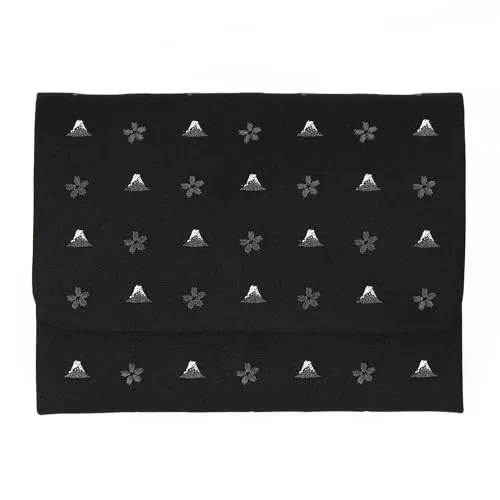 💳 Nishijin Ori card case
🟦 BUAISOU indigo tenugui
 🍶 Satsuma-yaki (Kagoshima)
 🔷 Satsuma Kiriko (Kagoshima)
📦 Shipping & where to buy from outside Japan — price snapshot across stores
Because the specific case is sourced from Amazon JP Global Store, international buyers have two clean paths. The dataset did not return a price, so the figures below are marked accordingly — verify at the listing before you buy. International shipping for small silk goods from Japan typically runs in the $15–$40 range to the US and EU, with customs duties possible above your local de minimis threshold.
| Store | Item / Variant | Price (JPY → USD est.) | Notes |
|---|---|---|---|
| 🇺🇸 Amazon.com (US) | Browse Japanese silk cases & tsumugi goods | varies (USD) | Best if you’re shopping from the US — Prime shipping, USD pricing, no international customs. Amazon US carries Japanese silk accessories from various makers for comparison; this exact Amami-woven case is sourced from Japan (next row). |
| 🇯🇵 Amazon JP Global Store | Honba Oshima Tsumugi eyeglass case (doro-zome) | Check listing — price unavailable in fetched data | The sourced listing for the exact item. Ships internationally from Japan to most major destinations. |
| Maker direct | Certified Oshima accessories | Varies | Amami cooperatives and certified makers sell accessories; international shipping support varies by maker. |
| Proxy services (Buyee / Tenso) | Any JP-only listing | Item price + forwarding fee | Useful if a particular pattern is listed only on a JP-domestic shop that does not ship abroad. |
JPY is the authoritative price; USD figures are estimates at a ¥150/USD baseline (mid-2026). Prices and stock fluctuate — confirm at the affiliate link for current data.
What it does well
Weaknesses and things to verify before buying
- No price in the fetched data. Only the listing identifier was available; live pricing may have shifted since the writing date and must be checked at the listing.
- No product photography in the dataset. The exact pattern and color of the case shown can only be confirmed on the live listing image — verify before buying if appearance matters to you.
- Silk needs gentle care. Mud-dyed silk is not machine-washable and should be kept away from prolonged moisture, abrasion, and direct sun.
- “Oshima Tsumugi” imitations exist. Confirm the listing specifies Honba (genuine) Amami cloth and, where possible, references the certification mark — printed or machine-imitation cloth is sold under similar names.
- Pattern and color vary by piece. Because cases are cut from cloth, the kasuri pattern is not standardized; what you receive may differ slightly from any sample image.
- Small-batch availability. This is a craft accessory, not a mass-produced good — stock can lapse, and a specific pattern may not be reorderable.
- Customs and duties. Orders above your country’s de minimis threshold may attract import duty on arrival.
Conclusion — which buyer type are you?
Other ways to approach this purchase
🏆 Editor’s Pick
❓ Frequently Asked Questions
Is this eyeglass case made from genuine Honba Oshima Tsumugi silk?
What is doro-zome (mud dyeing)?
Why is Oshima Tsumugi expensive, and why is an accessory more affordable?
Does Amazon JP Global Store ship this internationally?
How do I care for a mud-dyed silk case?
How is this different from Yuki Tsumugi and Ueda Tsumugi?
Where exactly is it made?
jpmono.com is curated by a Japan-based editorial team (working out of Toyama in the Hokuriku region and Nara in Kansai) and is independent. We don’t take payment from the makers we feature; income comes from affiliate links. We don’t physically test every product — we read maker’s specs and source listings.
This article was prepared with AI assistance and reviewed against the source listing data. Facts about the craft and its region are drawn from the provided spec notes; where data was incomplete (price and product imagery), this is stated plainly rather than filled in.
Affiliate disclosure: jpmono.com may earn a commission on qualifying purchases made through links on this page, at no additional cost to you.