![Nagasaki Cast Bronze Candlestick (Shokudai): Obaku Temple Metalwork [2026]](https://jpmono.com/wp-content/uploads/2026/05/japan-map-regions-and-prefectures-800x1050.png)
A shokudai (燭台, “candlestick”) is one of the quietest objects in a Japanese Buddhist altar, and one of the most revealing. The single cast-bronze stem with its broad drip pan was never decorative furniture; it was ritual equipment, paired and lit before the altar. The piece this guide centers on is a Japanese cast bronze altar candlestick in the karakane (唐金, “Tang metal,” a bronze-brass alloy) idiom — sand-cast, single-stemmed, with a drip pan — the form that Nagasaki’s Chinese-founded Zen temples kept in continuous demand for four centuries.
What makes Nagasaki bronze worth a closer look is not that it is older or rarer than the cast-bronze of Takaoka — it is not. Takaoka dominates Japan’s national output of cast-bronze flower vases and altar ware. Nagasaki’s distinction is historical: during the seclusion centuries it was Japan’s only legal window to the outside world, and the Chinese émigré communities who settled there built Ōbaku Zen temples that wanted ritual bronzes in a continental, Ming-Chinese taste rather than the Kyoto or Takaoka style. That demand sustained local casters working in a recognizably Chinese-influenced register.
This article is written for readers comparing a cast-bronze altar candlestick as either a working ritual object or a piece of regional metalwork with a documented story. It covers how the form differs from orin bells and koro censers, where the Nagasaki tradition comes from, and the details that may vary by workshop or finish.
📅 Published:
🔄 Updated:
⏱️ Read time: ~11 min
- Who this is for — and who should skip it
- Product overview (from published specs)
- Where this comes from
- Where to buy Nagasaki bronze candlesticks
- What it does well
- Weaknesses and things to verify before buying
- Conclusion — which buyer type are you?
- Other ways to approach this purchase
- ❓ Frequently Asked Questions
Who this is for — and who should skip it
- Maintain a Buddhist altar (butsudan) and want a cast-bronze candlestick for actual ritual use.
- Are drawn to the weight, patina, and hand-finished surface of sand-cast karakane bronze.
- Want a metalwork object with a documented regional and religious history, not a generic import.
- Prefer a single, restrained altar form over ornate gilt or lacquer pieces.
- Are comfortable verifying the exact workshop and current stock before ordering.
- Want a flagship cast-bronze flower vase — Takaoka is the better-documented choice there.
- Need a guaranteed maker mark and certificate; workshop details are not confirmed.
- Expect tea-light or taper compatibility without checking the cup and drip-pan dimensions.
- Are shopping purely on price and want fixed, real-time pricing before committing.
- Prefer the bright ring of an orin bell or the function of a censer — those are different objects entirely.
Product overview (from published specs)
Cast bronze candlesticks in the Nagasaki tradition are made by small workshops rooted in the Obaku temple metalwork lineage, and the pieces you find today vary in dimensions, weight and finishing. Live pricing, exact dimensions, and the present-day workshop name differ from piece to piece, so the table below separates what is typical of the craft from what should be confirmed with the maker before purchase.
| Attribute | What the product details indicate | Source |
|---|---|---|
| Object type | Buddhist altar candlestick (shokudai), single stem with drip pan | Product details |
| Material | Cast bronze / brass alloy (karakane), sand-cast finish | Product details |
| Finish | Sand-cast surface; bronze patina (color may vary by lighting) | Product details |
| Dimensions / weight | — | Not in data |
| Workshop / maker | — | Not in data |
| Origin tradition | Nagasaki cast-bronze / Ōbaku-temple ritual metalwork lineage | Editorial (history below) |
| Price | — | Not in data |
📖 Glossary — key terms
- Shokudai (燭台) — a candlestick; on a Buddhist altar, typically one of a paired set placed before the central image.
- Karakane (唐金, “Tang metal”) — a bronze/brass casting alloy long associated with continental Chinese metalwork; the everyday Japanese term for cast bronze used in altar ware.
- Ōbaku (黄檗) — the third major Zen school in Japan, introduced from Fujian China in the 17th century; its temples kept a strongly Chinese (Ming) aesthetic in architecture and ritual furnishings.
- Sakoku (鎖国, “closed country”) — Japan’s policy of national seclusion, roughly 1639 to 1854, during which Nagasaki was the sole legal port for foreign trade.
- Dejima (出島) — the fan-shaped artificial island in Nagasaki harbor that housed the Dutch trading post during seclusion.
- Tōjin-yashiki (唐人屋敷) — the walled Chinese residential quarter in Nagasaki.
- Butsudan (仏壇) — a household Buddhist altar cabinet, the setting where a shokudai is used.
Related metalwork and regional craft guides on jpmono.com — useful for placing this candlestick against neighboring forms and other Nagasaki crafts.
Where this comes from

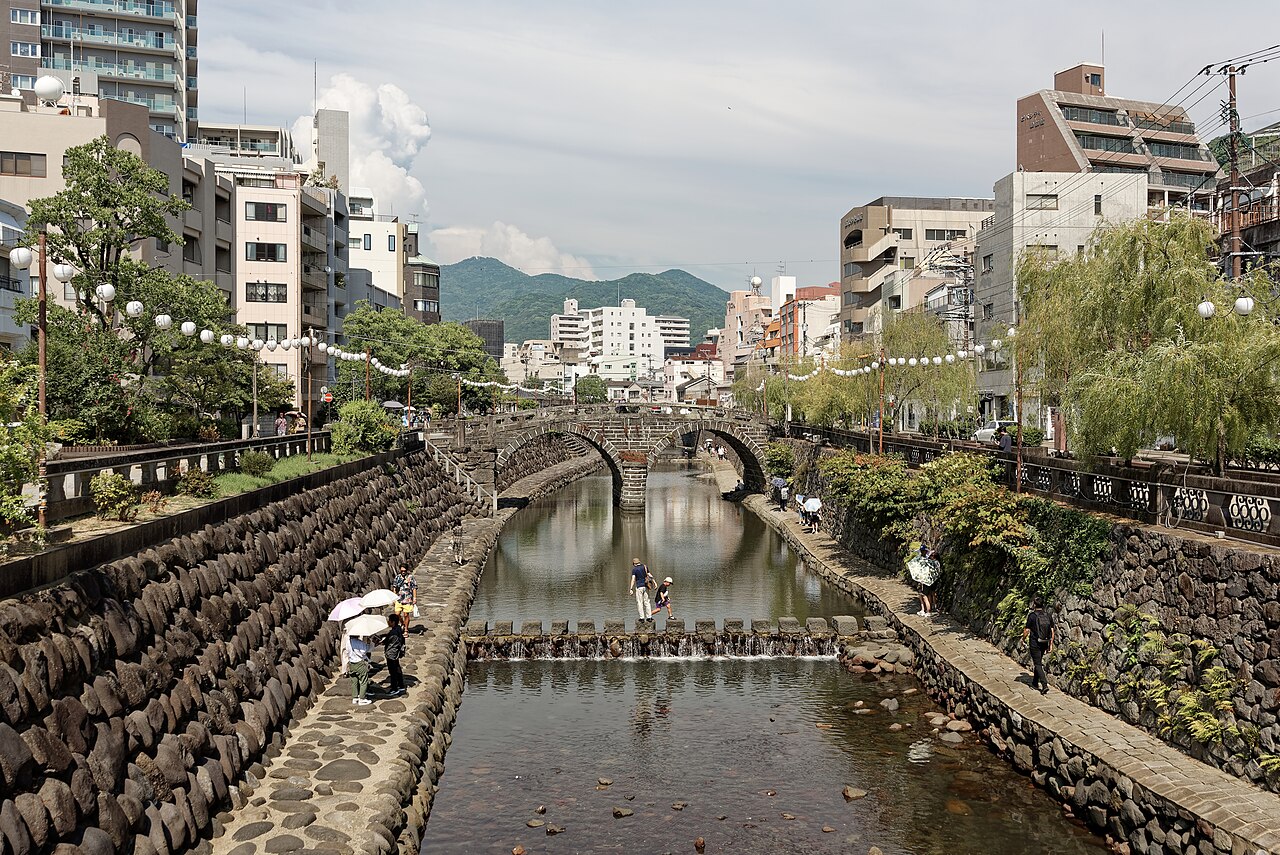
Nagasaki sits on a steep-sided inlet on the far western edge of Kyūshū, facing the East China Sea. The deep, sheltered harbor is the reason for everything that followed: it could take ocean-going ships, and it pointed toward China and Southeast Asia rather than toward the Japanese heartland. The hills rise straight off the water, so the city grew as a tight, terraced port — temples and merchant quarters stacked above the docks.
That geography made Nagasaki the natural choice when the Tokugawa shogunate sealed the country. During sakoku (鎖国, “closed country”), roughly from 1639 to 1854, foreign trade was funneled through this one harbor. Two communities formed the channel: the Dutch, confined to the fan-shaped artificial island of Dejima, and a much larger Chinese merchant population eventually housed in the walled Tōjin-yashiki (唐人屋敷, “Chinese residence”) quarter.
“For more than two centuries, almost everything Japan learned of the outside world — Dutch medicine, Chinese ritual, foreign metal — arrived through a single harbor on the edge of Kyūshū.”
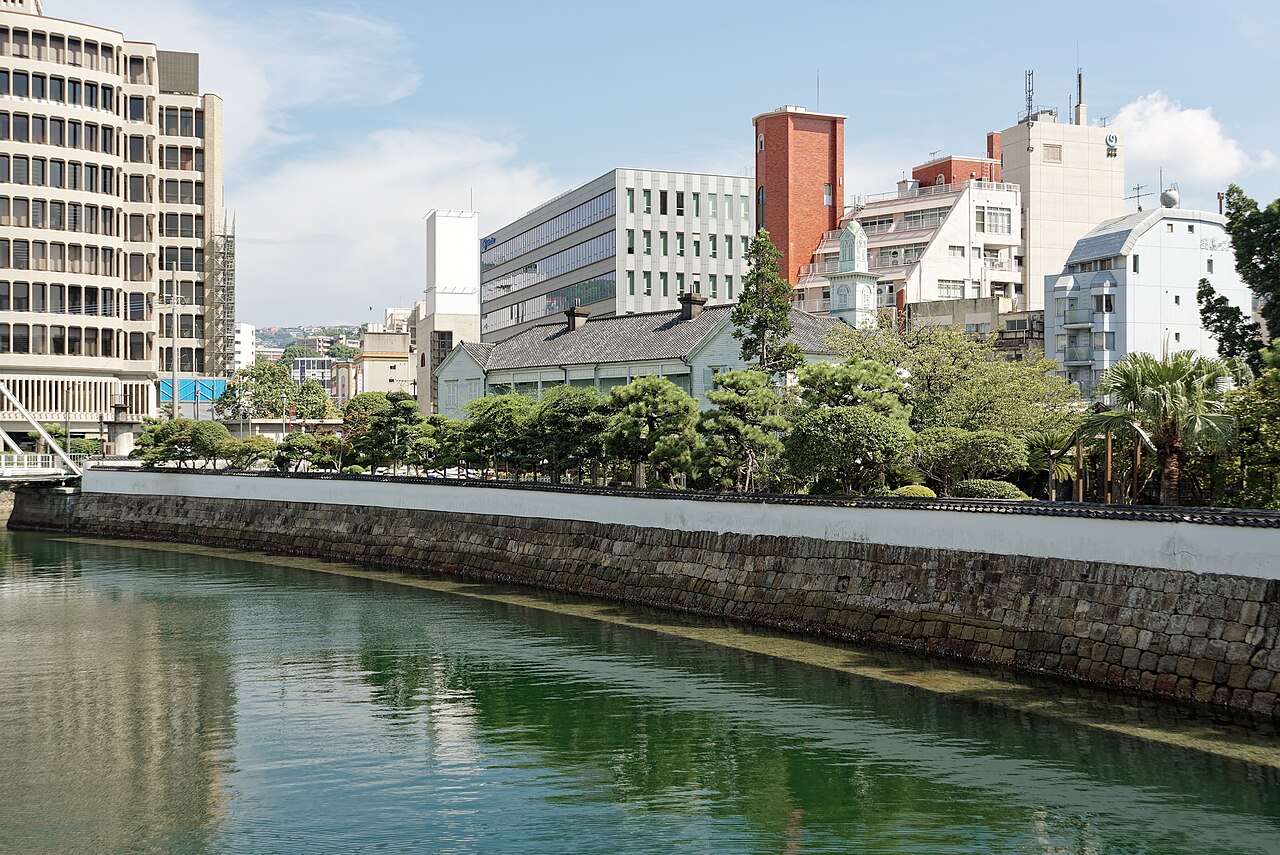
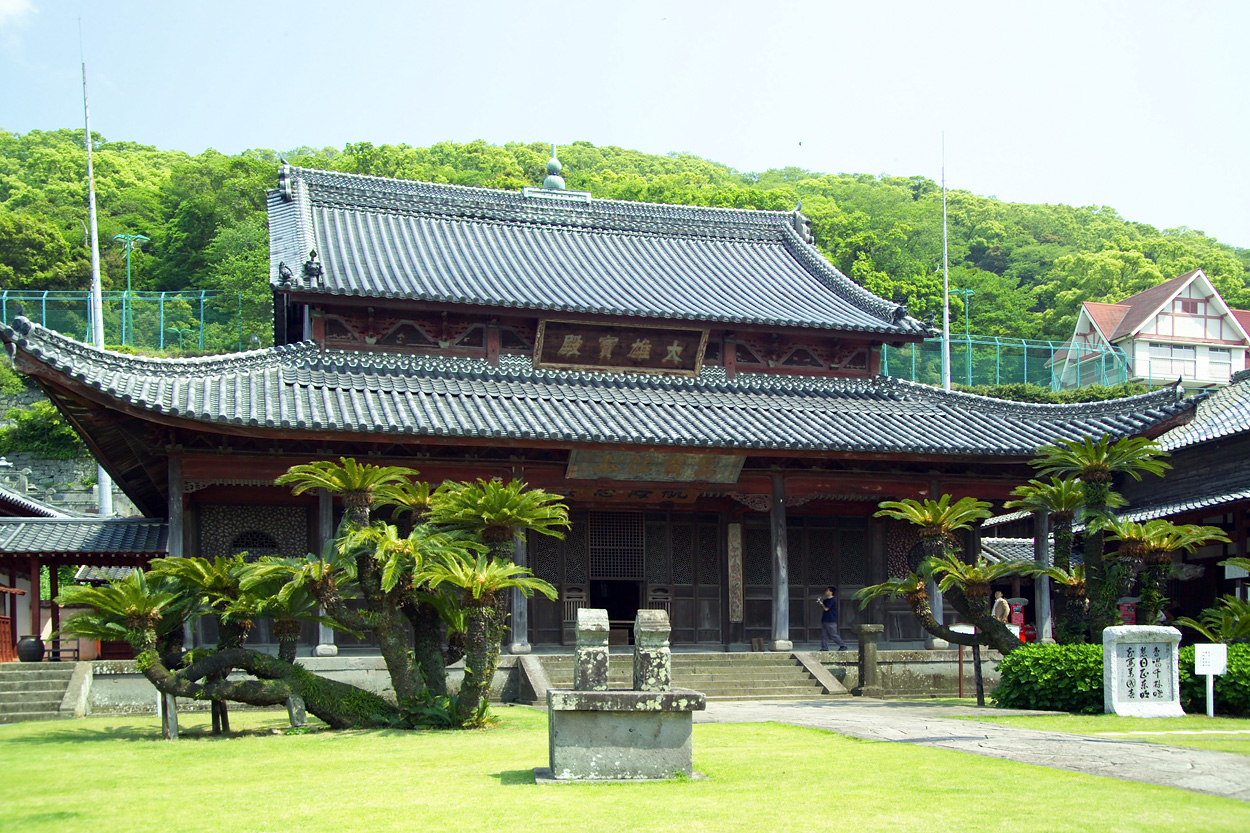
The Chinese community did not only trade. It built temples. To prove they were not covert Christians — a real danger in 17th-century Nagasaki — Fujianese merchant groups founded Buddhist temples in their own continental style and staffed them with monks brought from China. These became the Ōbaku (黄檗) Zen temples: Kōfuku-ji, founded in 1620 and the oldest of them; Sōfuku-ji, founded in 1629, whose Daiyū-hōden hall survives as a National Treasure in pure Ming style; and Shōfuku-ji. In 1654 the eminent monk Ingen Ryūki arrived from Fujian and formally established the Ōbaku school in Japan.
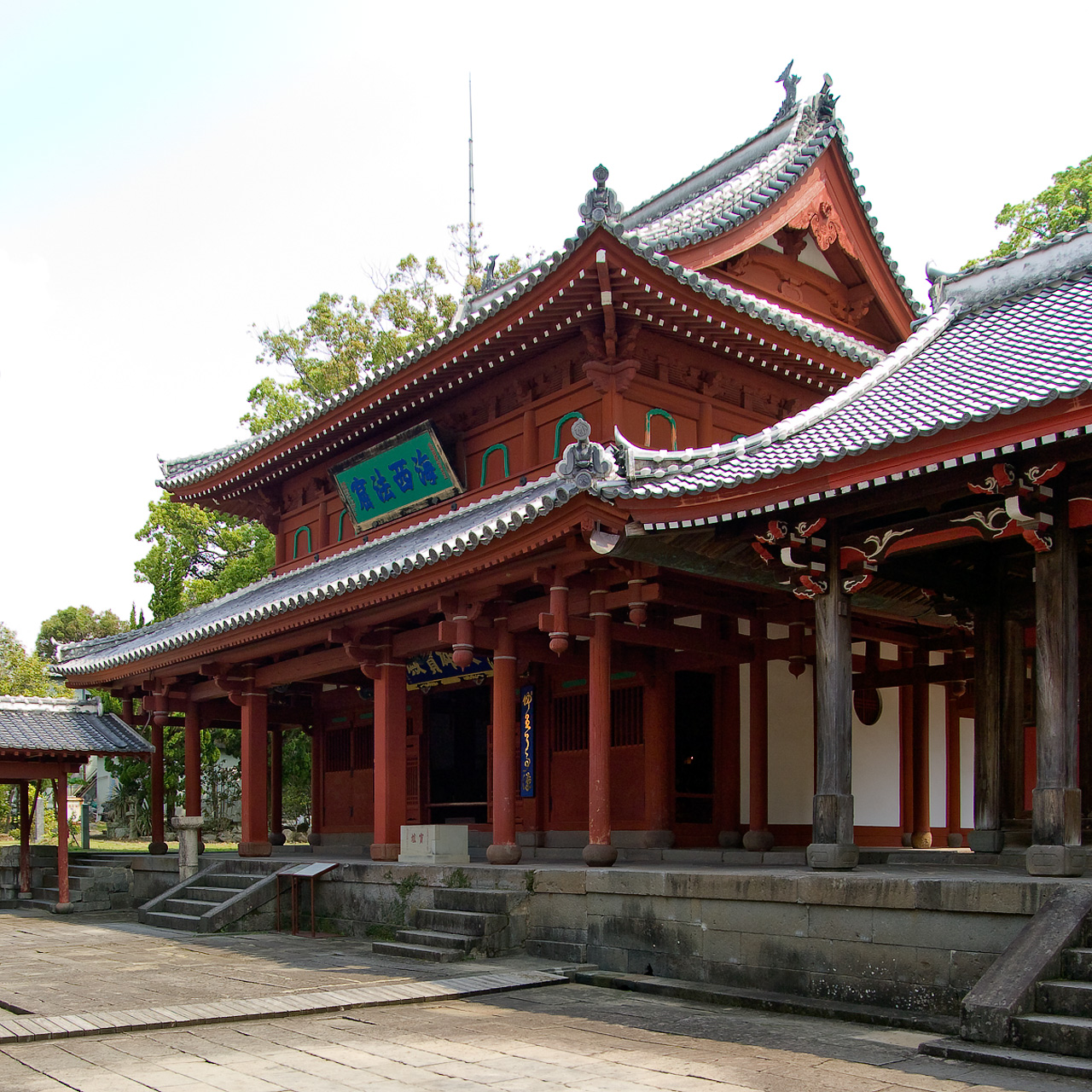
These temples needed ritual furnishings, and they wanted them in the Chinese idiom they had come from — not the Kyoto or Takaoka taste of the rest of Japan. Censers (kōro), flower vases, and paired candlesticks (shokudai) were cast in karakane, the bronze-brass alloy whose very name (唐金, “Tang metal”) points to its continental pedigree. That standing demand, renewed temple after temple and generation after generation, is what sustained a Chinese-influenced cast-bronze register in Nagasaki distinct from the mainstream of Japanese metalcasting.
- 1571 — Nagasaki opens as a port for foreign trade.
- 1620 — Kōfuku-ji founded, the oldest Ōbaku temple in Nagasaki.
- 1629 — Sōfuku-ji founded by the Fujianese community; its Daiyū-hōden is later a National Treasure.
- 1634 — Megane Bridge built under Kōfuku-ji’s monk Mokusu Nyojō.
- 1639 — Seclusion policy completed; Nagasaki becomes Japan’s sole legal foreign-trade port.
- 1641 — The Dutch trading post is relocated to Dejima.
- 1654 — Ingen Ryūki arrives from Fujian and establishes the Ōbaku Zen school in Japan.
- 1689 — The Tōjin-yashiki Chinese quarter is established, concentrating continental ritual demand.
- 1854 — Seclusion ends; Nagasaki’s special monopoly closes, but its temple bronze tradition persists.
A practical note on continuity, stated honestly. Takaoka, in Toyama Prefecture, remains Japan’s dominant center for cast-bronze flower vases and altar ware by volume, while Nagasaki’s claim is narrower and historical: it is the place where a Chinese-influenced ritual-bronze taste took root and was kept alive by temple demand. For a candlestick specifically — paired before the altar in the continental manner — that lineage is the differentiating story and the reason this form belongs to Nagasaki rather than to the national mainstream.
Where to buy Nagasaki bronze candlesticks
Hand-cast bronze shokudai from small Nagasaki workshops are typically priced in the mid-to-high thousands of yen, depending on size, weight and finish. JPY is the authoritative currency when buying in Japan; any USD figure shown elsewhere is only an estimate at a ¥150/USD baseline. Verify the current price with the seller before buying.
| Store | Item / Variant | Price | Notes |
|---|---|---|---|
| 🇺🇸 Amazon.com (US) | Browse Japanese cast bronze altar candlesticks | varies (USD) | Best if you are shopping from the US — Prime shipping, USD pricing, no international customs. Amazon US carries comparable Japanese altar ware and cast-bronze home goods; this article’s exact Nagasaki piece is sourced from Japan (next row). |
| 🇯🇵 Amazon JP Global Store | Cast bronze shokudai, single stem + drip pan | — | The specific sourced item. Ships internationally from Japan to most major destinations; customs may apply over local thresholds. |
| Maker direct | Unconfirmed — workshop not named in data | — | If the maker is identified, a direct order may be possible; verify the workshop before ordering. |
| Proxy services (Buyee / Tenso) | Forwarding for JP-domestic shops | Item price + forwarding fee | Useful if a non-Global-Store JP shop serves your country; adds a consolidation/forwarding fee and customs handling. |
What it does well
Weaknesses and things to verify before buying
- Workshop not confirmed. The present-day maker is not named here. If provenance matters to you, confirm the workshop and any maker mark before ordering.
- Fit depends on scale. The candle-cup and overall form determine what candles fit and whether it suits your altar scale.
- Single piece vs. pair. Altar use is traditionally a paired set. Confirm whether the purchase is one candlestick or a matched pair.
- Candle compatibility. Japanese altar candles (warōsoku) and Western tapers differ in base diameter; verify the cup or spike fits the candles you will use.
- Patina and care. Bronze darkens with handling and soot. If you want a permanently bright finish, this is the wrong material; if you welcome patina, it is the right one.
- Not the Takaoka flagship. If your goal is a top-documented cast-bronze flower vase rather than a candlestick, Takaoka ware is the better-supported category.
Conclusion — which buyer type are you?
Other ways to approach this purchase
❓ Frequently Asked Questions
What is a shokudai, and how is it used?
A shokudai is a candlestick. On a Japanese Buddhist altar it holds a candle before the central image, traditionally as one of a paired set alongside a flower vase and an incense censer. The cast-bronze form with a drip pan is the standard ritual type.
Why is this called a Nagasaki bronze when Takaoka is Japan’s main casting center?
Takaoka does dominate national cast-bronze output, especially flower vases. Nagasaki’s distinction is historical: its Chinese-founded Ōbaku Zen temples kept a continental, Ming-influenced demand for ritual bronzes alive through the seclusion centuries, giving the candlestick form a specific regional and religious lineage.
Does this ship internationally?
Bronze candlesticks of this kind are typically sold through the Amazon JP Global Store, through specialty Buddhist-supply shops, and through the workshops themselves. Shipping cost and delivery time vary by region, and customs duties may apply over local thresholds. US-based readers can also browse comparable items on Amazon US.
Is the price shown reliable?
No single retail price applies across all Nagasaki bronze candlesticks, so this guide does not quote one. JPY is the authoritative currency when buying in Japan, and any USD figure elsewhere is an estimate at roughly ¥150/USD. Always confirm the current price with the seller before buying.
Do I get one candlestick or a pair?
Altar candlesticks are traditionally used in matched pairs, but availability varies by seller. When choosing one, check whether the form is intended as a single piece or as a pair.
How do I care for cast bronze, and will it tarnish?
Cast bronze darkens naturally with handling and candle soot, developing a patina many owners value. Wipe it with a dry or barely damp cloth; avoid abrasive polishes unless you specifically want a bright finish. If you prefer a permanently shiny surface, bronze is not the right material.
jpmono.com is curated by a Japan-based editorial team (working out of Toyama in the Hokuriku region and Nara in Kansai) and is independent. We do not take payment from the makers we feature; income comes from affiliate links.
Affiliate disclosure: jpmono.com may earn a commission on qualifying purchases made through links on this page, at no additional cost to you.