![Aizu Hand-Forged Bunka Knife: Fukushima Samurai-Steel Blade [2026]](https://jpmono.com/wp-content/uploads/2026/05/japan-map-regions-and-prefectures-800x1050.png)
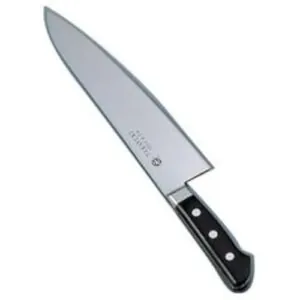
A bunka knife (文化包丁, bunka bōchō, “culture knife”) is the all-purpose blade a modern Japanese kitchen reaches for first — a close relative of the santoku, but with an angled, pointed tip that adds tip-work precision to the usual chopping and slicing. The version covered here is hand-forged in western Fukushima’s Aizu region, in high-carbon steel with a kurouchi (黒打ち, “black-forged”) finish: the dark forge scale is left on the blade flats rather than ground away. The look is rustic, and the reason is practical.
What makes an Aizu blade worth a second look is the lineage standing behind it. Aizu was the seat of a heavily armed samurai domain under the Matsudaira clan, a stronghold that sustained a deep community of swordsmiths and metalworkers for generations. When the sword era ended after the Boshin War of 1868, that forging knowledge did not vanish — it moved into farm tools and kitchen cutlery for the snowbound mountain villages of Okuaizu. The same high-carbon forge-welding and differential tempering used on swords still shape today’s hand-forged kitchen knives.
This guide is written for an international reader deciding whether a hand-forged carbon bunka knife from Aizu belongs in their kitchen. It covers what the format does well, where carbon steel will frustrate you, how it sits next to better-known Echizen, Sakai, and Kaga blades, and the realistic paths to buying one from outside Japan. Where the data is thin, this article says so plainly rather than guessing.
🔄 Updated:
⏱️ Read time: about 11 min
- Who this is for — and who should skip it
- Product overview (from published specs)
- 📍 Where this comes from — place, era, and the craft tradition
- 📌 How does it compare?
- Buying considerations
- 📦 Shipping & where to buy from outside Japan
- What it does well
- Weaknesses and things to verify before buying
- Conclusion — which buyer type are you?
- Other ways to approach this purchase
- ❓ Frequently Asked Questions
Who this is for — and who should skip it
- Want one versatile, all-purpose blade for vegetables, meat, and fish rather than a drawer of specialists
- Appreciate hand-forged carbon steel that takes — and holds — a very keen edge
- Like the angled, pointed bunka tip for detail work a blunt-nosed santoku cannot do
- Are willing to wipe the blade dry after each use and accept a developing patina
- Value a piece with documented regional heritage over a mass-finished stainless tool
- Want a knife you can leave wet in the sink — carbon steel rusts if neglected
- Put knives in the dishwasher (this will damage both edge and handle)
- Expect a polished, uniform factory finish — forge scale is intentionally uneven
- Already own a santoku and want something distinctly different rather than an overlapping shape
Product overview (from published specs)
Aizu uchihamono includes hand-forged high-carbon kurouchi bunka knives. Steel grade, blade length, and weight vary by maker; the table marks unconfirmed fields rather than guessing.
| Attribute | Value | Source |
|---|---|---|
| Type | Bunka knife (all-purpose blade, santoku relative) | General product information |
| Origin | Aizu region, western Fukushima Prefecture, Tōhoku, Japan | Spec / data_notes |
| Construction | Hand-forged (uchihamono) | Spec / data_notes |
| Steel | High-carbon steel | Spec hint |
| Finish | Kurouchi (black forge scale left on the flats) | Spec hint |
| Blade length | — | Not in fetched data |
| Weight | General product information | Not in fetched data |
| Edge | Grind style varies | Not in fetched data |
| Price | — | Not in fetched data |
International buyers may compare similar Japanese knives through overseas retailers, while maker-direct and proxy options depend on availability. Prices and exact specifications can change over time.
📖 Glossary — key Japanese terms
Bunka bōchō (文化包丁) — literally “culture knife.” A general-purpose Japanese kitchen blade, close in size and use to a santoku, but distinguished by an angled, pointed tip that handles precise tip work in addition to chopping and slicing.
Kurouchi (黒打ち) — “black-forged.” The dark iron-oxide scale formed during forging is deliberately left on the blade’s flats instead of being ground off. It gives a rustic look and adds a thin layer of corrosion resistance to those surfaces.
Uchihamono (打刃物) — “struck blades,” i.e., hand-forged cutlery, as opposed to blades stamped or cut from sheet stock.
Aizu (会津) — the mountainous western region of present-day Fukushima Prefecture, historically the territory of the Aizu domain.
Boshin War (戊辰戦争) — the 1868–1869 civil war that ended samurai rule; Aizu was the site of one of its hardest-fought campaigns, including the siege of Tsuruga Castle.
Byakkotai (白虎隊) — the “White Tiger” corps of teenage Aizu samurai, several of whom died at Iimoriyama in 1868 believing the castle had fallen.
📍 Where this comes from — place, era, and the craft tradition

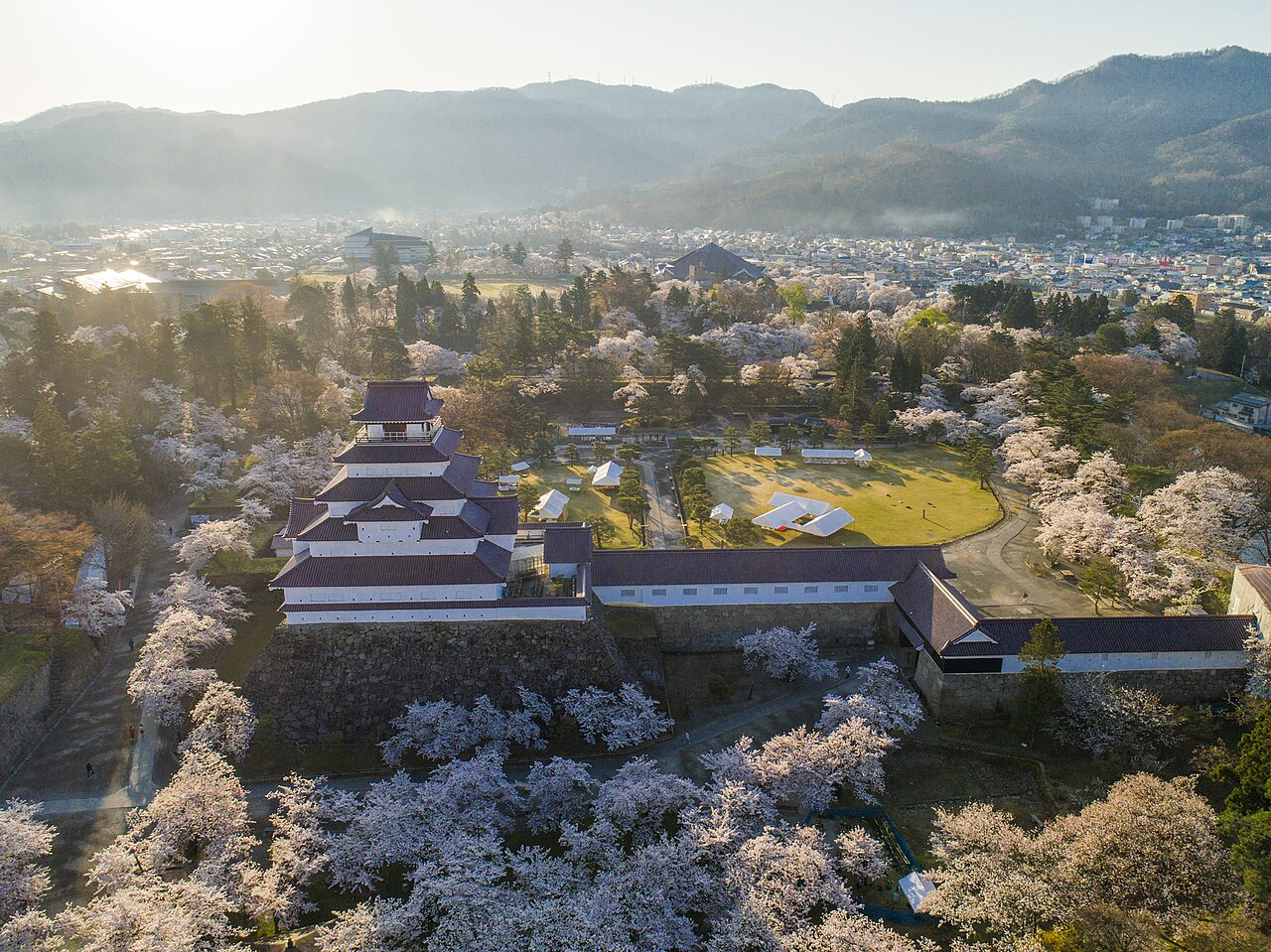
Aizu occupies the western, mountainous third of Fukushima Prefecture, in the southern Tōhoku region of Honshū — roughly 280 km north of Tokyo. It is a high inland basin ringed by mountains and laced by the Tadami River valley, with some of the heaviest snowfall in Japan. That geography shaped the craft economy: long winters turned farming villages into workshops, and a self-sufficient mountain domain needed its own smiths, lacquerers, and potters rather than imported goods.
Aizu was no ordinary rural district. Under the Matsudaira clan it was a heavily armed castle domain, a stronghold loyal to the Tokugawa shogunate, and a place that kept a deep community of swordsmiths and metalworkers busy through the Edo period. A domain built for war needs steel, and Aizu had the smiths to forge it.
The turning point came in 1868. The Boshin War reached Aizu with full force: the month-long siege of Tsuruga Castle, and the tragedy at Iimoriyama, where teenage members of the Byakkotai took their own lives believing the castle had already fallen. When the fighting ended, so did the samurai world that had employed the domain’s swordsmiths. Demand for swords collapsed almost overnight.
- Edo period — Aizu is a heavily armed Matsudaira-clan castle domain; swordsmiths and metalworkers cluster around Tsuruga Castle.
- 1868 — The Boshin War reaches Aizu: the siege of Tsuruga Castle and the Byakkotai tragedy at Iimoriyama end the samurai era.
- Meiji era (after 1868) — With swords no longer in demand, Aizu smiths redirect forge-welding and tempering skill into farm tools and kitchen cutlery for the Okuaizu mountain villages.
- Same period — Aizu-nuri lacquerware and Aizu Hongo-yaki pottery flourish alongside the forges, fed by the Tadami River valley — a dense regional craft cluster.
- 20th century onward — Aizu forging survives as domestic cutlery and tool smithing; the same high-carbon forge-welding and differential tempering shape hand-forged kitchen blades.
- 2026 — Hand-forged Aizu bunka knives are sold internationally through the Amazon JP Global Store.
Swordsmiths did not stop forging — they redirected the same heat-treatment and differential-hardening knowledge into the tools that still sold: sickles, hatchets, and kitchen knives for the snowbound mountain farming villages of Okuaizu. This is the same path that produced Japan’s famous cutlery towns, and it is the lineage a hand-forged Aizu bunka quietly inherits. The high-carbon forge-welding and differential tempering once aimed at a sword’s edge are now aimed at a vegetable knife’s.
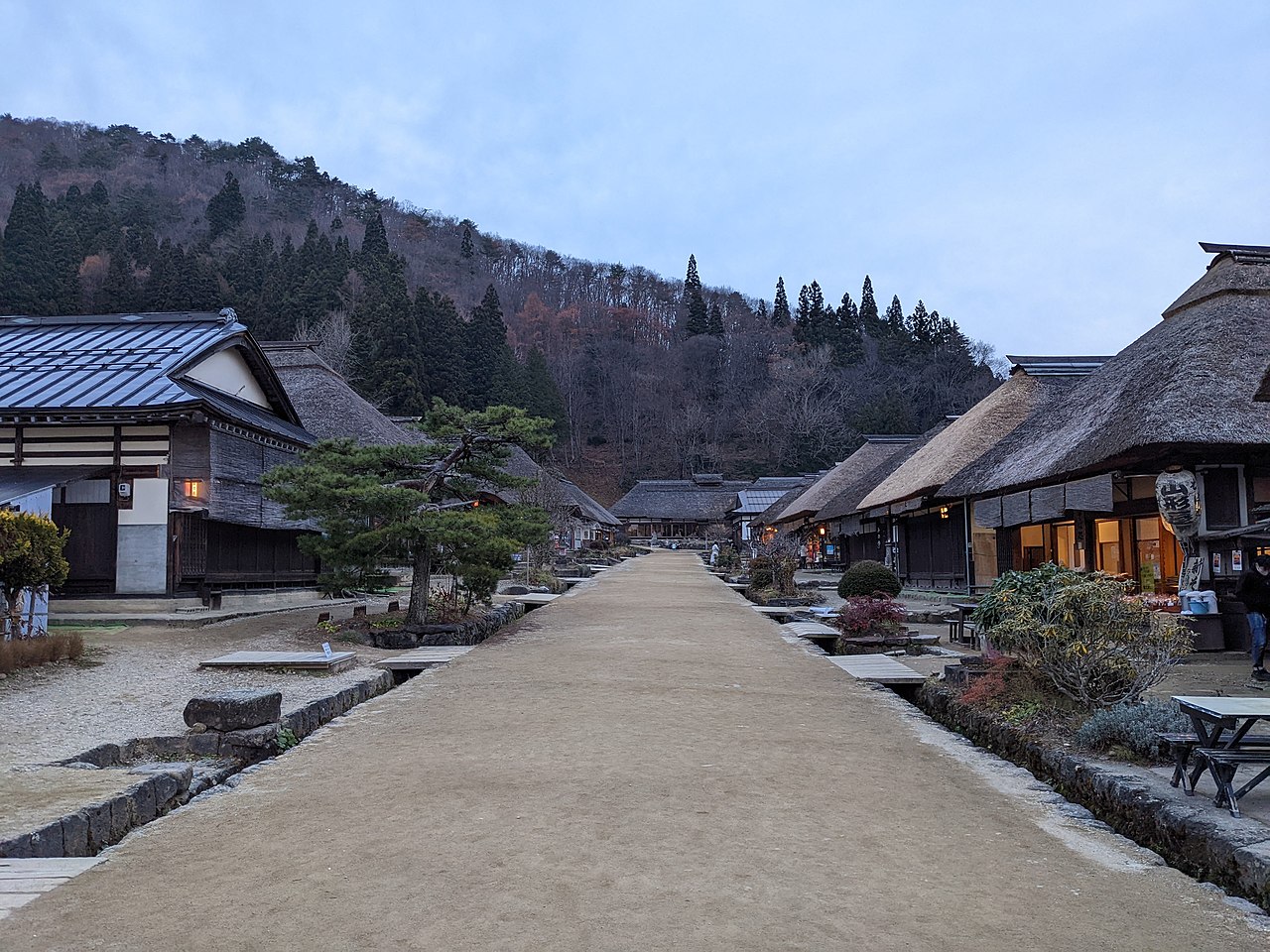
Aizu’s craft identity is broader than its blades. The region also nurtured Aizu-nuri (会津塗) lacquerware and Aizu Hongo-yaki (会津本郷焼) pottery, a dense craft cluster fed by the Tadami River valley and the same long winters that pushed households indoors to make things by hand. A knife from here is one strand of a much wider material culture — the same culture preserved in post towns like Ouchi-juku, where hand-forged tools were not heritage objects but daily necessities.
“A kitchen knife from Aizu is not a sword. But the hand that hardens its edge is working from a memory of swords — a domain that forged steel to be used, then taught those forges to feed a kitchen.”
One honest caveat: the heritage above is the regional and historical context drawn from the spec’s data notes, not a maker’s certified pedigree. Treat the swordsmith connection as the craft tradition of the place, not as a claim that this particular knife was forged by a registered sword lineage. The continuity that genuinely matters to a buyer is simpler — Aizu remains a region where blades are still hand-forged in carbon steel for everyday use.
📌 How does it compare?
Hand-forged Japanese blades vary by region, format, and use, and Aizu sits inside a wider craft cluster. If you are weighing the Aizu bunka against other options — or want to see the neighboring Aizu crafts — these jpmono.com guides are the closest comparisons:
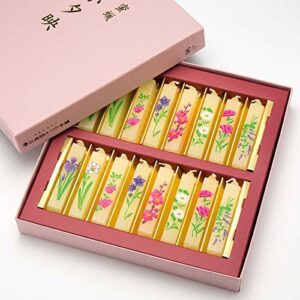 🕯️ Aizu Painted Candles
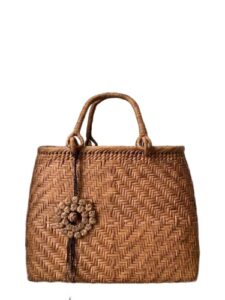 🧺 Okuaizu Yamabudo Basket
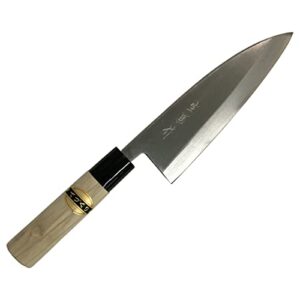 🔪 Echizen Santoku
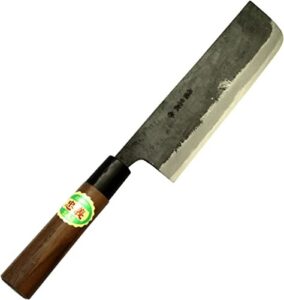 🥬 Kaga Nakiri
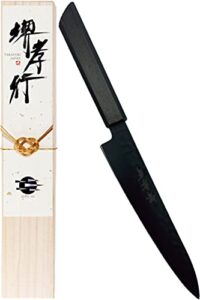 🔪 Oita Bungo Petty Knife
🗡️ Ainu Makiri
 🔪 Sakai Gyuto
🧵 Hirosaki Kogin
Buying considerations
Prices for Aizu bunka knives vary by maker and market. USD figures, where shown, are approximate estimates at a ¥150/USD baseline as of mid-2026; exchange rates can change.
| Store | Item / Variant | Price (JPY + USD est.) | Notes |
|---|---|---|---|
| 🇺🇸 Amazon.com (US) | Browse Japanese kitchen knives | varies (USD) | Best if you are shopping from the US — Prime shipping, USD pricing, no international customs. Amazon US carries hand-forged Japanese kitchen knives from various makers, useful for comparing steel, geometry, and price tiers. The exact Aizu bunka is sourced from Japan (next row). |
| 🇯🇵 Amazon JP Global Store | Aizu hand-forged kurouchi bunka knife | — | International shipping option from Japan; confirm destination coverage and fees before ordering. |
| Maker direct | — | — | No maker-direct storefront was confirmed in the data set. Small Aizu forges often sell only domestically. |
| Proxy services (Buyee / Tenso) | Same item via Japanese retailers | Item price + proxy fee + forwarding | A fallback if the Global Store does not ship to your country; adds a service fee and a Japan-side forwarding step. |
📦 Shipping & where to buy from outside Japan
The specific item is listed on the Amazon JP Global Store, which ships many household goods internationally to most major destinations. Knives are generally shippable, but some carriers and countries treat bladed items as restricted, so confirm at checkout that your destination is eligible before paying.
- Amazon JP Global Store — the simplest path; international shipping is calculated at checkout. Expect roughly $15–$40 to the US or EU for a single knife, higher to other regions.
- Amazon US (search) — easiest if you would accept a comparable hand-forged Japanese bunka or santoku from another maker with domestic Prime shipping rather than importing this exact blade.
- Proxy / forwarding services (Buyee, Tenso) — use if the Global Store will not ship to your country; they receive the parcel in Japan and re-ship it, for an added fee.
- Customs & duties — orders above your local import threshold may incur duty or VAT on arrival. Carbon-steel kitchen knives are food-contact tools, not regulated weapons in most jurisdictions, but check your local rules.
What it does well
Weaknesses and things to verify before buying
- Carbon steel rusts. This is the defining trade-off. The blade must be wiped dry after every use and not left wet or in contact with acidic food for long. If that routine does not fit your kitchen habits, choose stainless.
- It will develop a patina. High-carbon edges discolor to grey-blue with use. This is normal and even protective, but buyers expecting a permanently bright blade will be disappointed.
- It overlaps with a santoku. If you already own one, a bunka covers much of the same ground; the main differences are the tip shape and feel rather than a wholly new role.
- Forge-scale finish is uneven by design. No two kurouchi blades look identical, and surface texture varies. Buyers wanting a flawless factory finish should look elsewhere.
- Heritage is regional, not certified. The Aizu swordsmith context describes the place’s tradition; it is not a guarantee that this knife was made by a registered sword lineage.
Conclusion — which buyer type are you?
Other ways to approach this purchase
❓ Frequently Asked Questions
Does this knife ship internationally?
What is a bunka knife, and how is it different from a santoku?
Will the carbon-steel blade rust?
What does “kurouchi” mean?
Can I put it in the dishwasher?
What is the connection between Aizu and swords?
Why does the article show a price I cannot confirm?
jpmono.com is curated by a Japan-based editorial team (working out of Toyama in the Hokuriku region and Nara in Kansai) and is independent. We do not take payment from the makers we feature; income comes from editorial work. We do not physically test every product — we read maker specifications and craft sources.
This article was prepared with AI assistance and reviewed against craft references. Specifications and prices can vary by maker and over time.
Affiliate disclosure: jpmono.com may earn a commission on qualifying purchases made through links on this page, at no additional cost to you.