![Hidehira-nuri Gold-Leaf Lacquer Sake Cup: Hiraizumi Urushi Guinomi [2026]](https://jpmono.com/wp-content/uploads/2026/07/hidehira-nuri-gold-leaf-lacquer-sake-cup-where-to-buy-2026-featured.jpg)
A Hidehira-nuri (秀衡塗, “Hidehira lacquer”) sake cup is a small object carrying a very large story. It is a guinomi (ぐい呑み, a stout sake cup meant to be gripped in one hand) built up from thick coats of vermilion urushi (漆, Japanese lacquer) and then crowned with cut squares of gold leaf and a scattering of stylized “Genji clouds” (源氏雲, genji-gumo). The name points to Fujiwara no Hidehira, the 12th-century lord whose Northern Fujiwara clan turned the town of Hiraizumi, in what is now Iwate Prefecture, into a golden northern capital.
What makes the piece notable to an international reader is not just the gold. It is that the gold is a direct echo of a real building that still stands: the Konjikidō (金色堂, “Golden Hall”) of Chūson-ji, a wholly gold-leaf-covered Amida hall finished in 1124 and now part of a UNESCO World Heritage site. The same aesthetic that fed the medieval legend of “Zipangu, the land of gold” — the story Marco Polo carried back to Europe — is what a Hidehira-nuri cup miniaturizes and puts in your hand. Iwate is also Japan’s leading source of domestic urushi sap, so the region has an unusually complete lacquer lineage: raw material and finished vessel both come from the same northern ground.
This guide is written for readers weighing a first serious piece of Japanese lacquer as a gift or a daily drinking cup. We cover who the cup suits and who should skip it, what the published specifications do and do not tell you, how the price compares across stores, the care realities of natural urushi, and where the object actually comes from. One note up front: for this specific listing only the Amazon catalog snapshot was available at the time of writing, so live pricing and stock may have shifted — treat the affiliate link as the authoritative source for the current number.
🔄 Updated:
⏱️ Read time: ~11 min

- Who this is for — and who should skip it
- Product overview (from published specs)
- Price snapshot across stores
- Where this comes from
- What it does well
- Weaknesses and things to verify before buying
- Conclusion — which buyer type are you?
- Other ways to approach this purchase
- 🏆 Editor’s Pick
- ❓ Frequently Asked Questions
Who this is for — and who should skip it
- Want a first piece of Japanese lacquer with a real, datable cultural anchor rather than generic “gold” decoration
- Are buying a milestone gift — a toast to a wedding, retirement, or New Year — where the Hiraizumi gold story adds meaning
- Appreciate warm, matte-to-glossy natural urushi in the hand and understand it is not glass or ceramic
- Drink sake, whisky, or shōchū neat and want a cup sized for slow sipping
- Are willing to hand-wash and hand-dry a natural-material object
- Need dishwasher- and microwave-safe drinkware for daily heavy use
- Want a mirror-perfect, machine-uniform finish; hand-applied gold leaf varies piece to piece
- Are shopping purely on price and see lacquer as interchangeable with painted or coated cups
- Have a known urushi (lacquer sap) sensitivity — fully cured urushi is inert, but curing quality matters
- Expect same-day domestic delivery; this is typically an international ship from Japan
Product overview (from published specs)
Based on the listing snapshot, the table below summarizes what can be stated from published data. Where the catalog does not confirm a value, it is marked rather than guessed. Only the Amazon catalog snapshot was available for this specific item; live pricing may have shifted since the writing date.
Hidehira-nuri Gold-Leaf Lacquer Sake Cup
翁知屋 秀衡塗 盃 5杯
通常7~8日以内に発送します。 · Sold by こゆてゅこハウス · ASIN B0G53QG5DR
Price and availability as of 2026-08-31 02:30 JST. The Amazon listing at the time of purchase is authoritative. jpmono.com earns a commission on qualifying purchases at no extra cost to you.
| Attribute | What the data indicates | Source |
|---|---|---|
| Craft | Hidehira-nuri (秀衡塗) urushi lacquerware | Listing + maker tradition |
| Item type | Sake cup / guinomi (ぐい呑み) | Listing |
| Decoration | Vermilion urushi ground with cut gold-leaf squares and Genji-cloud (源氏雲) motif | Listing + tradition |
| Origin | Iwate Prefecture (Hiraizumi / Ninohe area), Tōhoku | Craft tradition |
| Core material | Wood core finished in natural urushi lacquer; gold leaf | Craft tradition |
| Capacity / dimensions | Unconfirmed — check the listing before buying | — |
| ASIN | B0G53QG5DR | Amazon JP Global Store |
| Price | Unconfirmed in the snapshot — verify at the retailer | — |
📖 Glossary — key terms in this guide
- Hidehira-nuri (秀衡塗) — a lacquerware tradition of Iwate, named after Fujiwara no Hidehira; vermilion urushi with cut gold-leaf and Genji-cloud decoration.
- Urushi (漆) — natural Japanese lacquer, the refined sap of the lacquer tree. Cured by humidity, not heat; inert once fully hardened.
- Guinomi (ぐい呑み) — a stout, one-hand sake cup, larger than a small ochoko, meant for unhurried drinking.
- Genji-gumo (源氏雲, “Genji clouds”) — stylized cloud bands from classical Heian-era painting, here rendered in gold leaf.
- Konjikidō (金色堂) — the “Golden Hall” of Chūson-ji temple, a gold-leaf-covered Amida hall completed in 1124.
- Joboji urushi (浄法寺漆) — domestic lacquer sap from Ninohe, Iwate; used in restoring national treasures.
- METI — Japan’s Ministry of Economy, Trade and Industry, which designates recognized traditional crafts.
Related pieces on jpmono.com — other Tōhoku lacquer, other Iwate crafts, and the wider sake-cup and lacquer clusters.
Price snapshot across stores
JPY is the authoritative price for the specific listed item; USD figures are approximate estimates at a ¥150/USD baseline. Prices and stock fluctuate — confirm at the retailer before buying.
| Store | Item / Variant | Price (JPY + USD est.) | Notes |
|---|---|---|---|
| 🇺🇸 Amazon.com (US) | Browse Japanese lacquer sake cups & guinomi | varies (USD) | Best if you are shopping from the US — Prime shipping, USD pricing, no international customs. Amazon US carries lacquer and urushi drinkware from several makers for comparison; this exact Hidehira-nuri piece is sourced from Japan (next row). |
| 🇯🇵 Amazon JP Global Store | This exact Hidehira-nuri guinomi (ASIN B0G53QG5DR) | Price unconfirmed in snapshot — check listing | The sourced listing for this item. Ships internationally from Japan to most major destinations. |
| Maker direct | Hidehira-nuri workshops (Iwate) | Varies | Some Iwate lacquer studios sell direct; international shipping and English support vary by workshop. |
| Proxy services (Buyee / Tenso) | Any Japan-only listing | Item price + proxy fee + forwarding | Useful when a listing does not ship to your country directly; adds a handling fee and a second shipping leg. |
Where this comes from

Iwate is the second-largest prefecture in Japan, occupying much of the northeastern Tōhoku region of Honshu. It is a land of mountains, gorges, and cold winters — the Kitakami River runs down its center, and the terrain that made it remote from the old capitals of Nara and Kyoto is exactly what let a distinct northern culture develop. Two towns matter for this cup: Hiraizumi in the south, where the story begins, and Ninohe in the north, a center of both lacquerware and the raw lacquer sap itself.
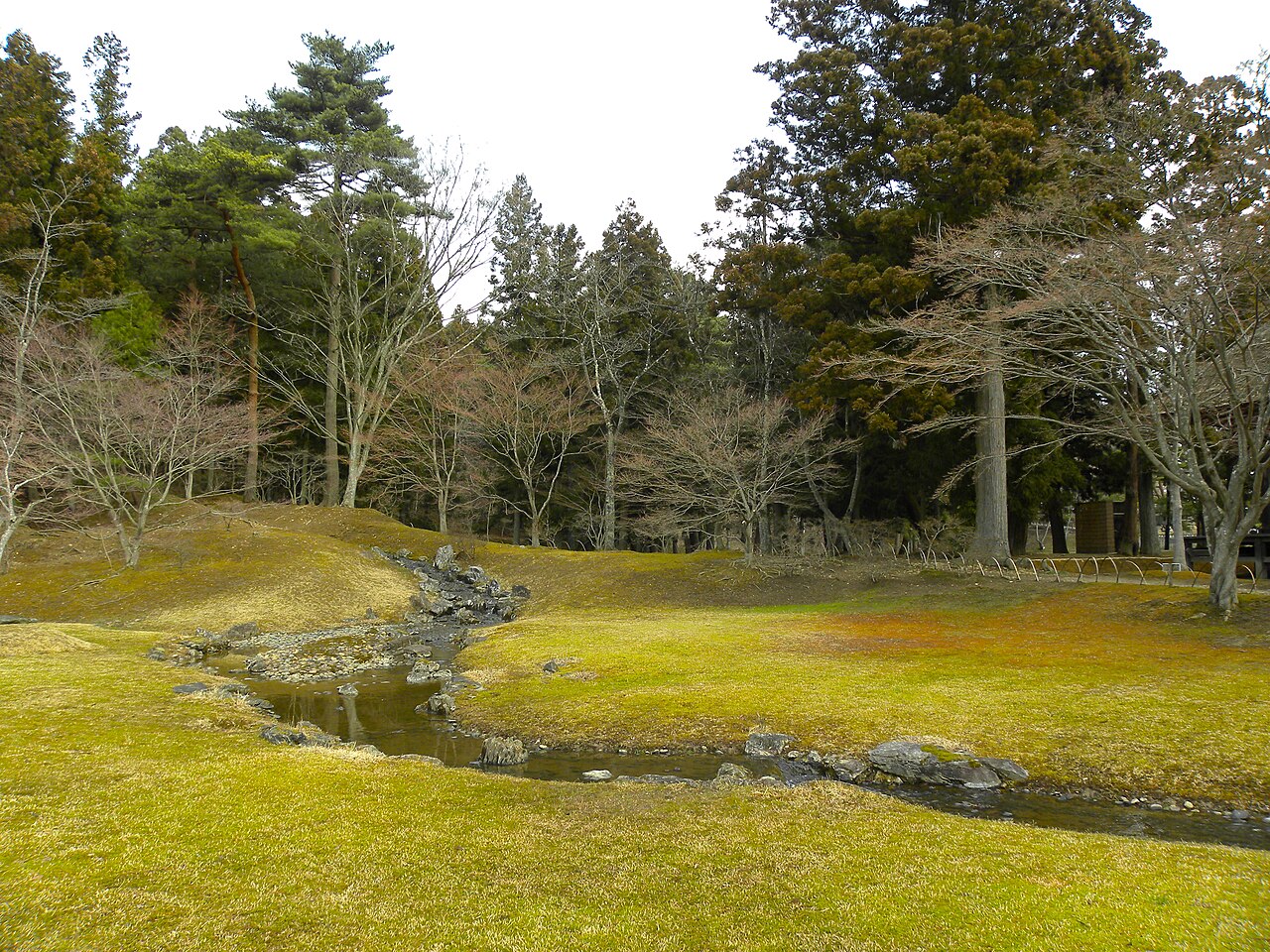
For roughly a century in the 1100s, Hiraizumi was one of the wealthiest places in Japan — a northern capital built on gold from local mines and on control of trade routes to the far north. Three generations of the Northern Fujiwara clan ruled it, and the third, Fujiwara no Hidehira, presided over its height. The clan built temples on the scale of the capital’s, and the ambition survives in stone and gold to this day.
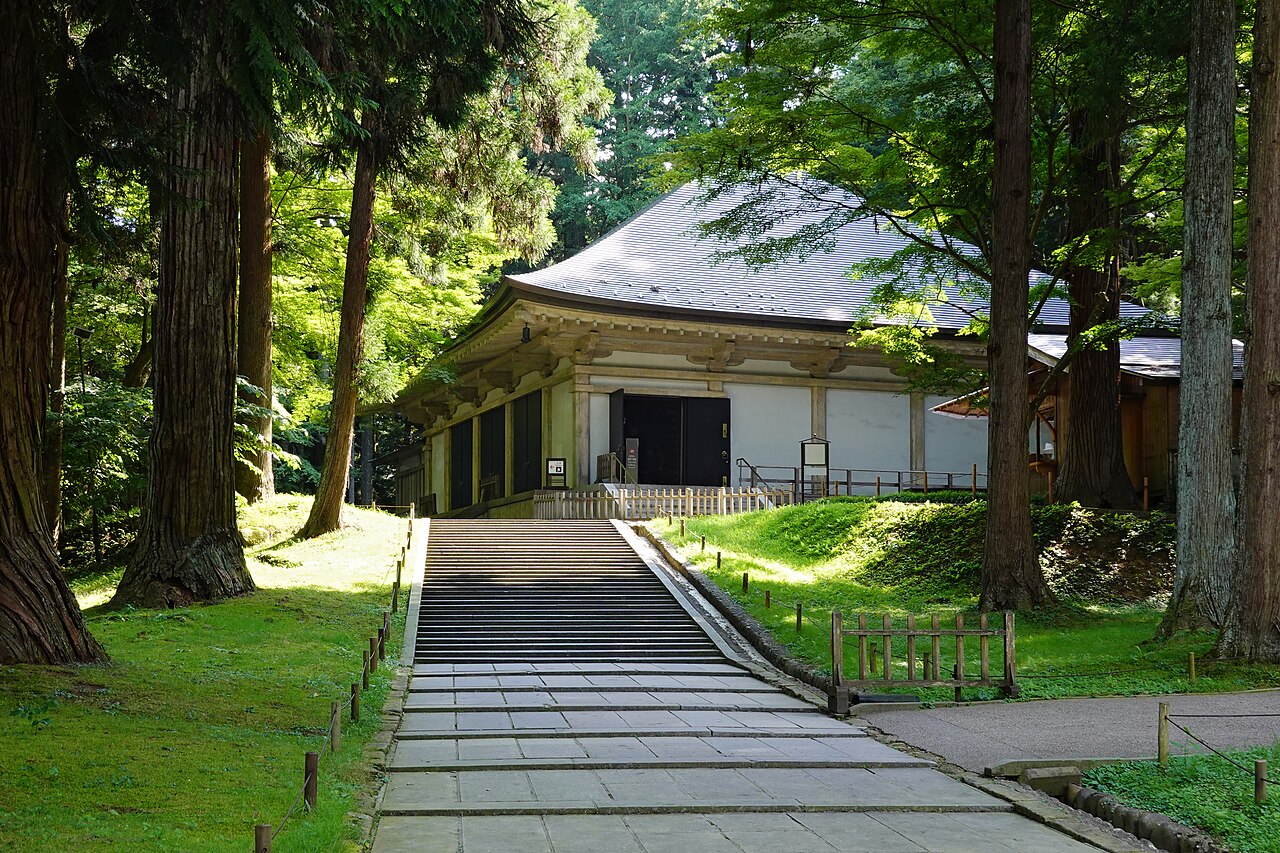
The most famous survivor is the Konjikidō, the “Golden Hall” of Chūson-ji, completed in 1124. It is a small Amida hall covered — inside and out — in gold leaf, with mother-of-pearl inlay and lacquered pillars, sheltered today inside a protective outer building. This is the aesthetic that a Hidehira-nuri cup carries in miniature: gold leaf against deep lacquer, applied by hand.
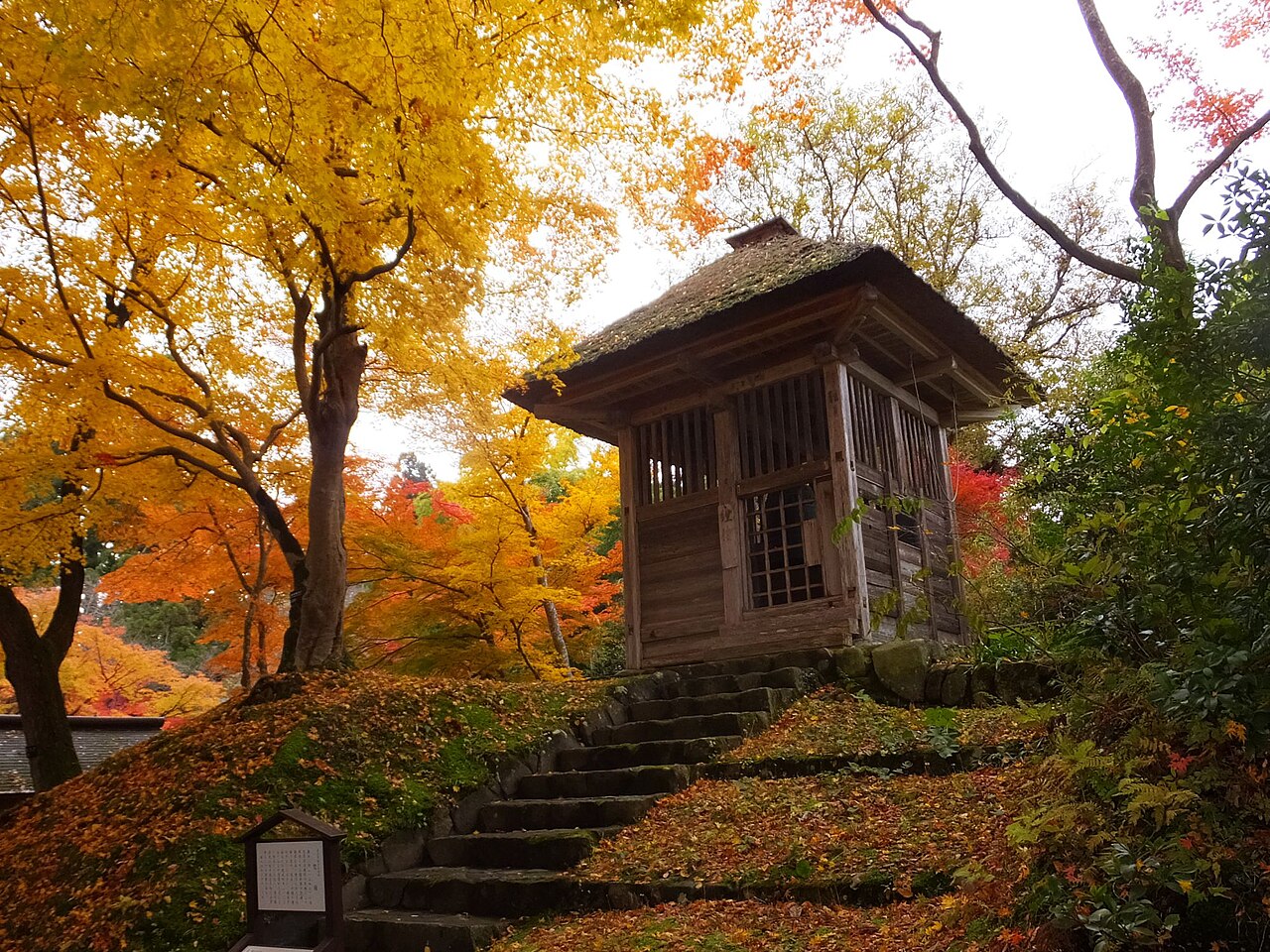
“The gold on this cup is not decoration borrowed from nowhere — it is the same gold that built a hall in 1124 and, five centuries later, seeded a European legend of a land made of it.”
Hidehira-nuri is traditionally said to descend from the lacquered bowls made for that Fujiwara court, which is why the ware carries Hidehira’s name. Whatever the precise line of transmission, the craft continued in the Iwate interior long after Hiraizumi’s political power ended, when the Northern Fujiwara fell in 1189. By the modern era it had settled into a recognizable style: thick vermilion urushi, cut squares of gold leaf, and the Genji-cloud bands drawn from classical Heian painting.
- 1124 — Chūson-ji’s Konjikidō, a wholly gold-leaf Amida hall, is completed at Hiraizumi.
- 1170s–1180s — Fujiwara no Hidehira rules Hiraizumi at its golden height; lacquered wares for the court are the traditional root of Hidehira-nuri.
- 1189 — The Northern Fujiwara fall to Minamoto no Yoritomo; Hiraizumi’s political era ends, but the crafts persist.
- late 13th c. — Marco Polo carries west the legend of “Zipangu,” an island so rich its halls were roofed in gold.
- Edo period — The Hidehira-nuri style stabilizes in the Iwate interior; Ninohe’s Joboji becomes a major source of domestic urushi.
- modern era — Joboji urushi is used in restoring national treasures such as Nikkō Tōshō-gū and Kyoto’s Kinkaku-ji.
- 2011 — Hiraizumi’s temples, gardens, and archaeological sites are inscribed as a UNESCO World Heritage site.
- 2026 — Hidehira-nuri is still made in Iwate, using domestic urushi and hand-applied gold leaf.
The material side of the story is what makes Iwate unusual. Most Japanese lacquerware today is finished with imported sap; Iwate is the country’s leading source of domestic urushi. Ninohe’s Joboji district produces the lacquer used to restore national landmarks, which means the same northern ground that grows the trees also supplies the vessels — an unbroken line from raw material to finished cup that few lacquer regions can claim.
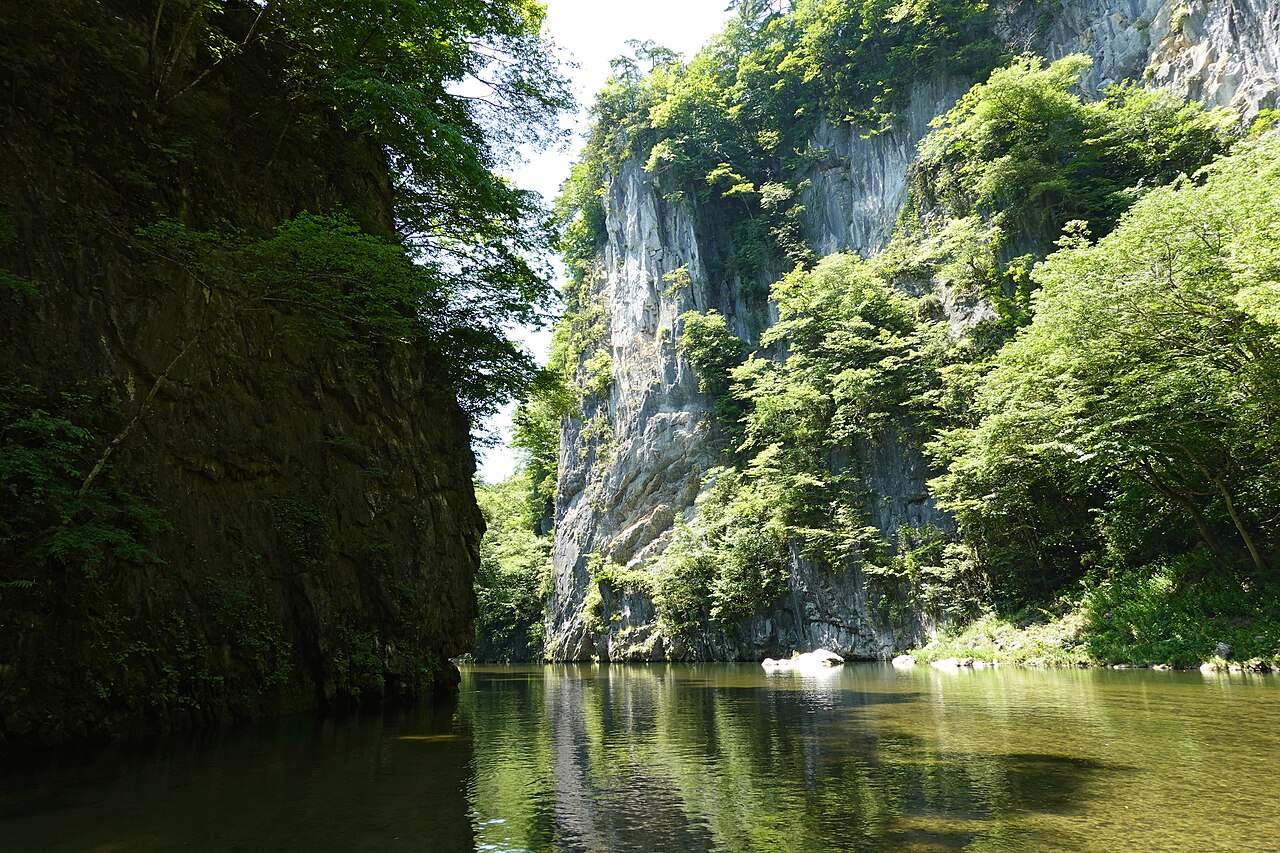
The cup fits a season and a table. In the cold Tōhoku winter, warm sake in a warm-feeling lacquer cup is a small, specific pleasure; the vermilion-and-gold palette also belongs to New Year and celebratory occasions, which is part of why these cups read as gifts. Iwate produces well-regarded local sake, and a Hidehira-nuri guinomi is at home with it.
What it does well
Weaknesses and things to verify before buying
- Size and capacity are unconfirmed in the snapshot. Guinomi vary widely; check the listed dimensions and volume so the cup matches how you drink.
- Price was not captured in the available data. Only the catalog snapshot was available; treat the affiliate link as the source of the current price and stock.
- Not dishwasher, microwave, or oven safe. Natural urushi requires hand-washing, no soaking, and no sudden heat. This is a care commitment, not a set-and-forget cup.
- Hand-applied gold leaf varies. Because the leaf is cut and placed by hand, no two cups are identical; buyers who want machine-perfect uniformity may be disappointed.
- Urushi sensitivity is a real consideration. Fully cured urushi is inert, but individuals with a known lacquer-sap sensitivity should be aware of the material before buying.
- International shipping and customs apply. This is typically shipped from Japan; factor in transit time and any local import duties above your country’s threshold.
- Maker/workshop attribution is general. The listing identifies the craft, but confirm the specific workshop and any traditional-craft designation on the product page if that matters to you.
Conclusion — which buyer type are you?
Other ways to approach this purchase
🏆 Editor’s Pick
❓ Frequently Asked Questions
Does Amazon JP ship a Hidehira-nuri sake cup internationally?
Many household items on the Amazon JP Global Store ship to most major destinations, and lacquer drinkware is generally eligible. Confirm your country is listed and check the quoted international shipping and any import duties on the product page before ordering.
How do I care for a natural urushi lacquer cup?
Hand-wash gently, avoid soaking, and dry with a soft cloth. Do not use a dishwasher, microwave, or oven, and keep it away from sudden heat and prolonged direct sunlight. Treated this way, urushi lacquer lasts for decades.
Is the gold real, and is it safe to drink from?
Hidehira-nuri traditionally uses gold leaf applied over the lacquer surface. Fully cured urushi is inert and food-safe. As with any hand-decorated ware, drink from it normally but avoid abrasive scrubbing that could wear the leaf.
What is the difference between Hidehira-nuri and other Tōhoku lacquer like Tsugaru-nuri?
Both are northern lacquer traditions, but the signatures differ: Hidehira-nuri is defined by vermilion urushi with cut gold-leaf and Genji clouds tied to Hiraizumi, while Tsugaru-nuri (from Aomori) is known for its polished, multi-layer mottled patterns. See our Tsugaru-nuri and Naruko lacquer guides linked above to compare.
Is this a good gift, and does it come boxed?
The vermilion-and-gold palette suits weddings, retirements, and New Year, so it reads well as a gift. Packaging varies by listing and workshop; check the product page to confirm whether a presentation box is included.
Why does the article lead with an Amazon US search link?
For readers shopping from the US, Amazon US offers Prime shipping, USD pricing, and no international customs, and it carries comparable Japanese lacquer drinkware. This exact Hidehira-nuri piece is sourced from the Amazon JP Global Store, which is the secondary link and ships from Japan.
jpmono.com is curated by a Japan-based editorial team (working out of Toyama in the Hokuriku region and Nara in Kansai) and is independent. We do not take payment from the makers we feature; income comes from affiliate links. We do not physically test every product — we read maker specs and source listings.
🤖 This article was drafted with AI assistance and edited against the source listing and publicly documented craft history. Specifications, pricing, and availability should be confirmed at the retailer before purchase.
Affiliate disclosure: jpmono.com may earn a commission on qualifying purchases made through links on this page, at no additional cost to you.