![Tsuboya-yaki Okinawan Pottery Yunomi Tea Cup Buying Guide [2026]](https://jpmono.com/wp-content/uploads/2026/09/tsuboya-yaki-okinawan-pottery-yunomi-where-to-buy-2026-featured.jpg)
- What it is: Everyday Okinawan tea cups (yunomi) in the yachimun pottery tradition, of which Naha’s Tsuboya district is the historic center.
- Made in: Okinawa Prefecture — Tsuboya-yaki is a METI-designated Traditional Craft of Japan; our pick’s listing says “Okinawa yachimun” without naming a kiln district.
- Price band: Entry-level for handmade Japanese teaware — our pick is a 3-cup set at ¥5,990 (≈ $40 USD) as of September 28, 2026; verify on the listing.
- Best for: Tea drinkers who want warm-toned, visibly handmade cups for daily use, or a gift set of three.
- Skip if: You need a confirmed Tsuboya workshop signature, a stated capacity, or matched, machine-identical pieces.
- Shipping: sold from Amazon Japan by a third-party seller — confirm your destination at checkout — jump to our pick ↓
Naha sits closer to Taipei than to Tokyo, and its pottery looks like it. Okinawan clay fires to warm reddish, ochre, and buff bodies, a long way from the pale gray stoneware of most mainland kilns, and the brushwork on it tends toward Shiisaa lion guardians and bold southern color rather than muted wabi-sabi restraint. Locally this ware is called yachimun (やちむん), often glossed as “kiln-fired things,” and its historic home is Tsuboya (壺屋), a pottery neighborhood in central Naha.
Tsuboya-yaki (壺屋焼) is officially designated a Traditional Craft of Japan by the Ministry of Economy, Trade and Industry. It carries the imprint of the Ryukyu Kingdom, an island state whose maritime trade with China and Southeast Asia shaped Okinawan culture long before the islands became a Japanese prefecture. For international readers, that makes an Okinawan yunomi a genuinely different object from the Kyoto, Mino, or Arita cups that dominate most “Japanese tea cup” searches.
This guide is written from a Japan-based editorial desk working out of Toyama and Nara, for readers outside Japan. It covers what Okinawan yachimun is, how it differs from mainland pottery, what the one currently verifiable Amazon Japan listing actually offers (a set of three cups), and how to buy from the US, Canada, the UK, or Australia.
🔄 Updated:
⏱️ Read time: about 11 min

- Who this is for — and who should skip it
- Product overview (from published specs)
- 📍 Where this comes from — place, era, and the craft tradition
- 📦 Shipping & where to buy from outside Japan
- Price snapshot across stores
- What it does well
- Weaknesses and things to verify before buying
- Conclusion — which buyer type are you?
- Other ways to approach this purchase
- 🏆 Editor’s Pick
- ❓ Frequently Asked Questions
Who this is for — and who should skip it
- Green-tea or hōjicha drinkers who want everyday cups with a visibly handmade surface
- Readers building a regional Japanese pottery collection who have nothing yet from Okinawa
- Gift buyers who want a ready-made set of three at an accessible price
- Households that like warm earth tones rather than the white porcelain look
- Readers with an interest in Ryukyu history and Okinawan design
- Collectors who need a named Tsuboya workshop or potter’s signature — this listing does not state one
- Buyers who need a confirmed capacity in ounces or milliliters before ordering
- Anyone who expects three identical cups — handmade sets vary piece to piece
- Readers who need dishwasher-safe confirmation in writing (the listing title does not say)
- Buyers who cannot wait roughly a week for dispatch plus international transit
Product overview (from published specs)
Only the Amazon Japan listing snapshot is available for this item; live pricing may have shifted since the writing date. The table below states what the listing title and page snapshot confirm and marks everything else as unconfirmed.
Tsuboya-yaki Okinawan Pottery Yunomi Tea Cup Buying Guide
沖縄 やちむん 湯呑み3個セット
通常5~6日以内に発送します。 · Sold by コレクトマーチ · ASIN B0HK7QH9HY
Price and availability as of 2026-09-28 00:43 JST. The Amazon listing at the time of purchase is authoritative. jpmono.com earns a commission on qualifying purchases at no extra cost to you.
| Attribute | Editor’s Pick (Amazon JP listing) | Source |
|---|---|---|
| Listing title | 沖縄 やちむん 湯呑み3個セット (“Okinawa yachimun yunomi, set of 3”) | Amazon JP, Sept 28, 2026 |
| Set contents | 3 yunomi tea cups | Listing title |
| Craft / region | Okinawan yachimun pottery; specific kiln district (Tsuboya or elsewhere) not stated | Listing title |
| Capacity / size | Unconfirmed — check the listing | — |
| Glaze / pattern | Unconfirmed — see listing photos | — |
| Maker / signature | Not stated | Listing title |
| Seller | コレクトマーチ (Collect March) | Amazon JP listing |
| Condition | New | Amazon JP listing |
| Availability | Usually ships within 5–6 days (通常5~6日以内に発送します) | Amazon JP listing |
| Price | ¥5,990 (≈ $40 USD) for the set — as of 2026-09-28; verify on the listing | Amazon JP listing |
Prices in USD are approximate (¥150/USD baseline) and depend on the current exchange rate.
📖 Glossary — Okinawan pottery terms used in this guide
- Yachimun (やちむん)
- The Okinawan word for pottery, often glossed as “kiln-fired things.” It covers Okinawan pottery broadly, not only Tsuboya.
- Tsuboya-yaki (壺屋焼)
- Pottery of the Tsuboya district of Naha, the historic center of Okinawan ceramics and a METI-designated Traditional Craft of Japan.
- Yunomi (湯呑み)
- An everyday Japanese tea cup, usually handle-less and taller than it is wide, used for sencha, hōjicha, and other daily teas (as opposed to the wide chawan bowl used for matcha).
- Kanyū (貫入)
- The fine crackle network that forms in a glaze as it cools. It is prized as a surface character rather than treated as a defect.
- Shiisaa (シーサー)
- The lion-dog guardian figure seen on Okinawan rooftops and gateposts, and a common motif on Okinawan pottery.
- Sanshin (三線)
- The three-stringed Okinawan lute, which also appears as a decorative motif.
- Ryukyu Kingdom (琉球王国)
- The independent island kingdom that ruled Okinawa before it became a Japanese prefecture, with its royal seat at Shuri in present-day Naha.
📍 Where this comes from — place, era, and the craft tradition

Naha is the capital of Okinawa Prefecture and sits on the southwest coast of Okinawa Island, the largest island in the Ryukyu chain that curves between Kyushu and Taiwan. The climate is subtropical, and the local clay is the first thing that separates Okinawan pottery from mainland ware: it fires to warm reddish, ochre, and buff tones rather than the pale or grayish bodies common in most mainland kilns. Tsuboya itself is a compact neighborhood a short walk from Kokusai-dōri, Naha’s main street.

For centuries, Okinawa was not part of Japan at all. The Ryukyu Kingdom ruled from Shuri, on the hills just east of present-day central Naha, and built its prosperity on maritime tribute trade with China and exchange across Southeast Asia. Southern Chinese ceramics that reached the kingdom through that trade are commonly cited as an influence on Okinawan glazes and forms, and the result is a pottery vocabulary that owes relatively little to mainland tea-ceremony aesthetics.

Under the kingdom, ceramic production was gathered into the Tsuboya neighborhood during the 17th century, and the district has remained the craft’s center ever since. Its Yachimun no Michi (Pottery Road) is still lined with workshops and pottery shops.
- 15th–16th centuries — The Ryukyu Kingdom’s maritime tribute trade with China and Southeast Asia brings foreign ceramics into Naha’s harbors.
- 17th century — The kingdom concentrates pottery production in Tsuboya, Naha.
- Late 19th century — The Ryukyu Kingdom ends and Okinawa becomes a prefecture of Japan.
- 1945 — The Battle of Okinawa devastates the island; the pottery tradition comes through it.
- 1972 — Okinawa returns to Japanese administration; yachimun increasingly serves as a marker of Okinawan identity.
- Late 20th century — Tsuboya-yaki is designated a Traditional Craft of Japan by METI.
- 2026 — Workshops on Yachimun no Michi continue to make everyday tableware and gift pieces.

The 20th century tested that continuity hard. The Battle of Okinawa in 1945 devastated the island, and the pottery tradition came through it. In the decades after Okinawa’s return to Japan in 1972, yachimun took on a second role: it stayed everyday regional tableware and also became a marker of Okinawan identity, chosen for gift-giving and hospitality.
That dual role is still visible today. The same Tsuboya shop can sell plain rice bowls for a local kitchen alongside Shiisaa-painted cups meant as gifts, and the decorative vocabulary of Shiisaa guardians, sanshin, and bold brushwork reads as distinctly Ryukyuan rather than mainland.
“With Okinawan pottery, the clay tells you where the cup came from before the glaze does.”
Other Okinawan crafts, plus yunomi and tea bowls from mainland kilns, for comparison.
 🍶 Ryukyu Glass Kara-Kara Sake Server — Okinawan glass for the same table →🎨 Ryukyu Bingata Stencil-Dyed Placemat — Okinawan textile →
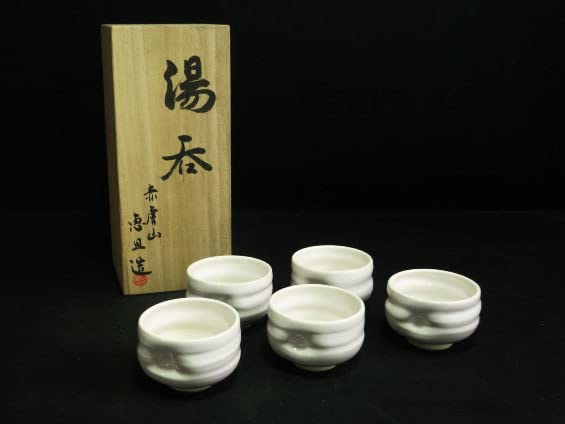 🍵 Akahada-yaki Nara-e Yunomi — a Nara yunomi →
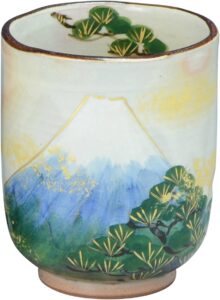 🍵 Aito Kyoyaki Shunzan Yunomi — a Kyoto-style yunomi →
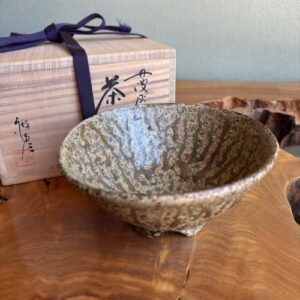 🍵 Tamba-yaki Chawan Matcha Tea Bowl — for matcha rather than daily tea →🍵 Shiraiwa-yaki Namako Yunomi — a northern glaze-driven yunomi →
📦 Shipping & where to buy from outside Japan
The Editor’s Pick is listed on Amazon Japan by a third-party seller, コレクトマーチ, with dispatch usually within 5–6 days. Amazon Japan’s Global Store ships many household items to 65+ countries, including Canada, the UK, and Australia, as well as the US. Third-party sellers set their own shipping destinations, so enter your address at checkout to confirm this listing ships to you.
Price snapshot across stores
| Store | Item / variant | Price (JPY + USD est.) | Notes |
|---|---|---|---|
| 🇺🇸 Amazon.com (US) | Browse Japanese pottery tea cups | varies (USD) | Best if you are shopping from the US: Prime shipping, USD pricing, and no international customs. Amazon US carries Japanese yunomi and tea cups from various kilns, which is useful for comparing shapes and price tiers. The Okinawan set covered here ships from Japan (next row). |
| 🇯🇵 Amazon JP Global Store | 沖縄 やちむん 湯呑み3個セット (Okinawa yachimun yunomi, set of 3), new | ¥5,990 (≈ $40 USD) — as of 2026-09-28; verify on the listing | Ships internationally from Japan to 65+ countries, including Canada, the UK, and Australia, with import fees estimated at checkout. The seller (コレクトマーチ) sets its own destinations, so confirm at checkout. Usually dispatched within 5–6 days. |
| Maker direct (Tsuboya workshops) | Individual workshop pieces | Unconfirmed — varies by workshop | Some Naha workshops sell online, but international shipping and English support vary. This is the route to use if you want a named potter. |
| Proxy services (Buyee / Tenso) | Any Japanese domestic listing | Item price + service fee + shipping | Useful when a Japanese seller ships only within Japan. Fees add up, so combine several items into one parcel. |
Prices and stock change frequently. The linked listing is authoritative. USD figures are approximate at ¥150/USD.
What it does well
Weaknesses and things to verify before buying
- Kiln district is not stated. The listing says “Okinawa yachimun,” not “Tsuboya-yaki.” Okinawan pottery is also made outside Tsuboya, so treat Tsuboya provenance for this specific set as unconfirmed.
- No capacity or dimensions in the title. Check the listing’s detail section or photos for size before ordering, especially if you want a particular volume for tea.
- No maker or potter named. If a signature or workshop name matters to you, buy directly from a named Naha workshop instead.
- Handmade variation. Cups in a handmade set usually differ slightly in shape, glaze flow, and color, so do not expect identical pieces.
- Care instructions are not in the title. Dishwasher and microwave suitability is not confirmed. Hand-washing is the conservative default for handmade earthenware.
- International shipping depends on the seller. A third-party seller may restrict destinations. Confirm at checkout, and use a proxy service if needed.
Conclusion — which buyer type are you?
Other ways to approach this purchase
🏆 Editor’s Pick
❓ Frequently Asked Questions
Is Tsuboya-yaki the same thing as yachimun?
Yachimun is the Okinawan word for pottery in general. Tsuboya-yaki refers specifically to pottery from the Tsuboya district of Naha, the historic center of the craft. All Tsuboya-yaki is yachimun, but not all yachimun is made in Tsuboya.
Is the Editor’s Pick confirmed to be made in Tsuboya?
No. The Amazon Japan listing title says “Okinawa yachimun yunomi, set of 3” and does not name a kiln district or potter. Treat Tsuboya provenance as unconfirmed, and buy from a named Naha workshop if that matters to you.
How much does the set cost?
¥5,990 (about $40 USD) for three cups on Amazon Japan as of 2026-09-28; verify on the listing. Shipping and any import fees are added at checkout.
Does it ship to the US, Canada, the UK, or Australia?
Amazon Japan ships many items to 65+ countries, including the US, Canada, the UK, and Australia. This set is sold by a third-party seller, which sets its own destinations, so enter your address at checkout to confirm. If it doesn’t ship to you, a proxy service such as Buyee or Tenso can forward it.
Are these cups dishwasher- or microwave-safe?
The listing title doesn’t say. Check the listing’s detail section. Without confirmation, hand-washing is the conservative choice for handmade earthenware.
How is Okinawan pottery different from mainland Japanese pottery?
The most visible difference is the clay: Okinawan clay fires to warm reddish, ochre, and buff tones, while most mainland kilns use pale or grayish clays. Decoration also differs. Okinawan pieces often feature Shiisaa guardians, sanshin, and bold brushwork rather than wabi-sabi restraint.
jpmono.com is curated by a Japan-based editorial team working out of Toyama in the Hokuriku region and Nara in Kansai, and is independent. We don’t take payment from the makers we feature; income comes from affiliate links. We read makers’ specs and source listings rather than physically testing every product. Read more about our editorial standards.
This article was drafted with AI assistance and reviewed against the source listing and the editorial fact base. Historical statements are limited to widely published accounts; product attributes are limited to what the listing states.
Affiliate disclosure: jpmono.com may earn a commission on qualifying purchases made through links on this page, at no additional cost to you.