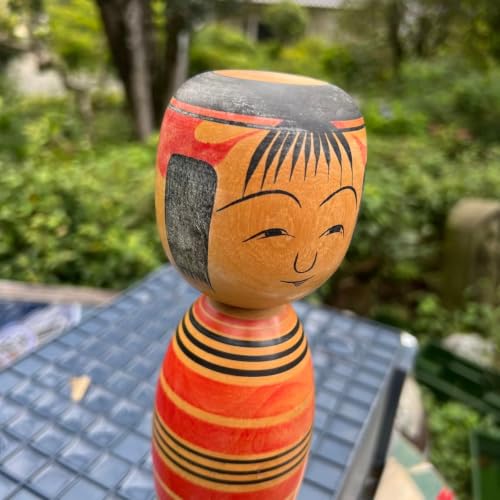
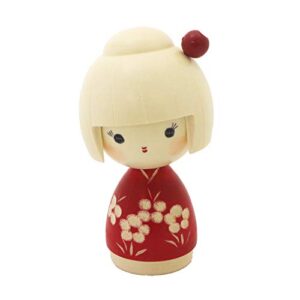
- What it is: a lathe-turned, painted wooden kokeshi doll from Tsuchiyu, the hot-spring district west of Fukushima City.
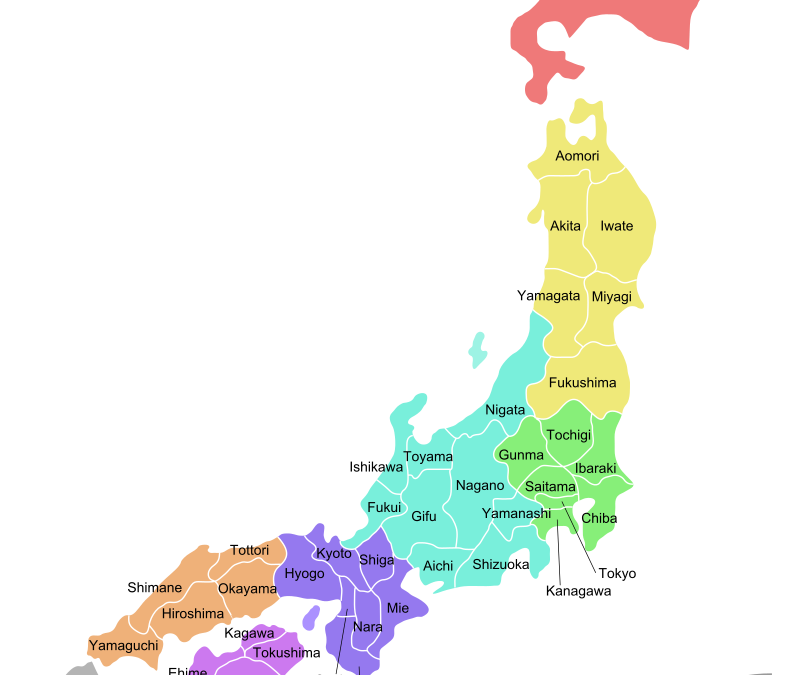
- Made in: Tsuchiyu, Fukushima City, Fukushima Prefecture — one of the traditional kokeshi production areas of northeastern Japan.
- Price band: ¥9,990 (about $67 USD) for the 30.5 cm used doll in our pick — mid-range for a large traditional kokeshi; verify on the listing.
- Best for: a reader who wants one substantial, place-specific wooden doll to display or give, and does not mind buying used.
- Skip if: you need a new, boxed, signed piece with papers, or a matched pair rather than a single doll.
- Shipping: ships internationally from Amazon Japan to 65+ countries, including Canada, the UK and Australia — jump to our pick ↓
The road west out of Fukushima City climbs into cedar and steam, and at the end of it sits a resort town that has been selling wooden dolls to travellers for longer than anyone can date with confidence. The dolls are called kokeshi (こけし): a cylindrical body, a rounded head, a painted kimono, a face reduced to a few confident strokes. In Tsuchiyu they were turned on a lathe by local woodworkers and carried home as souvenirs of a hot-spring stay.
That origin matters for anyone buying one today. Traditional kokeshi are not a single national product with a single factory behind them; they are a set of regional styles, each attached to a hot-spring town in northeastern Japan, and each still made in small workshops rather than on a production line. The distinction between a hand-made doll and a mass-produced souvenir is usually the size of the workshop, not a label on the box.
This article looks at one specific doll currently listed on Amazon Japan — a 30.5 cm Tsuchiyu-type piece attributed to the maker Saito Hiromichi, offered used at ¥9,990 — and then widens out to the questions that decide whether any Tsuchiyu kokeshi is right for you: what the listing actually confirms, what it leaves out, how the doll is likely to arrive, how it should be kept, and how it compares with other Fukushima crafts worth the same shelf space.
Updated
Read time: about 11 minutes

- Who this is for — and who should skip it
- Product overview (from published specs)
- 📍 Where this comes from — Tsuchiyu Onsen and the kokeshi lathe
- Price snapshot across stores
- 📦 Shipping & where to buy from outside Japan
- What it does well
- Weaknesses and things to verify before buying
- Conclusion — which buyer type are you?
- Other ways to approach this purchase
- 🏆 Editor’s Pick
- ❓ Frequently Asked Questions
Who this is for — and who should skip it
- want one substantial wooden object for a shelf, a hall table or a guest room, not a collection of small trinkets.
- care where a thing comes from and would rather own a doll from a named hot-spring town than a generic souvenir.
- are comfortable buying a used piece and asking the seller for extra photographs before paying.
- are buying a gift for someone with a connection to Fukushima, Tōhoku, or Japan’s hot-spring culture.
- accept that painted wood is a living surface that will darken slightly and should not be washed.
- need a brand-new doll in its original box, with a certificate or a visible signature.
- are shopping for a matched pair, a family set, or a doll small enough for a windowsill.
- want certainty about the painting method or the age of the piece before you order.
- expect easy returns; a cross-border used item is a slower, more conditional purchase.
- are decorating a child’s room — a 30.5 cm painted doll on a low shelf is better treated as an adult object.
Product overview (from published specs)
The table below is built from the live Amazon Japan listing, which is the only source we have for this particular doll. No matching Amazon.com listing exists, and we could not confirm a current direct sales page from the workshop, so everything stated here comes from the marketplace entry and its condition field.
Tsuchiyu Kokeshi
伝統こけし 土湯系 斉藤弘道 高さ30.5cm 木製人形 民芸品 置物
通常7~8日以内に発送します。 · Sold by 健やか未来 · ASIN B0HLFV6RZT
Price and availability as of 2026-10-28 09:14 JST. The Amazon listing at the time of purchase is authoritative. jpmono.com earns a commission on qualifying purchases at no extra cost to you.
| Attribute | What the listing states |
|---|---|
| Item | 伝統こけし 土湯系 斉藤弘道 高さ30.5cm 木製人形 民芸品 置物 — traditional kokeshi, Tsuchiyu type, Saito Hiromichi, 30.5 cm, wooden doll, folk craft, ornament |
| Type | Tsuchiyu type (土湯系), one of the regional styles of traditional kokeshi |
| Height | 30.5 cm (about 12 inches) |
| Material | Wood (木製); the listing does not name the species |
| Maker attribution | Saito Hiromichi (斉藤弘道), as stated in the listing title |
| Contents | One doll; the listing does not mention a stand, box or certificate |
| Condition | Used |
| Finish | Painted; the listing does not describe the method, and traditional kokeshi are generally described as painted by hand |
| Seller / dispatch | 健やか未来 — usually dispatched within 7–8 days (通常7~8日以内に発送します。) |
| Price | ¥9,990 (about $67 USD) as of October 28, 2026 |
| Amazon.com listing | None found; the US marketplace offers a general search for kokeshi and other Japanese wooden dolls |
ℹ️ The listing snapshot is the only live data we hold for this doll; the maker’s own sales page was not confirmed, and unlisted attributes are marked as such above.
📖 Glossary — the Japanese words that appear in kokeshi listings
- Kokeshi (こけし)
- A wooden doll with a cylindrical body and a separate rounded head, turned on a lathe and painted. The word is written in hiragana in most listings.
- Dentō kokeshi (伝統こけし)
- “Traditional kokeshi” — the regional, hot-spring-town lineage of the craft, as opposed to creative kokeshi made as an individual artist’s design. The listing uses this term.
- Tsuchiyu-kei (土湯系)
- The Tsuchiyu type or family — the style associated with Tsuchiyu Onsen, the hot-spring district west of Fukushima City.
- Rokuro (ろくろ)
- The lathe used to turn the body and the head of a kokeshi.
- Onsen (温泉)
- A hot spring, and by extension the resort town built around one. Tsuchiyu’s economy and its doll trade both grew out of onsen tourism.
- Mingei / minzoku kōgei (民芸品)
- Folk craft — the category under which the listing files the doll. It signals a handmade regional object rather than a fine-art piece.
📍 Where this comes from — Tsuchiyu Onsen and the kokeshi lathe
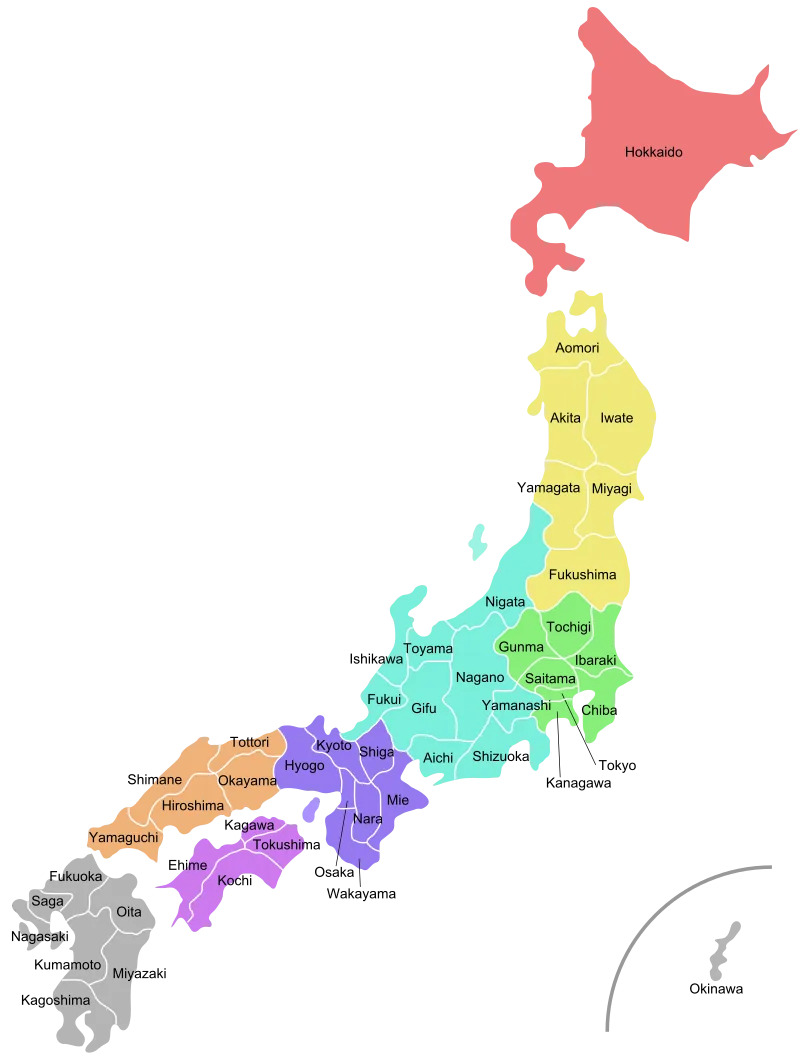
Tsuchiyu Onsen sits in the mountains west of Fukushima City, on the road that climbs toward the Bandai-Azuma highlands. It is a hot-spring resort in the old sense: a narrow street of inns and bathhouses, steam in the air, and a mountain wall behind it. Fukushima City below is the practical gateway — the prefectural capital, the rail junction, the place where the road turns west and starts to rise.
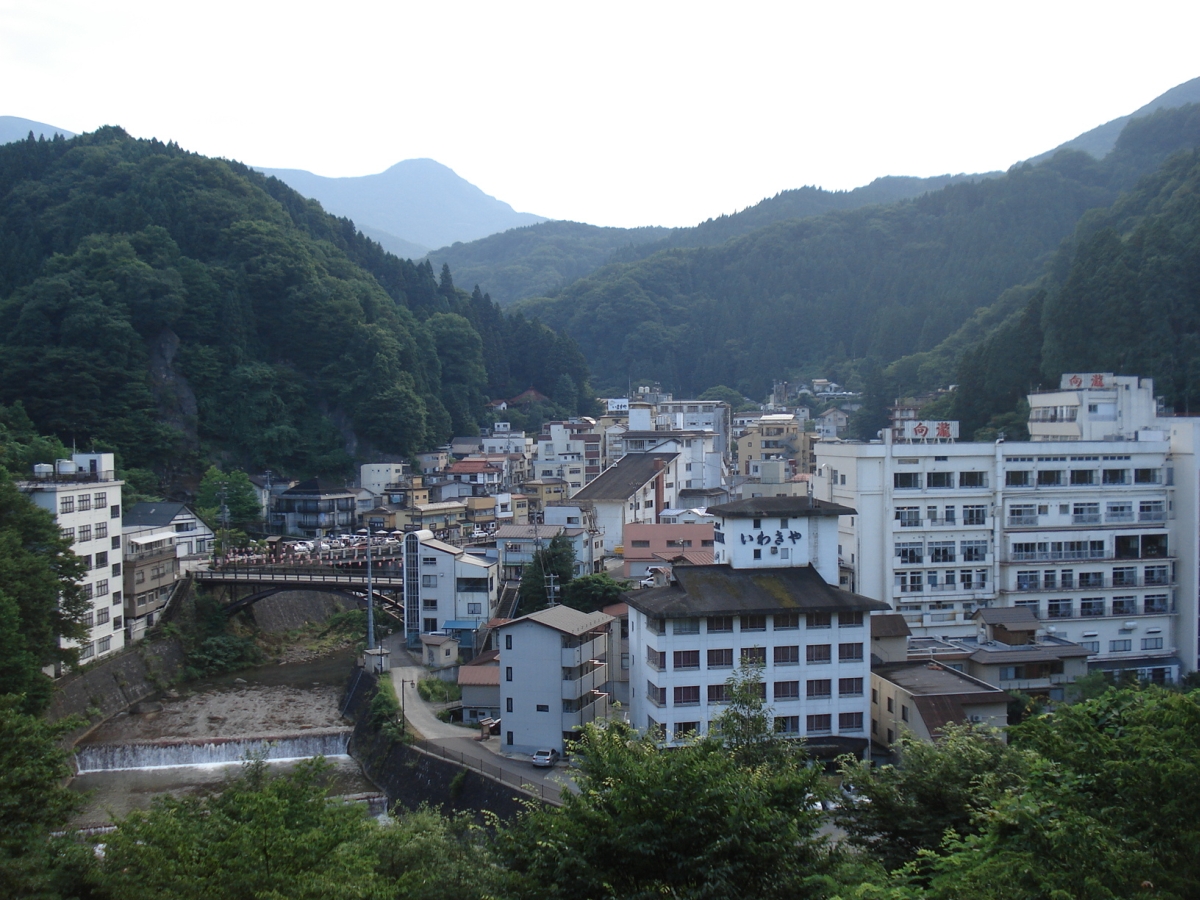
The geography is the reason the craft exists in this shape. A resort town needs something for guests to carry home, and the district had woodworkers who could supply it. The highlands above the town are a seasonal landscape of lakes, ridges and snow — the Bandai region — and the road that serves the resort also serves the woodworkers who turned souvenir goods in the same valley.


The historical anchor is the city rather than the mountain. Fukushima City developed as a castle town and post-station centre in the old Shinobu district — a place where the highway traffic stopped, ate and changed horses. A town on a road, with a resort up the valley, is exactly the sort of place where a souvenir craft takes root: enough travellers to buy, enough timber to work, and a settled population to keep the skills in families.
Traditional kokeshi are lathe-turned wooden dolls, generally described as emerging in the 19th century among woodworkers in the hot-spring towns of northeastern Japan. The exact origin is debated and no single founder is reliably documented, so what can be said with confidence is the setting rather than the date: a hot-spring town, a woodturner, and a guest looking for something to take home.
-
Edo period — Fukushima develops as a castle town and post-station centre in the old Shinobu district. -
19th century — Lathe-turned kokeshi take hold among woodworkers in the hot-spring towns of northeastern Japan, according to the commonly told account. -
1888 — The eruption of Mount Bandai reshapes the Urabandai landscape and leaves the Goshikinuma ponds behind. -
20th century — Tsuchiyu is counted among the traditional kokeshi production areas, and its workshops sell along the resort road. -
2011 — The Great East Japan Earthquake and the nuclear accident that followed cut travel to Fukushima, and the prefecture’s craft trade has been rebuilding its visitor base since. -
2026 — Dolls are still turned, painted and finished inside small workshops; the piece in our pick is a used 30.5 cm Tsuchiyu-type doll.
What “still made here” means in practice is modest and specific. Tsuchiyu dolls are turned from seasoned wood, painted by hand, and finished within the workshop that made them. The craft’s continuity rests on small family workshops rather than factories, which is the practical difference between a hand-made doll and a mass-produced souvenir. The output is the sum of individual benches, not a factory line.

“The practical difference between a hand-made doll and a souvenir is usually not the design. It is whether a family workshop is still standing behind the bench.”
The seasonal rhythm of the place explains the doll’s character as a gift. Resort visitors bought in the street and carried the doll home, where it sat on a shelf in a city apartment. That is still how it functions. It is a memento of a place with steam coming out of the ground, and it does that job without needing to be explained.
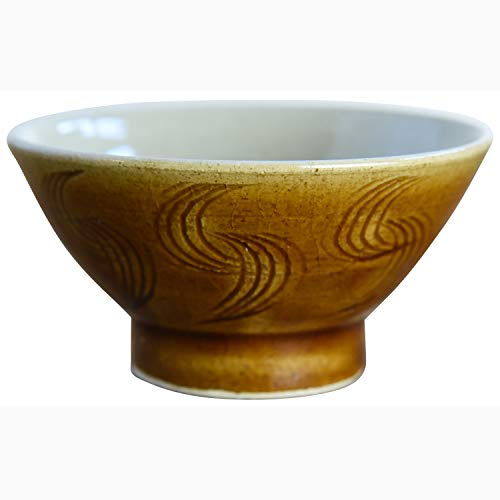
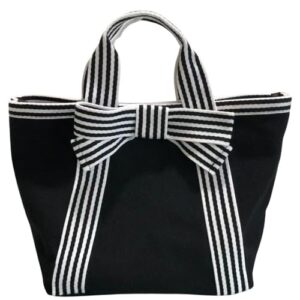
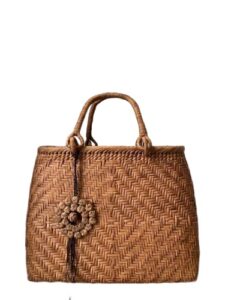
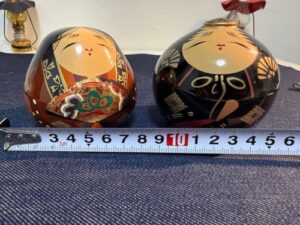
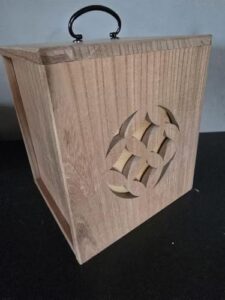
Other Fukushima and Japanese wooden or folk crafts we have written about, for readers weighing a doll against a bowl, a bag or a box.
Price snapshot across stores
Prices are quoted in yen first because yen is the authoritative figure for this listing; dollar amounts are estimates at roughly ¥150 to the dollar and will move with the exchange rate. The table scrolls sideways on a narrow screen.
| Store | Item / variant | Price | Notes |
|---|---|---|---|
| 🇺🇸 Amazon.com (US) | Browse Japanese kokeshi and wooden dolls | varies (USD) | The straightforward route if you are shopping from the United States: USD pricing, Prime shipping on many items, no international customs. Sellers there offer kokeshi of several regional styles, but not this exact Tsuchiyu piece — check the stated height and condition on each listing. |
| 🇯🇵 Amazon JP Global Store | 伝統こけし 土湯系 斉藤弘道 高さ30.5cm — used, single doll | ¥9,990 (≈ $67 USD as of 2026-10-28) | Ships internationally from Japan to 65+ countries — including Canada, the UK and Australia — with import fees estimated at checkout. Dispatched in 7–8 days per the listing. |
| Maker direct | Tsuchiyu workshops generally | — | We did not confirm an online shop for this maker in our snapshot. If you are travelling in Fukushima, buying at the workshop or an onsen-town shop is the way to see the piece first. |
| Proxy services (Buyee / Tenso) | Any Tsuchiyu doll from a Japanese shop that will not ship abroad | varies — item price plus proxy fee and two shipping legs | Useful when a domestic-only listing is the only one available. Budget for consolidation and for the fact that proxy purchases are usually non-returnable. |
📦 Shipping & where to buy from outside Japan
Amazon Japan ships internationally on a large share of its catalogue, and this listing is offered through the Global Store route, so the practical question is not whether it can leave Japan but what it costs to get it to your door. Expect roughly $15–$40 in shipping to the United States, the EU, Canada, the UK or Australia, with the exact figure calculated at checkout.
Amazon estimates and collects import fees at checkout for most destinations, which removes the worst of the surprise on delivery, but it does not remove the need to check your own country’s rules. Wooden folk craft is not normally a restricted category, though customs officers may open and inspect a parcel. If a parcel is held, the delay is usually measured in days rather than weeks.
Two alternatives are worth knowing. First, if you are in Japan or travelling there, buy in person at a Tsuchiyu shop — you can see the paint, the weight and the face before paying, which is a real advantage with a used piece. Second, when a domestic-only listing is the only source, a proxy service such as Buyee or Tenso will buy on your behalf and forward the parcel; the trade-off is a fee, two shipping legs and usually no returns.
What it does well
- 🧴 Daily care: dust with a soft dry cloth. Do not use furniture polish or a damp rag on painted wood.
- 💧 Water: never wash, soak or rinse it, and keep it away from a kitchen or bathroom windowsill where steam collects.
- ☀️ Light and heat: keep it out of direct sun and away from radiators, heaters and the top of a fireplace, all of which dry and crack turned wood.
- 🔧 Repairs: if the paint lifts or the head works loose, ask a woodworker or the seller before attempting a fix; household glue on a painted surface is usually a permanent mistake.
Weaknesses and things to verify before buying
- It is a used doll. The listing’s condition field says used, and no restoration history is given. Wear on a face, a chipped edge on the base or a faded obi will not necessarily show in a single catalog image, so ask for current photographs of the head, the body and the base before paying.
- The painting method is not stated for this piece. Traditional kokeshi are generally described as painted by hand, but the listing does not say so for this doll, and a used item may have been retouched at some point. If the method matters to you, ask the seller directly.
- One doll, not a set. The listing describes a single 30.5 cm doll and does not mention a stand, a box, a certificate or a second figure. Buyers expecting a pair or a presentation box will be disappointed.
- No signature or certificate is mentioned. The title attributes the doll to Saito Hiromichi, which is useful provenance, but it is a seller’s attribution. If you need a signed base or paperwork for insurance or resale, confirm it exists before ordering.
- The price is not a bargain. ¥9,990 (about $67) buys a used doll of this size, and shipping and import fees sit on top. Comparable new dolls and smaller used pieces exist at lower prices; you are paying for size, a named maker and the Tsuchiyu attribution.
- Cross-border returns are awkward. A used item bought from a marketplace seller across a customs border is not a try-it-and-send-it-back purchase. Read the seller’s return terms before checkout, and photograph the parcel as you open it.
- Wood and humidity travel badly. Turned wood can move in a dry, heated room or in an unheated cargo hold. Check how the seller packs, and let the doll sit in its wrapping for a day at room temperature before unwrapping it fully.
Conclusion — which buyer type are you?
For the mainstream buyer the calculation is simple: a single 30.5 cm wooden doll, from a named production area, attributed to a named maker, at a price that is reasonable for the size but not a steal. Everything else hangs on the condition photographs.
Other ways to approach this purchase
🏆 Editor’s Pick
伝統こけし 土湯系 斉藤弘道 高さ30.5cm 木製人形 民芸品 置物 — a single traditional Tsuchiyu-type kokeshi, 30.5 cm tall, attributed to Saito Hiromichi, sold used by 健やか未来 at ¥9,990 (about $67 USD) as of October 28, 2026. Dispatched in 7–8 days per the listing.
- One doll at a size that actually holds a shelf, rather than a miniature that disappears.
- A named production area and a named maker in the listing title, which is more provenance than most souvenir dolls carry.
- A used piece at a mid-range price — you are paying for size and attribution, not for a box or a certificate.
Price as of 2026-10-28; verify on the listing. The piece is offered used, and the seller’s photographs are the real condition report.
❓ Frequently Asked Questions
Is the doll in the Editor’s Pick new or used?
Used. The listing’s condition field says used, and the seller is 健やか未来. Ask for current photographs of the face, the hair and the base before you buy, because wear on a painted wooden doll is not always visible in a single catalog image.
How tall is it, and is it one doll or a set?
It is a single doll, 30.5 cm tall according to the listing title. The listing does not describe a stand, a box or a second figure, so none of those should be assumed.
Who made it?
The listing title attributes the doll to Saito Hiromichi (斉藤弘道) and identifies it as a Tsuchiyu-type traditional kokeshi. The listing does not say that a signature or certificate is included, so ask the seller if provenance matters to you.
How much does it cost, and will the price change?
¥9,990 as of October 28, 2026, or roughly $67 USD at about ¥150 to the dollar. Amazon JP prices and stock change, and a used listing is usually a single unit, so verify the price on the page before ordering.
Does Amazon Japan ship this to Canada, the UK or Australia?
Amazon Japan ships many items to 65+ countries, including Canada, the UK and Australia, with import fees estimated at checkout. Some items are restricted, so confirm your destination on the listing page. A proxy service is the fallback when a listing will not ship abroad.
How should I look after a painted wooden doll?
Dust it with a soft dry cloth, keep it out of direct sun and away from radiators, and do not wash or soak it. Painted wood dislikes sustained damp, so a dry shelf is safer than a bathroom or kitchen windowsill.
jpmono.com is curated by a Japan-based editorial team (working out of Toyama in the Hokuriku region and Nara in Kansai) and is independent. We do not take payment from the makers we feature; income comes from affiliate links. Read more about our editorial standards.
Written with AI assistance and edited by the jpmono editorial team. Listing details, prices and availability were checked on October 28, 2026; historical and craft context follows published accounts of the regional kokeshi tradition.
Affiliate disclosure: jpmono.com may earn a commission on qualifying purchases made through links on this page, at no additional cost to you.