![Shigaraki-yaki ‘Hechimon’ Mug by Marui Seitou — 1,250-Year Six-Old-Kiln Stoneware from Shiga (¥2,300 / ≈$15 USD) [2026 Buyer’s Guide]](https://jpmono.com/wp-content/uploads/2026/05/marui-shigaraki-hechimon-mug-where-to-buy-2026-featured-1393x1050.jpg)
Shigaraki-yaki (信楽焼) is the stoneware tradition of Shigaraki, a small mountain-basin town in southern Shiga Prefecture. It is one of the Six Old Kilns (Nihon Rokkoyō, 日本六古窯) — the six medieval pottery centers that anchor Japanese ceramic history — and its kilns have produced continuously since roughly the 8th century. Internationally, Shigaraki is recognized through the comical tanuki (raccoon-dog) statue that decorates restaurant entrances across Japan; locally and historically, the serious work is unglazed reduction-fired stoneware in the tea-ceremony tradition. The craft was designated a METI Traditional Craft Product (国指定伝統的工芸品) in 1976.
This guide covers the ‘Hechimon’ mug (B07Y1H6VCK) by Marui Seitou (丸伊製陶), a named Shigaraki workshop in Kōka City. The piece is a 330 ml mug in reduction-fired stoneware with a white-glaze (hakuyū 白釉) hand-carved surface. At ¥2,300 (≈ $15 USD as of May 2026) it sits in the impulse-purchase tier for real Shigaraki — well below the ¥30,000–¥100,000 named-craftsperson tea-ceremony pieces, but made by the same multi-generational workshop tradition.
This article is written for international buyers considering their first Shigaraki piece. We cover the 1,250-year arc from the Shigaraki Imperial Palace through the Momoyama tea-ceremony embrace to today’s workshops, then compare price tiers, alternative Shigaraki makers, and international shipping paths.
🔄 Last updated:
⏱️ Reading time: ~14 min

- Who this is for — and who should skip it
- Product overview (from published specs)
- 📍 Where this comes from — place, era, and the craft tradition
- Price snapshot across stores
- What it does well
- Weaknesses and things to verify before buying
- Conclusion — which buyer type are you?
- Other ways to approach this purchase
- 🏆 Editor’s Pick
- ❓ Frequently Asked Questions
- 📌 Related Japanese Crafts
Who this is for — and who should skip it
- Want a first Shigaraki piece without committing to a ¥30,000 tea-ceremony chawan
- Drink coffee or tea daily from a 300–340 ml mug and want something hand-made for it
- Appreciate visible glaze drips and hand-carved irregularity as features, not flaws
- Are building a collection that connects Six Old Kiln traditions (Tokoname, Bizen, Shigaraki…)
- Are buying a gift for someone who collects Japanese ceramics
- You want a matched set — each Hechimon piece is visibly different
- You prefer thin, white industrial porcelain (think Wedgwood / Noritake) — Shigaraki is the opposite aesthetic
- You expect dishwasher-safe convenience — hand-wash is recommended
- You want a sealed surface without patina — Shigaraki stoneware ages with use, and that is the point
- You are shopping under $10 — there are mass-market alternatives at that tier, but they are not Shigaraki
Product overview (from published specs)
Sources: Amazon US search (primary, moonill-20 tag) for related Japanese craft mugs, Amazon JP Global Store listing for B07Y1H6VCK (secondary, moonill-22 tag) as the sourced piece, plus maker direct via the Shigaraki Pottery Cooperative and proxy services (Buyee / Tenso) where relevant.
Shigaraki-yaki 'Hechimon' Mug by Marui Seitou
丸伊製陶 信楽焼 へちもん マグカップ コップ 大きめ 白釉彫 容量約330ml おしゃれ コーヒーカップ 陶器 職人手作り 伝統工芸 日本製 3-3333
残り1点 ご注文はお早めに · Sold by Eすたいる · ASIN B07Y1H6VCK
Price and availability as of 2026-08-31 02:30 JST. The Amazon listing at the time of purchase is authoritative. jpmono.com earns a commission on qualifying purchases at no extra cost to you.
| Field | Detail (per Amazon JP listing, May 2026) |
|---|---|
| Product | Marui Seitou Shigaraki-yaki ‘Hechimon’ Mug, white-glaze carved surface |
| ASIN | B07Y1H6VCK |
| Maker | Marui Seitou (丸伊製陶), Shigaraki, Kōka City, Shiga Prefecture |
| Material | Reduction-fired Shigaraki stoneware with white-glaze (hakuyū 白釉); hand-carved surface texture |
| Dimensions | Approximately ⌀ 8.5 × H 9 cm |
| Capacity | 330 ml — standard adult coffee / tea mug size |
| Weight | Approximately 280 g |
| Made in | Shigaraki, Kōka City, Shiga Prefecture, Japan |
| Price | ¥2,300 (≈ $15 USD as of May 2026, at ¥150/USD baseline) |
| International shipping | Available via Amazon JP Global Store. Estimated $8–$15 USD shipping; stoneware transit breakage approximately 2%. |
| Care | Hand-wash with hot water; microwave-safe per listing; avoid thermal shock |
📖 Glossary — key terms used in this guide
Shigaraki-yaki (信楽焼) — Stoneware tradition centered in Shigaraki, southern Shiga Prefecture. One of Japan’s Six Old Kilns.
Six Old Kilns (Nihon Rokkoyō, 日本六古窯) — The six medieval pottery centers that anchor Japanese ceramic history: Tokoname, Seto, Shigaraki, Echizen, Tamba, and Bizen.
Hechimon (へちもん) — Kansai dialect for “eccentric” or “oddball.” Marui Seitou’s signature line of slightly irregular hand-carved pieces — a self-deprecating brand name that signals each piece is a one-off.
Hakuyū (白釉) — Literally “white glaze.” A milky, semi-opaque glaze that pools visibly in carved grooves, distinguishing reduction-fired stoneware from industrial porcelain.
Reduction firing — Kiln firing under reduced oxygen, which pulls iron and other minerals to the surface and produces the characteristic reddish-brown and ash-tinted tones of Shigaraki ware.
Chawan (茶碗) — Tea bowl, particularly for matcha tea-ceremony use.
Mizusashi (水指) — Fresh-water container used in the tea ceremony.
Tanuki (狸) — Japanese raccoon-dog and folk-mythological shape-shifter. The comical sake-loving tanuki figure is Shigaraki’s most internationally recognized motif.
METI Traditional Craft (国指定伝統的工芸品) — National designation administered by Japan’s Ministry of Economy, Trade and Industry, recognizing crafts with continuous regional production and verified technique. Shigaraki-yaki was designated in 1976.
📍 Where this comes from — place, era, and the craft tradition

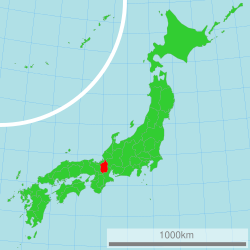
The region — Shigaraki, in southern Shiga Prefecture
Shigaraki (信楽) is a town within Kōka City (甲賀市), in southern Shiga Prefecture (滋賀県) — the inland prefecture northeast of Kyoto, defined by Lake Biwa, Japan’s largest lake. Shigaraki itself sits in a small mountain basin about 30 km southeast of Lake Biwa, in the hills bordering Kyoto and Mie prefectures.
For an international reader’s geography: Shigaraki is roughly 80 minutes from Kyoto Station by JR plus the Shigaraki Kogen Tetsudō line, about 90 minutes from Osaka, and about 80 km from Kansai International Airport (KIX). The Shigaraki Ceramic Cultural Park (信楽陶芸の森) is the central visitor destination, with kiln demonstrations, gallery exhibitions, and working studios. The Miho Museum — designed by I.M. Pei and opened in 1997 — sits about 10 km north, and is one of the architecturally most significant museums in Japan.
The pottery industry here is anchored by Shigaraki-tsuchi — a high-iron, high-feldspar local earth that fires to reddish-brown tones, and that picks up natural ash glazing during reduction firing. The same clay has been worked by Shigaraki potters for roughly 1,250 years.
The historical anchor — the 8th-century imperial palace
Shigaraki-yaki has an unusually well-documented founding context. In 742–743 CE, Emperor Shōmu (聖武天皇) built the Shigaraki Imperial Palace (信楽宮) as one of several short-lived alternative capitals during the politically turbulent Tenpyō era. The capital function lasted only about five years before returning to Heijō-kyō (Nara), but the construction required massive quantities of roof tiles and ceremonial vessels. Local potters developed tile-making and pottery operations to supply the imperial court.
When the capital moved away, the workshops continued — initially serving the surrounding Buddhist temple complex, then expanding into commercial production for the medieval economy. Archaeological evidence from kiln sites in the Shigaraki area documents continuous production from approximately 750 CE onward.
That 1,250-year continuity makes Shigaraki one of the longest continuously operating pottery centers in Japan, comparable only to Tokoname (Aichi, 12th century onward) and the older Sue-ware lineage. It is one of the Six Old Kilns (Nihon Rokkoyō, 日本六古窯) — the medieval pottery centers that anchor Japanese ceramic history: Tokoname, Seto, Shigaraki, Echizen, Tamba, and Bizen.
-
742–743 CE — Emperor Shōmu builds the Shigaraki Imperial Palace; local potters supply roof tiles and ceremonial vessels. -
12th–15th c. — Shigaraki develops into one of the Six Old Kilns; production shifts to large storage jars and water vessels for the medieval commercial economy. -
1568–1603 — Momoyama-period tea-ceremony embrace; Sen no Rikyū and Furuta Oribe value Shigaraki’s rough natural-glaze chawan and mizusashi. -
1603–1868 — Edo-period mass production for the Tōkaidō trade route economy; storage jars, brewing vessels, hibachi braziers. -
1930s — Fujiwara Tetsuzō develops the comical standing-tanuki figure as a Shigaraki signature product. -
1951 — Emperor Shōwa visits Shigaraki on his first post-WWII tour; the tanuki figure receives national publicity. -
1976 — Shigaraki-yaki designated a METI Traditional Craft Product (国指定伝統的工芸品). -
2019–2020 — NHK morning drama ‘Scarlet’ (スカーレット) set in a fictional Shigaraki workshop; visitor numbers rise approximately 40%. -
2026 — Approximately 150–200 active workshops; Marui Seitou continues the modern daily-use tier of the tradition.
The Momoyama tea-ceremony embrace
The stylistic moment that defines Shigaraki’s high-prestige reputation is the Azuchi-Momoyama period (1568–1603). The Sen no Rikyū-led tea-ceremony movement embraced Shigaraki-yaki for its rough natural-glaze aesthetic — pieces with visible iron-rich ash deposits, deliberately uneven shapes, and asymmetric forms became prized tea-ceremony chawan and water containers (mizusashi).
The features Sen no Rikyū and Furuta Oribe valued were specific: reduction-firing unevenness that left one side darker and one side lighter with visible kiln-flame marks; natural ash glazing as pine ash drifted through the kiln and settled on pieces, producing yellow-green patches; asymmetric hand-wheel work that did not aim for industrial uniformity; and the iron-bleed coloring of the Shigaraki clay, which aged beautifully with tea use.
“Shigaraki was not refined into prestige — it was prized for refusing to be refined. The same clay that made roof tiles for the imperial palace also made the tea bowls that defined Japanese taste.”
That Momoyama embrace transformed Shigaraki from a utilitarian commercial pottery into a high-prestige art ceramic. Named tea-master pieces from this period now sell at auction in the ¥50–500 million range.
Edo period and the move into mass production
Through the Edo period (1603–1868), Shigaraki expanded into mass-market storage and brewing vessels. Sake breweries, soy-sauce makers, and miso producers across Kansai bought Shigaraki jars in volume. The kilns scaled up; quality bifurcated into a tea-ceremony tier that continued the Momoyama legacy at premium prices, and a commercial tier for utilitarian volume production.
During the late Edo period, Shigaraki kilns also developed expertise in hibachi (火鉢, ceramic braziers) for indoor heating. By 1900, Shigaraki was Japan’s largest single-region producer of hibachi — a niche that quietly subsidized the kilns until electric heating displaced the form in the mid-20th century.
The tanuki statue — the 20th-century folk-art turn
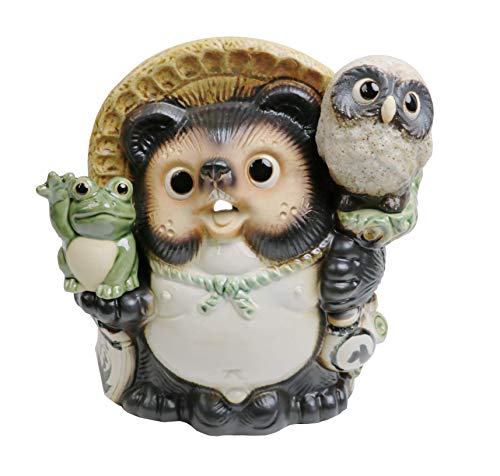
Shigaraki’s international visibility today comes largely from the tanuki (狸) statue — the comical figure with a round belly, large eyes, oversized testicles, a sake bottle in one hand, and a ledger in the other, that decorates restaurant entrances across Japan.
The origin: in the 1930s, a Shigaraki potter named Fujiwara Tetsuzō (藤原銕造) began producing standing-tanuki figures. The tanuki is a Japanese folk-figure with shape-shifting magical powers — kitsune-and-tanuki tales are core Japanese folklore — traditionally associated with luck and prosperity. Fujiwara’s figures combined the folk image with deliberate comical exaggeration, and the oversized features became the signature.
The defining moment was 1951: Emperor Shōwa (Hirohito) visited Shigaraki on his first post-WWII tour. The town arranged a welcome procession where children carried small tanuki figures; the Emperor commented favorably. The visit was photographed and reported nationally, and within months the Shigaraki tanuki became a nationally recognized symbol. Today, Otani Shigaraki Kiln is the dominant tanuki producer, accounting for roughly 70% of all Shigaraki tanuki figures.
The tanuki is not the piece in this article — but understanding it frames Shigaraki’s dual cultural identity: a serious tea-ceremony tradition that is also Japan’s most popular folk-figure factory.
Modern Shigaraki and Marui Seitou’s Hechimon line
Shigaraki-yaki was designated a METI Traditional Craft Product in 1976. The modern industry has approximately 150–200 active workshops in 2026, structured roughly into four tiers: a Living National Treasure tier (Tsujimura Shirō is currently among the most-collected masters); a named-workshop tea-ceremony tier (about 30 multi-generational kilns producing pieces at ¥10,000–¥100,000); a modern daily-use tier (Marui Seitou, Maruichi Honten, and similar, at ¥2,000–¥10,000); and a tanuki / souvenir tier centered on Otani Shigaraki Kiln.
A 2019 NHK morning drama, Scarlet (スカーレット), was set in a fictional Shigaraki workshop and dramatically boosted national interest in the craft. Shigaraki visitor numbers rose roughly 40% in the 2019–2021 period.
Marui Seitou (丸伊製陶) is a named Shigaraki workshop in the Kōka area, operating with multi-generational continuity. The Hechimon (へちもん) series is Marui’s signature line: “Hechimon” is Kansai dialect for “eccentric” or “oddball” — a self-deprecating brand name that acknowledges each piece is slightly different. Each piece is hand-carved with surface texture; no two are identical. The line spans mug, bowl, and yunomi forms, in glaze colors including white, black, blue, and ash, at the ¥2,000–¥4,000 daily-use tier.
Five generations of Shigaraki potters separate Sen no Rikyū’s mizusashi from a Hechimon mug. The materials, the firing technique, and the deliberate embrace of irregularity are the same.
Price snapshot across stores
Pricing as of May 2026. The authoritative price is the JPY listing on Amazon JP; USD figures are approximate at a ¥150/USD baseline. Prices and stock fluctuate — verify at the retailer before purchasing.
| Store | Item / Variant | Price (JPY + USD est.) | Notes |
|---|---|---|---|
| 🇺🇸 Amazon.com (US) | Browse Japanese stoneware mugs | varies (USD) | Best if you are shopping from the US — Prime shipping, USD pricing, no customs handling. Amazon US carries Japanese stoneware mugs from various makers; Marui Seitou’s exact Hechimon piece is sourced from Japan (next row). |
| 🇯🇵 Amazon JP Global Store | Hechimon white-glaze mug, 330 ml (B07Y1H6VCK) | ¥2,300 (≈ $15 USD) | The sourced listing for this guide. Ships internationally from Japan; estimated $8–$15 USD shipping. Stoneware transit breakage ~2%. |
| Maker direct | Marui Seitou via Shigaraki Pottery Cooperative | Catalog pricing similar to retail; shipping quoted on request | Most named Shigaraki workshops ship internationally on request via the Cooperative. Useful for larger orders or non-Amazon variants. |
| Proxy services (Buyee / Tenso) | Forwarding from Rakuten, Yahoo Shopping JP, or Mercari listings | ¥2,300 + proxy fee (¥500–¥1,500) + international shipping | Useful for variants Amazon JP does not stock. Total cost typically exceeds Amazon JP Global Store unless bundling multiple items. |
What it does well
Marui Seitou is a multi-generational Shigaraki kiln, not an anonymous OEM factory. The piece is part of a workshop lineage that traces directly into Shigaraki’s named-workshop tradition.
Each piece is hand-carved, so surface texture varies from unit to unit. The Hechimon brand name embraces this — “eccentric” or “oddball” in Kansai dialect — and the variation is a feature.
330 ml maps closely to a standard Western coffee mug or tea cup. Unlike traditional yunomi or chawan, no separate matcha workflow is needed — pour and drink.
Visible glaze drips, pooling in the carved grooves, and the slightly off-white tone all signal reduction-fired stoneware. For a first-Shigaraki buyer, the finish is the most legible introduction to the tradition’s aesthetic vocabulary.
Weaknesses and things to verify before buying
- No matched-set guarantee. The hand-carved finish means every piece varies. If you are buying two for a couple, expect them to look like siblings, not twins. For a true matched gift, the Maruichi Honten ‘Aozora & Yūgure’ pair is the more reliable option.
- Hand-wash recommended. The listing notes hot-water hand-washing; the carved surface and visible glaze pooling reward gentle care. Repeated dishwasher cycles can dull the glaze and stress the stoneware.
- Stoneware transit breakage risk. Approximately 2% transit breakage is normal for international stoneware shipments. Amazon JP Global Store packaging is generally adequate; specialty retailers often use double-walled boxes for higher reliability.
- Patina develops over time. Daily tea and coffee use will darken the carved grooves and deepen the surface — desirable in the tradition, but a buyer expecting a permanently new-looking white piece may be disappointed.
- Casual aesthetic, not formal dinnerware. The visible glaze drips and irregular surface read as folk-craft, not Wedgwood / Noritake porcelain. Probably wrong for formal Western dinner-party use, right for daily kitchen and tea-table use.
- Thermal shock warning. Pre-warm before pouring boiling water; do not move directly from refrigerator to hot water. Shigaraki stoneware is hardier than tea-ceremony porcelain, but it is still fired clay.
- Hand feel may surprise. The carved surface is intentionally textured. Buyers expecting smooth porcelain may find it tactilely unfamiliar at first — give it a week of use before judging.
Conclusion — which buyer type are you?
Building a serious tea-ceremony collection? Skip this and engage the Shigaraki Pottery Cooperative for a named-craftsperson chawan in the ¥30,000–¥500,000 tier. The Hechimon mug will not serve a formal sadō practice.
First Shigaraki piece, daily coffee or tea use, willing to hand-wash. This is the buyer the Hechimon mug is designed for. ¥2,300 is the lowest-friction entry into the tradition.
Want a tangible Shigaraki memory for under ¥1,500? Consider a small Otani Shigaraki tanuki figure instead — same town, same tradition, more compact, more iconic.
You want smooth, sealed, dishwasher-safe industrial porcelain. Shigaraki is the wrong tradition — try Mino-yaki (Gifu) or Kyō-yaki Kiyomizu industrial-tier instead.
Other ways to approach this purchase
Mid-October each year, direct-from-kiln pricing at the Shigaraki Pottery Festival (信楽陶器まつり) routinely runs 30–50% below retail. Worth planning a trip around if you are already visiting Kansai.
Mutual Adoration (NY), Native & Co (London), and tea-ceremony specialty shops carry rotating Shigaraki inventory at curated price points. Higher per-piece cost, no international shipping anxiety.
Amazon JP regularly issues coupons on Japanese-craft categories. Stacking a 5–10% coupon onto the ¥2,300 listing makes the effective price ≈ ¥2,070. Check the listing page before checkout.
If the Shigaraki connection matters more than the daily-use function, a small Otani Shigaraki tanuki figurine carries the same place-of-origin story at a different price point and zero breakage risk in daily handling.
🏆 Editor’s Pick
❓ Frequently Asked Questions
How is “Hechimon” pronounced, and what does it mean?
“Hechimon” (へちもん) is pronounced roughly “heh-chee-mon” with even emphasis. It is Kansai-dialect slang for “eccentric” or “oddball” — Marui Seitou chose it as a self-deprecating brand name acknowledging that every piece in the series is slightly irregular. The variation is the point, not a defect.
Will my mug look exactly like the listing photo?
No. Each Hechimon piece is hand-carved, and glaze pooling varies with kiln position during firing. The listing photo represents the line; the unit shipped will have its own surface texture and glaze pattern. Buyers who need photo-exact matching should consider industrial porcelain instead.
Is the white glaze food-safe? Can I use it daily for coffee and tea?
Yes. The hakuyū (white) glaze used on this mug is a standard food-safe ceramic glaze, vitrified during reduction firing. Daily coffee, tea, hot water, and most other beverages are fine. Avoid extreme thermal shock — pre-warm with hot tap water before pouring freshly boiled water.
Can I use the mug in the microwave and dishwasher?
Microwave-safe per the Amazon JP listing. Hand-wash with hot water is the recommended cleaning method; the listing does not explicitly endorse dishwasher use. Repeated dishwasher cycles can dull the glaze and stress hand-made stoneware, so most owners hand-wash.
What does shipping to the US, UK, or Australia cost?
Amazon JP Global Store ships this 280 g item internationally; based on listings as of May 2026, expect roughly $8–$15 USD shipping to the US and EU, and somewhat higher to Australia and New Zealand. Stoneware transit breakage is around 2% — Amazon usually replaces broken items on request. Customs duty is unlikely on a single sub-$50 item in most jurisdictions.
How is Shigaraki-yaki different from Bizen-yaki or Tokoname-yaki?
All three are Six Old Kilns. Bizen (Okayama) is famous for unglazed iron-rich stoneware with strong fire marks. Tokoname (Aichi) is associated with red-clay tea pots (kyusu). Shigaraki sits between the two — heavier than Tokoname, often glazed (unlike Bizen), with a softer iron-red base tone and a distinct Momoyama tea-ceremony lineage. The Hechimon white-glaze mug is more accessible than typical Bizen, less specialized than Tokoname’s kyusu line.
Where can I see Shigaraki-yaki in person if I visit Japan?
The Shigaraki Ceramic Cultural Park (信楽陶芸の森) in Kōka City is the main visitor destination — gallery exhibitions, working studios, and direct kiln sales, open daily 9:00–17:00. The Miho Museum sits 10 km north and is itself a major architectural destination (I.M. Pei, 1997). The annual Shigaraki Pottery Festival (信楽陶器まつり) in mid-October is the best opportunity for direct-from-kiln pricing. From Kyoto Station, allow about 80 minutes via JR plus the Shigaraki Kogen Tetsudō line.
jpmono.com is curated by a Japan-based editorial team working out of Toyama (Hokuriku region) and Nara (Kansai region), and is independent. We do not take payment from the makers we feature; income comes from affiliate links. We do not physically test every product (we read maker specs and source listings). Read more about our editorial standards.
Editorial note: research and drafting for this article were assisted by AI tooling against the maker’s published listing data and the editorial team’s regional knowledge base; final review and publishing are handled by the jpmono editorial team.
Affiliate disclosure: jpmono.com may earn a commission on qualifying purchases made through links on this page, at no additional cost to you.