![Tobe-yaki ‘Akasen Karakusa’ Mug by Senzan-Gama — 250-Year Ehime Porcelain Tradition (¥2,482 / ≈$17 USD) [2026 Buyer’s Guide]](https://jpmono.com/wp-content/uploads/2026/05/senzan-tobeyaki-mug-cup-where-to-buy-2026-featured-1375x1050.jpg)
Tobe-yaki (砥部焼) is the white-porcelain tradition of Tobe Town, in the central interior of Ehime Prefecture on the island of Shikoku. It has been practiced continuously since 1777 — the year a local potter named Sugino Sannosuke (杉野三之助) realized that the same kaolin-rich earth the area had been quarrying for centuries as toishi (砥石, sharpening stones) could, when crushed and refined, be fired into porcelain. The Tobe aesthetic that emerged from this discovery is unmistakable: thick, rugged white bodies with bold cobalt-blue underglaze patterns, almost always built around karakusa (唐草), the looping arabesque-vine motif.
This article looks at one specific entry-tier piece from that lineage — Senzan-Gama’s round mug in the “Akasen Karakusa” (赤線唐草, “red-line arabesque”) pattern, listed on Amazon JP for ¥2,482 (approximately $17 USD as of May 2026). Senzan-Gama (千山) is one of the named kilns inside the Tobe district; the mug is part of their daily-use line, the kind of object that turns up on weekday breakfast tables across western Japan and almost never appears in tourist catalogs.
The piece is small in price and modest in scope, but it is a fair gateway into a craft tradition that the Showa-era mingei movement specifically singled out as exemplary of utilitarian Japanese folk pottery. The comparison axes in this guide are: how it stacks up against more refined Arita / Imari porcelain, how it compares to the other regional ceramic lines covered on this site (Hasami, Hagi, Bizen, Kōyō-gama Arita), and how international buyers can actually get hold of it from outside Japan.
📅 Published:
🔄 Updated:
⏱ Read time: ~9 min

- Who this is for — and who should skip it
- Product overview (from published specs)
- 📍 Where this comes from — Tobe, Ehime, Shikoku
- Price snapshot across stores
- What it does well
- Weaknesses and things to verify before buying
- Conclusion — which buyer type are you?
- Other ways to approach this purchase
- 🏆 Editor’s Pick
- ❓ Frequently Asked Questions
- 📌 Related Japanese Crafts
Who this is for — and who should skip it
- Want a single canonical Tobe-yaki piece without committing to a full set
- Like sturdy, rim-thick daily-use ceramics over thin-walled refinement
- Care about kiln provenance (Senzan-Gama is a named, continuing Tobe kiln)
- Drink coffee, hojicha, or black tea in the 200–250 ml range
- Are building a comparison shelf of Japanese regional pottery (Hasami / Hagi / Bizen / Arita)
- Expect the eggshell-thin finish of Arita / Imari or European bone china
- Want a large 350 ml+ American-style coffee mug
- Need uniform, machine-perfect cobalt lines (Tobe is hand-painted underglaze)
- Are buying a gift that must arrive in a presentation box (this is a plain shipping carton)
- Want a discounted bulk set — Senzan rarely runs promotions on entry-tier pieces
Product overview (from published specs)
The table below summarizes what is verifiable from the Amazon JP listing as of May 16, 2026. Senzan-Gama does not maintain a public English-language site, so almost all spec text originates from the JP listing (with romaji translation) and the standard descriptive vocabulary used for Tobe-yaki by the Ehime prefectural craft association.

Tobe-yaki 'Akasen Karakusa' Mug by Senzan-Gama
砥部焼 千山(Tobeyaki senzan) 砥部焼 丸型マグカップ 赤線唐草 1個
残り15点(入荷予定あり) · Sold by Amazon.co.jp · ASIN B09NLVCNV2
Price and availability as of 2026-08-31 02:30 JST. The Amazon listing at the time of purchase is authoritative. jpmono.com earns a commission on qualifying purchases at no extra cost to you.
| Spec | Value | Source |
|---|---|---|
| Kiln / maker | Senzan-Gama (千山), Tobe, Ehime | Amazon JP listing, May 2026 |
| ASIN | B09NLVCNV2 | Amazon JP Global Store |
| Material | White porcelain with cobalt-blue + red-line karakusa (arabesque) underglaze | Listing description |
| Dimensions | ⌀ approx. 9 cm × H 8 cm | Listing description |
| Capacity | approx. 270 ml | Listing description |
| Weight | approx. 280 g | Listing description |
| Made in | Tobe, Ehime, Japan | Listing description |
| Care | Microwave OK, dishwasher OK (typical for Tobe); avoid thermal shock; stackable | Listing description |
| Price (JP) | ¥2,482 (≈ $17 USD as of May 2026) | Amazon JP, snapshot May 16, 2026 |
| Tradition designation | METI Traditional Craft Product (1976) | METI traditional crafts register |
Data note: only the Amazon JP listing snapshot is available for this specific piece; live pricing may have shifted since the writing date. Maker-direct (Senzan-Gama) does not list this exact SKU on a public web shop.
📖 Glossary — Japanese craft terms used in this article
- Tobe-yaki (砥部焼) — white porcelain tradition of Tobe Town, Ehime, on Shikoku. Continuously produced since 1777.
- karakusa (唐草) — “Chinese grass”; a looping arabesque-vine pattern of Sasanian / Central Asian origin transmitted to Japan via the Silk Road. The defining motif of Tobe-yaki.
- akasen (赤線) — “red line”; here it refers to a fine red rim or accent line painted alongside the cobalt arabesque.
- tobe-tsuchi (砥部土) — the local kaolin-rich clay derived from Tobe’s sharpening-stone (toishi) quarries; the raw material for the porcelain body.
- toishi (砥石) — sharpening stone. Tobe Town has produced toishi since the Nara period (8th century); the porcelain industry grew out of refining this same earth.
- underglaze (下絵付け, shitae-zuke) — decoration painted on the bisque body before the clear glaze coat. The cobalt blue of Tobe-yaki is applied this way.
- mingei (民芸) — “folk craft.” The 1920s–30s movement led by Yanagi Sōetsu (柳宗悦), Hamada Shōji, and Kawai Kanjirō, which championed anonymous everyday utilitarian objects. Tobe-yaki was one of their named exemplars.
- kiln (窯, kama or gama) — both the firing oven itself and, by extension, the workshop business. Senzan-Gama (千山窯) means “the Senzan kiln.”
- METI — Japan’s Ministry of Economy, Trade and Industry, which maintains the official register of Traditional Craft Products (伝統的工芸品). Tobe-yaki was designated in 1976.
📍 Where this comes from — Tobe, Ehime, Shikoku

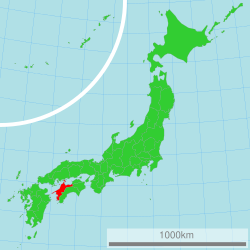
Shikoku is the smallest of Japan’s four main islands and the one international readers tend to know least. It sits south of western Honshu, separated by the Seto Inland Sea, and is most often associated abroad with the 88-temple Shikoku pilgrimage (henro). Ehime occupies the northwest quadrant of the island; its largest city is Matsuyama, famous for Dōgo Onsen — the bathhouse complex that inspired the bathhouse in Hayao Miyazaki’s Spirited Away. Tobe Town is a 30-minute drive inland from Matsuyama, in the foothills where the kaolin-bearing geology surfaces.
The reason a porcelain industry took root specifically here is straightforward: the same hills had been quarried for toishi (砥石, sharpening stones) since the Nara period, and the Tobe area was an established supplier of grindstones to swordsmiths across western Japan for nearly a thousand years before anyone tried firing the clay. The technical insight in 1777, attributed to local potter Sugino Sannosuke under Ōzu (大洲) domain patronage, was that the same kaolin-rich earth — when crushed, washed, and refined — would vitrify into white porcelain in the kiln. From that point on, toishi-grinding and porcelain-making coexisted in the same valley.
- 8th c. (Nara period) — Tobe area documented as a source of toishi (sharpening stones); kaolin-rich geology established as a regional resource.
- 1777 — Sugino Sannosuke (杉野三之助) successfully fires Tobe porcelain from refined local clay under Ōzu domain patronage. Conventional founding year of Tobe-yaki.
- Late Edo (early 1800s) — Tobe-yaki becomes the principal porcelain supplier to western Shikoku; thick rugged daily-use forms established.
- 1920s–30s — The mingei (民芸) movement led by Yanagi Sōetsu, Hamada Shōji, and Kawai Kanjirō embraces Tobe-yaki as exemplary utilitarian Japanese folk pottery.
- 1976 — METI designates Tobe-yaki as a Traditional Craft Product (伝統的工芸品).
- Late 20th c. — Tobe district consolidates into roughly 90 active kilns of varying scale; Senzan-Gama (千山) operates as one of the named multi-generational kilns producing daily-use porcelain.
- 2026 — Senzan-Gama’s Akasen Karakusa mug is still in continuous production at ¥2,482 (≈ $17 USD), listed on Amazon JP Global Store for international shipping.
The defining aesthetic — thick rugged white porcelain bodies with bold cobalt-blue karakusa underglaze — was not a Sugino-era invention. It was solidified in the early Showa period, when the mingei (民芸, “folk craft”) movement consciously chose Tobe-yaki as one of its representative crafts. Yanagi Sōetsu and his circle were interested in anonymous everyday objects whose beauty came from utility rather than from individual artistic ego, and Tobe-yaki’s combination of sturdiness, low cost, and confident hand-painted decoration fit their thesis precisely. Most kilns in the district adjusted toward this look in the decades after, and it has been the canonical Tobe-yaki look ever since.
“The kaolin under Tobe was first prized for sharpening sword steel; only on the second thought, eight centuries later, did anyone realize the same earth would also hold a coffee.”
Senzan-Gama (千山) is one of the named, continuing Tobe kilns. The kiln does not publish English-language histories, but its catalog appears regularly in Ehime-prefecture craft retailers and the Tobe-yaki Traditional Industries Hall (砥部焼伝統産業会館), which is the closest equivalent of an official kiln registry. The Akasen Karakusa mug is one of their staple daily-use SKUs — exactly the kind of object that mingei theory was written about.
Price snapshot across stores
| Store | Item / Variant | Price | Notes |
|---|---|---|---|
| 🇺🇸 Amazon.com (US) | Browse Japanese porcelain mugs | varies (USD) | Best if you’re shopping from the US — Prime shipping, USD pricing, no international customs. Amazon US carries Japanese porcelain mugs from Hasami, Arita, Kutani and other lines that are useful as comparison points. Senzan-Gama’s exact Akasen Karakusa piece is sourced from Japan (next row). |
| 🇯🇵 Amazon JP Global Store | Senzan-Gama Akasen Karakusa round mug · single · ASIN B09NLVCNV2 | ¥2,482 (≈ $17 USD) | Ships internationally from Japan. Estimated international shipping $8–$15 USD; total landed cost roughly $25–$32 USD. Authoritative source for this specific SKU. |
| Maker direct (Senzan-Gama) | — | — | Senzan-Gama does not run a public web shop with international shipping. The Tobe-yaki Traditional Industries Hall in Tobe Town stocks the kiln’s pieces for in-person buyers; international online direct purchase is not currently offered. |
| Proxy services (Buyee / Tenso) | Senzan pieces via Rakuten / Yahoo! Auctions JP listings | ¥2,200–¥3,000 + proxy fees + shipping | Useful if you want a different Senzan piece not on Amazon JP, or if Amazon JP Global Store does not ship to your country. Adds 15–20% proxy markup; longer transit. |
Prices and stock fluctuate. The JPY figure is authoritative; the USD estimate uses a ¥150/USD baseline as of mid-2026. Always verify at the retailer before purchasing.
What it does well
The thick rugged white porcelain body with bold cobalt karakusa is the textbook Tobe aesthetic — the look the mingei movement championed in the 1920s–30s and the one Ehime craft retailers point at when explaining the tradition.
Microwave and dishwasher safe per the listing, with a thick rim that handles real kitchen use. This is not a display piece — it is built for breakfast tables.
Senzan-Gama is a continuing Tobe kiln with a traceable catalog and consistent quality — not an anonymous OEM piece sold under a private-label brand.
At ¥2,482 (≈ $17 USD), this is a low-risk way to handle Tobe-yaki in person before committing to a full set, paired teacups, or larger plates from the same kiln.
Weaknesses and things to verify before buying
- White porcelain will pick up tea / coffee staining over time. The thick body and matte-leaning glaze make the interior more susceptible to ring marks than glossy Arita. Routine baking-soda cleaning handles it, but expect some patina.
- Hand-painted karakusa varies piece to piece. The cobalt brushwork is applied by hand under the glaze; expect minor differences in line weight and arabesque density from the listing photo. This is intrinsic to underglaze work, not a defect.
- Tobe rims are thick by design — less refined in the lip than Arita or bone china. If you prefer a thin-walled, almost knife-edge rim against the upper lip, Tobe-yaki is structurally the wrong tradition; look at Arita / Imari or Hasami’s thinner SKUs instead.
- Single SKU, single configuration. The Akasen Karakusa round mug is sold individually. There is no matching saucer or paired-set option on this specific listing; pair pieces and other forms exist in Senzan’s catalog but require separate orders.
- International shipping path is Amazon JP Global Store only. Senzan-Gama itself does not operate an international web shop. Buyers outside the Amazon JP Global Store country list will need to use a proxy service (Buyee, Tenso, ZenMarket), which adds 15–20% in fees.
- Avoid thermal shock. Per the listing care notes, do not pour boiling water into a fridge-cold mug — porcelain handles thermal gradients but not extreme ones. Pre-warm with hot tap water in winter.
- Plain shipping carton, not gift packaging. If this is intended as a gift, plan to add wrapping yourself; Amazon JP does not include a presentation box for this SKU.
Conclusion — which buyer type are you?
If your reference is Imari / Arita / Nabeshima eggshell porcelain, Tobe will read as too sturdy and too rural. Try the Arita Kōyō-gama review instead.
If you want one canonical Tobe-yaki piece on your shelf — sturdy, hand-painted, mingei-aligned, and actually usable for morning coffee — this Senzan mug at ¥2,482 is the entry-tier reference.
After international shipping the landed cost is roughly $25–$32 USD. If your ceiling is a $10 supermarket mug, Tobe-yaki is not the right category at all.
If your taste runs to Meissen, Wedgwood, or French Limoges with multi-color floral overglaze, Japanese mingei porcelain reads as deliberately austere by comparison — and that gap will not close with use.
Other ways to approach this purchase
Senzan-Gama’s entry-tier SKUs rarely move on price; Amazon JP runs occasional cross-category promotions but not Tobe-specific discounts. The ¥2,482 number is effectively the floor.
Not applicable for ceramics at this price point. Used Tobe pieces do circulate on Mercari and Yahoo! Auctions JP via proxy services, but the savings rarely justify the proxy fees for a sub-$20 item.
Amazon JP loyalty points apply to Global Store orders at the usual 1% baseline. If you are already an Amazon JP / Prime customer, the effective price drops marginally; not a decision driver on its own.
If you are not specifically interested in Japanese regional ceramic traditions, a hand-painted Tobe mug is overkill for daily caffeine duty. Industrial Hasami or even local stoneware will do the same job for less.
🏆 Editor’s Pick
❓ Frequently Asked Questions
Is the Senzan Akasen Karakusa mug microwave and dishwasher safe?
Yes. The Amazon JP listing’s care notes state microwave and dishwasher use are both supported, which is typical for Tobe-yaki porcelain. The main caveat is to avoid extreme thermal shock — do not pour boiling water into a fridge-cold mug, especially in winter.
Does it ship internationally?
Yes, via Amazon JP Global Store. The mug weighs about 280 g and ships internationally for roughly $8–$15 USD to most major destinations. Total landed cost is approximately $25–$32 USD. If your country is not on the Amazon JP Global Store eligibility list, proxy services such as Buyee or Tenso can forward the package for a 15–20% fee.
What does “Akasen Karakusa” mean?
“Akasen” (赤線) is “red line,” and “karakusa” (唐草) is the looping arabesque-vine pattern that is the canonical Tobe-yaki motif. The name refers to a fine red rim or accent line painted alongside the standard cobalt-blue arabesque — the contrast point that distinguishes this pattern from Senzan’s all-cobalt “Tako Karakusa” variants.
How is Tobe-yaki different from Arita-yaki?
Both are white porcelain traditions, but they aim at opposite ends of the spectrum. Arita-yaki (Saga Prefecture, Kyushu, since 1616) is refined, thin-walled, often multi-color overglaze, and historically associated with feudal court and export markets. Tobe-yaki (Ehime Prefecture, Shikoku, since 1777) is rugged, thick-bodied, cobalt-underglaze only or near-only, and was embraced by the mingei (folk craft) movement as a model of utilitarian Japanese pottery. Different intentions, both canonical.
Is Senzan-Gama still actively producing pottery?
Yes. Senzan-Gama (千山) is one of the named Tobe kilns currently in operation; its pieces are stocked through the Tobe-yaki Traditional Industries Hall in Tobe Town and distributed through Ehime craft retailers as well as Amazon JP. As of May 2026, the Akasen Karakusa round mug is in stock at the listed price.
What drinks does the 270 ml capacity suit best?
270 ml is a standard Japanese coffee / tea size — close to a small American mug, larger than a tea-ceremony chawan, smaller than a typical 350 ml Western office mug. It works for drip coffee, hojicha (roasted green tea), genmaicha, black tea, and most everyday hot drinks. A flat white or a full latte will overflow.
Will every mug look exactly like the listing photo?
Close, but not pixel-identical. The cobalt karakusa is painted by hand under the glaze; expect minor variation in line weight, arabesque density, and red-line placement from piece to piece. This is intrinsic to underglaze hand-painted porcelain and is generally considered a feature of mingei craft, not a defect.
jpmono.com is curated by a Japan-based editorial team working out of Toyama (Hokuriku region — Takaoka metalcasting, Toyama glass, Etchū washi) and Nara (Kansai region — the historical heartland of Japanese craft, with continuous tradition extending back over a thousand years), introducing Japanese household objects to international readers. We focus on items with verifiable craft heritage and clear international shipping paths. We do not physically test every product (we read maker’s specs and source listings); affiliate links support the editorial work.
🤖 This article was drafted with AI-assisted editorial tooling using Amazon JP product listing data fetched on 2026-05-16, then reviewed by the jpmono editorial team in Toyama / Nara. Pricing, ASINs, and dimensions come from the source listing; historical and craft-tradition context follows the Ehime prefectural craft association’s standard reference materials. Always verify live prices at the retailer.
Affiliate disclosure: jpmono.com may earn a commission on qualifying purchases made through links on this page, at no additional cost to you.