![Tosa Funayuki Knife — Kurouchi Black-Finish Aogami Carbon-Steel 165mm (¥5,709 / ≈$38 USD) [2026 Buyer’s Guide]](https://jpmono.com/wp-content/uploads/2026/05/tosa-uchihamono-funayuki-knife-where-to-buy-2026-featured-1294x1050.jpg)
Tosa uchihamono (土佐打刃物, literally “Tosa hammer-struck blades”) is the forged-blade tradition of Kōchi Prefecture on the southern coast of Shikoku island. It has been practiced continuously since the 16th century, and under the Edo-period Tosa domain it was ranked alongside Sakai (Osaka) and Echizen (Fukui) as one of Japan’s principal blade-forging regions. The Ministry of Economy, Trade and Industry designated it a Traditional Craft Product in 1998.
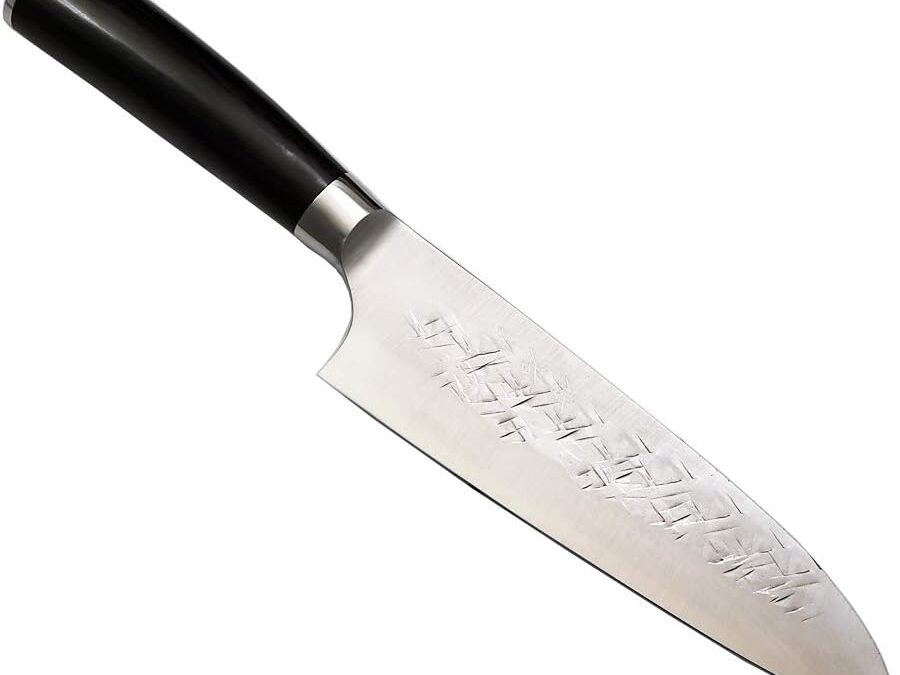
The defining visual signature of Tosa blades is kurouchi (黒打, “black hammer finish”) — the high-carbon steel is left with its rough forge-black scale visible on the spine and flats, rather than being polished to a mirror. The maker featured in this guide, Tosa Hamono Ryūtsū Center, is the prefectural blade distribution cooperative based in Kōchi; the specific listing covered here is a funayuki (舟行, “boat-going”) all-purpose knife with an Aogami #1 carbon-steel core and a walnut handle, retailing on Amazon JP for ¥5,709 (≈ $38 USD as of May 2026).
This buyer’s guide is written for international readers — anyone in the US, Europe, or Australia who is researching a first real Japanese hand-forged carbon-steel kitchen knife and wants to understand what Tosa-region work actually is, what trade-offs the kurouchi finish carries, and whether shipping from Japan is worth it at this price point. We cover the spec sheet, the place this comes from, where it sits relative to nearby Sakai and Echizen lines, and the care commitment carbon steel requires before you click buy.
📅 Published:
🔄 Updated:
⏱ Read time: ~13 min
- Who this is for — and who should skip it
- Product overview (from published specs)
- 📍 Where this comes from — Kōchi, Tosa, and the long forging tradition of Shikoku
- Price snapshot across stores
- What it does well
- Weaknesses and things to verify before buying
- Conclusion — which buyer type are you?
- Other ways to approach this purchase
- 🏆 Editor’s Pick
- ❓ Frequently Asked Questions
- 📌 Related Japanese Crafts
Who this is for — and who should skip it
- Want a real Tosa hand-forged carbon-steel knife at the lowest practical entry tier (under ¥6,000)
- Already own at least one knife and are comfortable with carbon-steel care — drying immediately, light oil, occasional honing
- Prefer a rustic kurouchi aesthetic over the mirror-polished Sakai or laminated Damascus look
- Want a mid-length multi-use blade (between a deba and a santoku) for fish, vegetables, and lighter butchery
- Are buying for yourself or for someone who explicitly asked for a Japanese carbon-steel knife
- Want a dishwasher-safe knife or one that can be left wet in the sink
- Are buying a gift for someone who has never owned a carbon-steel knife and is not expecting to maintain one
- Need a knife for frozen food, bone-in cuts, or heavy chopping (Aogami at this geometry will chip)
- Expect the mirror-polished look familiar from chain-store “Japanese chef knife” listings — kurouchi looks unfinished by comparison
- Want stainless or AUS-10 / VG-10 steel — this is a high-carbon blade that will patina and can rust if neglected
Product overview (from published specs)
Spec sheet drawn from the Amazon JP listing for ASIN B00DLYH9WY, captured 2026-05-16. Live pricing and stock may have shifted since the writing date — verify at the retailer before purchasing.

Tosa Funayuki Knife
土佐刃物 包丁 黒打 舟行包丁 クルミ柄 青鋼1号 165mm
一時的に在庫切れ; 入荷時期は未定です。 · Sold by Amazon.co.jp · ASIN B00DLYH9WY
Price and availability as of 2026-08-31 02:30 JST. The Amazon listing at the time of purchase is authoritative. jpmono.com earns a commission on qualifying purchases at no extra cost to you.
| Attribute | Detail |
|---|---|
| Maker | Tosa Hamono Ryūtsū Center (土佐刃物流通センター), Kōchi |
| Blade form | Funayuki (舟行) — multi-use, between deba and santoku |
| Blade length | 165 mm (~6.5 in) |
| Total length | Approximately 290 mm |
| Weight | Approximately 180 g |
| Core steel | Aogami (青紙) #1 high-carbon steel — premium tier of Hitachi Yasugi steels |
| Finish | Kurouchi (黒打) black forge-scale finish on spine and flats |
| Handle | Walnut wood (Japanese wa-handle style) |
| Made in | Kōchi Prefecture, Tosa region, Japan |
| Designation | METI Traditional Craft Product (designated 1998) |
| Sourced listing | Amazon JP Global Store (ASIN B00DLYH9WY), ¥5,709 (≈ $38 USD as of May 2026) |
| International shipping | Yes — via Amazon JP Global Store; $15–30 USD estimated to US/EU at ~180 g |
Only the Amazon JP listing snapshot is available as a primary data source for this exact listing; live pricing may have shifted since the writing date. USD figures are explicit estimates at a ¥150/USD baseline.
📖 Glossary — Japanese knife terms used in this article
- Uchihamono (打刃物)
- Literally “hammer-struck blades.” Refers to forged (not stamped or laser-cut) blades, made by hammering heated steel into shape. The opposite of uchihamono would be nukimono — blades stamped or cut from sheet steel.
- Kurouchi (黒打)
- “Black hammer finish.” The dark grey-black iron oxide scale that forms on hot-forged steel; left in place on the blade’s spine and flats as a deliberate aesthetic and protective layer, instead of being ground off.
- Funayuki (舟行)
- “Boat-going.” A Japanese knife form sized between a deba (heavy fish-breaking knife) and a santoku, historically used by coastal fishermen and rural cooks who needed one knife to handle fish, vegetables, and light butchery on a small boat or limited home kitchen.
- Aogami #1 (青紙1号)
- “Blue paper #1.” Hitachi Metals’ top tier of traditional high-carbon Yasugi steel, named for the paper label color on the original ingots. Aogami contains tungsten and chromium additions on top of the carbon base, which extend edge retention significantly past plain shirogami (white paper) steel. Susceptible to rust; not stainless.
- Wa-handle (和柄)
- “Japanese-style handle.” A simple D-shaped or octagonal wooden handle slid onto a tang (the metal extension of the blade) and held by friction plus a small ferrule, as distinct from the riveted Western-style yō-handle.
- METI Traditional Craft Product (経済産業大臣指定伝統的工芸品)
- A formal designation by Japan’s Ministry of Economy, Trade and Industry, requiring (among other criteria) a documented production tradition of at least 100 years, hand-craft technique, and concentration in a specific region. Tosa uchihamono was designated in 1998.
📍 Where this comes from — Kōchi, Tosa, and the long forging tradition of Shikoku


Tosa is the historical name for the southern half of Shikoku, the smallest of Japan’s four main islands. The province ran along the warm Pacific coast facing Tosa Bay, with the Shikoku Mountains forming a hard wall to the north that effectively cut it off from the rest of Honshū until modern roads and the Seto-Ōhashi bridge (completed 1988) connected it. That isolation matters for craft history: Tosa developed its own distinct economies — fisheries on the warm Kuroshio current, mountain forestry inland, and the blade industry that fed both.
The forging tradition began in earnest in the 16th century. The Chōsokabe clan, who briefly unified Shikoku under Chōsokabe Motochika before Toyotomi Hideyoshi’s 1585 campaign, drew smiths to Tosa to supply weapons during the Sengoku wars. After Sekigahara (1600) the Yamauchi family took over the Tosa domain, kept the blade industry as a strategic resource, and oriented it toward the practical needs of a rugged forest-and-coast economy — sickles, hatchets, axes, fish knives, kitchen knives. By the Edo period, Tosa was recognized alongside Sakai (Osaka) and Echizen (Fukui) as one of the three centers of Japanese hand-forged blades.
-
16th c. — Sengoku-period forging develops under the Chōsokabe clan, who consolidate Tosa province and recruit smiths to supply weapons. -
1601 — After Sekigahara, the Yamauchi family takes over the Tosa domain under the Tokugawa shogunate and preserves the blade industry as a domain asset. -
Edo period (1603–1868) — Tosa is ranked alongside Sakai (Osaka) and Echizen (Fukui) as one of the principal Japanese blade-forging regions. Production shifts toward agricultural and household blades for the mountainous Tosa terrain. -
Meiji–Shōwa (1868–1989) — Tosa specializes in farm and forestry blades — sickles, hatchets, axes — for the inland Shikoku economy, alongside kitchen and fish knives for the coastal communities. -
1998 — METI designates Tosa uchihamono a Traditional Craft Product (経済産業大臣指定伝統的工芸品), formally protecting the regional designation and technique. -
2026 — Roughly a few dozen registered Tosa smiths continue to forge by hand, with Tosa Hamono Ryūtsū Center acting as the prefectural cooperative for distribution.
The kurouchi finish that defines the Tosa look is less a stylistic choice than an honest record of the forging process. When carbon steel is heated and hammered, an oxide scale forms across the surface — dark grey-black, slightly textured. Sakai shops grind it off and polish the blade to a mirror; Echizen typically polishes the cutting bevel but leaves a hammered tsuchime pattern higher up. Tosa, historically working farm and fish blades where finish was secondary to function, simply leaves the scale where it lands. The result is a knife that looks unfinished by chain-store standards and entirely correct by Tosa standards.
“Tosa kurouchi is what carbon steel looks like when nobody has bothered to hide what it is — the forge-scale stays, the hammer marks stay, the knife arrives looking exactly like the object that came off the anvil.”
That continuity matters when you are deciding whether ¥5,709 buys a real piece of Japanese craft or a marketing position. Tosa Hamono Ryūtsū Center (土佐刃物流通センター) is the prefecture-backed distribution cooperative that aggregates output from the registered Tosa smiths — meaning the listing covered here is not OEM stock from a generic factory, but a piece forged in Kōchi by one of the cooperative’s member workshops, then routed through the Center for export-channel distribution including Amazon JP.
Price snapshot across stores
Pricing and shipping costs below were captured 2026-05-16 from the listed sources and may have shifted. The JPY figure on the Amazon JP row is the authoritative price for the specific listing covered in this article.
| Store | Item / Variant | Price | Notes |
|---|---|---|---|
| 🇺🇸 Amazon.com (US) | Browse Japanese carbon-steel kitchen knives | varies (USD) | Best if you’re shopping from the US — Prime shipping, USD pricing, no international customs. Amazon US carries hand-forged Japanese kitchen knives from Tojiro, Yoshihiro, Shun, and others — useful for comparing geometry, steel grades, and handle styles. This exact Tosa Hamono Ryūtsū Center piece is sourced from Japan (next row). |
| 🇯🇵 Amazon JP Global Store | Tosa Funayuki 165mm Kurouchi · Aogami #1 · walnut (B00DLYH9WY) | ¥5,709 (≈ $38 USD) | Ships internationally from Japan via Amazon JP Global Store. ~180 g; estimated $15–30 USD shipping to US/EU at the time of writing. Customs duties depend on destination thresholds. |
| Maker direct (Tosa Hamono Ryūtsū Center) | Cooperative catalog — broader knife range | JPY varies | The prefectural cooperative maintains a Japanese-language site listing member smiths and their work; not all SKUs are exported and the site may not ship internationally directly. Useful as a reference for what else the cooperative carries. |
| Proxy services (Buyee / Tenso) | Forwarded purchase from Rakuten or Yahoo! Auctions JP listings | Listing price + ~10–15% service fee + shipping | Use a proxy only if a desired Tosa SKU is not on Amazon JP Global Store. Adds handling fees and lengthens delivery; for B00DLYH9WY specifically, the Amazon JP Global Store path is simpler. |
What it does well
Weaknesses and things to verify before buying
- It will rust if you neglect it. Aogami #1 is high-carbon, not stainless. Leaving the blade wet — even for an hour in a damp sink — will produce surface rust. The kurouchi finish protects the spine and flats; the polished cutting edge needs to be wiped dry immediately after every use, and a thin film of food-safe oil (camellia or mineral) is recommended for long storage.
- It will patina, and the patina is permanent. After a few weeks of use the cutting edge will discolor — grey, then blue-grey, sometimes streaky. This is iron oxide forming a protective layer; it is normal and even desirable to a Japanese eye, but buyers expecting a permanently shiny edge will be disappointed.
- Not for bones or frozen food. The funayuki geometry is thin and intended for soft work. Cutting through chicken bones, frozen meat, or hard winter squash will chip the edge. The care notes on the listing explicitly say to avoid frozen items.
- Kurouchi finish looks rough, by design. The blade arrives with visible hammer marks, an irregular black scale, and a non-mirror polish on the bevel. Buyers comparing it side-by-side to a polished Sakai yanagiba may read “cheap” — but that’s the wrong frame; the finish is the regional signature, not a quality compromise.
- Wa-handle is not waterproof. The friction-fit walnut handle should not be left submerged in water or run through a dishwasher. Over years of careless washing the handle can loosen; the fix is to dry it after every use and re-glue or replace if it ever shifts.
- No certification card guaranteed. The Amazon JP listing does not state explicitly whether a Tosa Uchihamono Cooperative certification card is included with the knife. METI-designated regional crafts often ship with one; if you want it for gifting context, ask the seller via Amazon JP messaging before ordering.
- Single bevel vs double bevel — verify. Funayuki blades exist in both single-bevel and double-bevel grinds depending on the maker. The listing does not state this explicitly. If you intend to use the knife as a substitute for a Western chef’s knife, the double-bevel version is what you want; a single-bevel funayuki has a steeper learning curve for left-handed cooks.
- International shipping cost is non-trivial relative to price. A ¥5,709 knife with $15–30 USD shipping puts the landed cost in the $55–70 range. That’s still a fair price for a real Tosa piece, but it is no longer “cheap” — make sure you’ve compared against locally available Japanese-style knives at the same price.
Conclusion — which buyer type are you?
Other ways to approach this purchase
🏆 Editor’s Pick
- Why this one: Lowest practical price (¥5,709 ≈ $38 USD) for a genuinely hand-forged Tosa cooperative-routed blade.
- The steel: Aogami #1 — Hitachi’s top traditional carbon tier, with tungsten and chromium additions for edge retention.
- The form: Funayuki — multi-use Japanese geometry handling fish, vegetables, and light butchery on one blade.
- The signature: Kurouchi black-scale finish on spine and flats — the regional aesthetic of Tosa work, not a budget compromise.
❓ Frequently Asked Questions
Does Amazon JP Global Store ship this Tosa knife internationally?
What is the difference between Aogami #1 and Aogami #2 steel?
How do I care for a carbon-steel kurouchi knife?
Is a funayuki a good first Japanese knife if I currently use a Western chef’s knife?
How does Tosa compare to Sakai or Echizen for kitchen knives?
Will the knife arrive with a certificate of Tosa Uchihamono designation?
Is there a left-handed version of this funayuki?
jpmono.com is curated by a Japan-based editorial team working out of Toyama (Hokuriku region) and Nara (Kansai region), and is independent. We do not take payment from the makers we feature; income comes from affiliate links. Read more about our editorial standards.
🤖 Editorial note: this article was drafted with AI assistance from publicly available specifications, Amazon listing data, and editorial source notes; all factual claims about Tosa uchihamono history, METI designation year, and product specifications were drawn from the source notes and the linked Amazon JP listing. Prices, shipping estimates, and stock status fluctuate — verify at the retailer before purchasing.
Affiliate disclosure: jpmono.com may earn a commission on qualifying purchases made through links on this page, at no additional cost to you.