![Nishijin-ori Silk Necktie: Kyoto’s Court-Weave Craft, Where to Buy [2026]](https://jpmono.com/wp-content/uploads/2026/07/nishijin-ori-silk-necktie-where-to-buy-2026-featured.jpg)
- What it is: A 100% silk necktie woven — not printed — in the yarn-dyed jacquard tradition of Kyoto’s Nishijin district.
- Made in: Kyoto, Kyoto Prefecture (Kansai) — Nishijin-ori is a designated national Traditional Craft with a lineage that reaches back to the Heian-era court weaving bureau.
- Price band: mid-to-upper range for a silk necktie, as expected for a woven-jacquard rather than printed tie (see the live listing for the current figure).
- Best for: buyers who want a tie whose pattern has physical depth — brocade woven from pre-dyed threads, not ink on cloth.
- Skip if: you only wear knit or solid-block ties, or you want the flat, painterly look of a dyed (yūzen-style) tie.
- Shipping: ships internationally from Amazon Japan — jump to our pick ↓
Weave a pattern instead of printing it, and the design stops being a picture on the surface and becomes part of the cloth itself. Hold a Nishijin-ori (西陣織, “Nishijin weave”) necktie to a window and the motif catches light on its raised threads and drops into shadow between them — a depth that a dyed or printed tie, however finely rendered, cannot reproduce. That difference is the whole point of this object.
Nishijin-ori is the figured-textile weaving of Kyoto’s Nishijin quarter, a craft whose continuity runs back more than a millennium to the weaving bureau that supplied silk to the Heian court. The district takes its name from a war: the western (nishi) military camp of the Ōnin War of 1467–1477, on whose site the scattered weavers regathered once the fighting stopped. The technique that defines it is saki-zome (先染め, “yarn-dyed”) — the silk threads are dyed first, and the pattern is then built up on the loom, thread over thread, into a raised brocade.
This guide is written from a Japan-based editor’s desk for readers buying from outside Japan. It covers what a Nishijin-ori tie actually is, how the weave differs from a dyed Kyoto textile, who the tie suits and who should pass, how to buy it internationally, and how it compares with other Japanese woven-silk neckwear. Prices and stock move; the linked listing is always the authoritative source.
📅 Published: July 16, 2026 · ♻️ Last updated: July 16, 2026 · ⏱️ Read time: ~9 min
ℹ️ Live pricing and some listing specifics weren’t in our snapshot — the linked Amazon listing is authoritative, and unconfirmed attributes are marked below.

- Who this is for — and who should skip it
- Product overview (from published specs)
- Price snapshot across stores
- 📦 Shipping & where to buy from outside Japan
- What it does well
- Weaknesses and things to verify before buying
- 📍 Where this comes from — place, era, and the craft tradition
- Conclusion — which buyer type are you?
- Other ways to approach this purchase
- 🏆 Editor’s Pick
- ❓ Frequently Asked Questions
Who this is for — and who should skip it
- want a tie whose pattern has real texture — woven brocade, not print
- value provenance and buy from a named craft tradition rather than a fashion label
- wear structured, formal or business-formal tailoring the tie can anchor
- appreciate that yarn-dyed jacquard reads differently under changing light
- are choosing a gift with a documented Kyoto craft heritage
- prefer knit, grenadine or flat solid-block ties
- want the soft painterly look of a dyed (yūzen-style) silk
- need a machine-washable, low-maintenance accessory
- shop strictly on price — woven jacquard costs more than a printed tie
- are unsure of the exact colorway and can’t check the live listing first
Product overview (from published specs)
The table below draws on the Amazon US search path (primary), the Amazon JP Global Store listing where the specific item is sourced (secondary), and the maker’s craft tradition. Attributes not present in our snapshot are marked so you can verify them on the live listing rather than take a guess as fact.
Nishijin-ori Silk Necktie
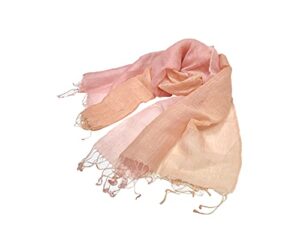
[OnCoM] ネクタイ 西陣織 千鳥柄 シルク 絹 バレンタイン 紫 メンズ ビジネス カジュアル 父の日 プレゼント ギフト 日本製 thsu2002-003
残り1点 ご注文はお早めに · Sold by オンコム · ASIN B085L5H297
Price and availability as of 2026-08-31 02:30 JST. The Amazon listing at the time of purchase is authoritative. jpmono.com earns a commission on qualifying purchases at no extra cost to you.
| Attribute | Detail | Source |
|---|---|---|
| Craft | Nishijin-ori — Kyoto figured-textile weaving, a national Traditional Craft | Craft tradition |
| Material | 100% silk | Amazon JP Global Store listing |
| Technique | Saki-zome (yarn-dyed) jacquard — threads dyed first, pattern woven on the loom | Craft tradition |
| Made in | Kyoto, Japan | Amazon JP Global Store listing |
| Colorway / pattern | Varies by listing option — check the live listing | Verify on listing |
| Width / length | Unconfirmed — check manufacturer / listing | Not in snapshot |
| Price | Not in snapshot — see live listing (JPY authoritative) | Verify on listing |
📖 Glossary — key terms
- Nishijin-ori (西陣織) — the figured-textile weaving of Kyoto’s Nishijin district; a designated national Traditional Craft.
- Saki-zome (先染め, “yarn-dyed”) — dyeing the threads before weaving, so the pattern is built from colored thread on the loom.
- Ato-zome / yūzen (後染め) — the opposite approach, in which pattern is dyed or painted onto finished white cloth (the Kyo Yūzen method).
- Jacquard — a loom mechanism, adopted by Nishijin in the Meiji era, that controls each warp thread individually to weave complex raised figures.
- Oribe-no-tsukasa (織部司) — the imperial court’s weaving bureau in Heian-kyō, the deep root of the Nishijin lineage.
- Ōnin War (応仁の乱) — the 1467–1477 conflict whose western camp (nishi-jin) gave the district its name.
Related Japanese craft guides on jpmono — other Kyoto crafts, and other woven-silk neckwear from around Japan.
Price snapshot across stores
USD figures, where shown, are approximate estimates at a ¥150/USD baseline; the JPY price on the JP listing is the authoritative one. Our snapshot did not capture a live price, so verify the current figure at the retailer before buying.
| Store | Item / variant | Price (JPY + USD est.) | Notes |
|---|---|---|---|
| 🇺🇸 Amazon.com (US) | Browse Japanese silk neckties | varies (USD) | Best if you’re shopping from the US — Prime shipping, USD pricing, no international customs. Amazon US carries Japanese woven-silk neckties from several makers, useful for comparing weaves and price tiers. The specific Nishijin-ori tie is sourced from Japan (next row). |
| 🇯🇵 Amazon JP Global Store | The featured Nishijin-ori 100% silk necktie | See live listing (JPY authoritative) | Ships internationally from Japan to 65+ countries — including Canada, the UK and Australia — with import fees estimated at checkout. |
| Maker direct | Nishijin weavers / Kyoto textile shops | varies | Many individual Nishijin ateliers sell through their own or Kyoto craft-association storefronts; selection and colorways are broader but international shipping is inconsistent. |
| Proxy services (Buyee / Tenso) | Any JP-only listing | item + forwarding fee | Useful when a tie is only listed on JP-domestic shops; adds a forwarding fee and a consolidation step. |
📦 Shipping & where to buy from outside Japan
The featured tie is sourced from the Amazon JP Global Store, which ships internationally to 65+ countries — including Canada, the UK and Australia. For a light, low-value item like a silk tie, expect shipping in roughly the $15–$40 band to the US, EU, Canada, UK and Australia, with Amazon estimating and collecting any import fees at checkout for most destinations.
If you are shopping from the US, the Amazon.com search link in the price table is the easiest path for USD pricing and Prime delivery on comparable Japanese silk neckwear. If you want this exact Nishijin-ori piece, use the Amazon Japan Global Store link. Where a specific tie appears only on a JP-domestic shop, a proxy service such as Buyee or Tenso can forward it, at the cost of an extra fee.
- 🍽️ Machine wash: no — silk neckwear is dry-clean or specialist-clean only.
- 🧴 Daily care: untie the tie fully after each wear and rest it rolled or hung so the woven face recovers its shape.
- ☀️ Storage: keep out of prolonged direct sunlight; silk dyes can fade over time.
What it does well
Weaknesses and things to verify before buying
- No live price in our snapshot. The current figure was not captured; treat the linked listing as authoritative and check before buying.
- Colorway and pattern vary by listing option. Woven ties differ from photo to photo — confirm the exact color and motif on the live listing rather than assuming.
- Dimensions unconfirmed. Tie width and length were not in our data; if you have a preferred tie width, verify it before ordering.
- Not low-maintenance. Silk neckwear is dry-clean only and needs resting between wears; this is not a wash-and-go accessory.
- Higher price than printed ties. Woven jacquard costs more to produce than a printed silk tie, and the listing will reflect that.
- Formal register. The woven brocade look suits structured tailoring; it can feel dressy against very casual outfits.
📍 Where this comes from — place, era, and the craft tradition

Kyoto sits in the Yamashiro basin of south-central Kyoto Prefecture, in the Kansai region, ringed by mountains on three sides and threaded by rivers running down toward Osaka Bay. The Nishijin district lies in the northwest of the old city, on the edge of the quarter around Kitano Tenmangū shrine. It is not a neighborhood built around a river or a port; it is built around a craft, and the streets still carry the sound of looms.

The name records a war. During the Ōnin War of 1467–1477 — a conflict that gutted much of Kyoto — the city’s weavers scattered. When the fighting ended, they regathered on the site that had held the western (nishi) military camp, the nishi-jin, and resumed production there. The district has carried that name, and that craft, ever since.
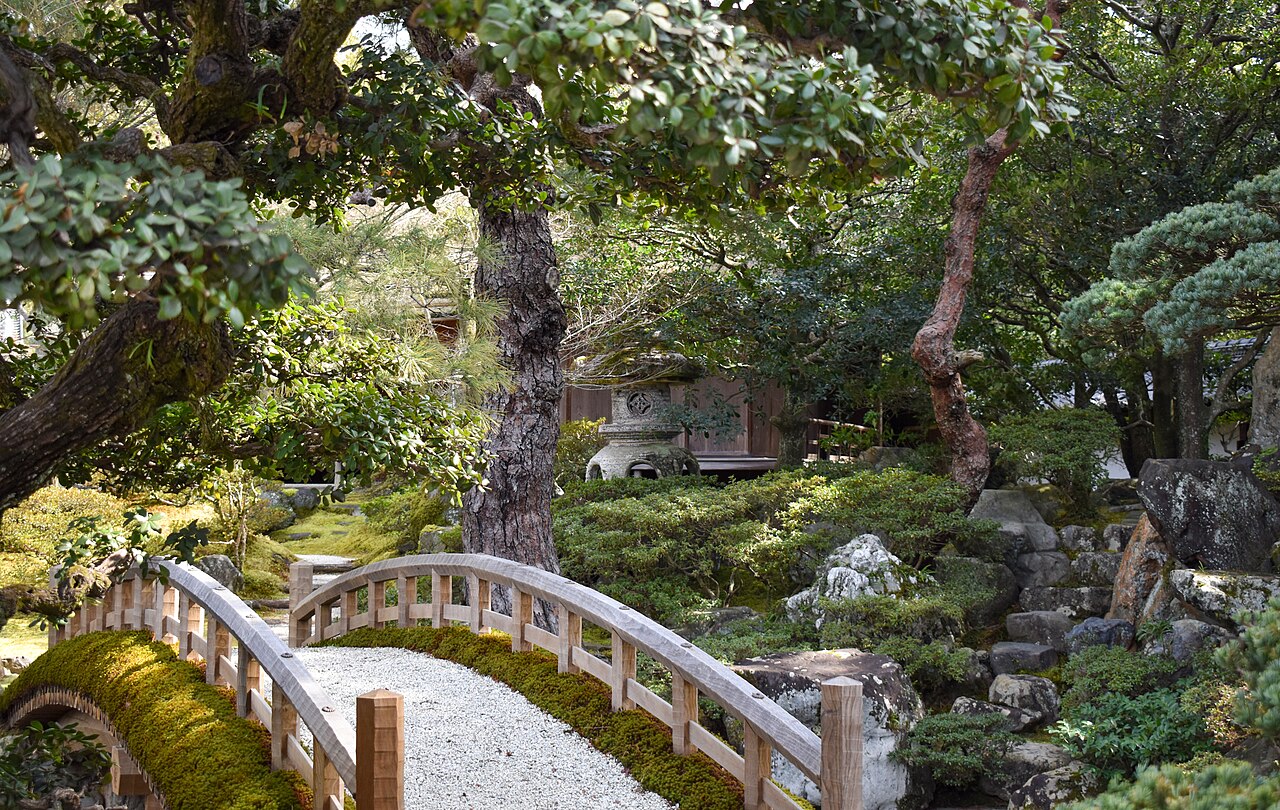
But the lineage runs deeper than the war that named it. Kyoto — Heian-kyō — was the imperial capital from 794 until 1869, and the court that settled here maintained a weaving bureau, the Oribe-no-tsukasa (織部司), to supply silk to the emperor and the aristocracy. It is that bureau, and the concentration of skilled weavers it drew into the capital, that Nishijin traces itself back to — well over a thousand years of continuity making figured silk for the court.
- 794 — Heian-kyō (Kyoto) becomes the imperial capital; the court weaving bureau (Oribe-no-tsukasa) supplies silk to the aristocracy.
- 1467 — The Ōnin War begins; Kyoto’s weavers scatter from the capital.
- 1477 — The war ends; weavers regather on the site of the western (nishi) camp and resume production — the Nishijin name.
- 1477–1869 — With Kyoto the imperial capital until 1869, Nishijin supplies kimono silk to the court and aristocracy.
- Meiji era (1868–1912) — Nishijin adopts the European jacquard loom, enabling more intricate yarn-dyed patterns.
- Today — A designated national Traditional Craft; the technique adapts to neckties, purses, and obi alongside kimono cloth.
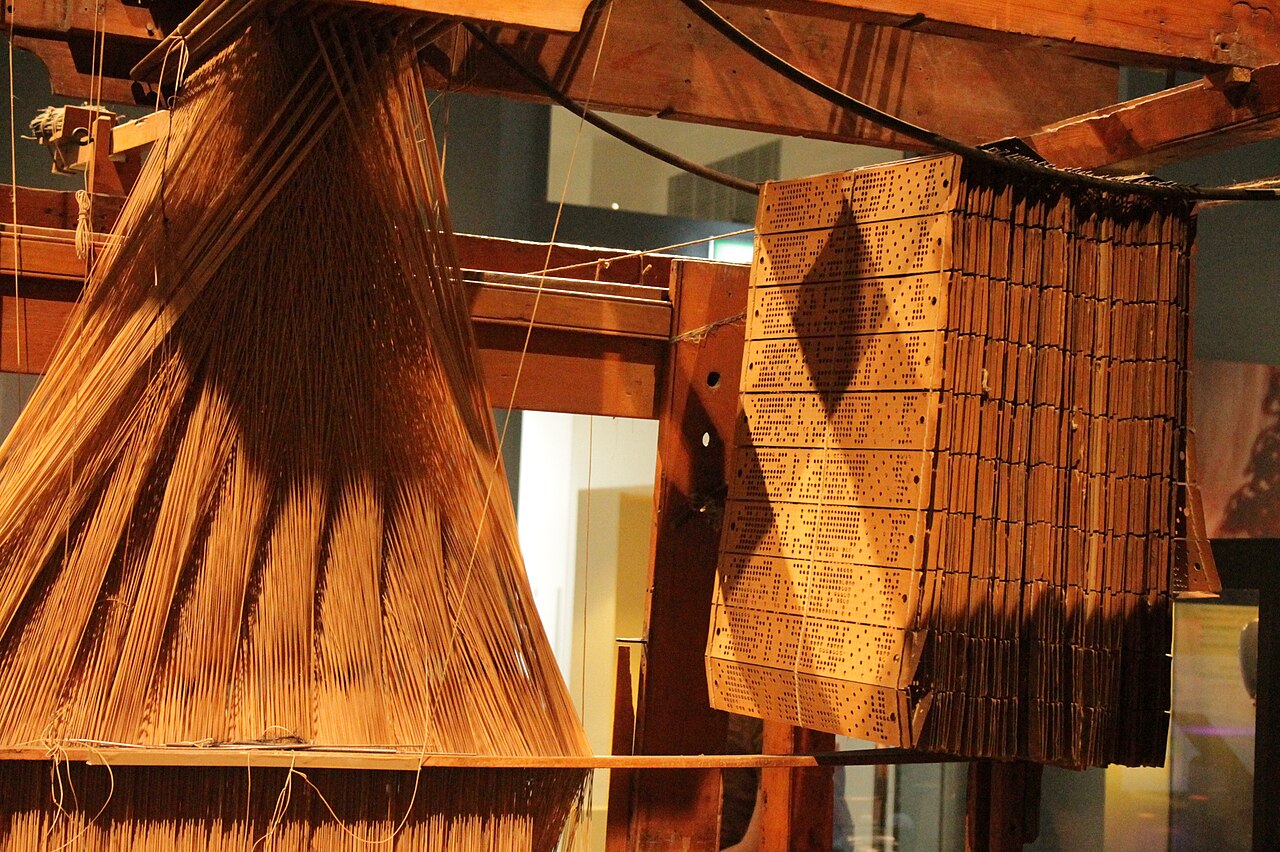
The technique is what sets Nishijin apart from Kyoto’s other great textile craft. Kyo Yūzen dyes or paints pattern onto finished white cloth — pigment on a prepared surface. Nishijin works the other way around: it is saki-zome, yarn-dyed. The silk threads are dyed to their final colors first, and the design is then constructed on the loom, thread crossing thread, into a raised brocade. The jacquard mechanism adopted in the Meiji era let those pre-dyed threads build up figures of considerable intricacy. The result is a cloth in which the pattern is not on the surface — it is the surface.
“Yūzen paints the pattern onto the cloth. Nishijin weaves the pattern into it — which is why the design has a shadow.”
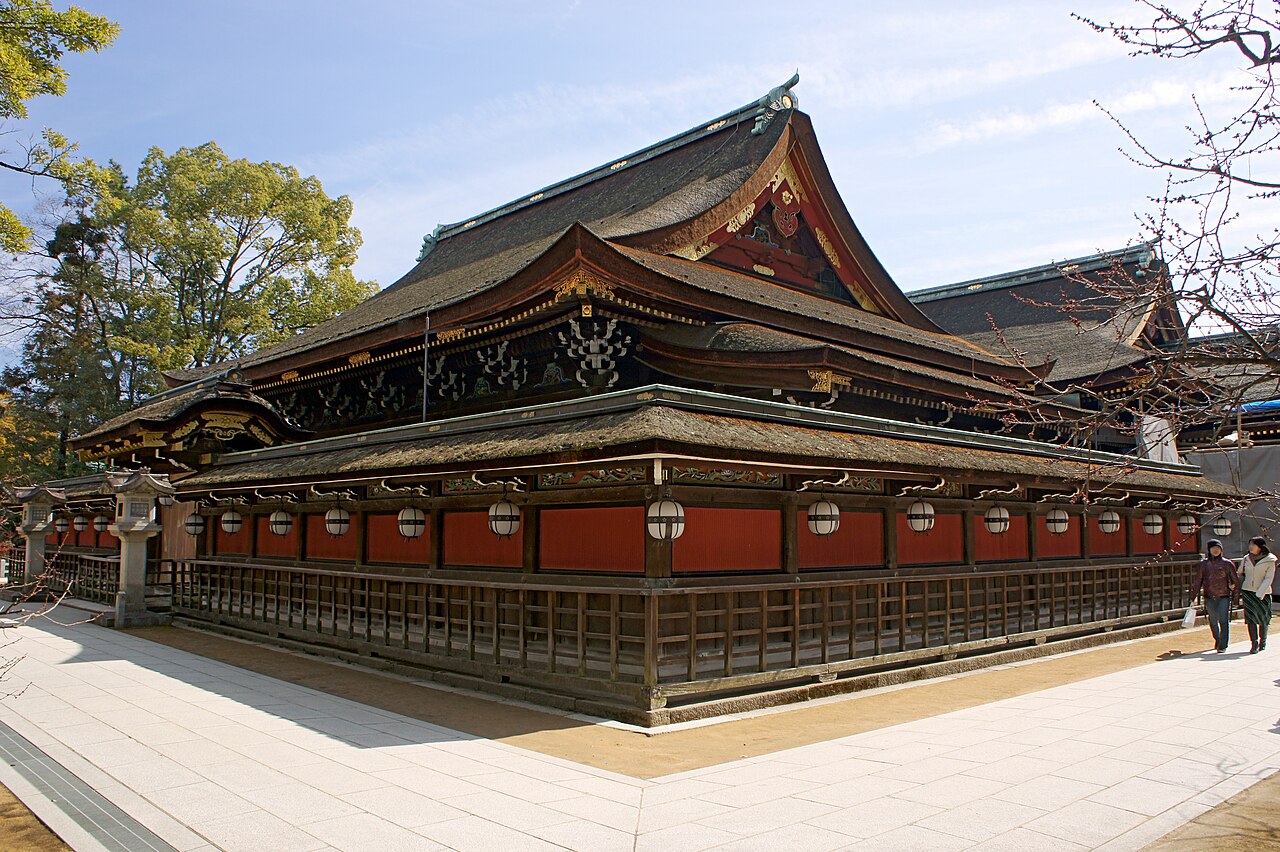
What “still being made here” means for Nishijin is a district that never left. The weavers who returned after 1477 anchored the trade in place, and the same quarter has produced figured silk continuously since. For centuries that meant kimono and obi for the court and aristocracy; today the same yarn-dyed jacquard technique is applied to smaller objects an international buyer can actually use — neckties, purses, and obi among them. The tie in this guide is that adaptation: a millennium of court-weaving method, scaled to a strip of silk you can knot at the collar.
Conclusion — which buyer type are you?
Other ways to approach this purchase
🏆 Editor’s Pick
❓ Frequently Asked Questions
What makes Nishijin-ori different from a printed silk tie?
Nishijin-ori is saki-zome (yarn-dyed): the silk threads are dyed first and the pattern is woven on the loom, producing a raised, dimensional brocade. A printed tie has its pattern applied to the finished cloth surface, so it stays flat. The woven approach gives the design texture and a subtle play of light.
How is Nishijin-ori different from Kyo Yūzen?
Both are Kyoto textile crafts, but they work in opposite directions. Kyo Yūzen dyes or paints pattern onto finished white cloth (ato-zome). Nishijin-ori weaves the pattern from pre-dyed threads (saki-zome). One is a dyeing craft, the other a weaving craft.
Can I buy this tie if I live outside Japan?
Yes. The featured tie is sourced from the Amazon Japan Global Store, which ships to 65+ countries including Canada, the UK and Australia, with import fees estimated at checkout. US shoppers can also browse comparable Japanese silk neckties via the Amazon.com link for USD pricing and Prime shipping.
How do I care for a silk Nishijin-ori tie?
Treat it as dry-clean or specialist-clean only — do not machine wash silk neckwear. Untie the tie fully after each wear and let it rest so the woven face recovers its shape, and keep it out of prolonged direct sunlight to avoid fading.
Why is Nishijin-ori considered special?
It is a designated national Traditional Craft from Kyoto’s Nishijin district, whose weaving lineage runs back to the Heian court’s weaving bureau — over a thousand years of making figured silk for the imperial court and aristocracy. The district takes its name from the western camp of the Ōnin War (1467–1477).
Does the exact color and pattern match the photo?
Woven ties vary by listing option, and our snapshot did not capture every colorway. Always confirm the exact color and pattern on the live listing before ordering, since the option you see may differ from the sample image.
jpmono.com is curated by a Japan-based editorial team (working out of Toyama in the Hokuriku region and Nara in Kansai) and is independent. We don’t take payment from the makers we feature; income comes from affiliate links. Read more about our editorial standards.
This article was drafted with AI assistance and edited against the maker’s listing and craft-tradition references. Specifications and prices were not independently lab-tested; verify current details at the retailer before purchasing.
Affiliate disclosure: jpmono.com may earn a commission on qualifying purchases made through links on this page, at no additional cost to you.