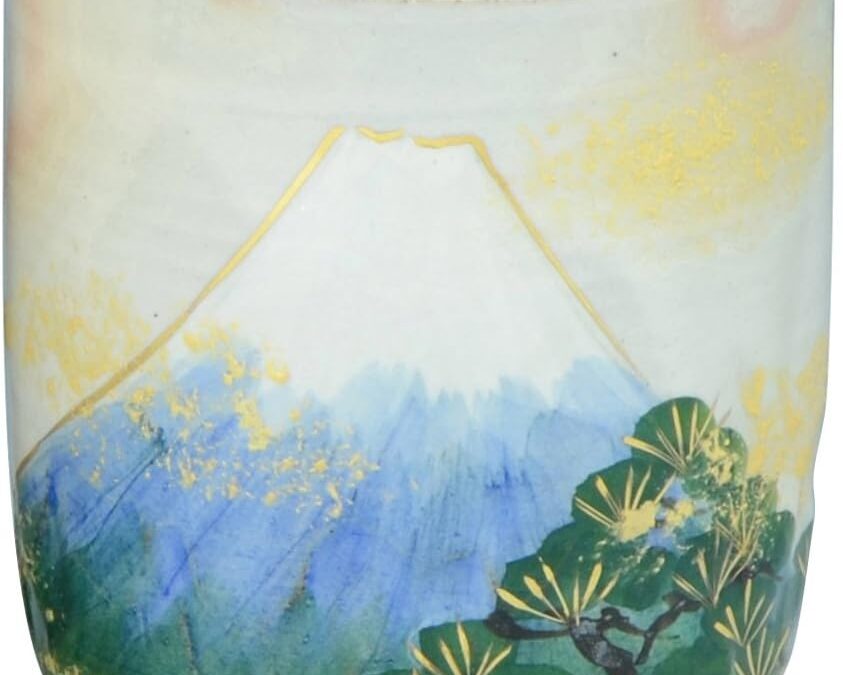
![Hagi-yaki ‘Hime-Tsuchi’ Yunomi by Tsubakishu-Gama — 425-Year Yamaguchi Tea-Ceremony Pottery (¥3,650 / ≈$24 USD) [2026 Buyer’s Guide]](https://jpmono.com/wp-content/uploads/2026/05/tsubaki-shu-hagi-yaki-yunomi-where-to-buy-2026-featured.jpg)
Hagi-yaki (萩焼) is the tea-ceremony pottery of Hagi, on the northern coast of Yamaguchi Prefecture. The tradition has been practiced continuously since 1604, when Mori Terumoto — lord of the Chōshū domain — brought the Korean potters Lee Chakkō (李勺光) and Lee Kō (李敬) to Hagi to establish a domain-supported kiln. METI designated Hagi-yaki a Traditional Craft Product in 2002. The pieces are immediately recognizable: soft pinkish-cream glazes, soft Hagi clay, and a fine network of crackles called kannyū (貫入) that absorb tea over years of use and gradually shift the surface color — a phenomenon the trade calls Hagi no nanabake (萩の七化け, “Hagi’s seven transformations”).
In the tea world, Hagi sits second only to Raku in the old ranking Ichi Raku, Ni Hagi, San Karatsu (“Raku first, Hagi second, Karatsu third”). That places it among the most prized teaware traditions in Japan — a context most international buyers do not arrive with. This 280 ml round yunomi from Tsubakishu-Gama (椿秀窯), a named Hagi kiln, is made in the classical Hime-Tsuchi (姫土, “princess clay”) light-clay style at an unusually accessible ¥3,650.
This guide is written for international readers — primarily in the US, EU, and Australia — who want a single daily-use Hagi yunomi from a real Hagi kiln, not a souvenir-grade replica. We cover what Hagi-yaki actually is, what to expect when the clay starts aging under tea, how this Tsubakishu-Gama piece compares with other Japanese yunomi traditions on our site, and exactly which stores will ship it abroad.
🔄 Last updated
⏱ ~10 min read
🇯🇵 Sourced from Amazon JP

- Who this is for — and who should skip it
- Product overview (from published specs)
- 📍 Where this comes from — Hagi, Yamaguchi, and four centuries of tea pottery
- 📌 How does it compare?
- Price snapshot across stores
- 📦 Shipping & where to buy from outside Japan
- What it does well
- Weaknesses and things to verify before buying
- Conclusion — which buyer type are you?
- Other ways to approach this purchase
- 🏆 Editor’s Pick
- ❓ Frequently Asked Questions
- 📌 Related Japanese Crafts
Who this is for — and who should skip it
- Want a daily-use tea cup from a real Hagi kiln (not a generic “Japanese-style” mug)
- Like the idea of a vessel that visibly changes over years of use — Hagi no nanabake
- Drink Japanese green or roasted teas (sencha, hōjicha, bancha) at 280 ml per pour
- Are entering the Hagi-yaki tradition at an impulse price (¥3,650) rather than committing ¥15,000–¥40,000 to a chawan first
- Are comfortable hand-washing porous pottery and skipping the dishwasher
- Want a dishwasher-safe, microwave-safe mug for coffee or tea bags
- Dislike crackle patterns and consider visible kannyū a “defect”
- Want pristine, unchanging surface — Hagi clay absorbs liquid and ages
- Need matched pairs or sets right away (this is a single yunomi, hand-made variation is the norm)
- Prefer the dense, stoneware-hard feel of Bizen or Karatsu — Hagi is deliberately soft
Product overview (from published specs)
The data below reflects the Amazon JP Global Store listing snapshot as of May 16, 2026. Live pricing may have shifted; always verify at checkout. USD figures use a ¥150/USD baseline.

Hagi-yaki 'Hime-Tsuchi' Yunomi by Tsubakishu-Gama
萩焼 椿秀窯 姫土丸湯呑(280ml)
通常4~5日以内に発送します。 · Sold by ★キャストオンラインショップ★ · ASIN B0F27ZXW89
Price and availability as of 2026-08-31 02:30 JST. The Amazon listing at the time of purchase is authoritative. jpmono.com earns a commission on qualifying purchases at no extra cost to you.
| Field | Value | Source |
|---|---|---|
| Item | Hagi-yaki Hime-Tsuchi Round Yunomi 280 ml (萩焼 椿秀窯 姫土丸湯呑) | Amazon JP listing |
| ASIN | B0F27ZXW89 | Amazon JP listing |
| Maker | Tsubakishu-Gama (椿秀窯), Hagi, Yamaguchi | Amazon JP listing |
| Material | Hagi clay with soft pink-cream glaze; reduction-fired with kannyū (vein-crackle) | Amazon JP listing |
| Dimensions | ⌀ ~8 cm × H 8 cm; 280 ml capacity | Amazon JP listing |
| Weight | ~180 g | Amazon JP listing |
| Origin | Hagi, Yamaguchi Prefecture, Japan | Amazon JP listing |
| Tradition designation | Hagi-yaki — METI Traditional Craft Product (2002) | METI registry |
| Price | ¥3,650 (≈ $24 USD as of May 2026) | Amazon JP Global Store |
| International shipping | Available via Amazon JP Global Store; 180 g item, est. $8–15 USD to US/EU | Listing snapshot |
📚 Glossary — Japanese ceramic terms you’ll encounter in this guide
Hagi-yaki (萩焼) — Tea-ceremony pottery tradition based in the city of Hagi, Yamaguchi Prefecture. Continuous production since 1604.
Yunomi (湯呑) — A taller, cylindrical Japanese tea cup for everyday tea (as opposed to chawan, the bowl used in formal tea ceremony). Typically 150–300 ml.
Hime-Tsuchi (姫土, “princess clay”) — A lighter, more delicate variety of Hagi clay; produces the soft pinkish-cream surface this piece is known for. Distinct from the heavier Daidō-Tsuchi body used for many Hagi chawan.
Kannyū (貫入) — The fine network of glaze crackles caused by glaze and clay body contracting at different rates as the kiln cools. In Hagi, this is desired — the crackle network is what absorbs tea over time.
Hagi no nanabake (萩の七化け, “Hagi’s seven transformations”) — The traditional way of describing how a Hagi piece visibly changes color as tea is absorbed into the porous body and crackle network over months and years of use.
Ichi Raku, Ni Hagi, San Karatsu (一楽二萩三唐津) — A tea-master saying ranking the three most prized tea-ware traditions: Raku-yaki first, Hagi-yaki second, Karatsu-yaki third.
Chōshū domain (長州藩) — The Edo-period feudal domain centered on Hagi (1600–1871), ruled by the Mori clan. Patronized the Hagi kilns from their founding in 1604.
Tsubakishu-Gama (椿秀窯) — One of the named Hagi kilns currently producing both ceremonial and daily-use Hagi-yaki. The maker of this piece.
📍 Where this comes from — Hagi, Yamaguchi, and four centuries of tea pottery
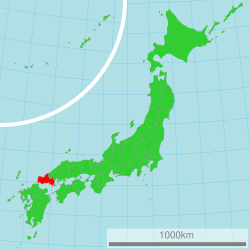

Hagi is a small coastal city on the Sea of Japan side of Yamaguchi Prefecture, at the very western end of Japan’s main island. The Abu River meets the sea here at a sheltered triangular delta, and the old castle town occupies the flat ground between the river mouth and the surrounding hills. From Tokyo it is a ~5-hour journey by shinkansen and local train (via Shin-Yamaguchi); from Fukuoka, on the other side of the Kanmon Straits, it is roughly two and a half hours by car. The geography matters because Hagi was, for most of the Edo period, the seat of the Chōshū domain — one of the most powerful and consequential domains in late-Edo Japanese politics — and the city’s pottery industry was built on that domain’s patronage.
The founding date for Hagi-yaki is firmly fixed: 1604. After the Bunroku-Keichō campaigns in Korea (1592–1598), Mori Terumoto — by then re-installed at Hagi as the head of the much-reduced Mori domain — brought two Korean potters, brothers Lee Chakkō (李勺光) and Lee Kō (李敬), into Hagi. Their kiln, established under direct Chōshū patronage, fused Korean white-slip body techniques with the emerging Japanese tea-ceremony aesthetic of Sen no Rikyū’s followers. That hybrid lineage is what produced Hagi’s signature: soft, porous bodies; restrained, irregular forms; pale glazes that craze rather than vitrify; and a deliberate openness to change with use.
-
1592–1598 — Bunroku-Keichō campaigns in Korea; Korean potters dispersed across western Japan, seeding new kiln traditions (Karatsu, Satsuma, Arita, Hagi). -
1604 — Mori Terumoto, lord of Chōshū, brings the Korean potters Lee Chakkō and Lee Kō to Hagi. The Matsumoto-Nakanokura kiln is established under domain patronage. Hagi-yaki is born. -
1657 — A second domain kiln is opened at Fukawa (southwestern Yamaguchi), expanding the Hagi tradition to a second center. -
Late Edo — The tea-master ranking Ichi Raku, Ni Hagi, San Karatsu circulates among chajin, placing Hagi second only to Raku in tea-ware prestige. -
1871 — Abolition of the domain system; Chōshū patronage ends. Hagi kilns continue privately. -
1955 onward — Sakata Deika XI is designated a Living National Treasure (Ningen Kokuhō) for Hagi-yaki, anchoring the tradition’s 20th-century revival. -
2002 — METI designates Hagi-yaki an official Traditional Craft Product (伝統的工芸品) — relatively late among Japanese ceramic traditions. -
2026 — Roughly 100 active Hagi-yaki kilns operate in and around Hagi, including Tsubakishu-Gama — the maker of the yunomi in this guide.
The technique itself is what makes Hagi instantly recognizable. The local clays — including the lighter Hime-Tsuchi (“princess clay”) used in this piece, and the heavier Daidō-Tsuchi used for many of the famous tea bowls — are deliberately left coarse and porous. The glazes are equally restrained: usually a translucent straw-ash or feldspar glaze that pools unevenly and crazes finely as the kiln cools. That fine crazing is the kannyū network, and it is not a flaw. Over months and years, tea seeps into the crackles and the porous body, slowly darkening the cup’s tone. The trade name for that change — Hagi no nanabake, “Hagi’s seven transformations” — is the central pleasure of owning a Hagi piece.
“The Hagi cup you buy in May 2026 is not the cup you will hand to a guest in 2031. The clay records every pot of tea that passed through it.”
Tsubakishu-Gama (椿秀窯) is one of the named Hagi kilns operating in this lineage today. The kiln produces both formal tea-ceremony pieces and accessible daily-use items like this 280 ml round yunomi. At ¥3,650, it sits firmly in the daily-use price tier — well below the ¥15,000–¥40,000 range typical of Hagi chawan, and an order of magnitude below the named Living-National-Treasure-line pieces that move at auction. The point of this kind of piece is not investment-grade authenticity; it is a real, locally-fired Hagi cup at a price where you can actually use it every day and watch the surface develop.
📌 How does it compare?
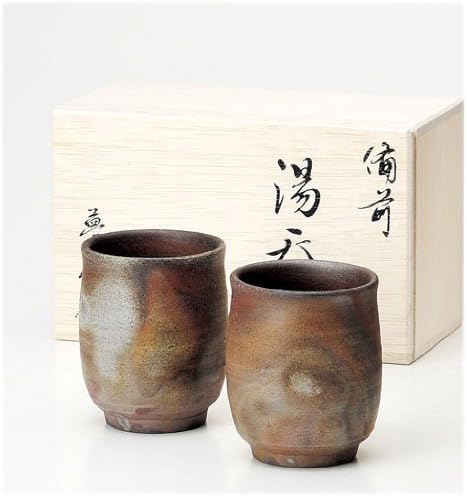

Bizen Yunomi Pair (Okayama)
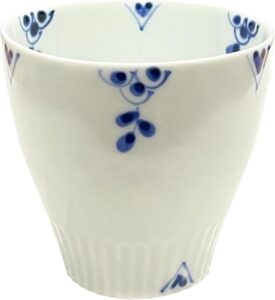

Arita-yaki Kōyō-gama (Saga)
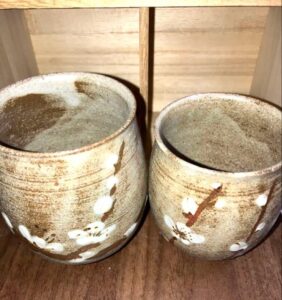
Kasama-yaki Tayama Pair (Ibaraki)
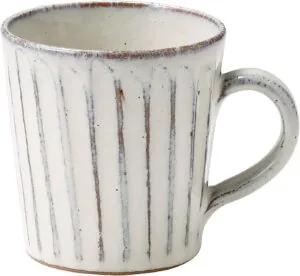

Shigaraki Hechimon Mug (Shiga)
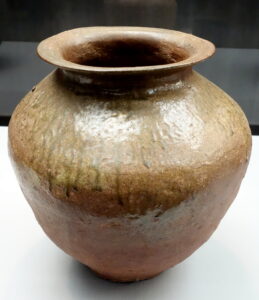
Tokoname Kyusu (Aichi)
Price snapshot across stores
The data below uses the Amazon JP Global Store listing as the authoritative price for the specific item (Tsubakishu-Gama B0F27ZXW89). The Amazon US row is a curated search path for related Japanese yunomi and tea-ware — the Tsubakishu-Gama piece itself is sourced from Japan. USD figures are estimates at ¥150/USD baseline.
| Store | Item / Variant | Price | Notes |
|---|---|---|---|
| 🇺🇸 Amazon US (search) | Browse Japanese yunomi & tea-ware | varies (USD) | Best if you’re shopping from the US — Prime shipping, USD pricing, no international customs. Amazon US carries Hagi-style yunomi from various makers, plus broader Japanese tea-ware (Arita, Tokoname, Mino). Tsubakishu-Gama’s exact Hime-Tsuchi piece is sourced from Japan (next row). |
| 🇯🇵 Amazon JP Global Store | Tsubakishu-Gama Hime-Tsuchi Yunomi 280 ml (B0F27ZXW89) | ¥3,650 ≈ $24 USD |
Ships internationally from Japan to most major destinations. ~180 g, est. $8–15 USD shipping to US/EU. Customs typically negligible at this value. |
| Maker direct (Tsubakishu-Gama) | Hagi-yaki yunomi & chawan range | Unconfirmed — check maker site | Hagi kilns typically sell on-site and through regional galleries; English-language online ordering varies kiln to kiln. Verify shipping policy before ordering. |
| Proxy services (Buyee / Tenso) | Rakuten, Yahoo Auctions, Mercari listings of Tsubakishu-Gama and other Hagi kilns | Item + ~¥1,000–2,500 service fee + international shipping | Useful if you want a one-of-a-kind Hagi piece (older or auction lots) outside Amazon JP’s catalog. Slower than Amazon JP Global; adds a service-fee layer. |
📦 Shipping & where to buy from outside Japan
For international buyers, the cleanest path for this specific item is Amazon JP Global Store, which ships to most major destinations (US, EU, UK, Australia, Canada) and handles customs paperwork up-front. The listing for B0F27ZXW89 confirms Global Store eligibility at the time of writing. At 180 g, expect roughly $8–15 USD in international shipping to the US or EU; transit is typically 1–2 weeks via DHL or Japan Post. Customs duties on a single ¥3,650 (~$24) ceramic item are usually below de minimis thresholds in the US ($800) and Australia (A$1,000), and modest in the EU (~21% VAT on declared value once over local thresholds).
If you want pieces by named Hagi kilns that are not on Amazon JP, the alternative is a proxy service like Buyee or Tenso, which buys on your behalf from Rakuten, Yahoo Auctions Japan, or Mercari Japan and consolidates international shipping. This is slower (typically 2–4 weeks), adds a service fee (~¥1,000–¥2,500 per order), but opens access to one-off and vintage Hagi pieces that the Amazon catalog does not stock.
What it does well
Weaknesses and things to verify before buying
- Not dishwasher or microwave safe. Hagi clay is porous and the glaze crackles are fine fissures, not a sealed barrier. Dishwasher detergent and thermal cycling will degrade the surface. Hand-wash with hot water (no soap) and let it air-dry fully.
- Pre-warm before use. Pouring near-boiling water directly into a cold, dry Hagi cup risks thermal shock — including stress cracks that propagate from the kannyū network. Rinse the cup with warm water first.
- It will stain — that is the point. If you find tea-darkened ceramic unappealing, Hagi is the wrong tradition. The “transformation” some buyers love is the same change other buyers will read as “this cup is stained.”
- Hand-thrown variation. Color, weight, exact crackle pattern, and minor surface character vary unit to unit. The image is representative; your cup will not be a pixel-perfect match. If you need matched pairs for a gift, order two and accept some variation, or buy a manufactured-matched set from a different (sealed-glaze) tradition.
- “Mushikui” notches at the rim are intentional. Hagi pieces sometimes show a small bite-mark-like indentation at the rim (mushikui, 虫喰い, “moth-eaten”), which is a traditional Hagi aesthetic. International buyers occasionally mistake this for damage. Spec sheets indicate the Tsubakishu-Gama line is a clean round form, but rim character can vary.
- Listing is from a third-party seller, not Amazon Direct. The Amazon JP page lists “Hagi-yaki on Amazon JP” as the merchant, not Amazon itself. Returns, replacement, and damage-in-transit handling may be slower than for Amazon Direct items — read the seller’s return policy before ordering, especially for international shipments.
- Live pricing may have moved. Only the Amazon JP listing snapshot is available; live pricing and Global Store eligibility may have shifted since the writing date (May 16, 2026). Verify at checkout.
Conclusion — which buyer type are you?
Other ways to approach this purchase
🏆 Editor’s Pick
❓ Frequently Asked Questions
Does Amazon JP Global Store ship this Hagi-yaki yunomi internationally?
Is the crackle pattern (kannyū) a defect?
Can I put this in the dishwasher or microwave?
What is the difference between Hime-Tsuchi and Daidō-Tsuchi?
How does Hagi compare to Bizen, Shigaraki, or Arita?
Is this a good gift for someone new to Japanese tea?
Where is Hagi, and can I visit the kilns?
jpmono.com is curated by a Japan-based editorial team (working out of Toyama in the Hokuriku region and Nara in Kansai) and is independent. We do not take payment from the makers we feature; income comes from affiliate links. Read more about our editorial standards.
This article was prepared with AI-assisted drafting from publicly available Amazon JP listing data, METI Traditional Craft registry information, and editorial knowledge of Hagi-yaki history. All facts have been checked against the source data; pricing reflects the snapshot date and may have changed. No physical inspection of the listed product was performed.
Affiliate disclosure: jpmono.com may earn a commission on qualifying purchases made through links on this page, at no additional cost to you.