- What it is: An eight-variety assortment of bite-size Japanese rice crackers, each piece individually wrapped.
- Made in: Nagaokakyo, Kyoto Prefecture — a Kyoto confectionery assortment built around seasonal shapes and flavors.
- Price band: Not captured in our listing snapshot, so no figure is given here — check the live listing before ordering.
- Best for: Gift-giving, sharing with tea, or anyone who wants a small introduction to Kyoto arare and senbei.
- Skip if: You avoid shellfish, need a confirmed delivered price, or want one large bag of a single flavor.
- Shipping: Sold from Japan; international eligibility must be confirmed per destination — jump to our pick ↓
Eight small rice crackers, each in its own wrapper, sit in a box named for a mountain landscape and a classical poetry anthology. That is the premise of Ogura Sanso’s Yamashunju (をぐら山春秋): not one snack in quantity, but eight different pieces in a single, gift-ready format.
The assortment is made in Nagaokakyo, in southern Kyoto Prefecture, by a maker whose products belong to the long Kyoto tradition of sweets made to be given as much as eaten. The current product description lists shrimp arare, black sesame senbei, black soybean arare, sweet soy senbei, salted salad senbei, aosa seaweed senbei, sugar-coated arare, and kelp senbei. The same description gives a shelf life of 90 days from production.
This page sets out what the published listings actually say, how the box has changed, and how an overseas buyer should approach the purchase. It also marks the points that were not confirmed in the available data — starting with the price and the current Amazon listing, neither of which was captured at the time of writing.
Updated October 19, 2026
7 min read
- Who this is for — and who should skip it
- Product overview (from published specs)
- 📍 Where this comes from — Nagaokakyo, Kyoto
- 📦 Shipping & where to buy from outside Japan
- Price snapshot across stores
- What it does well
- Weaknesses and things to verify before buying
- Conclusion — which buyer type are you?
- Other ways to approach this purchase
- 🏆 Editor’s Pick — Ogura Sanso Yamashunju (をぐら山春秋)
- ❓ Frequently Asked Questions
Who this is for — and who should skip it
- You want a small, presentable box rather than a large bag of one cracker.
- You are buying a gift for someone who drinks green tea and likes savory Japanese snacks.
- You want to try several textures and seasonings in one purchase.
- You are curious about the seasonal and poetic framing behind a Kyoto sweet.
- You need something that travels well because every piece is wrapped.
- You or the recipient avoid shellfish — shrimp arare is one of the eight varieties.
- You need a confirmed total price before ordering; no price was captured for this page.
- You dislike seaweed, soy, or sweet-salty combinations.
- You want a substantial snack rather than a bite-size piece with tea.
- You need guaranteed overseas delivery to a country with strict food-import rules.
Product overview (from published specs)
The table below separates what the maker’s product description states from what was not available. No net weight, ingredient percentages, or price is listed because those values were not part of the captured product data.
| Maker | Ogura Sanso |
|---|---|
| Product name | Yamashunju (をぐら山春秋), assortment box |
| Place of manufacture | Nagaokakyo, Kyoto Prefecture, Japan |
| Type | Assorted arare and senbei rice crackers |
| Varieties | Eight: shrimp arare, black sesame senbei, black soybean arare, sweet soy senbei, salted salad senbei, aosa seaweed senbei, sugar-coated arare, kelp senbei |
| Wrapping | Individually wrapped pieces |
| Shelf life | 90 days from the date of production, per the official listing |
| Allergens | Contains shrimp; the full allergen statement was not captured — check the package or live listing |
| Net weight | Not confirmed in the available product data |
| Price | Not captured — no JPY or USD figure is asserted on this page |
ℹ️ Our snapshot did not include a live price or a current item listing. The linked searches are authoritative for price and stock; unconfirmed attributes are marked in the table above.
📖 Glossary — the Japanese terms on this page
- Arare (あられ)
- Small rice crackers, often made from glutinous rice, that can be savory, sweet, or coated.
- Senbei (煎餅)
- Flat rice crackers, typically grilled or baked and seasoned with soy, salt, sesame, or seaweed.
- Ogura Hyakunin Isshu (小倉百人一首)
- A classical anthology of one hundred waka poems by one hundred poets, long used for memorization and card games.
- Yamashunju (山春秋)
- The product name: yama means mountain, and shunju pairs spring and autumn. The box presents the assortment through seasonal shapes and flavors.
- Nagaokakyo (長岡京)
- A city in southern Kyoto Prefecture, named after the short-lived capital that once stood on this ground.
- Aosa (あおさ)
- A green seaweed used in Japanese cooking, similar in use to nori but with a finer texture and a stronger sea flavor.
- Kelp (kombu, 昆布)
- A thick edible seaweed used as a seasoning base in Japanese cooking and also pressed or coated onto rice crackers.
📍 Where this comes from — Nagaokakyo, Kyoto
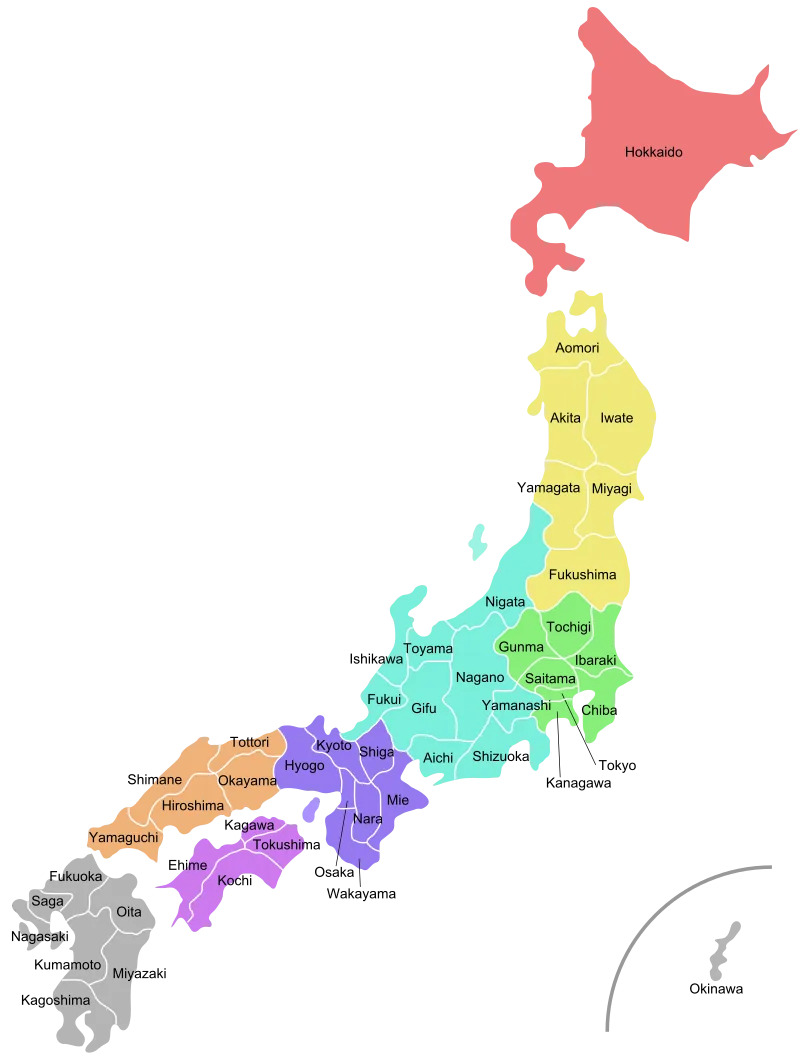
Nagaokakyo occupies a stretch of southern Kyoto Prefecture where the built-up edge of Kyoto gives way to the plain running toward Osaka. It is a residential city today, with commuter links in both directions, and it sits inside the wider Kansai region that has been the political and cultural center of Japan for most of its recorded history.
The city’s name is older than the city itself. In 784, the court established a new capital at Nagaoka-kyō, a planned grid of streets laid out on this ground. The move lasted barely a decade: in 794 the capital shifted again to Heian-kyō, the city now known as Kyoto. The abandoned capital left its name behind, and the modern municipality of Nagaokakyo still carries it.
Kyoto, meanwhile, remained the imperial capital until 1869. Across those centuries, the city’s confectionery trade grew alongside court ritual, temple life, and tea practice. Sweets became a formal language of greeting and season — a way of marking a visit, a holiday, or a change in the year. A boxed assortment such as Yamashunju belongs to that habit: it is designed to be handed over, opened, and shared.
“In Kyoto, a rice cracker is often a greeting before it is a snack.”
The name also points toward poetry. The Ogura Hyakunin Isshu is a 13th-century anthology of one hundred waka poems by one hundred poets, and it takes its name from Ogura, an area in the hills west of central Kyoto. Generations of Japanese readers have memorized its verses and played the card game built from them. Yamashunju draws on that reference: yama, mountain, plus shunju, spring and autumn, with each piece shaped and seasoned to suggest a season rather than to taste like a single flavor.
-
784 — The court establishes Nagaoka-kyō as the capital on this ground. -
794 — The capital moves to Heian-kyō, present-day Kyoto. -
13th century — The Ogura Hyakunin Isshu anthology is compiled. -
1869 — The imperial court relocates to Tokyo, ending Kyoto’s role as the capital. -
March 1, 2026 — Ogura Sanso replaces the nori-wrapped arare with kelp senbei. -
2026 — The box is sold as eight individually wrapped varieties with a 90-day shelf life.
What is verifiable about the maker today is the product itself: eight varieties, individual wrapping, and a stated shelf life of 90 days. The maker’s founding year and generation count are not confirmed here, so they are not stated. The location, however, is clear, and it places the box inside a Kyoto confectionery culture that has been continuous for centuries.
Other Japanese sweets and teas that suit the same table, from Kyoto yokan and konpeito to roasted teas and matcha.
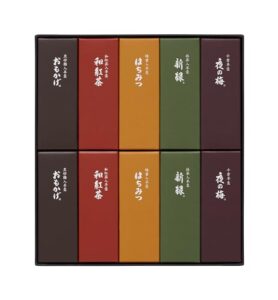
 Toraya Small Yokan (小形羊羹, 10-bar assorted box) — Kyoto
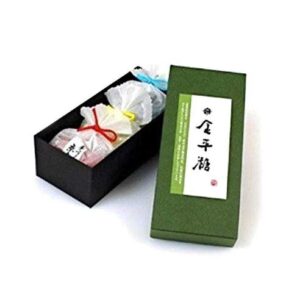
 Ryokujuan Shimizu Konpeito (緑寿庵清水 金平糖, sealed small gift jar)
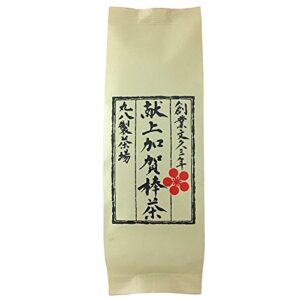
 Maruhachi Seichajo Kenjo Kaga Bocha (献上加賀棒茶, sealed bag or tin)
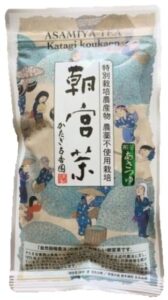
 Katagi Kokoen Asamiya-cha Sencha (朝宮茶 煎茶, sealed 100 g loose-leaf)
🍵Suzuki Seicha Honkaku Ise Cha (鈴木製茶 本格伊勢茶, sealed bag)
 Hoshino Seichaen Yame Matcha (星野製茶園 八女抹茶, sealed 30–40 g tin)
📦 Shipping & where to buy from outside Japan
Amazon Japan’s Global Store ships many food and household items internationally, and the program covers 65+ countries including Canada, the UK, and Australia. Eligibility is set per item and per destination, so the checkout page is the only reliable test for this particular box.
Expect air shipping of roughly $15–$40 to the US, EU, Canada, the UK, or Australia, depending on carrier, weight, and speed. Amazon estimates or collects import fees at checkout for many destinations; where it does not, your country’s customs office sets the threshold and the handling fee. Food is scrutinized more closely than most goods, and because the assortment includes shrimp arare, check your destination’s rules on imported seafood products before ordering.
If the Global Store will not ship the item to you, the maker’s own online shop is the most direct source inside Japan, though overseas delivery from that shop is not confirmed here. Proxy services such as Buyee or Tenso can receive a domestic order and forward it abroad; they add a handling fee and a second shipping charge, and they cannot override your country’s food-import rules.
Price snapshot across stores
Prices for Japanese snacks move with the exchange rate, the shipping method, and the season. The rows below set out where the box appears and what to check at each source; the JPY figure on the live sales page is the one that counts.
| Store | Item / variant | Price (JPY + USD est.) | Notes |
|---|---|---|---|
| 🇺🇸 Amazon.com (US) — search | Japanese rice crackers and senbei assortments | Varies (USD) | Useful if you are shopping from the US: USD pricing, Prime shipping, and no international customs. Results are comparable Japanese snacks, not necessarily this exact box. |
| 🇯🇵 Amazon JP Global Store | Ogura Sanso Yamashunju assortment box | Not captured — check listing | Ships internationally from Japan to 65+ countries — including Canada, the UK, and Australia — with import fees estimated at checkout. |
| Maker direct (Ogura Sanso online shop) | Yamashunju assortment box | Not captured — check shop | Japanese-language shop; domestic delivery is the norm, and overseas eligibility is not confirmed here. |
| Proxy services (Buyee / Tenso) | Same item, bought from a Japanese retailer | Item price + proxy fee + international shipping | A workable route when direct shipping is unavailable. Fees vary, and the parcel is still subject to your country’s food-import rules. |
What it does well
Weaknesses and things to verify before buying
- No confirmed price. Neither a JPY figure nor a USD estimate was available for this page, so the total cost — including shipping — remains unknown until you open the live listing.
- Shrimp is in the box. Shrimp arare is one of the eight varieties. Anyone avoiding shellfish should treat the assortment as unsuitable unless the maker’s allergen statement says otherwise for a specific piece.
- Food-import rules vary. Seafood-based snacks face extra scrutiny in some countries. Amazon’s international eligibility does not guarantee that customs will release the parcel.
- Packaging adds up. Eight individual wrappers plus an outer box is more material than a single bag of crackers. That is the trade-off for the gift format.
- The recipe changed on March 1, 2026. The nori-wrapped arare was replaced by kelp senbei. Buyers who remember an earlier version should expect one piece to be different.
- Bite-size portions. This is a tea snack, not a filling one. Households that go through crackers quickly may find one box disappears in a single sitting.
- No current item listing was captured. The Amazon Japan link below opens a search rather than a fixed product page, because no ASIN was available at the time of writing.
Conclusion — which buyer type are you?
Other ways to approach this purchase
🏆 Editor’s Pick — Ogura Sanso Yamashunju (をぐら山春秋)
- One box, eight experiences. The range runs from shrimp and black soybean to sugar-coated arare and kelp senbei, so a first-time buyer can taste across the style without committing to a large bag.
- It is ready to give. Individual wrapping and a compact box do most of the presentation work; the poetic name gives the recipient something to read into.
- The timing is practical. At 90 days from production, the box can be ordered ahead for a visit or a holiday without the freshness window closing immediately.
A direct item link and a yen price were not available at the time of writing, so both buttons open searches. Use them to check the current box, its price, and whether your address is eligible for delivery.
❓ Frequently Asked Questions
What is inside the Yamashunju assortment?
The maker’s current description lists eight varieties: shrimp arare, black sesame senbei, black soybean arare, sweet soy senbei, salted salad senbei, aosa seaweed senbei, sugar-coated arare, and kelp senbei. Each piece is individually wrapped.
How long does the box keep?
The official listing gives a shelf life of 90 days from the date of production. Check the date printed on the package when it arrives.
Does it contain shrimp?
Shrimp arare is one of the eight varieties, so the assortment is not suitable for anyone avoiding shellfish. The full allergen statement was not available in our snapshot; check the package or the live listing before ordering.
Can it be shipped to Canada, the UK, or Australia?
Amazon Japan ships many food and household items internationally, but eligibility is decided per item and per destination. Confirm at checkout, and check your country’s rules on imported seafood products because the box includes shrimp arare.
Is it a good gift?
The individual wrapping and the eight-variety format suit sharing and gift-giving, and the 90-day shelf life leaves a reasonable window. The box is small and light, so it also packs easily. Confirm the price and delivery date before relying on it for a specific occasion.
Why is it called Yamashunju?
The name combines yama (mountain) with shunju (spring and autumn), and the assortment is presented with seasonal shapes and flavors. It also points to the Ogura Hyakunin Isshu, the classical poetry anthology associated with the Ogura area of Kyoto.
*jpmono.com is curated by a Japan-based editorial team (working out of Toyama in the Hokuriku region and Nara in Kansai) and is independent. We do not take payment from the makers we feature; income comes from affiliate links. Read more about our editorial standards.*
Drafted with AI assistance and reviewed against published product information. Prices, stock, and shipping eligibility were not independently verified and can change.
Affiliate disclosure: jpmono.com may earn a commission on qualifying purchases made through links on this page, at no additional cost to you.